

Standards Beat Goals in Trading
Goals set a target you may never reach. Standards set a minimum you refuse to drop below. Learn why trading standards protect your account better than goals.

"Make $10,000 this month." That is a goal. It is also the kind of statement that leads traders into their worst decisions. Because when you are two weeks into the month and only at $3,000, the goal starts whispering: increase your size, take more trades, stay in longer, push harder. And that is when the account gets destroyed.
Standards work differently. A standard is not something you reach for. It is something you refuse to fall below. "I will not risk more than 1% per trade" is a standard. "I will not take more than 3 trades per day" is a standard. These survive losing streaks, winning streaks, and everything in between.
TL;DR
Goals are aspirational (what you want to achieve). Standards are foundational (what you refuse to accept).
Trading rules that function as standards hold during emotional extremes; goal-based rules collapse under pressure.
You do not become the best version of yourself; you settle into the worst version you are willing to tolerate.
Defining your minimum acceptable behavior is more protective than setting profit targets.
Standards plus guardrails create a floor that keeps rising.
The Difference Between a Goal and a Standard
A goal lives in the future. "Hit $10,000 in monthly profit." "Achieve a 55% win rate." "Pass the funded challenge by March." Goals are about what you want to happen. They depend on market conditions, on execution, on factors partially outside your control.
A standard lives in the present. "I journal every trade before placing the next one." "I follow my pre-market routine every single session." "I never risk more than 1% per trade." Standards are about what you do right now, regardless of what the market is doing.
The critical difference: goals can fail without any behavior change on your part. You could follow your plan perfectly and still miss a monthly profit target because the market did not cooperate. But a standard can only fail if you break it. It is entirely within your control.
Think about standards you already follow in daily life. You brush your teeth every morning. You lock your door when you leave. You do not steal from stores. These are not goals you are working toward. They are non-negotiable minimums that define who you are.
Trading standards work the same way. They define the worst version of yourself that you are willing to accept at the trading desk.
Why Goals Fail After the First Losing Streak
Here is the pattern. A trader sets a goal: "Make $5,000 this month." Week 1, she makes $1,800. On track. Week 2, two losing days drop her to $1,200 for the month. Now she is behind pace.
The goal creates pressure. To hit $5,000, she needs to average $1,267 per week for the remaining 3 weeks. That is almost double her Week 1 pace. So she does what the goal demands: she takes more trades. She increases her lot size. She holds winners longer, hoping for bigger moves.
Some of those decisions work. Most do not. By the end of the month, she has $2,800 in profits and $3,200 in losses from the over-trading that the goal pressure created. Net: -$400.
The goal did not protect her. It pushed her toward the exact behaviors that destroyed the month.
Walkthrough: Goal Pressure vs Standard Protection
Trader A (goal-based): $10,000 account, goal is +5% ($500) this month. After 2 weeks, he is at +1% ($100). He increases risk from 1% to 2% per trade to catch up. Uses 0.2 lots on EUR/USD instead of 0.1 lots with a 50-pip stop.
Math check: 0.2 lots = $2/pip. $2 times 50 pips = $100 risk per trade = 1% of $10,000. Wait, that is still 1%. He intended 2%.
Correction: to risk 2% ($200) with a 50-pip stop, he needs 0.4 lots. $4/pip times 50 pips = $200. Correct.
He takes 4 trades in one session at 0.4 lots. Three lose. 3 times $200 = $600 loss. One day just cost him 6% of his account. The month ends -4.5% instead of the targeted +5%.
Trader B (standard-based): same $10,000 account. Standard: never risk more than 1% per trade, max 3 trades per day, three-loss rule (stop trading after 3 consecutive losses). After 2 weeks at +1%, she does not change anything. The standard holds.
Worst possible day: 3 losses at $100 each = $300 = 3%. She stops. The standard caps the damage.
End of month: +2.5%. Less than Trader A wanted, but a real gain instead of a real loss.
How to Define Your Trading Standards
Effective trading standards share three traits: they are specific, they are behavioral (not outcome-based), and they are things you can verify immediately.
Here are five standards that protect most retail traders:
1. Risk per trade. "I will not risk more than [X]% per trade." This is the foundational standard. Everything else builds on it. If this one holds, single trades cannot destroy you.
2. Daily trade limit. "I will not take more than [X] trades per day." This prevents the death spiral of overtrading after losses. Pick a number and treat it like a hard wall.
3. Daily loss limit. "If I lose [X]% in a single session, I stop." This is the emergency brake. It caps how bad any single day can get.
4. Setup compliance. "I only trade A-plus setups that match my written criteria." This eliminates boredom trades, revenge trades, and "it looks kinda good" trades.
5. Journaling. "I log every trade before placing the next one." This creates a friction point that forces a pause between trades.
Write them down. Print them. Put them next to your monitor. Standards only work if they are visible and specific.
Enforcing Standards When Emotions Push Back
The hard part is not defining standards. It is holding them when your emotions are screaming at you to break them.
After a big win: "I should increase my size because I'm on a roll." The standard says: no size changes mid-session. The standard wins.
After a bad loss: "I need to get this back immediately." The standard says: max 3 trades per day, and you have already hit 3. The standard wins.
After a boring session: "I should take this marginal setup because I have not traded all day." The standard says: only setups that match your criteria. The standard wins.
The emotional resistance is strongest in the first 2 to 3 weeks. After that, the standard starts becoming part of your identity. You stop being "a trader who tries not to overtrade" and become "a trader who does not overtrade." That identity shift is the real prize.
Walkthrough: Standards Holding Under Pressure
A trader on GBP/USD has a $15,000 account. Standards: 1% risk per trade ($150), 3 trades per day, daily loss limit of 2% ($300).
Session starts badly. Trade 1: 0.15 lots, 100-pip stop, loss. $1.50/pip times 100 pips = $150 loss. Running daily loss: $150.
Math check: 0.15 lots on GBP/USD = $1.50/pip. $1.50 times 100 pips = $150 = 1% of $15,000. Correct.
Trade 2: same setup criteria, different pair (EUR/USD). 0.15 lots, 100-pip stop, loss. $150. Running daily loss: $300. Daily loss limit hit.
Math check: 0.15 lots on EUR/USD = $1.50/pip. $1.50 times 100 pips = $150 = 1%. Correct. Two trades, $300 total = 2%.
The emotion says: "Take one more, the third setup is perfect." The standard says: "$300 daily limit hit. Session over." He closes the platform.
Result: -2% for the day instead of the potential -4% or -6% that a revenge sequence would have produced. The standard held.
How EdgeFlo Enforces Your Standards Automatically
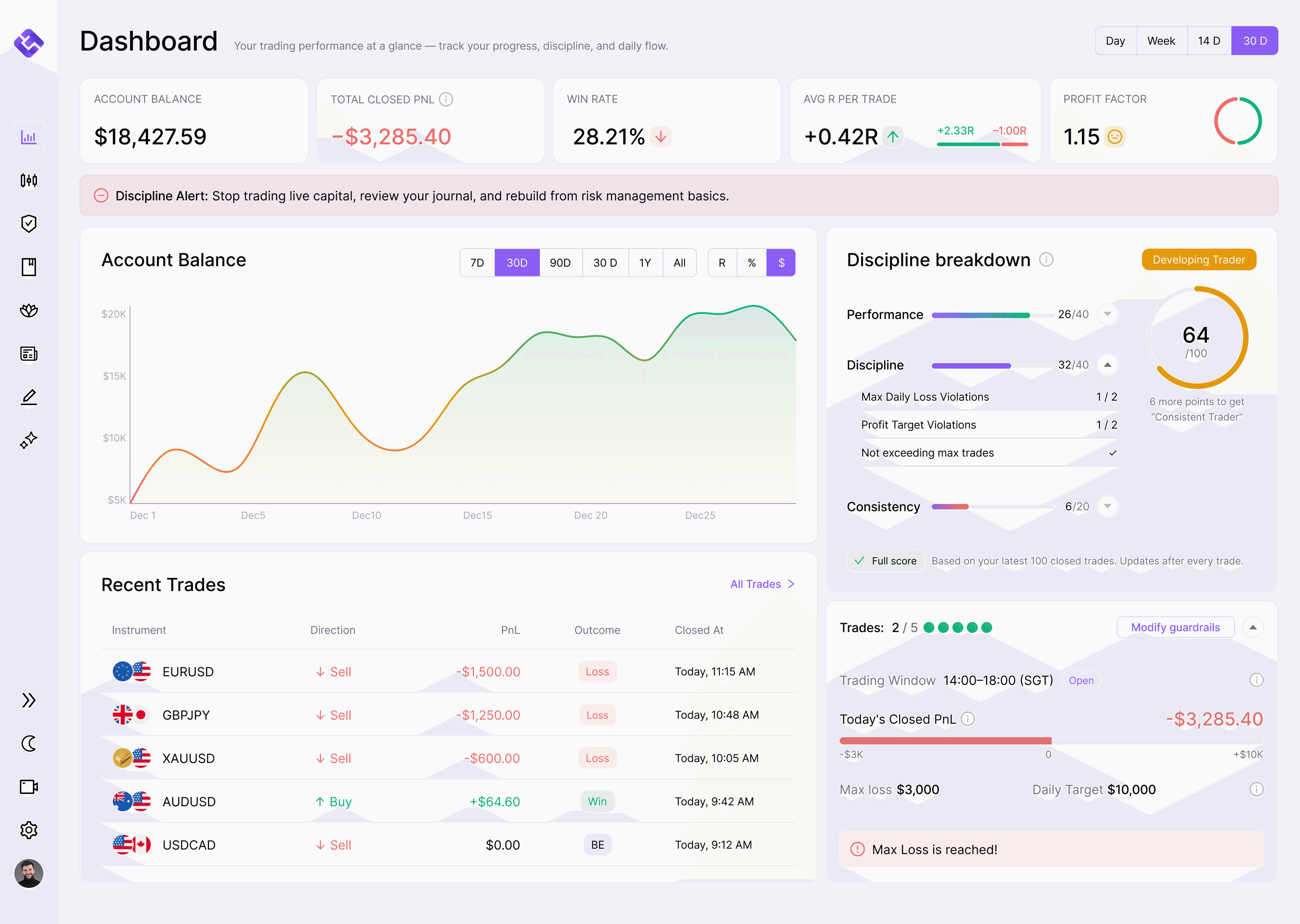
EdgeFlo's guardrail system turns your trading standards into active limits. You set your daily loss limit and trade cap in the platform, and the guardrails restrict trading when those limits are reached. You can override them, because they are your standards, not handcuffs, but the override is a conscious decision, not an unconscious drift.
The pre-market checklist prompts you to confirm your standards before the session begins. It surfaces the question every morning: "What are my rules today?" That visibility reinforces the standard before a single trade is placed.
When standards are written, visible, and structurally enforced, they become the foundation of your floor. And once the floor is solid, everything above it is growth.
The Edge Brief
Receive Insights on trading psychology, discipline, and the behavioral patterns that create consistent traders from our Founder and the EdgeFlo team, delivered to your inbox.
Think different. Trade different.
What is the difference between a goal and a standard in trading?
Why do trading goals fail after losing streaks?
How do I set my first trading standard?
Can I have both goals and standards?

Turn discipline on.
Every session.
EdgeFlo is the environment serious traders operate inside.
Start 7-Day Free Trial
Cancel anytime.
No long-term commitment.

Think Different, Trade Different.