

Simplicity in Trading: One Market, One Setup
Simplicity in trading beats complexity. Learn why mastering one market, one timeframe, and one setup creates consistent profitability.

Most traders lose because they are doing too much. Too many pairs. Too many indicators. Too many strategies running at the same time. Simplicity in trading is the antidote. One market, one timeframe, one setup. That is all you need to build consistency.
Sound boring? Good. Boring is how profitable traders actually make money.
TL;DR
Complexity creates confusion, which leads to hesitation and bad entries.
Mastering one setup on one pair in one session builds deep pattern recognition faster than surface-level knowledge across ten setups.
Every profitable strategy works for someone, but only if they stop switching before mastery.
Simplify first. Expand only after your journal data proves consistency.
The Complexity Trap
You have probably been there. Five indicators stacked on your chart, three pairs open across multiple monitors, and two different strategies you are "testing" at the same time. The result? You freeze when the setup appears because you cannot tell which signal to follow.
This is the complexity trap, and it catches almost everyone.
Here is how it usually starts. You find a strategy that looks promising. You test it for a week, maybe two. Then you hit a losing streak and immediately think the strategy is broken. So you go hunting for another one. You find something new, stack it on top of the old one, add a couple of indicators for "confirmation," and suddenly your chart looks like a Christmas tree.
The irony is brutal. Every single one of those strategies could have worked. Price action, smart money concepts, candlestick patterns, simple moving average crossovers. There are profitable traders using each of these approaches right now. The difference is they mastered one of them instead of dabbling in all of them.
Walkthrough: The Overloaded Chart
Imagine a trader opens EUR/USD on the 1-hour timeframe during the London session. They have Bollinger Bands, RSI, MACD, a Fibonacci retracement, and three EMAs loaded. Price pulls back into a demand zone and the 50 EMA, but RSI is at 55 (not oversold enough), MACD has not crossed yet, and price is sitting mid-Bollinger Band. They hesitate. While they are waiting for all five signals to align, price shoots up 60 pips without them. The setup was clean. The extra indicators created doubt.
That hesitation is the tax you pay for indicator overload.
One Market, One Timeframe, One Setup
The fix is radical simplification. Pick one market. Pick one session. Pick one setup. That is your entire trading plan.
Why does this work? Because depth beats breadth in trading.
When you trade EUR/USD every single day during the London session, you start to notice things other traders miss. You learn how price behaves around the London open. You recognize when a move is exhaustion versus continuation. You develop a feel for that pair's rhythm that no indicator can replicate.
When you trade one setup (say, a liquidity sweep into a demand zone with a break of structure confirmation), you see that pattern hundreds of times. You know what a clean version looks like. You know what a messy version looks like. You stop taking the messy ones.
This is how a trading edge actually develops. Not from finding the perfect strategy, but from going so deep into one approach that you execute it better than almost anyone else.
Here is the framework:
One market: Pick a single pair you will trade exclusively. EUR/USD is the most liquid and the easiest to learn on.
One timeframe: Choose the timeframe that fits your schedule. If you can only trade the London session, the 15-minute or 1-hour chart works well.
One setup: Define the exact conditions that must be present for you to take a trade. Write them down. Put them in your mechanical trading plan. Follow them every day.
Why Simple Strategies Survive
Markets change. Volatility cycles shift. What worked beautifully in a trending environment looks ugly in a range. Complex strategies break apart when conditions change because there are too many moving parts. One indicator starts giving false signals, and the whole chain collapses.
Simple strategies survive because they rely on foundational market behavior that does not change. Price creates structure. Buyers and sellers leave footprints. Liquidity gets taken before real moves happen. These principles have worked for decades and will continue to work because they describe how markets actually function.
A strategy with two conditions (for example, "price sweeps a low, then breaks structure to the upside at a demand zone") gives you a clear, binary answer. Either the setup is there or it is not. No ambiguity. No conflicting signals. No paralysis.
Walkthrough: Simple Setup, Clear Execution
A trader watches GBP/USD on the 15-minute chart during the London session. Their one setup is: price sweeps a session low, taps a 1-hour demand zone, and prints a bullish break of structure on the 15-minute. At 8:45 AM London time, price sweeps the Asian session low at 1.2640, taps the 1-hour demand zone at 1.2635, and breaks structure at 1.2660. The trader enters long at 1.2660 with a stop at 1.2630 (30 pips) and a target at 1.2750 (90 pips). The trade hits target during the New York overlap. That is a 3R trade from a dead-simple setup, executed without a single indicator.
The trader did not need five indicators to confirm this. They needed one setup they had backtested hundreds of times.
How to Simplify Your Current Approach
If your charts are cluttered right now, here is a practical path to simplification.
Step 1: Audit your current tools. Open your chart and list every indicator, template, and tool you have loaded. Be honest. Most traders have at least three things they never actually use for entries.
Step 2: Identify your core setup. Look through your last 30 trades. Which pattern did you actually trade most often? Which one had the highest hit rate? That is your core setup. Everything else is noise.
Step 3: Remove everything that does not serve that setup. If your setup is based on price action and demand zones, you do not need RSI. You do not need Bollinger Bands. Strip the chart down to price and the structural levels that matter.
Step 4: Commit to one pair and one session for 30 days. This is the hard part. You will see setups on other pairs. You will feel like you are leaving money on the table. Ignore that feeling. Your job is not to catch every move. Your job is to master one environment.
Step 5: Track your results. After 30 days, review your journal data. If your one-setup, one-pair approach is delivering consistent results, stay on it. If the data shows a genuine problem (not just a bad week), adjust one variable at a time. Not three.
The traders who make it through the learning curve are not the ones with the most knowledge. They are the ones who went deep enough on one approach to develop real mastery. Simplicity is not a limitation. It is the fastest path to consistent execution.
How EdgeFlo Supports Simple Trading
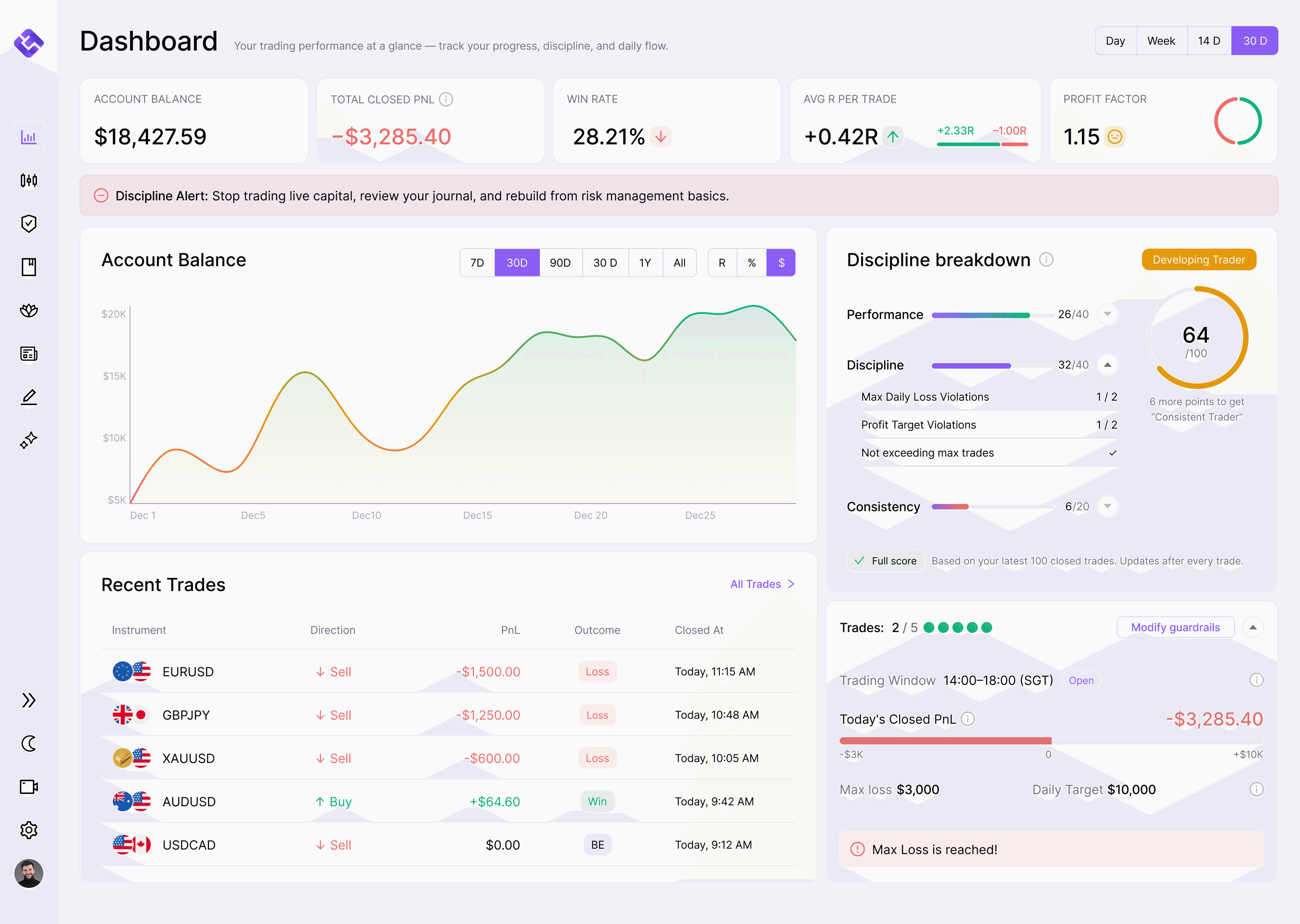
EdgeFlo is built around the idea that fewer decisions lead to better execution. The Edge plan builder lets you document your one setup with exact entry criteria, exit rules, and risk parameters, then keeps that plan visible next to your chart every session. You do not have to remember your rules. They are right there.
The trading journal automatically imports your trades and lets you tag each one by setup type. After 50 trades, you can see exactly how your core setup performs. No guessing, no estimation. Real numbers.
If you are ready to strip away the complexity and focus on one approach, EdgeFlo gives you the structure to do it. Define your plan, execute your plan, review your plan. That is the entire system.
The Edge Brief
Receive Insights on trading psychology, discipline, and the behavioral patterns that create consistent traders from our Founder and the EdgeFlo team, delivered to your inbox.
Think different. Trade different.
Does simplicity in trading mean using no indicators?
How long should I stick with one setup before switching?
Can I trade multiple pairs with a simple strategy?
What if my simple strategy stops working?

Turn discipline on.
Every session.
EdgeFlo is the environment serious traders operate inside.
Start 7-Day Free Trial
Cancel anytime.
No long-term commitment.

Think Different, Trade Different.