

Scalping vs Day Trading: Which Timeframe Pairing Fits You
Compare scalping, day trading, and swing trading by timeframe pairing, screen time, and trade frequency. Find which trading style matches your schedule and temperament.
The difference between scalping, day trading, and swing trading comes down to which timeframes you pair for analysis and entries. Each style uses the same structural process (higher timeframe for direction, lower timeframe for entry) but the specific charts and holding times change everything about your trading day.
Choosing the wrong style for your schedule and temperament is one of the most common reasons traders struggle with consistency. If you hate sitting at a screen for hours, scalping will drain you. If you cannot stand holding overnight, swing trading will keep you up at night. The right style is the one you can actually follow.
TL;DR
All three styles use the same entry model: higher timeframe sets direction, lower timeframe sets entry.
Scalpers pair the 4H/1H with the 5M/1M. Day traders pair the Daily/4H with the 15M. Swing traders pair the Weekly with the 1H.
Speed vs patience is the core tradeoff. Scalping gives more opportunities but demands more screen time and faster execution.
Your lifestyle and personality should dictate your style, not what looks profitable on social media.
Document your timeframe pairing in your trading plan and do not switch mid-session.
How Timeframe Pairing Works
Every trading style uses two timeframes. The higher timeframe tells you the direction. The lower timeframe tells you when to enter.
The higher timeframe shows the market structure: who controls price, where the key zones sit, and what the overall order flow is doing. You do not trade on this timeframe. You read it. It answers the question "which side am I on today?"
The lower timeframe is where you execute. You wait for price to pull back into a zone identified on the higher chart, then look for your entry confirmation (a market structure shift, a flip zone, a sweep) on the lower chart. The entry pattern is the same regardless of style. What changes is the speed.
Markets are fractal. The same higher-high, higher-low structure you see on the weekly chart appears on the 5-minute chart. This is why the entry model works across all timeframes. You are not learning three different strategies. You are applying one strategy at different speeds.
Scalper: Speed and Precision
Higher timeframe: 4-hour or 1-hour Entry timeframe: 5-minute or 1-minute Typical holding time: 5 minutes to 1 hour Trades per session: 3 to 8
Scalping is the fastest style. You are looking for the same structural setups, but everything happens quickly. A zone on the 4-hour chart, a pullback on the 1-minute, a market shift, entry. The entire sequence can play out in under 10 minutes.
The advantage: more opportunities per session. Because you are operating on smaller timeframes, you see more setups form during kill zones. A day trader might get one or two valid entries. A scalper might see five.
The cost: screen time and execution pressure. You need to be at your charts for the entire session. Your entries require fast decisions. If you hesitate for 30 seconds on the 1-minute chart, the move has already happened. That speed amplifies emotional pressure, which is why scalpers need strict rules against overtrading.
Walkthrough: Scalper on GBP/USD
The 4-hour chart shows a bullish trend with a demand zone at 1.2680. During London session, price drops to 1.2683 on the 1-minute chart. A higher low forms at 1.2685. A market structure shift prints on the 1-minute at 1.2692, breaking the last swing high.
Entry at 1.2694. Stop below the higher low at 1.2682 (12 pips). Target at the next 1-hour supply zone at 1.2730 (36 pips). Position size: 0.3 lots on a $5,000 account.
Total time from zone touch to entry: about 8 minutes. The trade reached target within 45 minutes. This is a typical scalping trade: fast, precise, done before lunch.
Day Trader: The Middle Ground
Higher timeframe: Daily or 4-hour Entry timeframe: 15-minute Typical holding time: 1 to 8 hours Trades per session: 1 to 3
Day trading is the most popular style for a reason. It gives you enough context from the higher timeframe without demanding the split-second reactions of scalping.
Your pre-market routine marks out zones on the daily or 4-hour chart. During the session, you drop to the 15-minute chart and wait for price to reach your zone. When it does, you look for the confirmation pattern: flip, shift, entry.
The advantage: you can step away. A 15-minute candle takes 15 minutes to form. You are not glued to the screen watching every tick. You check in, assess, and execute when the setup appears.
The cost: fewer opportunities. Because the 15-minute chart moves slower, you might go an entire session without a valid setup. That patience is a feature, not a bug. But if you are someone who gets bored and starts forcing trades, day trading will test your discipline.
Day traders who plan their session in advance tend to handle the waiting better. When your zones are already marked and your entries are pre-defined, the session becomes a matter of execution, not searching.
Swing Trader: Patience Pays
Higher timeframe: Weekly Entry timeframe: 1-hour or 4-hour Typical holding time: 2 to 10 days Trades per week: 1 to 3
Swing trading is the slowest style. You read the weekly chart for the big picture, identify zones on the daily, and enter on the 1-hour or 4-hour when structure confirms.
The advantage: minimal screen time. You can check charts once or twice a day and still catch every setup. This works for traders with full-time jobs or other commitments. You are not competing with algorithms on the 1-minute chart.
The cost: holding overnight and through weekends. You need to accept open drawdown without panicking. A trade that is 30 pips in profit can gap against you on Monday morning. That requires a different temperament than scalping, where you close everything before you step away.
Position sizing matters more for swing traders because the stop distances are wider. A scalper's stop might be 10 pips. A swing trader's stop could be 80 pips. The dollar risk stays the same (controlled by lot size), but the wider stop means smaller position sizes and slower account growth per trade.
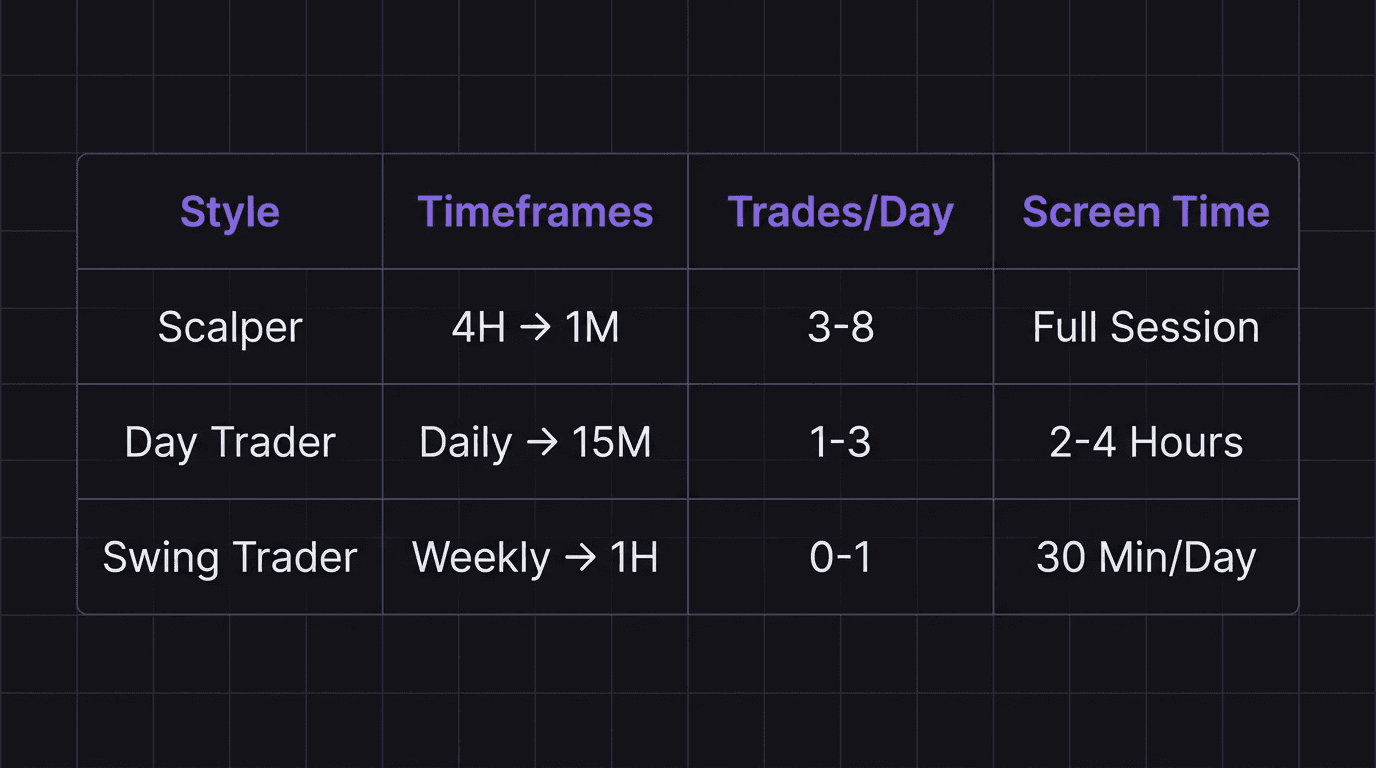
Style | Higher TF | Entry TF | Holding Time | Trades/Day | Screen Time |
|---|---|---|---|---|---|
Scalper | 4H / 1H | 5M / 1M | 5 min to 1 hr | 3 to 8 | Full session |
Day Trader | Daily / 4H | 15M | 1 to 8 hrs | 1 to 3 | 2 to 4 hrs |
Swing Trader | Weekly | 1H / 4H | 2 to 10 days | 0 to 1 | 30 min/day |
How EdgeFlo Matches Your Style to Your Plan
Your trading style should be written into your plan, not decided on the fly each morning. Switching from scalping to swing trading mid-session because "nothing is happening" is a recipe for inconsistency.
EdgeFlo's Edge plan builder lets you document your trading style and timeframes as part of your active plan. Your plan states your higher timeframe, your entry timeframe, and your session window. When you review trades, you can see whether you followed your declared style or drifted into a different one.
That visibility matters. Many traders think they are day traders but their journal shows 12 trades on a Tuesday (scalper behavior) and zero trades on Wednesday (swing trader behavior). The data reveals the inconsistency, and the plan gives you something concrete to measure against.
The Edge Brief
Receive Insights on trading psychology, discipline, and the behavioral patterns that create consistent traders from our Founder and the EdgeFlo team, delivered to your inbox.
Think different. Trade different.
What timeframes do scalpers use?
Is scalping harder than day trading?
What is the best timeframe pairing for day trading?
Can I switch between scalping and swing trading?

Turn discipline on.
Every session.
EdgeFlo is the environment serious traders operate inside.
Start 7-Day Free Trial
Cancel anytime.
No long-term commitment.


Think Different, Trade Different.