

Pips and Lots Explained: The Units Every Forex Trader Needs
A pip is the fourth decimal place in a forex quote. Lot size determines how much each pip is worth in dollars. Learn the math with clear examples.
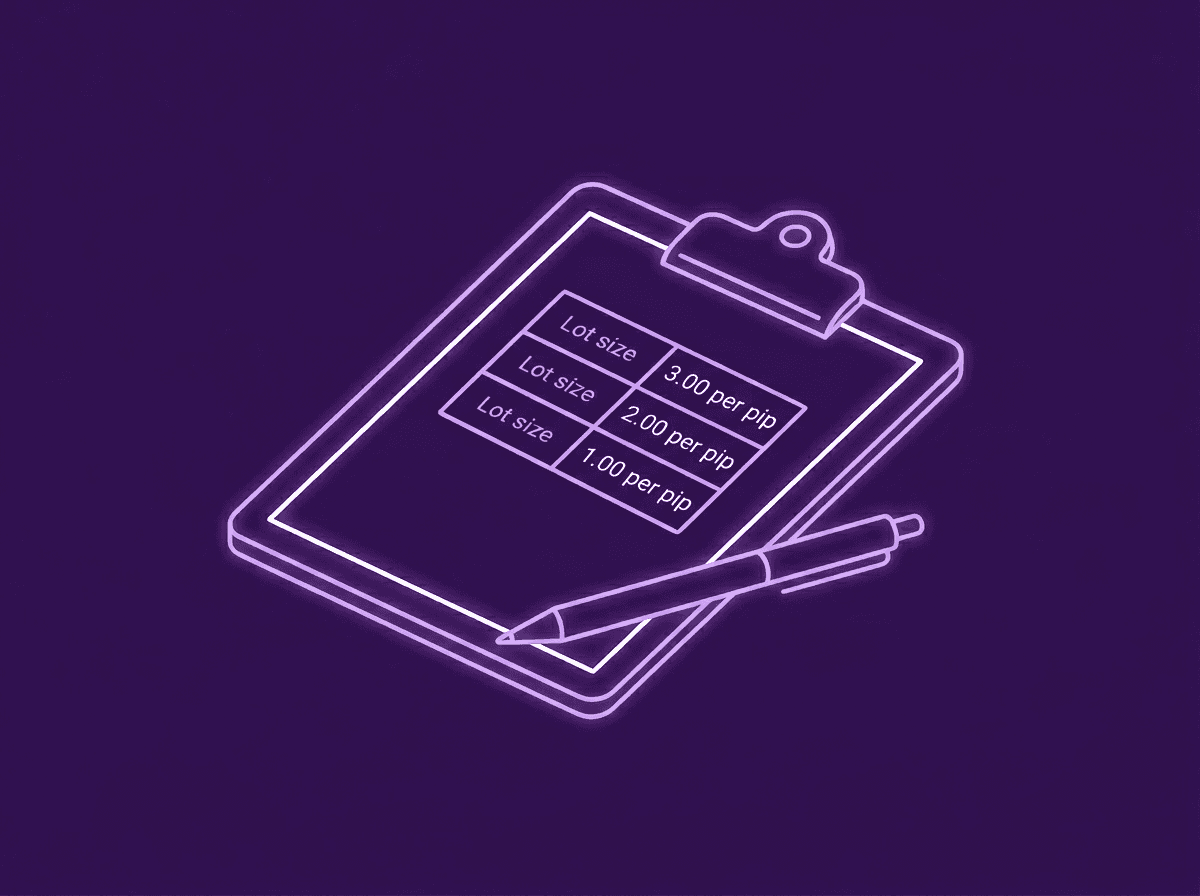
A pip is the smallest standard price movement in a forex pair, and your lot size determines how much money that pip movement is worth. On EUR/USD, one pip equals $10 per standard lot, $1 per mini lot, and $0.10 per micro lot. Understanding these two units is the single most important math skill in forex, because every position size, risk calculation, and profit target depends on them.
TL;DR
A pip is the fourth decimal place in most forex pairs (0.0001). For Japanese yen pairs, it is the second decimal place (0.01).
A standard lot is 100,000 units, a mini lot is 10,000 units, and a micro lot is 1,000 units.
On EUR/USD: 1.0 lot = $10/pip, 0.1 lot = $1/pip, 0.01 lot = $0.10/pip.
Your lot size is the lever that controls your dollar-per-pip exposure.
Get this math wrong and your risk calculations fall apart before you ever enter a trade.
What a Pip Is and How to Count Them
Pip stands for "percentage in point." It measures the change in exchange rate between two currencies at the smallest commonly quoted increment.
For most currency pairs (EUR/USD, GBP/USD, AUD/USD, and others quoted to four decimal places), one pip is the fourth digit after the decimal point.
EUR/USD at 1.0926 to 1.0936 = a 10-pip move upward.
Count it by looking at that fourth decimal position. The number went from 2 to 3 in the hundredths-of-a-cent position. But the last digit also moved, so you calculate the total: 1.0936 minus 1.0926 = 0.0010, which is 10 pips.
Counting Pips in Practice
Here are three examples to lock this in:
EUR/USD moves from 1.1246 to 1.1248. That is a 2-pip increase. (1.1248 minus 1.1246 = 0.0002.)
GBP/USD drops from 1.2576 to 1.2566. That is a 10-pip decrease. (1.2576 minus 1.2566 = 0.0010.)
AUD/USD climbs from 0.6500 to 0.6600. That is a 100-pip increase. (0.6600 minus 0.6500 = 0.0100.)
Most brokers quote prices to five decimal places. That fifth digit is called a pipette (or fractional pip). One pipette equals one-tenth of a pip. So if EUR/USD moves from 1.09263 to 1.09265, that is a 0.2-pip move. Pipettes give you more precise pricing, but your risk math should focus on whole pips.
Standard, Mini, and Micro Lots
Forex is traded in lots. A lot is simply a standardized unit of measurement for how large your position is. There are three sizes you need to know:
Lot Type | Volume | Units | Dollar Per Pip (EUR/USD) |
|---|---|---|---|
Standard | 1.0 | 100,000 | $10.00 |
Mini | 0.1 | 10,000 | $1.00 |
Micro | 0.01 | 1,000 | $0.10 |
When you place a trade on your broker platform, the "volume" field is where you select your lot size. If you type 1.0, you are trading a standard lot. Type 0.1, you are trading a mini lot. Type 0.01, you are trading a micro lot.
Most beginners should start with micro lots. The reason is straightforward: you need to make mistakes while the cost of those mistakes is small. On a micro lot, a 50-pip loss costs you $5. On a standard lot, that same 50-pip loss costs $500. Same market, same move, completely different consequences for your account.
Sound extreme? It is. And this is exactly why position sizing is not optional. It is the first skill you build after understanding pips and lots.
How Lot Size Determines Dollar Per Pip
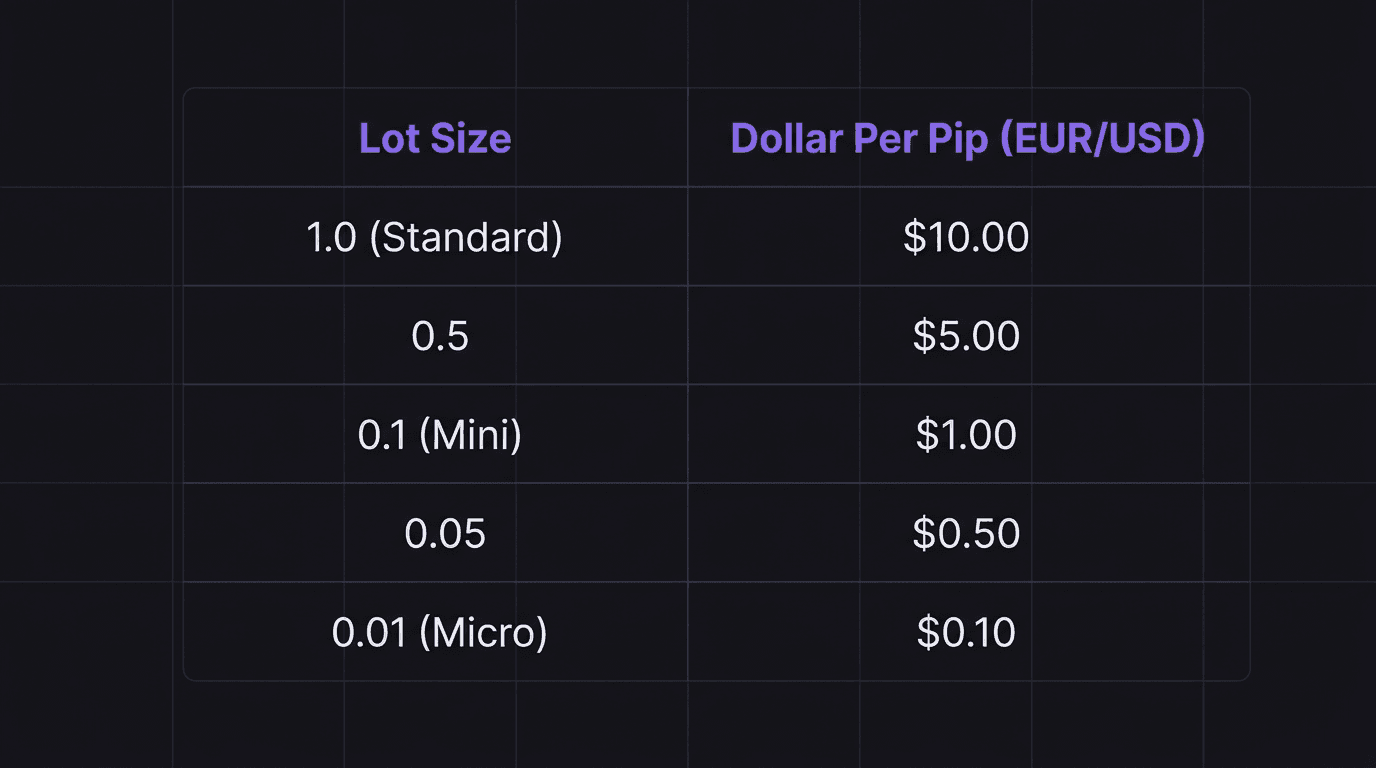
This is the math that ties everything together. Your lot size multiplied by the pip value gives you the dollar amount each pip is worth on your trade.
For standard USD-denominated pairs (EUR/USD, GBP/USD, AUD/USD):
1.0 lot = $10 per pip
0.5 lots = $5 per pip
0.1 lot = $1 per pip
0.01 lot = $0.10 per pip
The formula is: Lot size x 100,000 x 0.0001 = dollar per pip.
For 0.5 lots: 0.5 x 100,000 x 0.0001 = $5 per pip.
Walkthrough: Calculating Your Risk on a Real Trade
You are trading EUR/USD. Your account balance is $5,000. You want to risk 1% per trade, which means your maximum loss on this trade is $50. Your analysis gives you a stop loss of 25 pips below your entry. You need to find the right lot size.
Step 1: Risk amount = $5,000 x 0.01 = $50. Step 2: Dollar per pip needed = $50 / 25 pips = $2 per pip. Step 3: Lot size = $2 / $10 per standard lot pip = 0.2 lots.
You enter 0.2 lots. If your stop loss gets hit (25 pips), you lose exactly $50 (0.2 lots = $2/pip, $2 x 25 = $50). If the trade hits your take profit at 75 pips, you gain $150 ($2 x 75 = $150). Your risk-to-reward ratio on this trade is 1:3.
Why This Math Matters Before Every Trade
If you skip the lot size calculation, you are gambling on how much you will lose. Imagine you entered the same trade at 0.5 lots instead of 0.2 lots. Your stop loss of 25 pips now costs you $125 (0.5 lots = $5/pip, $5 x 25 = $125), which is 2.5% of your account. That is more than double your intended risk. One trade, one mistake in the volume field, and you have taken on risk you did not plan for.
Walkthrough: What Goes Wrong With the Wrong Lot Size
Same $5,000 account. Same 25-pip stop. But this time you typed 1.0 lot by accident instead of 0.1. On a standard lot, each pip is $10. Your stop loss hits. 25 pips x $10 = $250 loss. That is 5% of your account wiped out on a single trade. You planned to risk 1%. You risked five times more because of a decimal place error. This is the most common execution mistake beginners make, and it is completely avoidable with a position size calculator.
Japanese Yen Pairs: The Two-Decimal Exception
Japanese yen pairs (USD/JPY, EUR/JPY, GBP/JPY) are quoted differently from other pairs. Instead of four decimal places, they use two.
USD/JPY at 154.50 to 154.60 = a 10-pip move.
The pip is the second digit after the decimal point. If USD/JPY moves from 154.67 to 154.65, that is a 2-pip decrease.
The dollar-per-pip calculation is also slightly different for yen pairs. The formula is:
0.01 / current exchange rate x lot size in units = pip value
For USD/JPY at 154.50 with a standard lot: 0.01 / 154.50 x 100,000 = approximately $6.47 per pip.
This is why yen pairs have a pip value of roughly $6.50 per pip per standard lot, rather than the flat $10 you get on EUR/USD or GBP/USD. The exact number shifts as the exchange rate changes, but for quick mental math, $6.50 per pip per standard lot is a reliable estimate for current USD/JPY and EUR/JPY rates.
That difference matters. If you set a 30-pip stop on USD/JPY with 1.0 lot, your risk is approximately $194 (30 x $6.47), not $300. Use the exact formula or a pip value calculator, especially when your account balance and risk percentage leave little room for error.
Ever traded a yen pair and been surprised by how much smaller or larger the dollar movement was than you expected? That is because you applied the wrong pip value. Now you know why.
How EdgeFlo Keeps Your Pip Math Clean
Calculating lot sizes and pip values manually works, but it adds friction to every trade. EdgeFlo includes a built-in risk calculator that does the math for you. Enter your account balance, risk percentage, and stop loss distance, and the calculator returns the exact lot size. No spreadsheets, no mental arithmetic under pressure.
The guardrail system also flags trades where your selected lot size exceeds your stated risk rules. If you set a risk limit of 1% per trade and accidentally enter a lot size that would put 3% at risk, EdgeFlo warns you before you execute (you can still override if you choose to). That one check alone saves new traders from the decimal-place mistake that blows accounts.
When you are ready to place your first trade, having the pip math built into your workflow means you spend less time calculating and more time analyzing supply and demand setups.
The Edge Brief
Receive Insights on trading psychology, discipline, and the behavioral patterns that create consistent traders from our Founder and the EdgeFlo team, delivered to your inbox.
Think different. Trade different.
How much is 1 pip worth?
What is the difference between a pip and a pipette?
Why are Japanese yen pairs different?
Does lot size affect risk?

Turn discipline on.
Every session.
EdgeFlo is the environment serious traders operate inside.
Start 7-Day Free Trial
Cancel anytime.
No long-term commitment.

Think Different, Trade Different.