

Risk Per Trade: When to Use 1% vs 0.5% (Decision Framework)
Learn when to risk 1% vs 0.5% per trade. A clear decision framework for live and funded accounts with de-risking triggers and recovery math.
Risk per trade is the percentage of your account balance you stand to lose on a single position. It is the most important number in your trading plan. Set it too high and one bad week wipes out months of gains. Set it too low and you can't grow. The answer for most traders: 1% during normal conditions, 0.5% when your account is under pressure.
This isn't a fixed rule you set once and forget. It's a decision you make before every trade based on your current drawdown, your recent performance, and how close you are to a danger zone.
TL;DR
1% risk per trade is the standard for live and funded accounts in normal conditions.
Drop to 0.5% when your account falls below 98% of its starting balance (the de-risk trigger).
At 0.5% risk with 1:3 R:R, one winner recovers a 2.5% drawdown. You're always one trade away.
Never go above 2% unless you have years of verified track record behind you.
Risk percentage determines position size, not the other way around. Decide risk first, then calculate lots.
Why Risk Per Trade Is the Only Number That Matters
New traders obsess over win rate. Experienced traders obsess over risk per trade.
Here's why. A 70% win rate means nothing if you're risking 10% per trade. Three losses in a row (which happens regularly at 70% win rate) puts you down 30%. Meanwhile, a 35% win rate with 1% risk and 1:3 R:R is consistently profitable.
The number that controls whether your account survives isn't how often you win. It's how much you lose when you're wrong.
Think of it like speed limits on a highway. You could drive 150 mph and arrive faster on a clear day. But one deer, one patch of ice, one distracted moment, and the consequences are catastrophic. Driving 70 mph gets you there safely every time.
Risk per trade is your speed limit. It caps the damage from any single mistake.
The 1% Rule (And When It's Too Much)
One percent of your account per trade is the standard for a reason. On a $10,000 account, that's $100. On a $100,000 funded account, that's $1,000.
At 1% risk, you can lose 10 trades in a row and still have 90% of your account intact. Most strategies with proper backtesting don't produce 10 consecutive losers, so 1% gives you a massive cushion.
But 1% is too much in certain situations:
Your account is in drawdown. If your $100,000 funded account has dropped to $97,000, continuing to risk 1% ($970 per trade) accelerates the bleed. Three more losers and you're at $94,000, likely near the firm's maximum drawdown limit.
You just switched strategies or pairs. Your backtest data doesn't apply yet. The new setup hasn't been proven with real money.
You're coming off a losing streak. After four or five losses, your emotional state is compromised. Bigger risk amplifies the fear that wrecks execution.
In all three situations, the move is the same: cut to 0.5%.
The 0.5% Rule for Funded Accounts
Funded accounts have hard drawdown limits. Most prop firms revoke your account if you lose 5-10% of the starting balance. That means every percentage point of risk carries more weight than on a personal account.
At 0.5% risk on a $100,000 account, each trade risks $500. You can lose 10 trades in a row and only be down 5%. That's still alive at most firms.
More importantly, 0.5% is where you should start when you first receive a funded account. The evaluation phase tested your skill. The funded phase tests your discipline. Capital preservation is the priority, not rapid growth.
The progression looks like this:
Phase | Risk Per Trade | Why |
|---|---|---|
First month funded | 0.5% | Prove you can protect capital |
After 2-3 profitable months | 1.0% | Consistency is established |
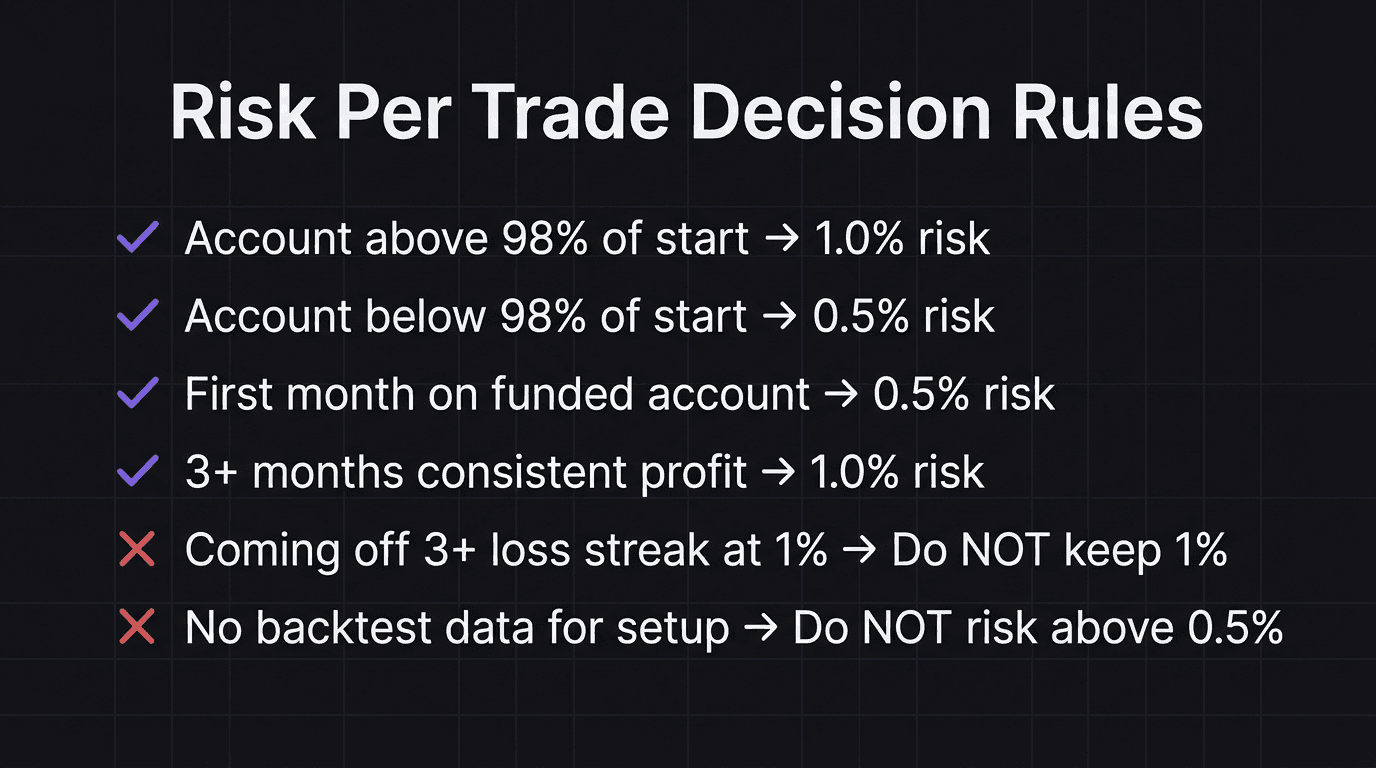
In drawdown (below 98% of start) | 0.5% | De-risk to survive |
At 5% profit with room to run | Up to 2.0% | Optional acceleration (advanced only) |
Notice that table goes both directions. You scale risk up when conditions support it and scale it back down when they don't. It's dynamic, not static.
The De-Risk Trigger: When to Cut Size
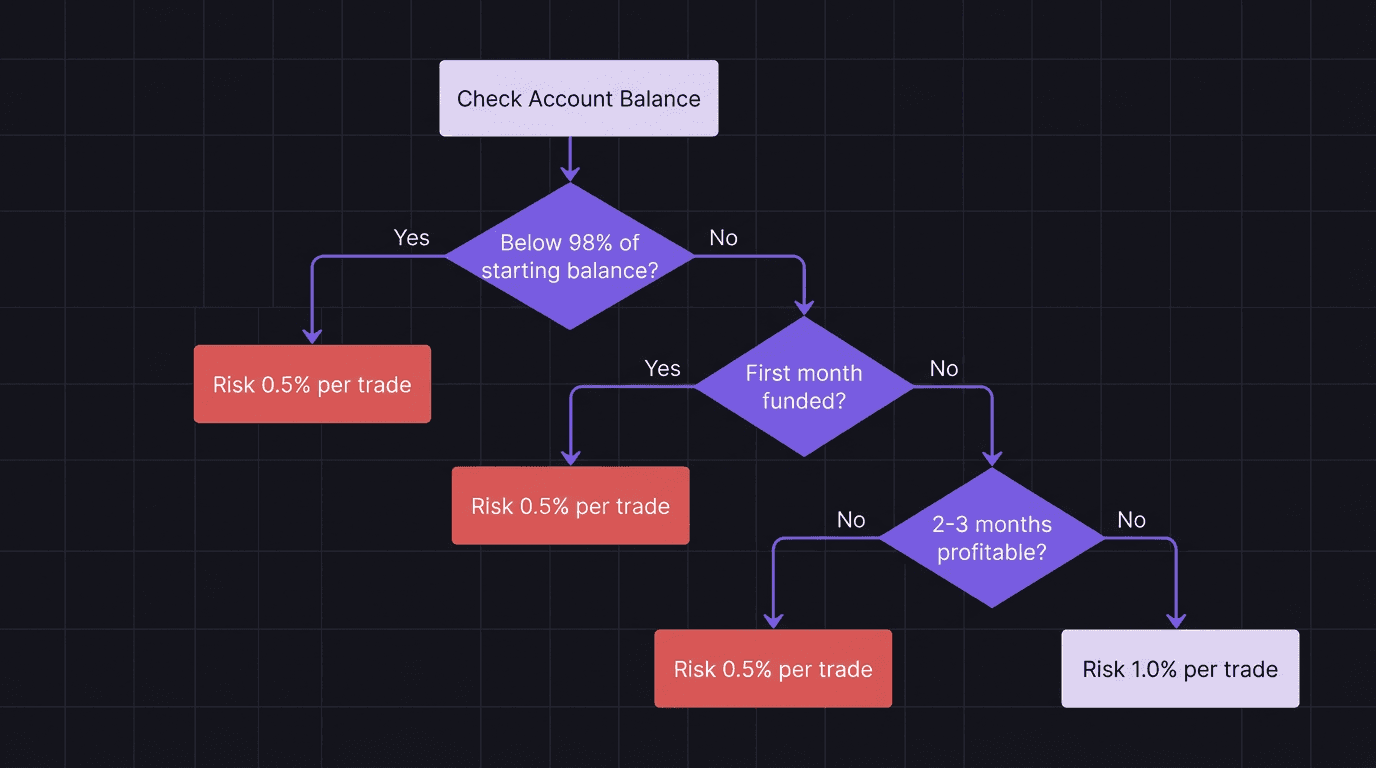
The de-risk trigger is a specific account level where you automatically cut risk from 1% to 0.5%. No debate. No "I feel fine, I'll keep going." It's a rule.
The trigger: when your balance drops below 98% of your starting capital.
On a $100,000 funded account, that's $98,000. The moment you see $97,999, your next trade uses 0.5% risk. Period.
Why 98%? Because at 98%, you've lost 2% of your account. If the firm's drawdown limit is 5%, you have 3% of room left. At 0.5% risk per trade, that's six losing trades before you're in real danger. At 1% risk, it's only three.
Six trades gives you time. Three trades gives you panic.
Walkthrough: De-Risking on EUR/USD
> You're trading EUR/USD on a $100,000 funded account. Risk per trade: 1% ($1,000). You've been running 1% risk for two months with consistent results. > > Monday: Short EUR/USD at 1.0880 during London open. Stop at 1.0910 (30 pips). Target at 1.0790 (90 pips, 1:3 R:R). Price hits your stop. Loss: -$1,000. Balance: $99,000. > > Tuesday: Long EUR/USD at 1.0840. Stop at 1.0810. Target at 1.0930. Price reverses and hits your stop. Loss: -$1,000. Balance: $98,000. > > Wednesday morning: Balance is at $98,000. De-risk trigger hit. You switch to 0.5% risk ($490 per trade) before even looking at charts. > > Wednesday trade: Long EUR/USD at 1.0820. Stop at 1.0790 (30 pips). Target at 1.0910 (90 pips, 1:3). Price runs to target. Win: +$1,470. Balance: $99,470. > > One trade at 0.5% risk with 1:3 R:R recovered nearly 1.5% of your account. You went from danger zone to recovery with a single disciplined setup.
That's the power of proper risk-to-reward. Even at half your normal risk, the math works in your favor.
One Trade Away: How 1:3 R Recovers Everything
This concept changes how you think about drawdowns. At 0.5% risk with a 1:3 reward-to-risk ratio, one winning trade returns 1.5%. That single win can recover a drawdown of -2.5% back to -1%.
Most traders in a drawdown think "I need five winning trades to dig out of this hole." With 1:3 R:R at 0.5% risk, you need one or two.
The math:
Risk | R:R | Win Return | Losses Recovered |
|---|---|---|---|
0.5% | 1:3 | +1.5% | Recovers 3 losses at 0.5% |
0.5% | 1:5 | +2.5% | Recovers 5 losses at 0.5% |
1.0% | 1:3 | +3.0% | Recovers 3 losses at 1.0% |
This is why minimum R:R matters as much as risk percentage. If you're risking 1% but only targeting 1:1, you need a 60%+ win rate to be profitable. At 1:3, you need just 30-35%.
Ever done the math on your own trades? Pull up your trading journal and check your average R:R. If it's below 1:2, your risk per trade setting barely matters because your winners aren't big enough to cover your losers.
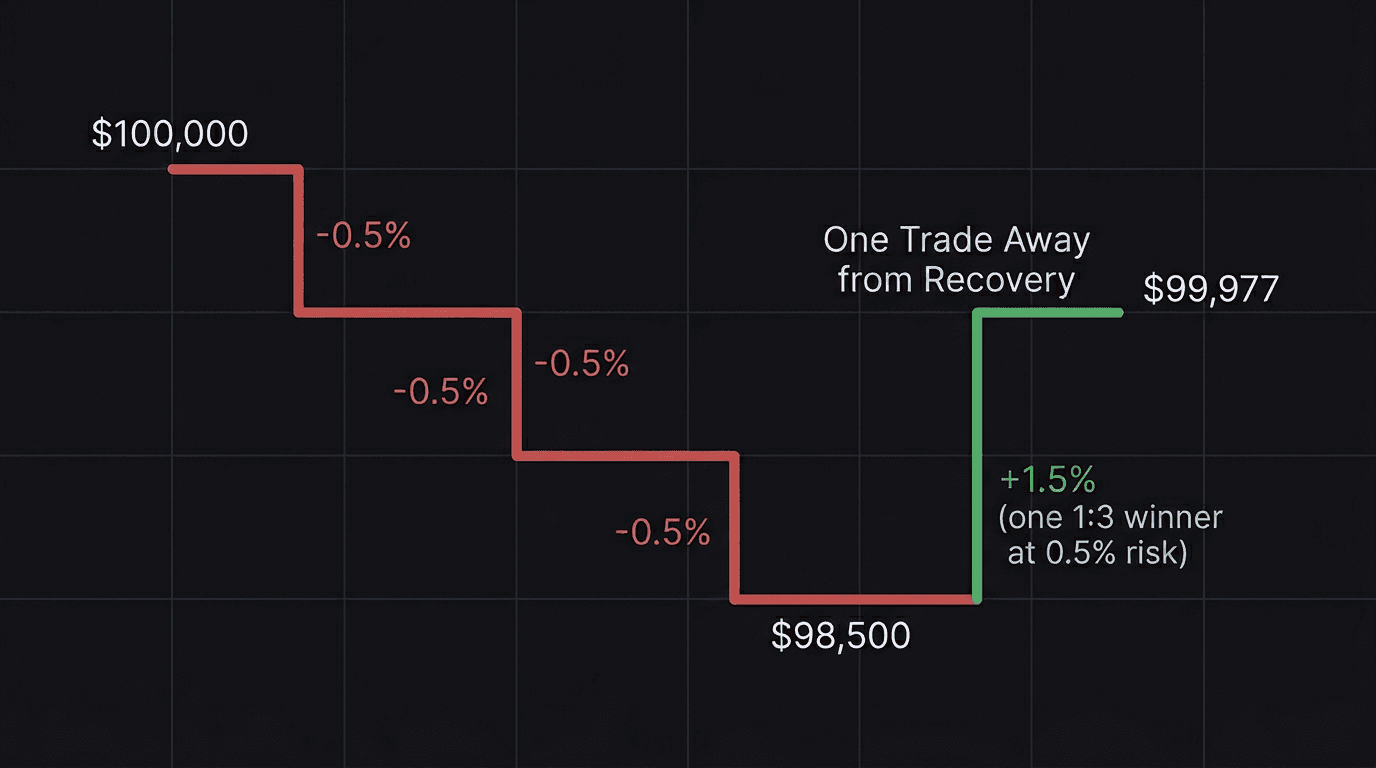
The mindset shift: you're not trying to win your way out of a hole with volume. You're waiting for one clean setup and letting the R:R do the work. This is why revenge trading is so destructive. It replaces patience with urgency, and urgency destroys R:R.
What About Going Above 1%?
Some traders ask about increasing to 2% risk when they're in profit. The source material suggests this: once your funded account reaches 5% profit ($105,000 on a $100k account), you could optionally increase to 2% to accelerate toward the 10% payout target.
This is advanced territory. Only consider it if:
You have 3+ months of live data showing your strategy works at 1%
Your account has a 5% buffer above starting balance
You've already taken a payout (proving the system works end to end)
You're willing to drop back to 1% immediately after one losing trade at 2%
For most traders reading this, sticking to the 0.5%-1% range is the right call. The traders who blow up fastest are the ones who "just wanted to try 3% for one trade."
How EdgeFlo Calculates and Enforces Risk Per Trade
Doing this math manually before every trade is tedious. And tedious processes get skipped, especially when you're already stressed from a losing streak. That's exactly when correct position sizing matters most.
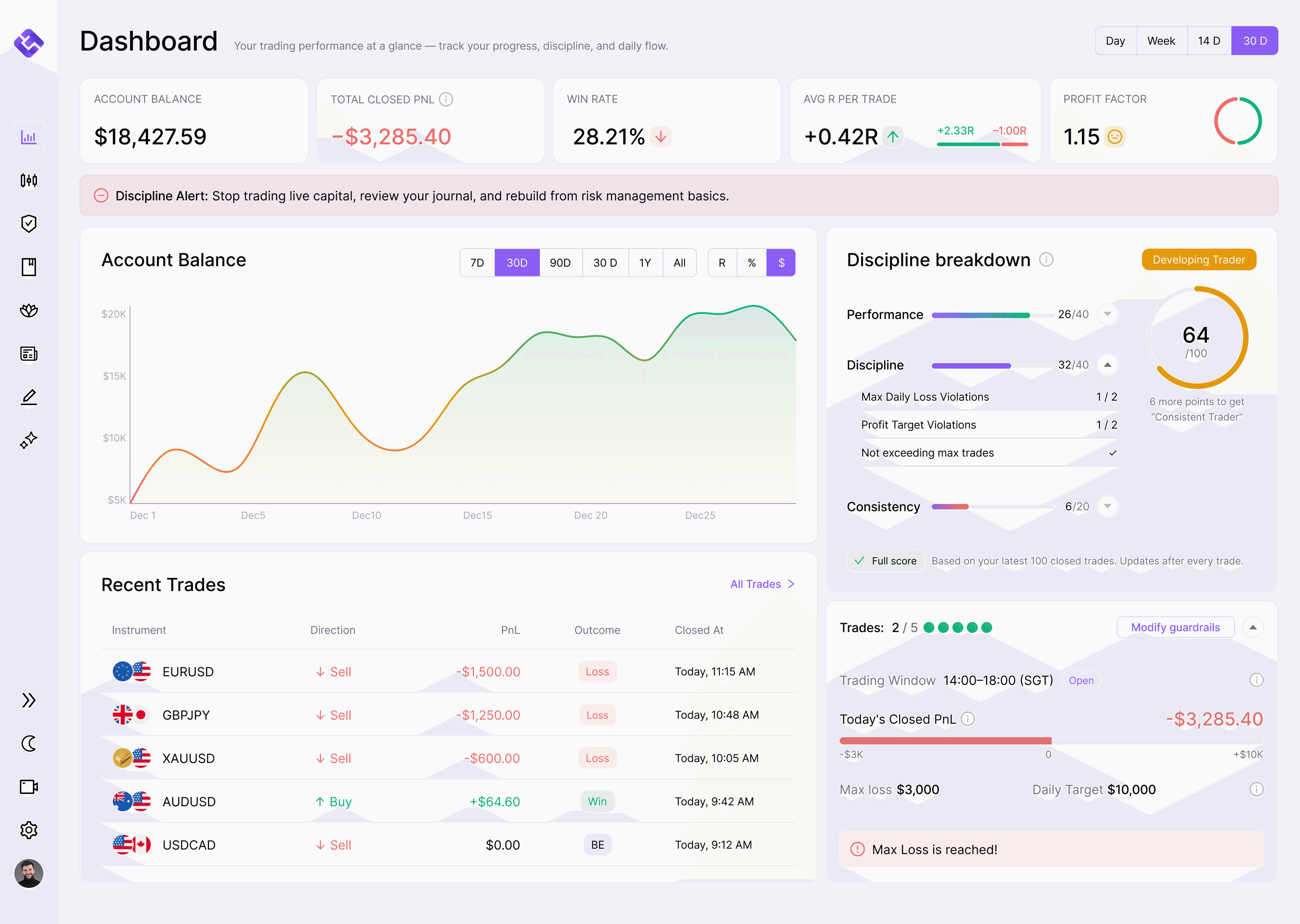
EdgeFlo auto-calculates lot size based on your account balance, your risk per trade setting, and the stop loss distance for each trade. You set your risk to 1% or 0.5%, place your stop loss, and EdgeFlo shows you the exact lot size. No spreadsheet. No calculator tab. No rounding errors.
But calculation alone isn't enough. EdgeFlo's guardrails include a risk per trade limit. If you try to place a trade that exceeds your pre-set risk, the Trade button disables. You can override it (the choice is always yours), but you have to consciously decide to break your own rule. That friction is the difference between "I accidentally risked 3%" and the mistakes that drain accounts. Most traders don't need a hard block. They need a moment to pause and reconsider.
The Edge Brief
Receive Insights on trading psychology, discipline, and the behavioral patterns that create consistent traders from our Founder and the EdgeFlo team, delivered to your inbox.
Think different. Trade different.
What percentage should I risk per trade?
When should I reduce my risk per trade?
What is the 1% rule in trading?
Can I still make money risking only 0.5% per trade?

Turn discipline on.
Every session.
EdgeFlo is the environment serious traders operate inside.
Start 7-Day Free Trial
Cancel anytime.
No long-term commitment.

Think Different, Trade Different.