

Your First Forex Trade, Step by Step
A complete walkthrough of placing your first forex trade. From reading the chart to setting stop loss, take profit, and lot size, one step at a time.
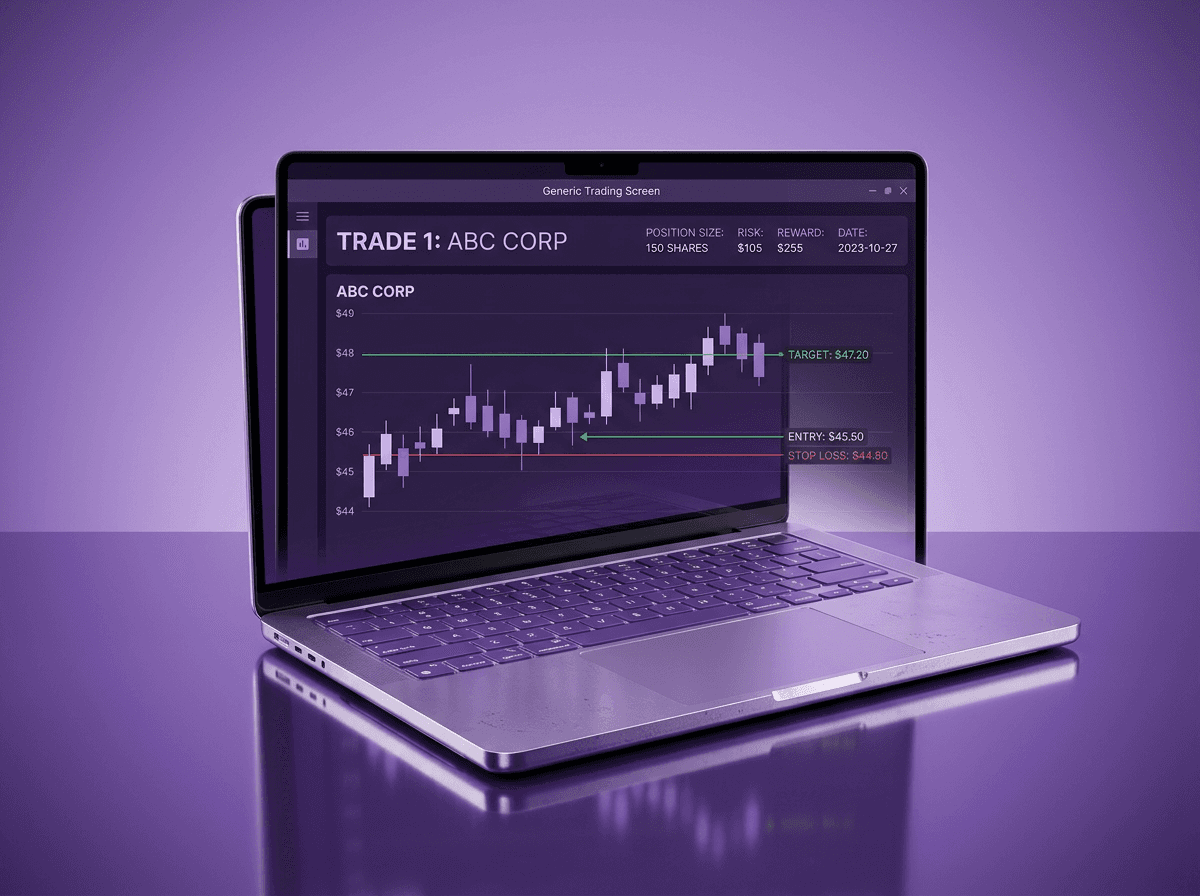
Your first forex trade does not need to be complicated. It needs to be structured. Most beginners lose money on their first trades because they skip steps, not because they picked the wrong direction. They enter without knowing their stop loss, their lot size, or how much money they are actually risking.
This walkthrough takes you through every decision, from reading the chart to clicking the button, in the exact order a disciplined trader would follow.
TL;DR
Identify the trend direction on a higher timeframe before looking for entries.
Mark a supply or demand zone on the medium timeframe for your entry area.
Set your risk at 1% of your account per trade.
Calculate your lot size based on your stop loss distance, not the other way around.
Use a minimum 2R reward-to-risk ratio so your winners outpace your losers.
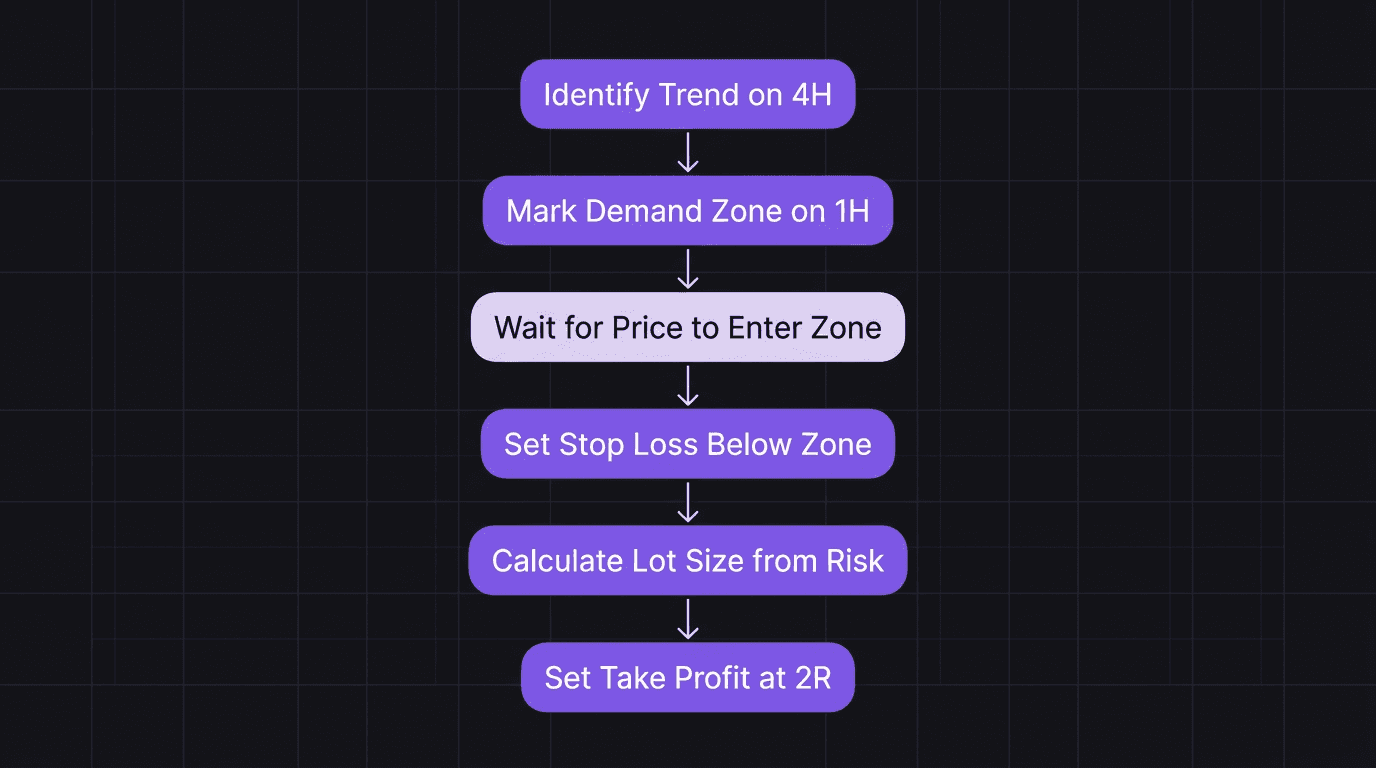
Step 1: Identify the Trend Direction
Open your chart on the 4-hour timeframe. You are looking for one thing: is price making higher highs and higher lows (uptrend), lower highs and lower lows (downtrend), or moving sideways (consolidation)?
For your first trade, only trade in the direction of the trend. If the 4-hour chart shows higher highs and higher lows, you are looking for buys. If it shows lower highs and lower lows, you are looking for sells. If it is moving sideways, close the chart and come back later.
This is market structure in its simplest form. You do not need indicators. You just need to see whether each swing high is higher or lower than the previous one, and whether each swing low is higher or lower than the previous one.
Example: EUR/USD on the 4-Hour Chart
You open EUR/USD and see three clear swing points: a swing low at 1.0820, a swing high at 1.0910, a higher swing low at 1.0855, and price currently pushing toward 1.0910 again.
Higher lows confirmed. You are looking for buys.
Step 2: Find Your Entry Zone
Now drop down to the 1-hour timeframe. You are looking for a demand zone, a price area where institutional buyers previously stepped in and pushed price higher.
Find the last pullback before a strong move up. That consolidation or the origin candle of the impulse move is your demand zone.
For this example, on the 1-hour chart you see price consolidated between 1.0845 and 1.0860 before an impulse candle pushed price from 1.0860 to 1.0910. The zone from 1.0845 to 1.0860 is your demand zone.
You do not enter yet. You wait for price to pull back into this zone.
Step 3: Wait for Price to Reach Your Zone
This is the hardest step because it requires patience. Price might take hours or even a full trading session to pull back to your zone. That is fine.
Do not enter early because "it looks like it might go up." Do not move your zone because price is close but has not touched it. Do not switch to a different pair because you are bored.
You wait. When price enters the zone between 1.0845 and 1.0860, you move to the next step.
Step 4: Set Your Stop Loss
Your stop loss goes at a price that invalidates your trade idea. For a buy at a demand zone, that means below the zone.
If your demand zone spans from 1.0845 to 1.0860 and you enter at 1.0852, place your stop loss at 1.0838 (below the zone with a few pips of buffer). That gives you 14 pips of stop distance.
The stop loss is not optional. It is the ceiling on your loss. Without it, a single bad trade can destroy your account.
Step 5: Calculate Your Lot Size
This is where most beginners get it wrong. They pick a lot size that "feels right" instead of calculating it from their risk.
Here is the formula: Lot size = Risk amount / (Stop loss in pips x Pip value per lot)
For a $10,000 account risking 1% per trade:
Math check: 1% of $10,000 = $100 risk. Stop loss = 14 pips. EUR/USD pip value per standard lot = $10/pip. $100 / (14 pips x $10) = $100 / $140 = 0.71 lots.
So you would trade 0.71 standard lots (or round down to 0.70 lots for simplicity). Each pip move equals $7.
If you are on a smaller account, say $1,000, the same 1% risk gives you $10. With a 14-pip stop, you would use 0.07 lots ($0.70 per pip).
Math check: 1% of $1,000 = $10 risk. $10 / (14 pips x $10) = $10 / $140 = 0.07 lots. 0.07 lots = $0.70/pip. $0.70 times 14 pips = $9.80 risk (within the $10 budget).
The lot size adapts to your stop distance, not the other way around. A wider stop means a smaller lot size. A tighter stop means a larger lot size. Your dollar risk stays constant. For a deeper look at the math, read position sizing in trading.
Step 6: Set Your Take Profit
For your first trade, use a simple 2R target. You are risking 14 pips, so your take profit sits 28 pips above your entry.
Entry at 1.0852 + 28 pips = take profit at 1.0880.
Math check: 0.70 lots = $7/pip. $7 times 14 pips = $98 risk. $7 times 28 pips = $196 profit at 2R. $196 / $98 = 2.0R.
A 2R target means you only need to win 34% of your trades to break even. Win 40% and you are profitable. That is the power of asymmetric risk-to-reward. You do not need to be right most of the time. You need your winners to be bigger than your losers.
Step 7: Execute and Walk Away
You have your entry, stop, target, and lot size. Place the trade. Then close the chart.
Seriously. Close it. Watching every tick does nothing except tempt you to move your stop, close early, or add to a losing position. Your plan is set. Let it play out.
If price hits your stop, you lose $98. If it hits your target, you make $196. Both outcomes are acceptable because you planned for both before you entered.
What a Losing First Trade Looks Like (And Why It Is Fine)
You enter at 1.0852. Price drops to 1.0838 and your stop triggers.
You lose $98. Your account is now $9,902. You still have 99 more 1% bullets before this account is gone. One loss does not matter. What matters is that you followed the process.
The worst version of a first trade is not a loss. It is a trade with no stop loss that "should have worked" but drops 100 pips while you stare at the screen hoping it comes back. That is a $700 lesson on a 0.70-lot position. The stop loss turned that potential disaster into a $98 planned expense.
Common First-Trade Mistakes to Avoid
Picking lot size before stop loss. "I want to trade 1 full lot" is backwards thinking. Your lot size is a function of your risk and stop distance. Start with how much you can afford to lose.
No stop loss. "I will watch it and close manually." You will not. The one time you look away is the time price drops 50 pips in two minutes.
Moving the stop loss further away. Price is approaching your stop and you panic. You move it 10 pips lower. Now your risk is 24 pips instead of 14, your lot size is too large for the new stop, and your risk per trade just jumped from 1% to 1.7%.
Closing a winning trade too early. Price moves 10 pips in your favor and you take the profit. That is $70 instead of $196. You just turned a 2R trade into a 0.7R trade, which means you now need a 59% win rate to break even instead of 34%.
How EdgeFlo Simplifies Your First Trade
The hardest part of a first trade is not the analysis. It is the math and the discipline. Calculating lot sizes, keeping risk at 1%, and resisting the urge to move your stop are where beginners break.
EdgeFlo's auto risk calculator handles the lot sizing math for you. Enter your stop loss level, and it calculates the correct lot size for your account size and risk percentage. No manual division. No rounding errors.
Guardrails can restrict you from exceeding your risk per trade. If you try to enter a position that risks more than your set percentage, the guardrail warns you. You can override it, but you have to actively choose to break the rule. That extra friction is often enough to make you pause and recalculate.
The Edge Brief
Receive Insights on trading psychology, discipline, and the behavioral patterns that create consistent traders from our Founder and the EdgeFlo team, delivered to your inbox.
Think different. Trade different.
How much money do I need for my first forex trade?
What lot size should a beginner use?
Where should I place my stop loss on my first trade?
What is a good risk-to-reward ratio for beginners?

Turn discipline on.
Every session.
EdgeFlo is the environment serious traders operate inside.
Start 7-Day Free Trial
Cancel anytime.
No long-term commitment.

Think Different, Trade Different.