

Plan Adherence Rate: The Metric That Beats Win Rate
Your plan adherence rate measures how often you follow your own rules. Here is why it matters more than win rate and how to calculate it.

Your plan adherence rate measures one thing: how often you actually follow your own rules. It is the single most honest number in your trading journal, and almost nobody tracks it.
Win rate gets all the attention. But win rate is partly outside your control. Market conditions shift, volatility spikes, and perfectly valid setups fail. Plan adherence is 100% within your control. It answers the question every struggling trader avoids: "Am I doing what I said I would do?"
TL;DR
Plan adherence rate equals plan-trades divided by total trades, expressed as a percentage.
It measures execution quality, not trade outcomes, making it a purer signal than win rate.
Aim for 80% adherence. Below 70% means your rules are unclear or you are consistently breaking them.
Fixing adherence from 60% to 80% often improves results more than switching strategies.
Track it weekly in your journal. It is the fastest way to spot discipline drift.
What Plan Adherence Rate Is
Plan adherence rate is a percentage. Take the number of trades where you followed every single rule in your trading plan and divide it by the total number of trades you took. Multiply by 100.
If you took 20 trades this month and followed your complete plan on 16 of them, your plan adherence rate is 80%.
The remaining 4 trades are off-plan. Maybe you entered without confirmation. Maybe you sized up after a win. Maybe you traded outside your session window. The reason does not matter for the calculation. If any rule was broken, the trade is off-plan.
This is a binary measure. Each trade either followed every rule or it did not. There is no partial credit. You do not get 80% adherence on a single trade because you followed 4 out of 5 rules. One broken rule makes the entire trade off-plan.
Why binary? Because partial adherence is where traders hide. "I mostly followed my plan" is the most common self-delusion in trading. The binary system forces honesty.
How to Calculate It
You need two numbers from your trade journal:
Total trades taken in the measurement period (week, month, or quarter)
Plan-trades: trades where every rule was followed (includes plan-wins and plan-losses)
Plan Adherence Rate = (Plan-Trades / Total Trades) x 100
Walkthrough: Calculating a Real Week
A trader takes 10 trades on EUR/USD during the London session over one week.
- Monday: Plan-win (followed rules, won). Plan-loss (followed rules, lost). - Tuesday: Off-plan-loss (entered before confirmation candle closed). - Wednesday: Plan-win. Plan-loss. - Thursday: Off-plan-win (traded New York session, which is outside the plan). Plan-win. - Friday: Plan-loss. Off-plan-loss (moved stop loss to reduce risk mid-trade).
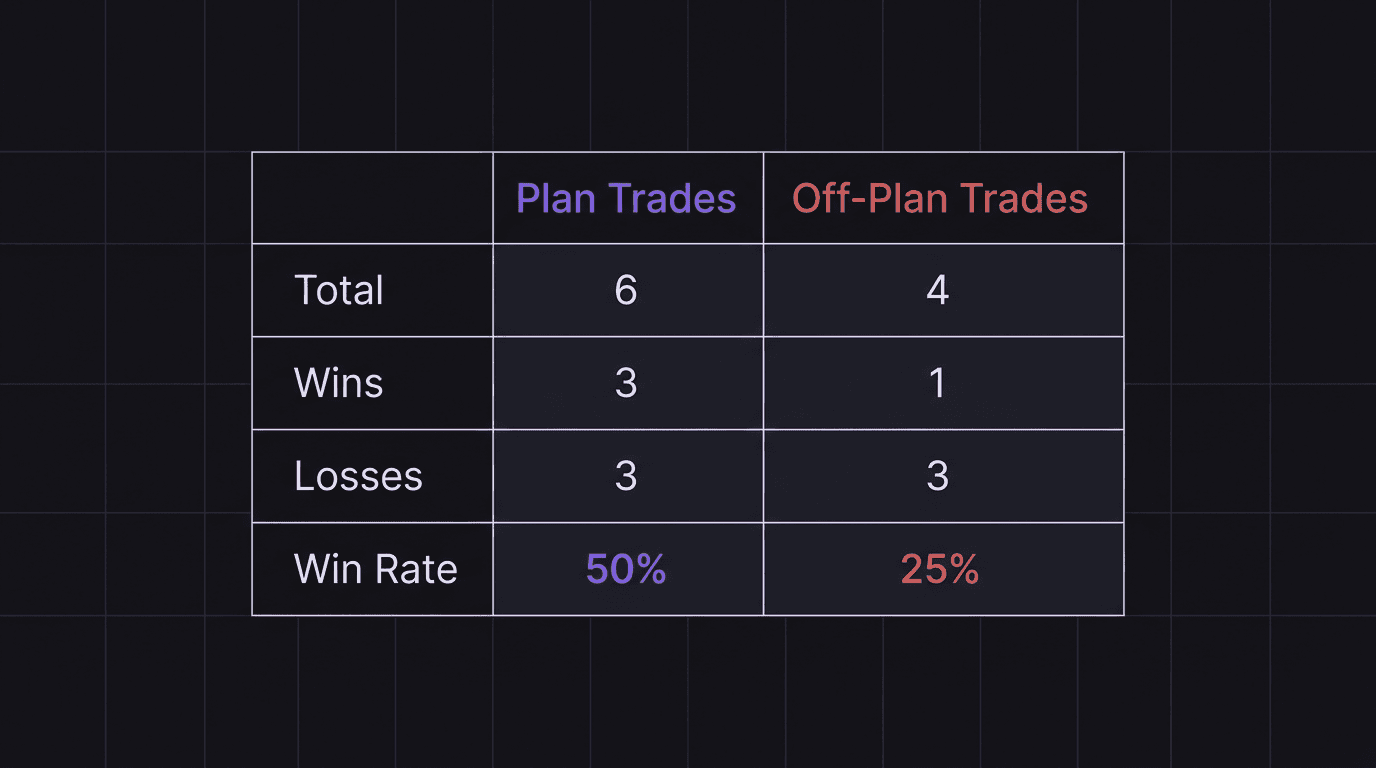
Counting: 6 plan-trades (3 wins, 3 losses) and 4 off-plan trades (1 win, 3 losses).
Plan adherence rate: 6 / 10 = 60%.
Notice that the trader's win rate for plan-trades is 50% (3 wins, 3 losses), while the off-plan win rate is 25% (1 win, 3 losses). That gap is not a coincidence. Off-plan trades almost always perform worse because they are, by definition, outside the strategy that was tested and validated.
Why 80% Adherence Changes Everything
Most traders have a tested strategy that works. The problem is not the strategy. The problem is that they follow it 50% to 60% of the time and fill the rest with impulsive, emotional, or FOMO-driven trades.
Here is why 80% is the target:
At 60% adherence, nearly half your trades are random noise. Your actual edge gets diluted by off-plan trades that have no statistical basis. You cannot know whether your strategy works because you are not running it consistently enough to generate meaningful data.
At 80% adherence, your off-plan trades are occasional slips rather than a pattern. Your results start to reflect your actual strategy performance. The signal emerges from the noise. And you can finally answer the question: "Is my plan profitable, or am I just not following it?"
Walkthrough: Same Strategy, Different Adherence
Trader A and Trader B both trade the same strategy on GBP/USD. The strategy has a tested win rate of 40% with an average 2.5R per winner.
Trader A (60% adherence, 50 trades): - 30 plan-trades: 12 wins at 2.5R = 30R gained, 18 losses at 1R = 18R lost. Net from plan: +12R. - 20 off-plan trades: 4 wins at 1.5R = 6R gained, 16 losses at 1R = 16R lost. Net from off-plan: -10R. - Total: +2R over 50 trades.
Math check: - 30 plan-trades x 40% win rate = 12 wins. 30 plan-trades x 60% loss rate = 18 losses. - 12 wins x 2.5R = 30R. 18 losses x 1R = 18R. 30R minus 18R = +12R. - 20 off-plan trades x 20% win rate = 4 wins. 20 off-plan trades x 80% loss rate = 16 losses. - 4 wins x 1.5R = 6R. 16 losses x 1R = 16R. 6R minus 16R = -10R. - Total: 12R minus 10R = +2R.
Trader B (80% adherence, 50 trades): - 40 plan-trades: 16 wins at 2.5R = 40R gained, 24 losses at 1R = 24R lost. Net from plan: +16R. - 10 off-plan trades: 2 wins at 1.5R = 3R gained, 8 losses at 1R = 8R lost. Net from off-plan: -5R. - Total: +11R over 50 trades.
Math check: - 40 plan-trades x 40% win rate = 16 wins. 40 plan-trades x 60% loss rate = 24 losses. - 16 wins x 2.5R = 40R. 24 losses x 1R = 24R. 40R minus 24R = +16R. - 10 off-plan trades x 20% win rate = 2 wins. 10 off-plan trades x 80% loss rate = 8 losses. - 2 wins x 1.5R = 3R. 8 losses x 1R = 8R. 3R minus 8R = -5R. - Total: 16R minus 5R = +11R.
Same strategy. Same market. Same skill level. Trader B made 5.5 times more R simply by following the plan on 80% of trades instead of 60%. The entire difference comes from fewer off-plan trades dragging down results.
That is why trading consistency matters more than finding a better strategy.
Fixing Low Adherence Without Willpower
If your adherence is below 70%, do not try to fix it with motivation. Motivation fades by Wednesday. You need structural changes that make rule-breaking harder.
1. Simplify your rules. If your plan has 12 entry criteria, you will skip some under pressure. Reduce to the 5 that matter most. A simpler plan is easier to follow.
2. Write a pre-trade checklist. Before every entry, run through a physical or digital checklist. If any box is unchecked, you do not enter. This turns discipline from a feeling into a procedure.
3. Grade every trade immediately. After you close a trade, mark it plan or off-plan in your journal before doing anything else. Do not wait until the weekend. The immediate feedback loop builds awareness.
4. Review your off-plan trades weekly. In your weekly review, isolate just the off-plan trades. What rule did you break? What triggered it? Was it the same trigger as last week? If you find the same trigger twice, that is the single thing to fix.
5. Set a session-level guardrail. Decide that after 2 off-plan trades in a session, you stop trading for the day. This prevents the spiral where one rule violation leads to three more.
The common thread: these are environment changes, not attitude changes. You are not trying to be more disciplined. You are making it structurally harder to break your rules without a conscious decision.
How EdgeFlo Supports Plan Adherence
EdgeFlo's trade plan builder (Edge) keeps your rules visible on screen during every session. You are not relying on memory to follow a plan you wrote last month. The plan is right there.
After each trade, EdgeFlo's post-trade self-reporting prompts you to grade the trade against your documented rules. That immediate feedback loop (plan or off-plan, tagged at the moment of truth) is what makes adherence trackable without manual spreadsheets.
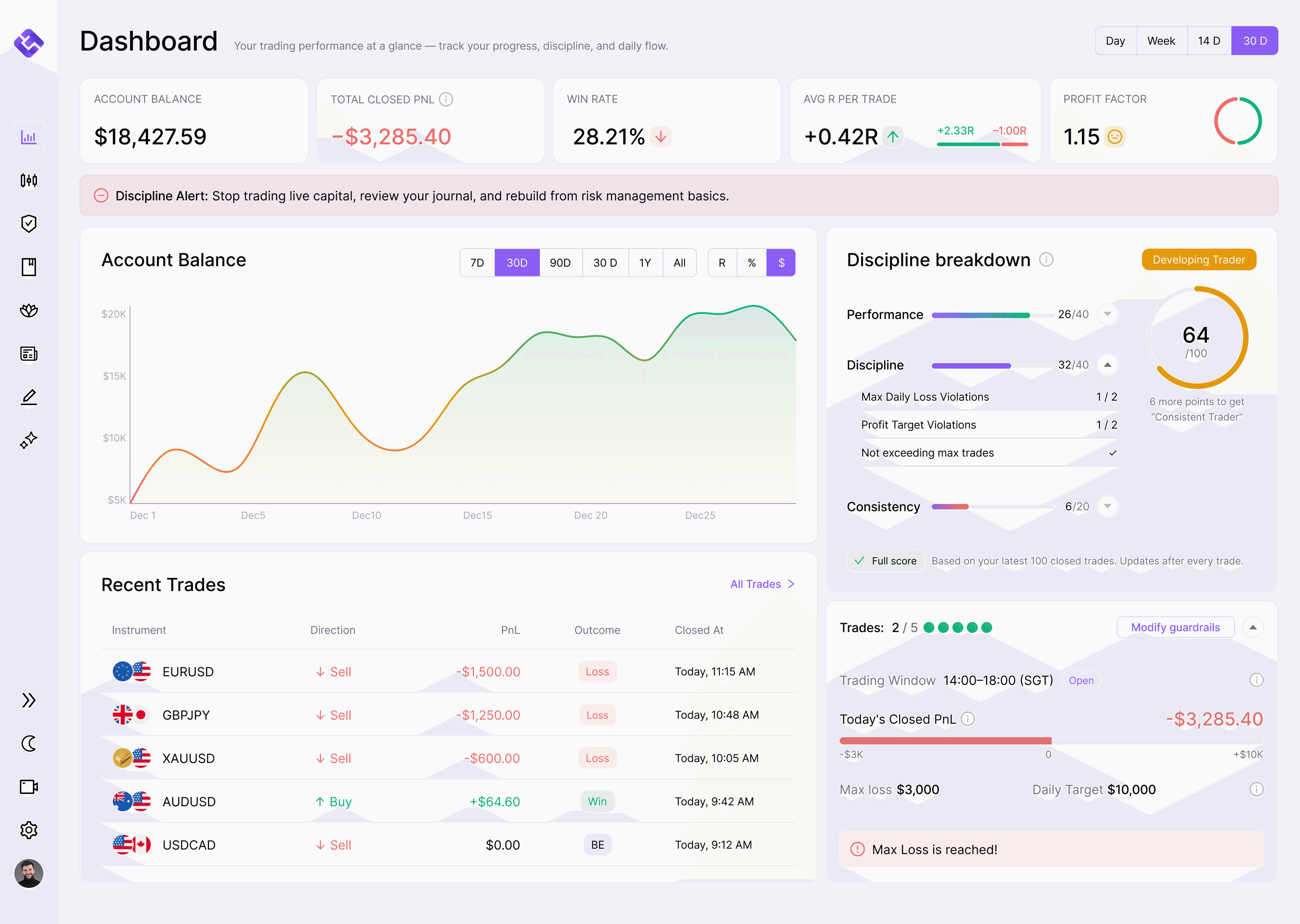
The trading dashboard then rolls up your adherence rate across days, weeks, and months. If your adherence drops below your target, you see it in the numbers before it shows up in your P&L. And the guardrails feature (with override) can restrict trading after you hit a session limit, putting a structural barrier between one mistake and five.
The Edge Brief
Receive Insights on trading psychology, discipline, and the behavioral patterns that create consistent traders from our Founder and the EdgeFlo team, delivered to your inbox.
Think different. Trade different.
What is plan adherence rate in trading?
How do I calculate my plan adherence rate?
What is a good plan adherence rate?
Why does plan adherence matter more than win rate?

Turn discipline on.
Every session.
EdgeFlo is the environment serious traders operate inside.
Start 7-Day Free Trial
Cancel anytime.
No long-term commitment.

Think Different, Trade Different.