

Forex Lot Sizes: Standard, Mini, and Micro
Standard lots are 100,000 units. Mini lots are 10,000. Micro lots are 1,000. Learn how lot size controls your pip value and why picking the right one matters.
A standard lot in forex is 100,000 units of the base currency. A mini lot is 10,000 units. A micro lot is 1,000 units. On EUR/USD, that translates to $10 per pip for a standard lot, $1 per pip for a mini lot, and $0.10 per pip for a micro lot. Your lot size is the single biggest lever that determines how much money you make or lose on every pip of price movement.
Most new traders get this backward. They pick a lot size based on how much they want to make, not how much they can afford to lose. That is the fastest path to blowing an account with oversized positions.
TL;DR
Standard lot = 100,000 units = $10/pip on EUR/USD.
Mini lot = 10,000 units = $1/pip on EUR/USD.
Micro lot = 1,000 units = $0.10/pip on EUR/USD.
Your lot size should be calculated from your risk per trade, not from your profit target.
A position sizing calculator does this math for you so you never have to guess.
What Is a Lot?
In forex, you cannot buy a single unit of a currency pair the way you buy one share of stock. Currencies trade in standardized bundles called lots.
When you open a buy position on EUR/USD with 1 standard lot, you are buying 100,000 euros. The value of that position fluctuates with the exchange rate, and each pip of movement is worth $10.
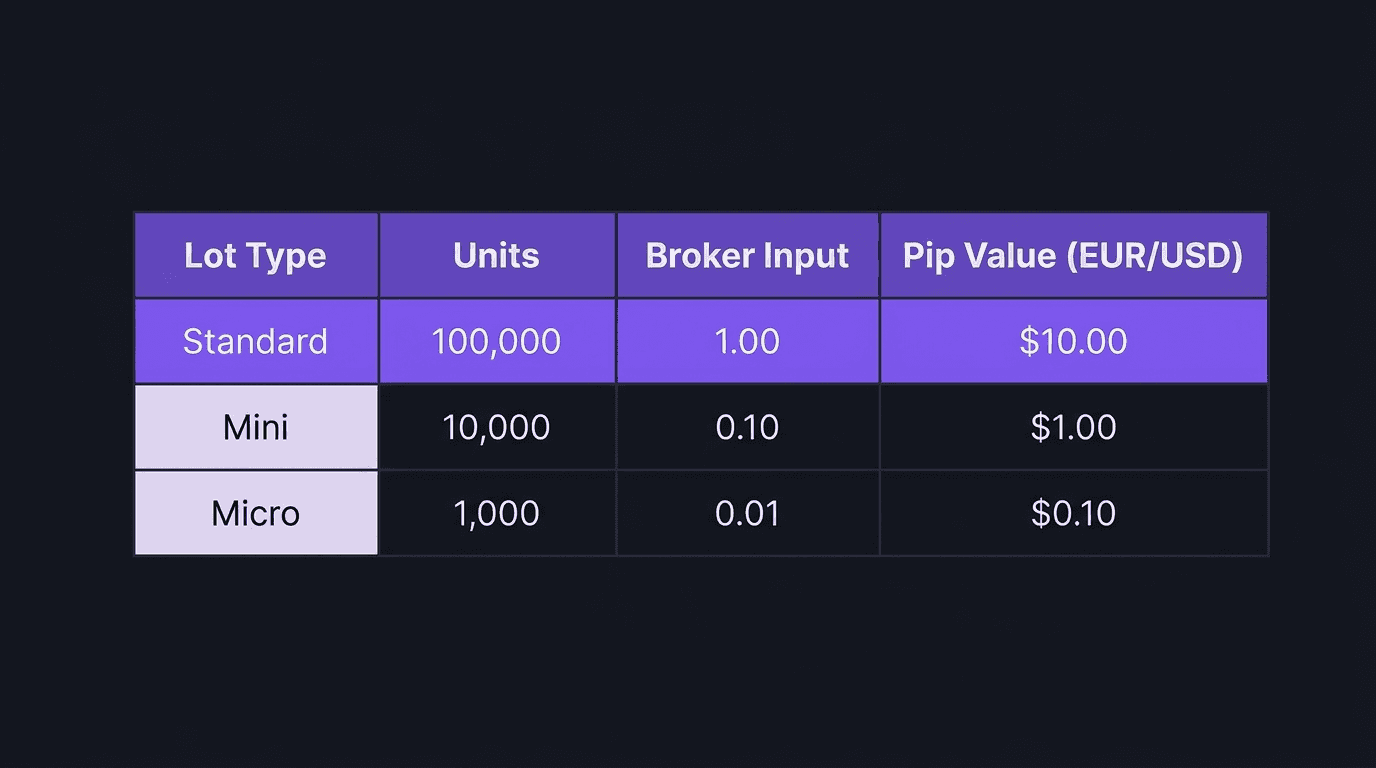
Here is the full lot size table:
Lot Type | Units | Lot Size (in broker) | Pip Value (EUR/USD) |
|---|---|---|---|
Standard | 100,000 | 1.00 | $10.00 |
Mini | 10,000 | 0.10 | $1.00 |
Micro | 1,000 | 0.01 | $0.10 |
These values apply to pairs where USD is the quote currency (EUR/USD, GBP/USD, AUD/USD). For pairs like USD/JPY, the pip value depends on the current exchange rate and works out to approximately $6.60 per pip per standard lot.
How Lot Size Connects to Dollars
The lot size you choose determines how much each pip is worth in your account currency. This is the bridge between "price moved 50 pips" and "I made (or lost) $500."
Take a practical example. You buy EUR/USD and price moves up 292 pips (a large move, but it happens on 4-hour candles during volatile sessions).
At 1 standard lot (1.00): 292 pips times $10 = $2,920 profit.
At 1 mini lot (0.10): 292 pips times $1 = $292 profit.
At 1 micro lot (0.01): 292 pips times $0.10 = $29.20 profit.
Same price movement. Completely different outcomes. The chart did not change. Only the lot size changed.
This works identically in reverse. If price moves 292 pips against you at 1 standard lot, you lose $2,920. That is why lot size is a risk management decision, not a profit optimization decision.
The Right Way to Choose Lot Size
Do not pick a lot size and then calculate how much you might make. Start with how much you are willing to lose.
Step 1: Decide your risk per trade as a percentage. For most traders, 1% of account balance is the standard. On a $10,000 account, that is $100 per trade.
Step 2: Determine your stop loss distance in pips. If your trade setup requires a 25-pip stop loss, that is your number.
Step 3: Calculate your lot size.
Lot size = risk in dollars / (stop loss in pips times pip value per standard lot)
For EUR/USD: $100 / (25 pips times $10) = $100 / $250 = 0.40 lots.
So you would trade 0.40 lots. Each pip is worth $4. If you get stopped out at 25 pips, you lose exactly $100, which is your 1% risk.
Walkthrough: What Happens When You Skip This Step
A trader with a $5,000 account sees a setup on GBP/USD with a 40-pip stop loss. Instead of calculating the right lot size, he picks 0.5 standard lots because "it is not a full lot, so it should be fine."
At 0.5 lots on GBP/USD, each pip is worth $5. His 40-pip stop loss means he is risking 40 times $5, which is $200. That is 4% of his $5,000 account on a single trade.
Three consecutive losses at this size would cost $600, wiping out 12% of his account. Recovery from a 12% drawdown requires a 13.6% gain just to get back to even.
The correct lot size would have been: $50 (1% of $5,000) / (40 pips times $10) = 0.125 lots. Each pip would be worth $1.25, and the 40-pip stop loss would cost exactly $50. Three consecutive losses would cost $150, or 3% of the account. Much more survivable.
Lot Size and Leverage: The Relationship
Leverage determines how much buying power your account has. A $1,000 account with 100:1 leverage has $100,000 in buying power, enough to open 1 standard lot on EUR/USD.
But being able to open 1 standard lot does not mean you should. At 1 standard lot, every pip costs $10. A 100-pip move against you wipes out your entire $1,000 account.
This is the trap that catches new traders. High leverage lets them trade large lot sizes on small accounts. The lot size is technically allowed by the broker, but the risk is absurd. You can leverage a $50 account at 500:1 and get $25,000 in buying power. That is enough for a micro lot or two. But your stop loss has to be almost nonexistent, and a single bad trade ends the account.
The rule is simple: leverage gives you access. Position sizing gives you survival. Use leverage to enable the correct lot size for your risk rules, not to trade the biggest size your broker allows.
Walkthrough: Leverage Without Risk Rules
A trader deposits $80 into a broker offering 500:1 leverage. Buying power: $80 times 500 = $40,000. That is enough for 0.4 standard lots on EUR/USD.
At 0.4 lots, each pip is worth $4. A 20-pip move against the trade costs $80. The entire account is gone in 20 pips.
For context, EUR/USD can move 20 pips in under a minute during a news release. This is not trading. This is a coin flip with extra steps.
Matching Lot Size to Account Size
Here is a practical reference for 1% risk per trade on EUR/USD with a 25-pip stop loss:
Account Size | 1% Risk | Lot Size (25-pip SL) | Pip Value |
|---|---|---|---|
$1,000 | $10 | 0.04 lots | $0.40 |
$5,000 | $50 | 0.20 lots | $2.00 |
$10,000 | $100 | 0.40 lots | $4.00 |
$25,000 | $250 | 1.00 lots | $10.00 |
$50,000 | $500 | 2.00 lots | $20.00 |
Notice that you need a $25,000 account before a standard lot makes sense at 1% risk with a 25-pip stop. On smaller accounts, mini and micro lots are the only responsible option.
How EdgeFlo Handles Lot Sizing
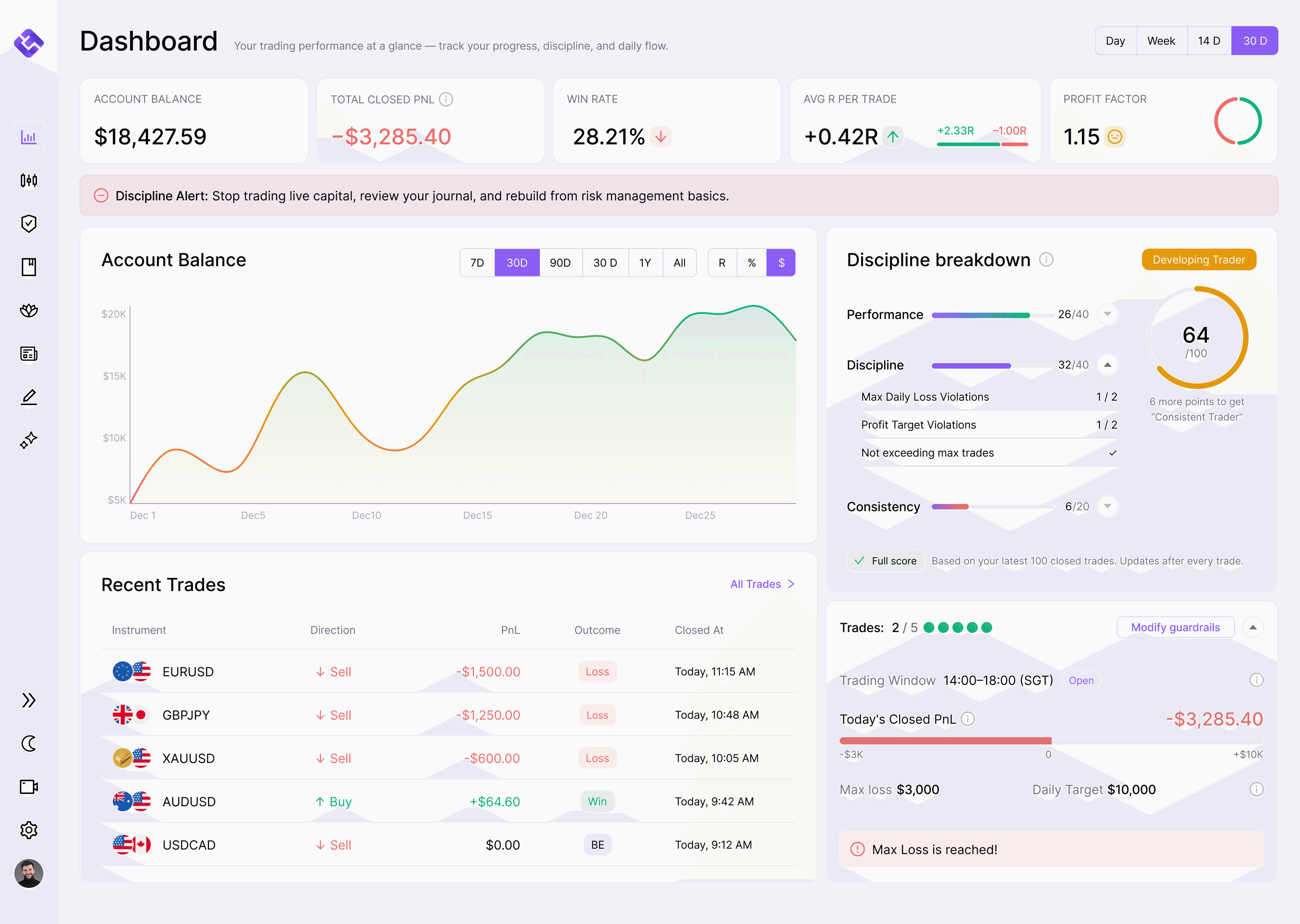
EdgeFlo's auto risk calculator does this math for you in real time. You set your risk percentage (say, 1%) and enter your stop loss distance. The calculator outputs the exact lot size. As price fluctuates and your entry price shifts, the lot size adjusts automatically so your dollar risk stays constant.
This removes the most common lot sizing mistake: mental math under pressure. When you are staring at a setup and your heart is racing, the last thing you want to do is divide decimals in your head. The calculator handles it, and your only job is to decide whether the trade meets your criteria.
The Edge Brief
Receive Insights on trading psychology, discipline, and the behavioral patterns that create consistent traders from our Founder and the EdgeFlo team, delivered to your inbox.
Think different. Trade different.
How many units is a standard lot in forex?
What is the smallest lot size I can trade?
How does lot size affect my risk per trade?
Should beginners trade standard lots?

Turn discipline on.
Every session.
EdgeFlo is the environment serious traders operate inside.
Start 7-Day Free Trial
Cancel anytime.
No long-term commitment.

Think Different, Trade Different.