

One Inch Wide, a Mile Deep: Why One Market Beats Five
Switching markets resets your learning to zero. Learn why committing to one market, one style, and one session for 6 to 12 months builds the edge that pays.
Why Depth Beats Breadth in Trading
You cannot hit mastery if you keep switching games. Every time you jump to a new market, you reset your pattern recognition to zero. The nuances you spent weeks learning (how price behaves at London open on EUR/USD, what a liquidity sweep looks like on the 15-minute chart, how news candles settle on your favorite pair) all become irrelevant the moment you switch to NQ futures or Bitcoin.
Most traders jump because the current market feels hard. What they do not realize is that every market feels hard at some point. The discomfort is not a signal to switch. It is the price of admission for building a real edge.
The principle is simple: go one inch wide and a mile deep. Pick one market, one style, one session window, and commit for six to twelve months minimum. That is where mastery lives.
TL;DR
Every market switch resets your pattern recognition to zero.
Depth builds intuition. Breadth destroys it.
Pick one market, one trading style, and one session window.
Commit for at least 6 months before evaluating whether to change anything.
The discomfort you feel in month 3 is normal, not a reason to switch.
Pattern Recognition Resets When You Switch
Pattern recognition is the ability to look at a chart and know what is likely to happen next without consciously analyzing every detail. It is the difference between a beginner reading every candle and a veteran glancing at structure and seeing the setup instantly.
This skill only develops through repetition. Hundreds of sessions watching the same pair during the same window. Thousands of candles in the same market context. Your brain builds a library of "I have seen this before" that no course or indicator can replicate.
When you switch markets, that library becomes useless. EUR/USD during the London session behaves nothing like NQ futures during the New York open. The speed is different. The typical ranges are different. The liquidity patterns are different. You are starting from scratch.
Strategy hopping works the same way. Every time you abandon your approach after a losing week, you throw away weeks of data that would have told you whether the strategy actually works.
Walkthrough: The Cost of Switching After Three Months
Trader A picks EUR/USD and trades the London session using a supply-and-demand strategy. She commits for 6 months. During months 1 and 2, her win rate is 28% and she is slightly negative. By month 3, she starts recognizing recurring patterns during the first hour of London. Her win rate climbs to 35%.
Math check (month 3, 15 trades, $500 account, 1% risk = $5 per trade): 5 wins x $15 (3R) = $75. 10 losses x $5 = $50. Net: $75 minus $50 = $25 profit. Return: $25 / $500 = 5%.
By month 6, her win rate is 38% and she knows exactly which setups to take and which to skip.
Trader B starts with EUR/USD but switches to Bitcoin in month 2 because crypto is "trending." Then switches to NQ futures in month 4 because a YouTube video made it look easy.
After 6 months, Trader B has two months of data in three different markets. Win rate across all three: 24%. No pattern recognition in any of them. Net result: negative $180.
Same starting skill. Same capital. Different commitment. Trader A is building an edge. Trader B is collecting surface-level exposure in everything and mastery in nothing.
The Power of One: Market, Style, Session
The commitment is not just "pick a market." It is three decisions locked together:
One market. EUR/USD, GBP/USD, NQ, gold, Bitcoin, whatever. Pick the one that fits your schedule and personality. Then trade only that.
One trading style. Scalping, day trading, or swing trading. Each style requires different skills, different time commitments, and different psychological tolerance. If you keep switching between day trading and swing trading, you never develop the execution habits for either.
One session window. If you trade forex, pick London or New York (or the overlap). If you trade stocks or futures, pick the first two hours of the cash session. Show up at the same time every day and leave at the same time. This builds a routine that compounds your skill.
When you lock in all three, something shifts. You stop looking for opportunities everywhere and start seeing them in the one place you actually understand. The noise drops. Your confidence comes from data, not hope.
This is what "simplicity in trading" actually looks like. Not a simple strategy. A simple focus.
The 6-Month Minimum Commitment
Six months is not arbitrary. It is the minimum time needed to:
See your market in multiple conditions (trending, ranging, volatile, quiet).
Collect enough trades for your backtest and forward test data to be statistically meaningful (at least 50 to 100 trades).
Build the unconscious pattern recognition that separates beginners from competent traders.
Experience at least one extended losing streak and learn how to survive it without abandoning your plan.
Most traders quit their market after 2 to 4 weeks of drawdown. They tell themselves the market changed, the strategy stopped working, or a different instrument would be easier. But the real issue is they have not invested enough screen time to see the full cycle.
The returns in trading are not linear. They are exponential. The outsized payoff comes in month 5, month 6, month 8 (after you have paid the tuition of losses in months 1 through 4). If you keep switching every time it gets uncomfortable, you never reach the compounding phase.
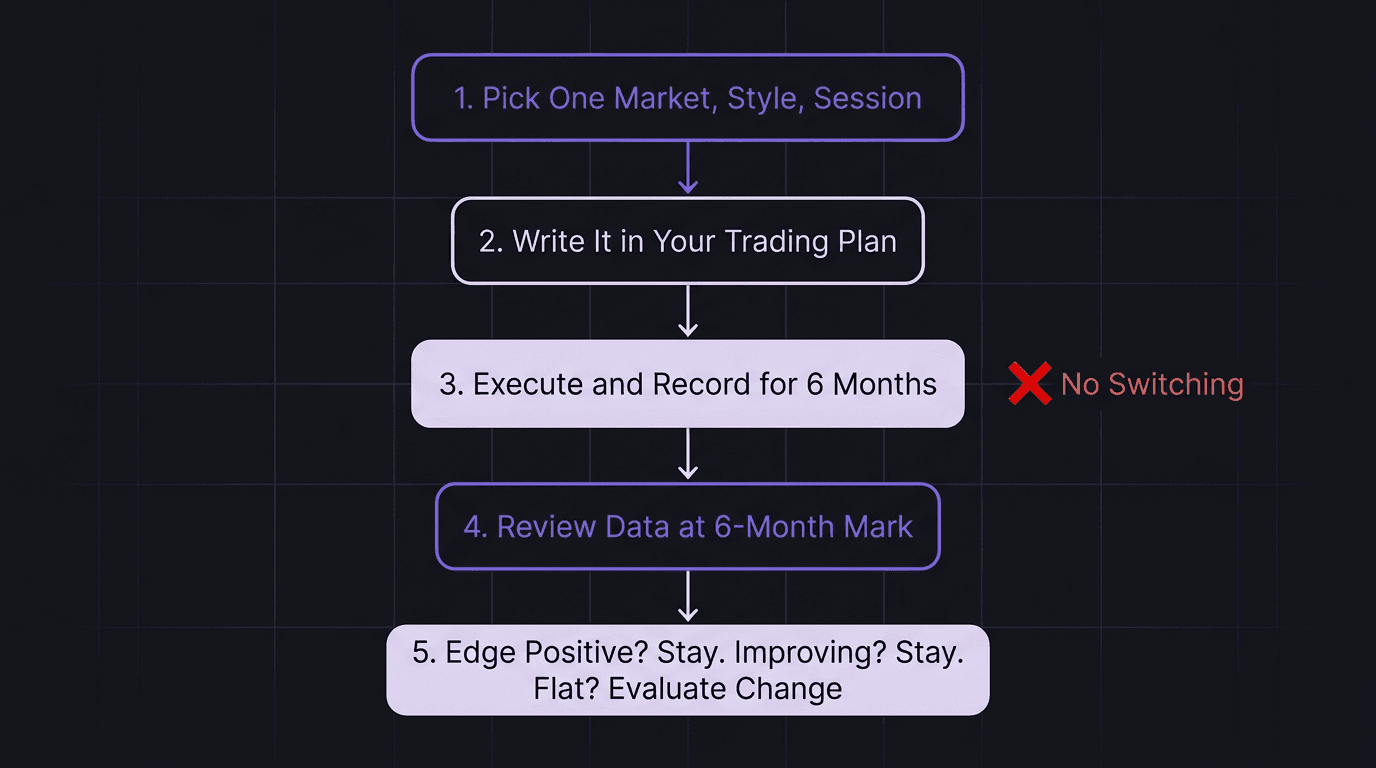
The commitment framework:
Pick your one market, style, and session window.
Write it down in your trading plan. Make it visible.
Set a calendar reminder for 6 months. That is your earliest review date.
Between now and that date, your only job is to execute and record. No switching. No "testing" a different market on the side.
At the 6-month mark, review your data. If your edge is positive, stay. If it is negative but improving, stay longer. If it is flat with no improvement trend, then (and only then) evaluate a change.
How EdgeFlo Keeps You Focused on One Lane
The biggest threat to single-market commitment is not the market itself. It is the temptation to switch when things get uncomfortable.
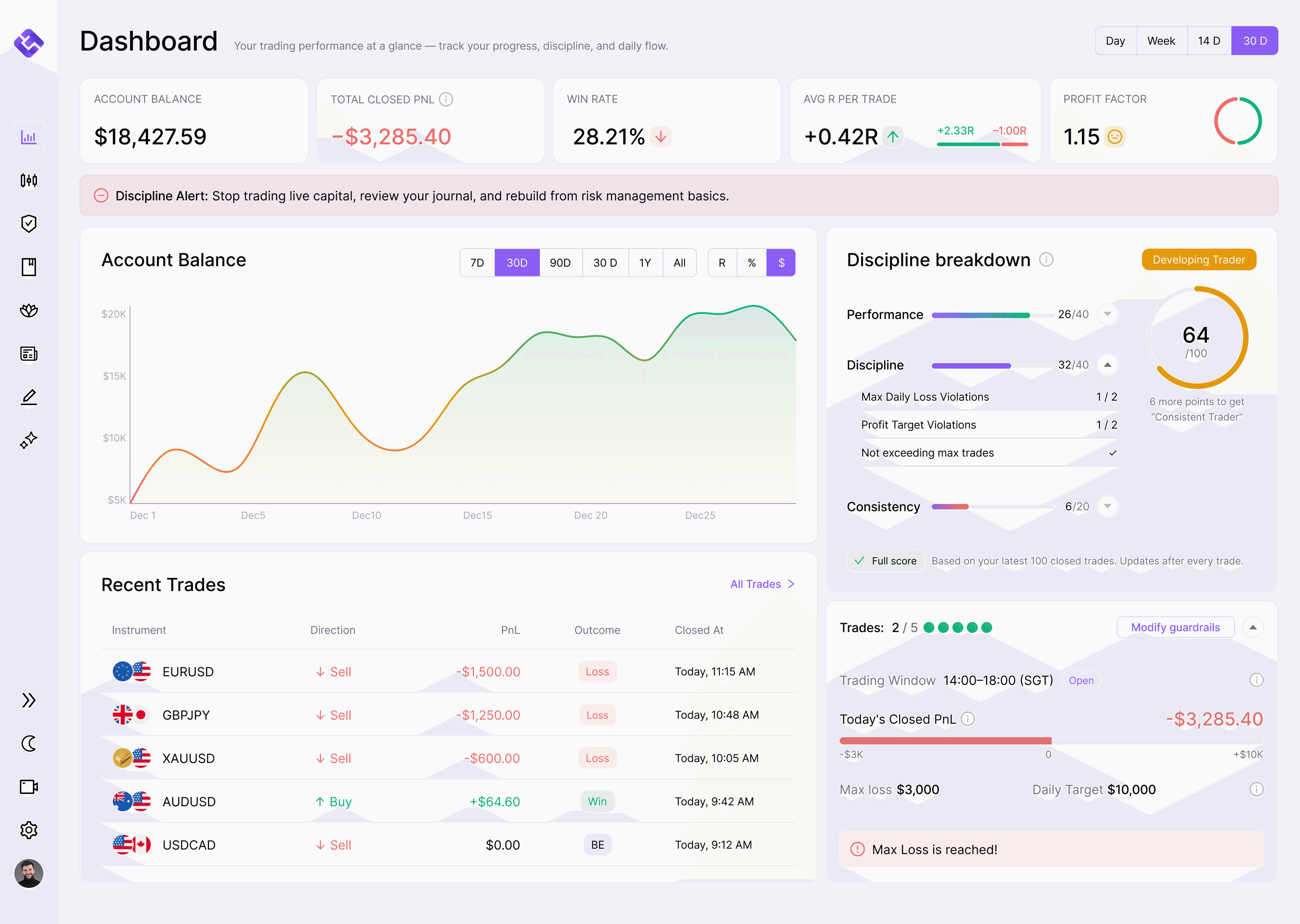
EdgeFlo's Edge plan builder lets you document exactly what you committed to: the market, the style, the session, the entry criteria, the risk parameters. That plan stays visible during every trading session. When the urge to chase Bitcoin or try futures hits, your plan is right there reminding you of the commitment.
The trading dashboard surfaces your long-term performance data for your chosen market. After three months, you can see whether your win rate is trending up, whether your average R is stable, and whether your execution quality is improving. That data is the antidote to shiny object syndrome. When you can see measurable progress, the pull toward a different market loses its power.
The Edge Brief
Receive Insights on trading psychology, discipline, and the behavioral patterns that create consistent traders from our Founder and the EdgeFlo team, delivered to your inbox.
Think different. Trade different.
Why should I trade only one market?
How long should I commit to one market before switching?
Does trading multiple markets diversify my risk?
What if my chosen market goes through a bad period?

Turn discipline on.
Every session.
EdgeFlo is the environment serious traders operate inside.
Start 7-Day Free Trial
Cancel anytime.
No long-term commitment.

Think Different, Trade Different.