

One Session Trading: London or New York
Trading both London and New York sessions doubles your risk of giving back profits. Pick one session, trade it, walk away. Here's how to choose.
Trade one session per day. London or New York, not both. This is the single most effective trading rule that most beginners overlook because it feels like leaving money on the table. It is not. A funded trader with $850K in capital described it bluntly: "If I got money from London, I don't want to give it back to New York." That statement captures years of painful experience compressed into one sentence. The second session is where you are most likely to overtrade, take marginal setups, and erase the day's work.
TL;DR
Pick one session (London or New York) and trade only that session each day. This is a rule, not a suggestion.
The second session is where most retail traders give back their profits. Emotional state changes after the first session create lower-quality decisions.
Decision fatigue is real. After 3-4 hours of active trading, your execution quality drops measurably.
Your pre-market routine should lock in which session you are trading before you open charts.
The One-Session Rule
The one-session rule is simple. Before the market opens, you decide which session you will trade. When that session ends, you close your charts. Done.
For forex traders, kill zones define when the best setups appear:
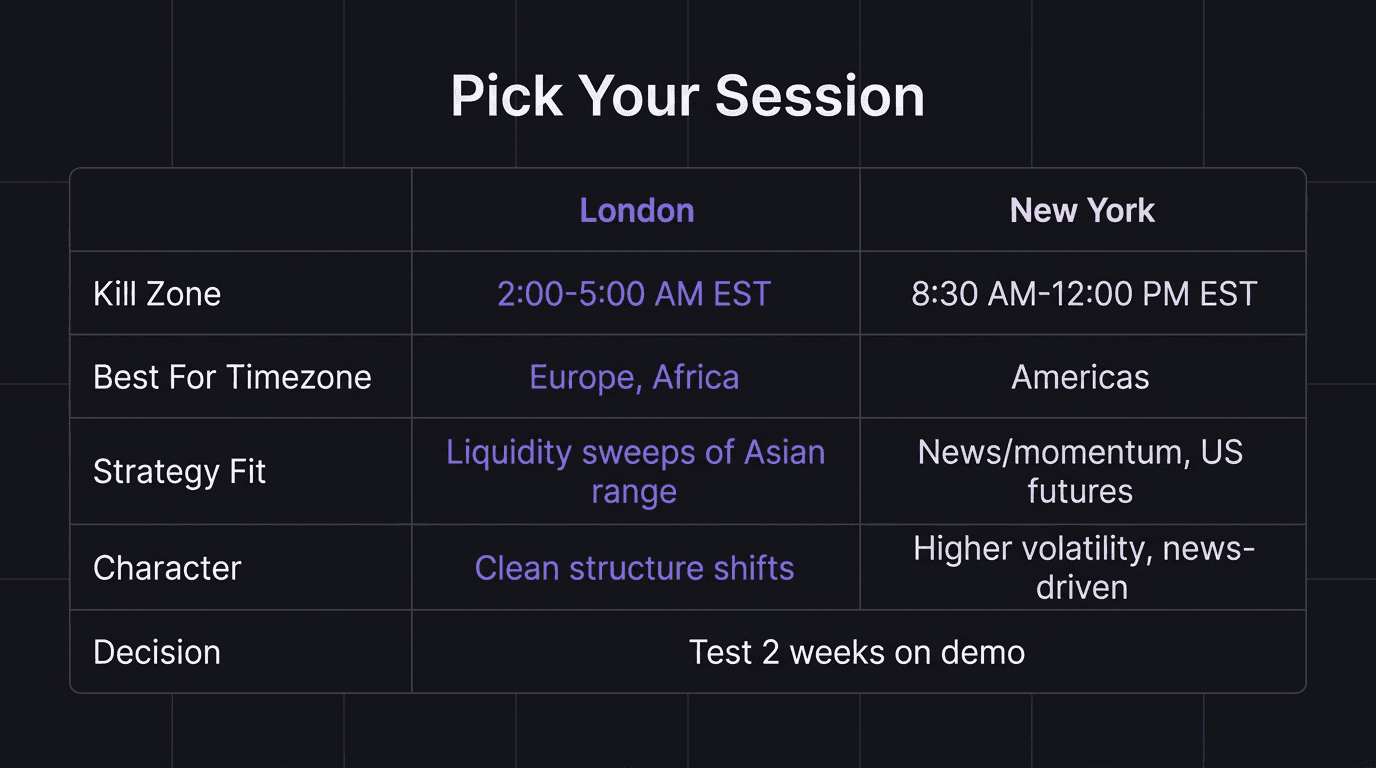
London kill zone: 2:00 AM to 5:00 AM EST (7:00 AM to 10:00 AM GMT)
New York kill zone: 8:30 AM to 12:00 PM EST
That is a 3 to 3.5 hour window. Not an 8-hour shift. Not a full market day. One focused window where your strategy has the highest probability of delivering clean setups.
Outside these windows, price action tends to be choppier, spreads widen, and the best institutional moves have already played out. Trading during dead zones between sessions is not "getting more opportunities." It is trading noise.
Why one session works
Your strategy was probably developed and tested during a specific session. The setups that work during London open (liquidity sweeps of Asian range highs and lows, clean market structure shifts) look different from New York setups (news-driven moves, overlap volatility). Even if the same core concepts apply, the character of price action changes.
When you trade one session consistently, you learn the personality of that session. You learn what a "normal" London sweep looks like versus an extended one. You learn which New York moves tend to reverse after the first hour. This session-specific pattern recognition only develops through repetition within the same window.
Trading both sessions means you are learning two different environments simultaneously and doing both halfway.
Why Two Sessions Doubles Your Risk
The math and psychology both argue against trading two sessions. Here is why.
The giving-back problem
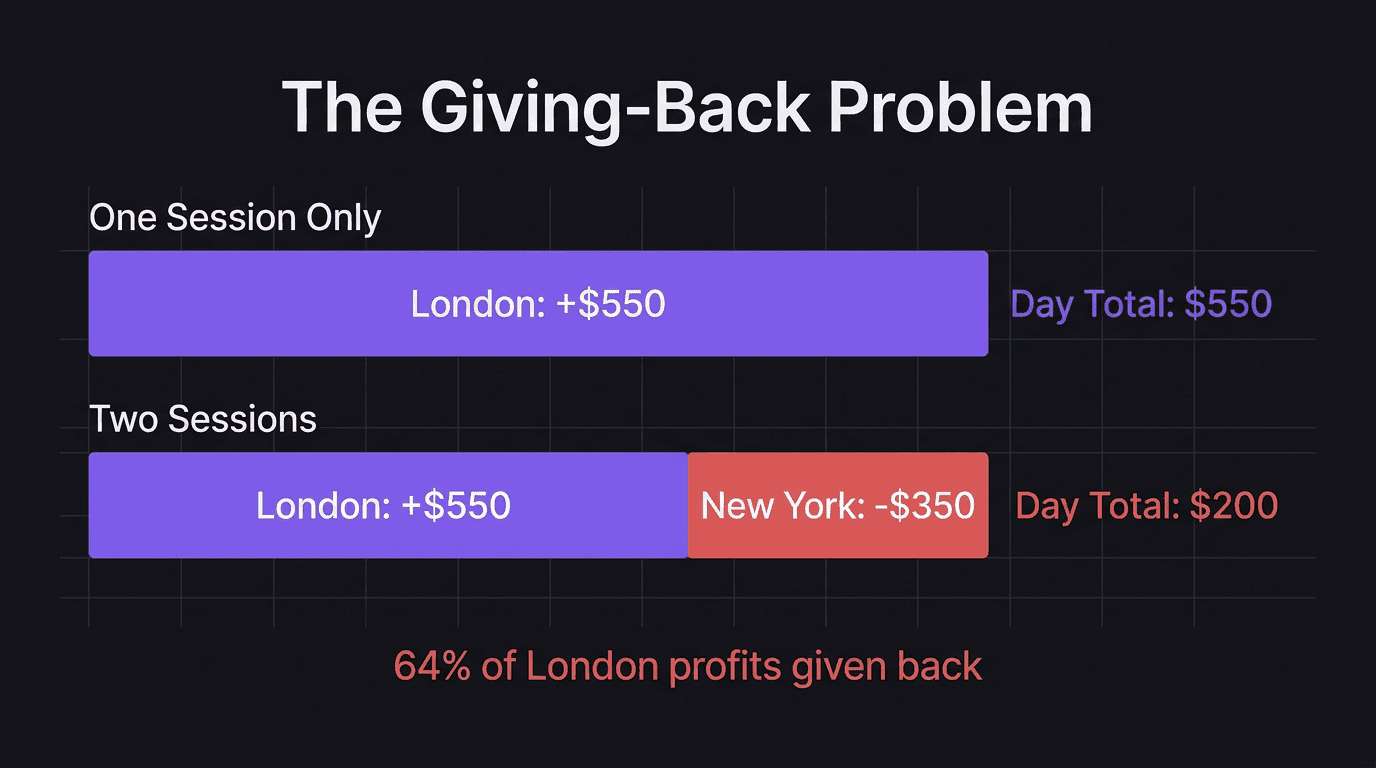
Walkthrough example: You trade London and catch a clean GBP/USD long off a sweep of the Asian low at 1.2640. You enter at 1.2655 after a structure shift, with your stop at 1.2630 and target at 1.2710. Price hits your target. You are up $550 on a 1-lot position. Great session.
Now it is 8:30 AM EST. New York opens. You see GBP/USD pulling back from your target area. You think: "I know this pair well today. I watched it all morning. Let me grab one more trade." You short at 1.2695, expecting a continuation down. But the New York session brings fresh buying. GBP/USD pushes to 1.2730, hits your stop, and you lose $350. You are up $200 for the day instead of $550.
You just gave back 64% of your London profits for a trade you would have never taken if you had not been staring at the screen for 7 hours.
This is not a hypothetical. This is the most common pattern among traders who work both sessions. The London profit creates a sense of safety ("I can afford a small loss") and the extended screen time creates a sense of familiarity ("I know what this pair is doing today") that both lead to looser entry standards.
Decision fatigue is measurable
After 3 to 4 hours of active chart watching, your ability to make good decisions degrades. This is not a mindset problem. It is a neurological reality. Studies on decision fatigue show that the quality of choices declines after sustained concentration, regardless of the domain.
For traders, this shows up as:
Wider entry criteria. A setup that you would have filtered out at 3:00 AM looks "good enough" at 10:00 AM.
Slower reactions. You hesitate on valid entries or hold losers too long because processing speed drops.
Emotional leakage. Frustration, boredom, and restlessness become harder to manage, leading to FOMO trading.
The emotional trap
After a winning first session, you trade the second session feeling invincible. After a losing first session, you trade the second session trying to recover. Both states produce terrible trades.
The only neutral emotional state is the one you have at the start of your first session, before any results exist. By trading only one session, you always start from that neutral state. You never bring the emotional residue of a morning session into an afternoon session.
How to Pick Your Session
Your session choice depends on three factors: timezone, strategy, and honest self-assessment.
Timezone
If you live in Europe or Africa, London is the natural choice. You wake up, do your pre-market routine, and trade during normal morning hours.
If you are in North or South America, New York fits your schedule better. London session happens while most Americans are sleeping (2:00 to 5:00 AM EST), which means setting alarms, disrupting sleep, and trading when your body wants to be unconscious.
Some traders force themselves into the London session from US time zones because they have heard it is "better." For most people, the sleep disruption costs more in execution quality than the session gains in setup quality. Trade the session that lets you show up well-rested and focused.
Strategy alignment
Different strategies work better in different sessions:
Liquidity sweep + structure shift strategies work well in London because the Asian range creates clean liquidity pools above and below.
News-based or momentum strategies work better in New York, especially during high-impact releases (NFP, CPI, FOMC).
Futures traders (ES, NQ) are naturally aligned with New York because US index futures have their primary moves during US market hours.
The two-week test
If you genuinely do not know which session suits you, run a test. Trade London for two weeks on demo or sim. Track your results, your energy level, and how many rules you followed. Then trade New York for two weeks with the same tracking.
Compare the data. Most traders find that one session clearly outperforms, not because of strategy edge, but because of execution quality. You follow rules better when you are alert, rested, and trading at your natural time.
What NOT to do: A trader decides to "maximize opportunities" by trading London from 2:00 to 5:00 AM EST and then trading New York from 8:30 AM to noon. They set an alarm for 1:30 AM, do a pre-market routine, trade for 3 hours, take a 3-hour break, then trade again. After two weeks, they have made $2,100 in London and lost $1,800 in New York. Net: $300. If they had traded only London, they would have netted $2,100 and gotten better sleep. The New York session cost them $1,800 and 10 hours of extra screen time per week.
Protecting Profits by Walking Away
The hardest part of the one-session rule is not picking a session. It is walking away after it ends, especially when you are having a good day.
Close the charts
Literally close your trading platform when your session ends. Do not leave it running on a second monitor. Do not check "just to see what happened." Every glance at a moving chart is an invitation to trade.
Pre-commit to the shutdown
In your pre-market routine, write down the time you will stop trading. "My session ends at 5:00 AM EST. At 5:01 AM, charts are closed." When you pre-commit in writing, breaking the commitment feels like breaking a promise instead of just making a casual decision.
Use structural barriers
If willpower is not enough (and for most traders, it is not), use tools that enforce the limit. Some platforms allow session-based trading restrictions. Some traders use website blockers on their charting platforms outside session hours. The point is to make trading outside your session harder, not just mentally but practically.
Redefine "leaving money on the table"
The phrase "leaving money on the table" assumes that trading more equals earning more. For retail traders, the opposite is usually true. You make money during your best hours in your best session. Everything outside that window is likely to reduce your net result.
You are not leaving money on the table. You are protecting the money already on your table.
How EdgeFlo Supports One-Session Trading
Walking away from the charts is a discipline problem, and discipline problems respond better to environmental design than to willpower. EdgeFlo lets you build your one-session rule directly into your trading environment.
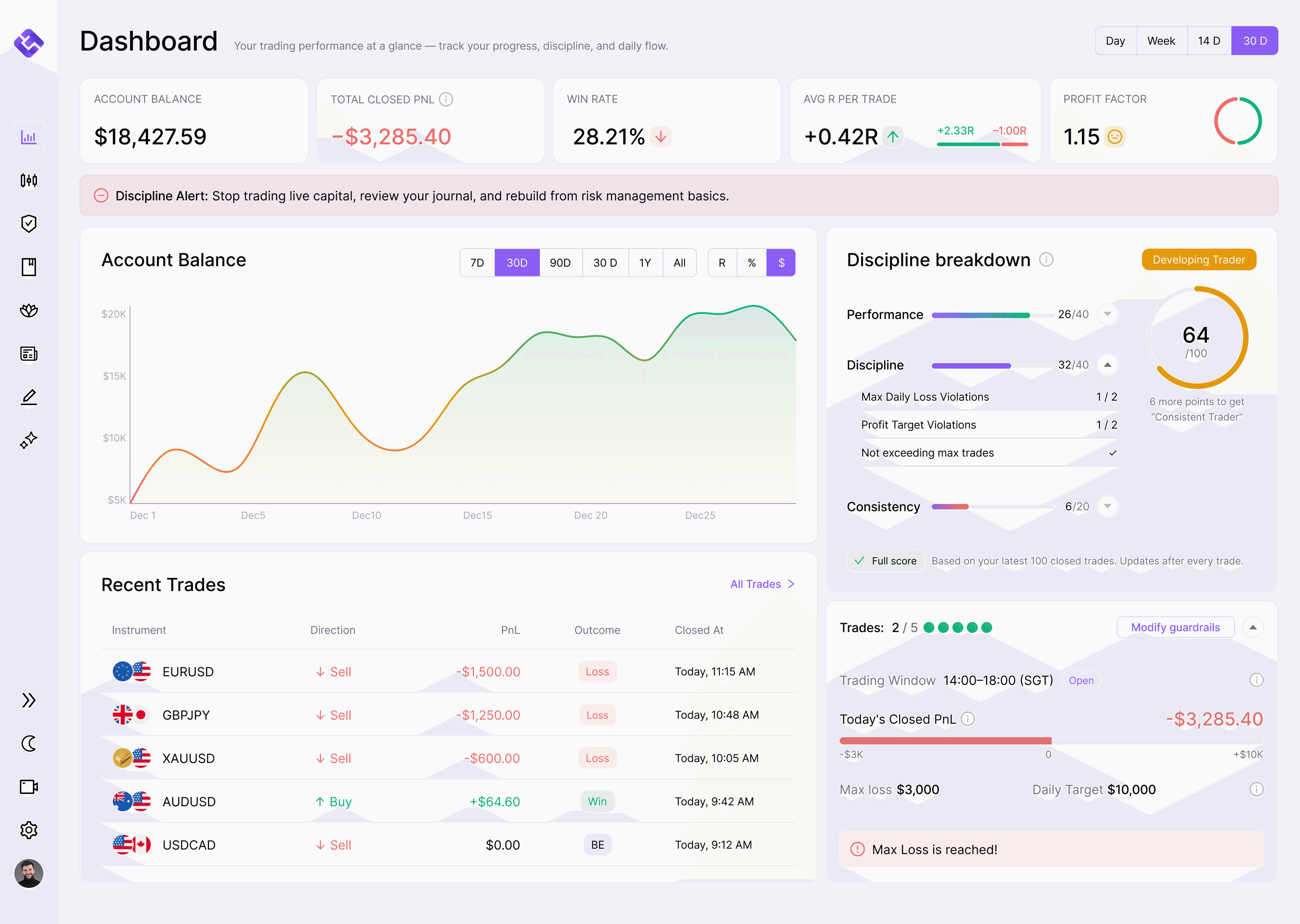
Set a maximum number of trades per session or a daily trade limit as a guardrail. When you hit your limit, EdgeFlo restricts further trading. You can override it if a genuinely exceptional setup appears, but the override requires a conscious decision. This pause is often enough to stop you from drifting into a second session "just for one more trade."
Your pre-market routine in EdgeFlo can include a session commitment prompt, where you confirm which session you are trading before you place a single order. Combined with the trading journal's session-level analysis, you build a clear record over time of exactly how much your chosen session outperforms the alternatives, reinforcing the one-session rule with your own data.
The Edge Brief
Receive Insights on trading psychology, discipline, and the behavioral patterns that create consistent traders from our Founder and the EdgeFlo team, delivered to your inbox.
Think different. Trade different.
Should I trade London or New York session?
Can I trade both London and New York sessions?
Why do traders lose money in the second session?
How do I stop myself from trading the second session?

Turn discipline on.
Every session.
EdgeFlo is the environment serious traders operate inside.
Start 7-Day Free Trial
Cancel anytime.
No long-term commitment.

Think Different, Trade Different.