

Off-Plan Wins in Trading: Why Profit Can Hurt You
Off-plan wins are more dangerous than plan losses. They reinforce rule-breaking with profit, creating a behavior loop that destroys consistency over time.

An off-plan win happens when you break your trading rules and still make money. You enter a trade that does not meet your criteria, manage it outside your plan, and somehow close it in profit. It feels like a reward. It is actually a trap.
Off-plan wins are more dangerous to your long-term trading than plan losses. A plan loss costs you money once. An off-plan win costs you discipline over and over, because every profitable rule-break makes the next one easier.
TL;DR
An off-plan win is a profitable trade that broke your rules. It feels like skill but is usually luck.
Profit from rule-breaking creates a reinforcement loop that makes you more likely to break rules again.
Off-plan wins erode plan adherence gradually. Most traders do not notice until their consistency collapses.
A plan-loss where you followed every rule is objectively better for your development than an off-plan win.
Grade every trade honestly. If it was off-plan, label it that way regardless of the P&L.
What an Off-Plan Win Looks Like
You are trading GBP/USD during the London session. Your plan says: wait for a break of structure on the 15-minute chart, confirm with a demand zone on the 5-minute, enter on the retest. Clear criteria.
But the 1-hour chart looks bullish and price is moving now. You have not gotten a setup all morning. So you enter long without the break of structure, without the demand zone confirmation. Just a feeling that it is going up.
Price rallies 45 pips. You close the trade with a 2R profit.
Your account is bigger. Your process is worse. And your brain just filed "skip the criteria, trust the gut" under "things that work."
That is an off-plan win. The money is real. The lesson it teaches is wrong.
How It Differs From Adapting
Experienced traders sometimes adjust entries based on live context. That is different from breaking rules. Adaptation happens within a framework. You might enter slightly earlier because the demand zone was respected cleanly and momentum confirmed. That is still within your plan's boundaries.
An off-plan trade is fundamentally different. It ignores the plan entirely. No criteria met, no checklist followed, no structure-based reasoning. Just impulse dressed up as "reading the market."
If you find yourself explaining why a trade was "basically" on plan, it was not on plan.
The Reinforcement Trap
Here is why off-plan wins cause so much damage. Your brain runs on reinforcement. Do something, get rewarded, do it again. This is not a personality flaw. It is how human learning works.
When you follow your plan and take a loss, the pain signal is mild because you know you did the right thing. The process was correct even if the outcome was negative.
But when you break your rules and get paid, the reward signal is powerful. Profit triggers dopamine. Your brain does not distinguish between profit from discipline and profit from luck. It just knows: that action produced a reward. Repeat the action.
After one off-plan win, the temptation to break rules again is slightly stronger. After three, you start rationalizing it. "I read the market well." "My instincts are getting better." After five or six, you are trading a completely different system than the one you tested, and you do not even realize it.
This is the reinforcement trap. Each off-plan win makes the next rule-break more likely, until following your plan feels like the harder option.
Walkthrough: The $400 Win That Cost $2,000
A trader has a $20,000 account, risks 1% per trade ($200), and trades a tested strategy on EUR/USD. Their plan requires a liquidity sweep below a demand zone before entry.
On Monday, they see price approaching a demand zone without a sweep. They enter anyway because "the zone looks strong." The trade works. 2R profit. $400 in the account.
On Wednesday, similar setup. No sweep. They enter again because Monday worked. This time it stops out for a 1R loss. $200 gone.
On Friday, another borderline setup. No sweep again. The trader hesitates, remembers Monday, and enters. Stops out. Another $200 loss.
The following week, the trader takes three more no-sweep entries. Two stop out ($400 in losses). One works for $400 profit.
Tally after two weeks of off-plan trades:
2 off-plan wins: +$400 each = $800
4 off-plan losses: -$200 each = $800
Net: $0
The trader broke even on the off-plan trades while missing four clean on-plan setups during those two weeks (already in off-plan positions or past the daily trade limit). Those missed setups would have produced an estimated $1,200 based on their historical average.
That Monday $400 win did not just cost $400 in opportunity. It set off a chain that cost over $1,200 in missed on-plan profits for $0 net gain.
How Off-Plan Wins Lead to Off-Plan Losses
The progression is predictable. Off-plan wins create confidence in rule-breaking. That confidence leads to larger and more frequent off-plan trades. Larger off-plan trades produce larger off-plan losses.
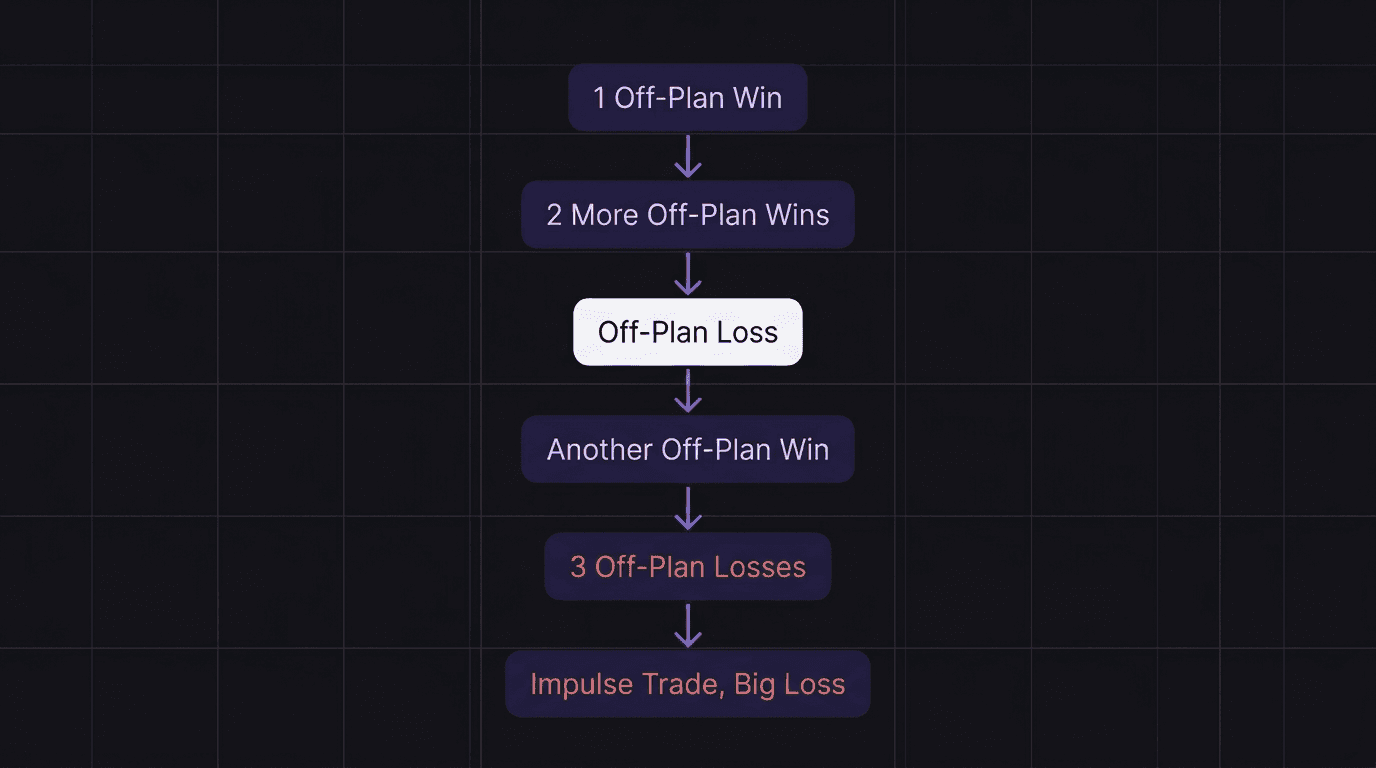
Here is the typical sequence:
One off-plan win. "That worked."
Two more off-plan wins over the next week. "Maybe I am developing intuition."
An off-plan loss. "Bad luck. I will try again."
Another off-plan win. "See? It does work."
Three off-plan losses in a row. "What is going on?"
Impulse trade with double position size to recover. Big loss.
By stage 6, the trader has completely abandoned their tested strategy. They are gambling with extra conviction because early off-plan wins told their brain this was a good idea.
The fix is not willpower at stage 6. The fix is honesty at stage 1. Grade the trade. Label it off-plan. Do not celebrate it.
Fixing the Behavior Before It Compounds
The most effective fix for off-plan wins is simple: grade every trade immediately after you close it.
Not at the end of the day. Not at the end of the week. Right after the trade closes. Was it on-plan or off-plan? Binary. No gray area.
This creates a moment of honesty that short-circuits the reinforcement loop. Yes, you made money. But you also have to write "off-plan" in your journal. That label is a friction point. It forces you to acknowledge that the profit came from breaking rules, not from skill.
Three Rules for Handling Off-Plan Wins
Rule 1: Never adjust your position sizing based on off-plan profits. If your off-plan trades made you $500, do not use that $500 to justify a larger position size. That is compounding a mistake.
Rule 2: Track your on-plan percentage weekly. If it drops below 80%, that is a red flag. Read your trade review notes and find out why. Something is pulling you off your system.
Rule 3: If a recurring off-plan pattern keeps producing profits, test it before adopting it. Do not add it to your plan in real-time. Backtest it. Forward test it. If it holds up across 50 or more trades, then formally incorporate it. Until then, treat every off-plan profit as noise.
The goal is not to never take an off-plan trade (you are human, it will happen). The goal is to see it clearly, label it honestly, and not let it rewire your behavior. Your trading rules exist for a reason. Protect them.
Trading consistency comes from executing the same tested process over and over. Off-plan wins are the biggest threat to that consistency because they feel like progress when they are actually regression.
How EdgeFlo Supports Plan Adherence
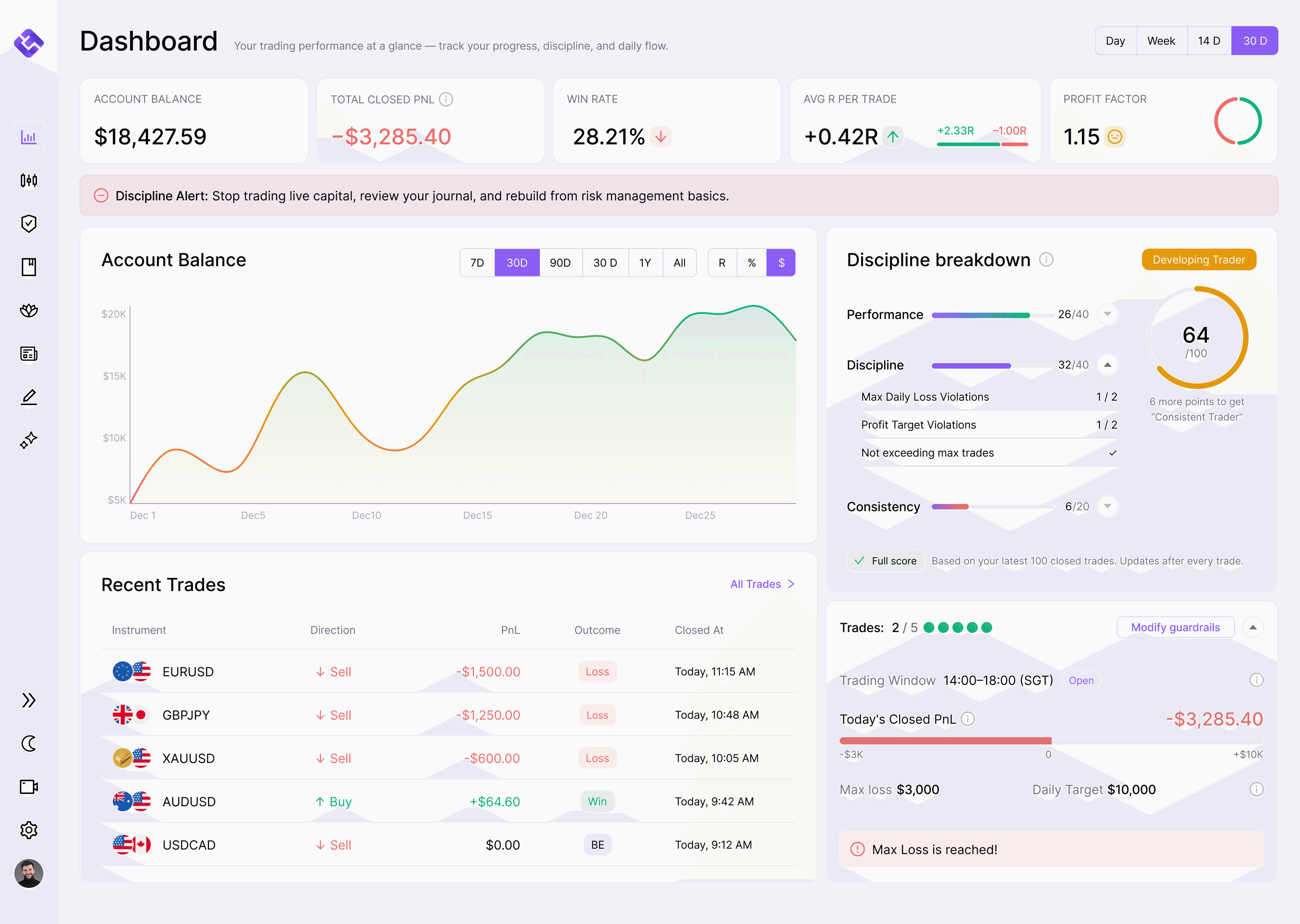
EdgeFlo's trade plan builder (Edge) keeps your written rules visible during execution. After each trade, the post-trade self-reporting flow asks whether the trade matched your active plan. You can override the guardrails, but you have to choose to, which means every off-plan trade is a conscious decision rather than an unconscious drift.
The trading dashboard tracks your plan adherence rate alongside your financial metrics. If your off-plan trade count starts climbing, you see it in the numbers before it becomes a habit. The weekly AI report (Plus plan) flags drops in adherence rate and links them to specific sessions so you can trace the cause.
The point is not to prevent you from ever trading off-plan. It is to make sure you see it when you do.
The Edge Brief
Receive Insights on trading psychology, discipline, and the behavioral patterns that create consistent traders from our Founder and the EdgeFlo team, delivered to your inbox.
Think different. Trade different.
What is an off-plan win in trading?
Why are off-plan wins dangerous?
Are off-plan wins just luck?
How should I handle an off-plan win?

Turn discipline on.
Every session.
EdgeFlo is the environment serious traders operate inside.
Start 7-Day Free Trial
Cancel anytime.
No long-term commitment.

Think Different, Trade Different.