

Max Trades per Day: How to Pick Your Number
Setting a max trades per day limit stops overtrading better than willpower. Learn how to choose your daily trade count based on your strategy and style.
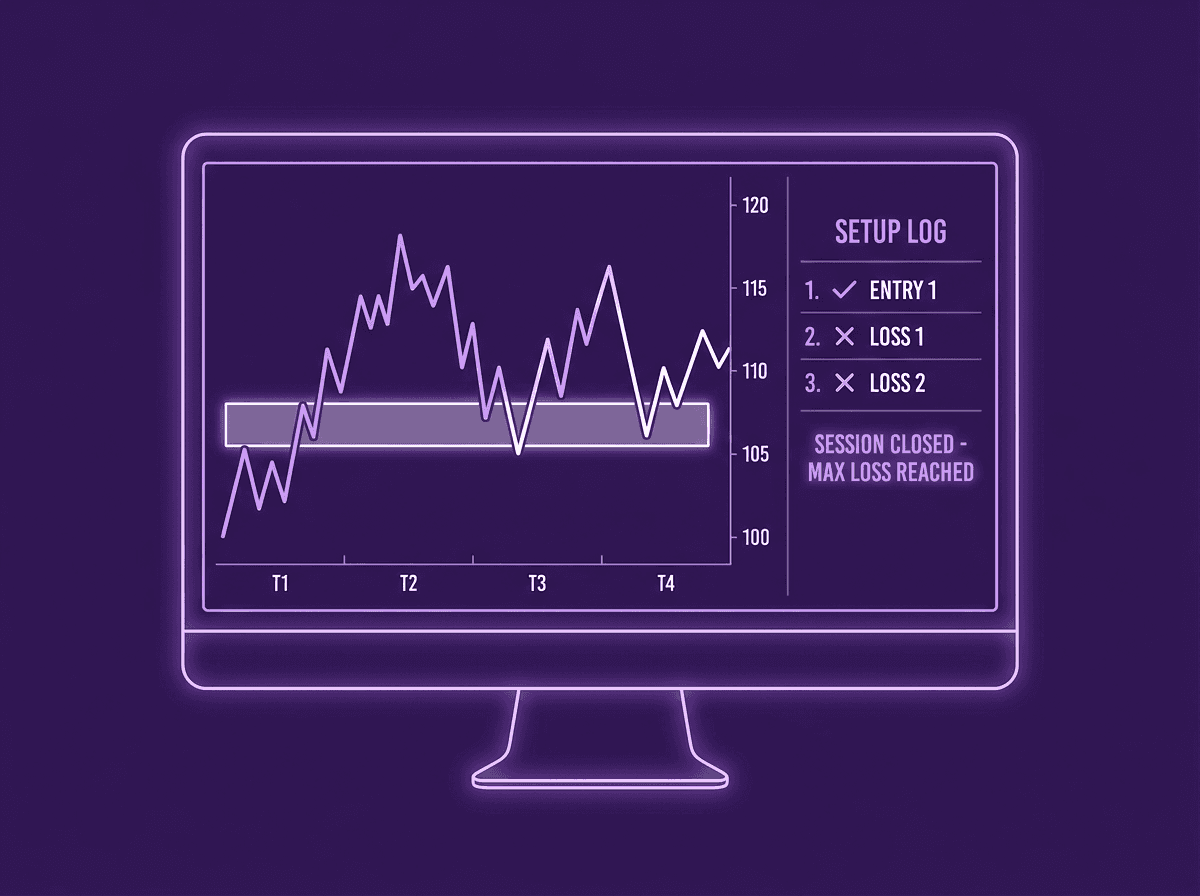
A max trades per day limit is a fixed number you set before the session starts, and once you hit it, you stop trading. No debates, no "just one more." The limit exists because willpower fails under pressure, and overtrading is the single fastest way to drain an account.
Most traders already know they overtrade. The problem is not awareness. The problem is that knowing you should stop and actually stopping are two completely different skills. A mechanical trade count limit removes the decision from the moment and makes it for you in advance, when you are calm and thinking clearly.
TL;DR
A daily trade count limit is a pre-set number that stops you from overtrading when emotions take over.
Willpower alone does not work, mechanical enforcement does.
Your optimal number depends on your strategy type, timeframe, and historical win rate after trade N.
Review your journal to find the exact trade count where your edge starts falling apart.
Treat the limit like a trading rule, not a suggestion.
Why a Trade Count Limit Works
Ever had a green morning turn red by 2 PM? You took three solid trades, banked some pips, then kept going. Trade four was okay. Trade five was forced. Trade six was revenge for trade five. By the close, you gave back everything.
That pattern is not a personality flaw. It is a design problem. Your trading environment let you keep clicking buy and sell long after your edge was gone.
Here is what the data usually shows when traders review their journals: the first two or three trades of the day carry the highest win rate and the best risk-to-reward. Everything after that trends downward. Not always, but often enough that the pattern is impossible to ignore.
A trade count limit works because it targets the root cause of overtrading. It is not about stopping you from trading. It is about stopping you from trading badly. The limit says: "You planned three setups. You took three setups. Now walk away."
The Overtrading Spiral
Here is how overtrading actually unfolds, step by step:
Walkthrough: The Five-Trade Slide on EUR/USD
You wake up, run your pre-market routine, and identify two clean setups on EUR/USD during the London session. Trade 1: short from 1.0880 resistance, 20-pip stop, 40-pip target, 0.5 lots. It hits, $200 profit (0.5 lots x $10/pip x 40 pips). Trade 2: long from 1.0840 support on a pullback, same risk parameters. It hits, another $200. You are up $400 on a $10,000 account, risking 1% per trade with 2R reward.
Now you are sitting there, feeling sharp. You see a "setup" on GBP/USD. It is not in your plan. You take it anyway. It chops around, you move your stop once, it clips you for -$100. Now you are up $300 instead of $400. That stings. So you jump into USD/JPY to "make it back." That one loses too, another -$100. You are at $200, frustrated, scanning five pairs for anything that moves. Trade five triggers, another loss at -$100. You finish the day at $100.
Two good trades. Three garbage trades. The garbage trades ate most of your gains. A max of two trades per day would have locked in that $400.
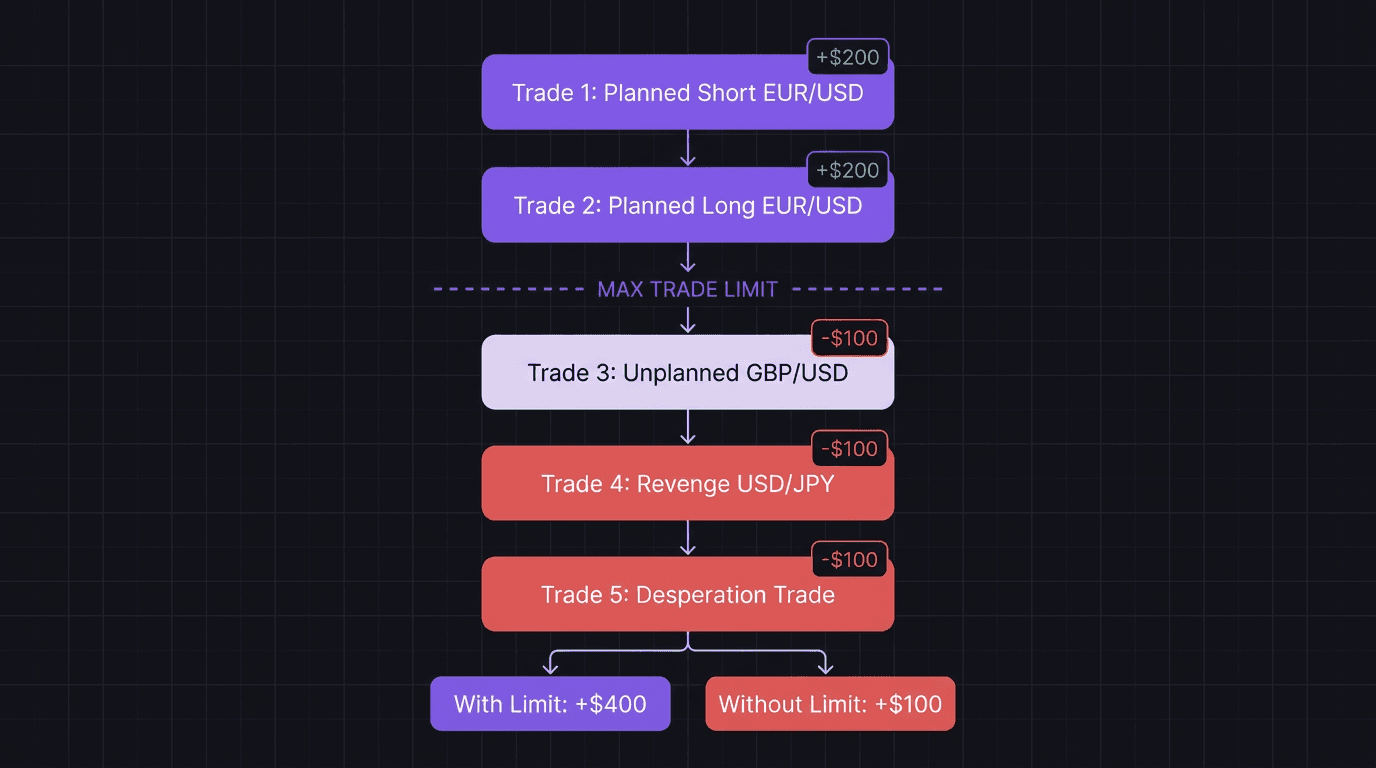
That walkthrough is not hypothetical. It is the most common pattern in trading journals. The first few trades carry the edge. Everything after is noise.
How to Choose Your Daily Maximum
There is no magic number. Anyone who tells you "three trades per day" without knowing your strategy is guessing. Your number depends on three things: your strategy type, your timeframe, and your actual data.
Strategy Type Matters
A swing trader scanning daily charts might only get one or two valid setups per day. Their max should be two or three. A scalper on the 1-minute chart during the London-New York overlap might take eight legitimate setups. Their max is higher, but it still exists.
The point is not to pick a small number for the sake of discipline theater. The point is to find the number where your edge still holds.
Find Your Number in Your Journal
If you have been tracking trades (and if you have not, start now), pull up the last 30-60 trading days and answer these questions:
What is your win rate on trades 1-3 of the day?
What is your win rate on trades 4-6?
What is your win rate on trade 7 and beyond?
Where does your average R-multiple start dropping?
For most retail traders, the data tells a clear story. Win rate holds steady for the first few trades and then falls off a cliff. The trade count where it drops, that is your number.
Walkthrough: Finding Your Number
You pull 40 days of journal data. On days where you took 1-3 trades, your win rate was 58% with an average R of 1.8. On days where you took 4-5 trades, win rate dropped to 44% with an average R of 1.1. On days with 6+ trades, win rate was 31% and average R was 0.6. Your max should be 3 trades per day. The data is not ambiguous.
Quick Reference by Strategy Type
Strategy | Timeframe | Typical Max Range |
|---|---|---|
Swing trader | 4H / Daily | 1-2 trades |
Intraday trend | 15M / 1H | 2-4 trades |
Scalper | 1M / 5M | 5-10 trades |
News trader | Event-based | 1-3 per event |
These are starting points. Your journal data overrides any table.
What Happens When You Hit the Limit
This is where most traders fail. They set a limit, then blow through it the first time they feel the urge. Sound familiar?
The problem is not the limit itself. The problem is that nothing enforces it. Writing "max 3 trades" in a notebook is a suggestion. You need something that actually stops you.
Here is what your post-limit routine should look like:
Close the charts. Not minimize, close. Remove the temptation entirely.
Log your session. Write down what you traded, what worked, what did not. Do it while the memory is fresh.
Walk away. Go outside, go to the gym, do something physical. Brad, the founder of EdgeFlo, talks about this, actively choosing discomfort outside of trading so you can handle discomfort inside of it. The gym builds the same muscle as walking away from a screen.
Review before tomorrow. Before your next session, check whether your three trades followed your plan. If two out of three were off-plan, the problem is not trade count, it is trade consistency.
The hardest part is not hitting the limit. The hardest part is what you do in the 30 seconds after you hit it. That moment, where you feel the itch to take "just one more", is the entire game.
The Difference Between Discipline and Willpower
Most trading advice tells you to "be more disciplined." That is like telling someone with a broken leg to walk it off. Discipline is real, but it is not what most people think it is.
Willpower is a limited resource. You have a finite amount of it each day, and the market drains it fast. Every price tick, every near-miss, every trade that almost hit your target but reversed, all of it chips away at your ability to make good decisions. By trade four or five, you are running on fumes.
Discipline is not about white-knuckling through temptation. Discipline is about building systems that remove the temptation in the first place. It is the difference between staring at a plate of cookies and deciding not to eat one versus not having cookies in the house at all.
A trade count limit is environment design. You are not relying on your future self to make the right call in the heat of the moment. You are making the call now, when the market is closed and your head is clear.
Brad put it this way during a coaching session: "Learning is changing behavior. If you don't change your behavior, you still do the same old stupid stuff. You still commit the same mistakes over and over again." A trade count limit forces the behavior change mechanically. You do not have to want to stop. You just stop.
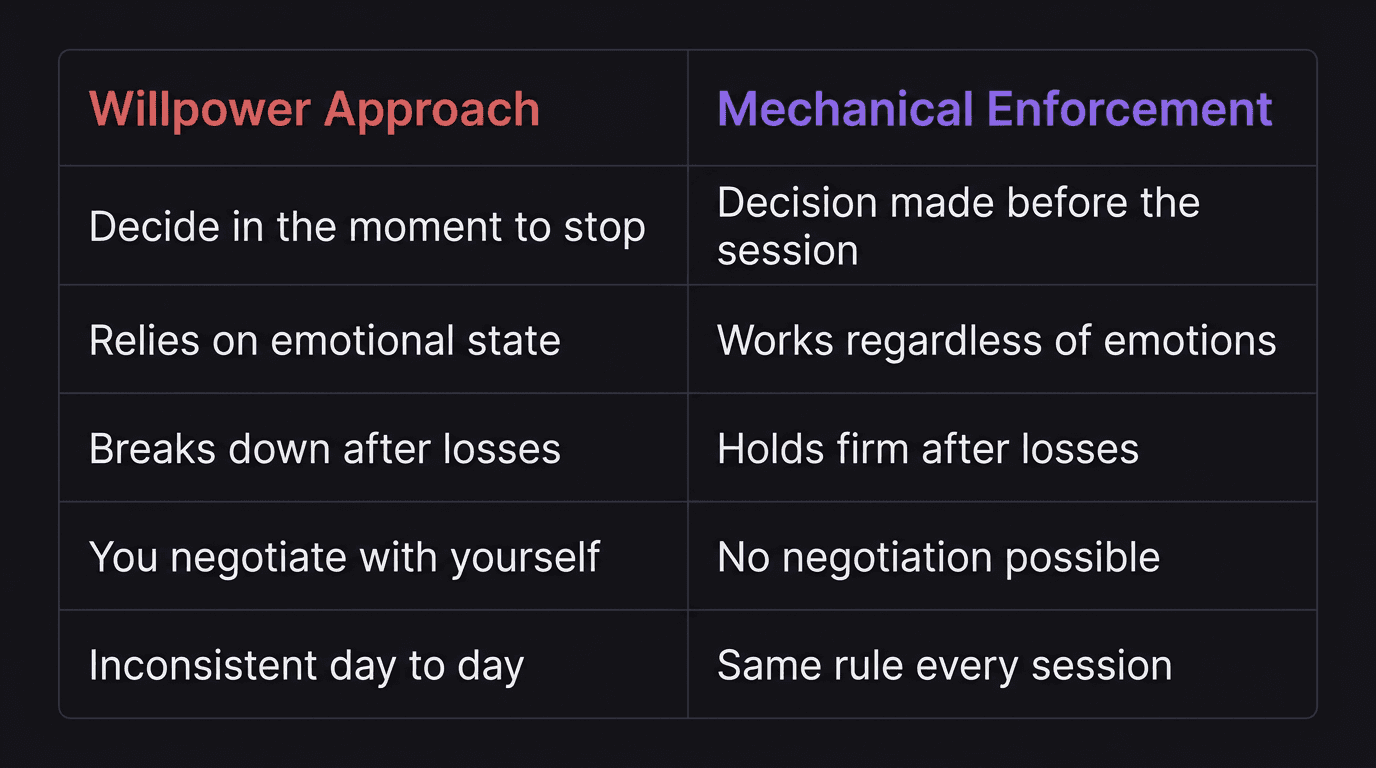
This is what separates traders who plateau from traders who compound. The ones who compound build guardrails that do not depend on how they feel. They treat FOMO as an engineering problem, not a character flaw.
How EdgeFlo Locks the Button at Your Limit
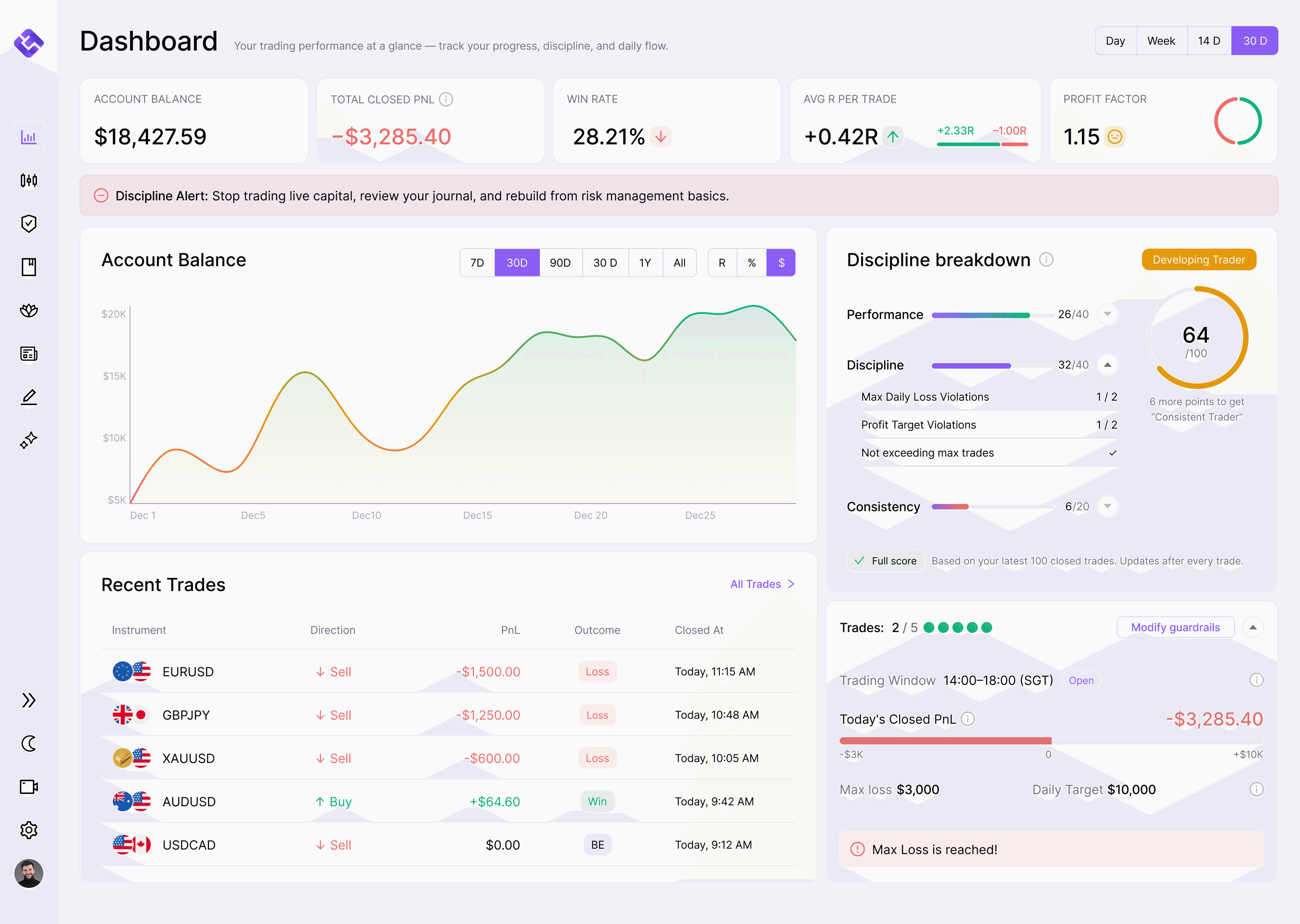
EdgeFlo builds the trade count limit directly into the execution platform. You set your max trades per day in your settings, say, three, and the platform tracks your count in real time. When you hit three, the buy and sell buttons gray out.
That is it. No pop-up you can dismiss. No confirmation dialog you click through on autopilot. The buttons go gray. You physically cannot place another trade.
But EdgeFlo is not a cage. The override is always available. If you genuinely see a fourth setup that meets every criterion in your plan, you can unlock the buttons and take the trade. The difference is that you have to make a conscious choice to override, which means you cannot accidentally overtrade. You can only deliberately overtrade. And that distinction changes everything.
This pairs with the daily loss limit feature, which grays out the buttons when your P&L hits a threshold you set. Between the two, trade count and loss limit, you have mechanical guardrails on both the quantity and the cost of your trading day. The result is an environment where your worst impulses cannot run unchecked, but your judgment still has the final word.
The Edge Brief
Receive Insights on trading psychology, discipline, and the behavioral patterns that create consistent traders from our Founder and the EdgeFlo team, delivered to your inbox.
Think different. Trade different.
How many trades per day is too many?
Does a trade count limit hurt profitability?
Should scalpers have a higher max trade count?
Can I change my daily trade limit over time?

Turn discipline on.
Every session.
EdgeFlo is the environment serious traders operate inside.
Start 7-Day Free Trial
Cancel anytime.
No long-term commitment.

Think Different, Trade Different.