

Max Daily Loss Rule: Stop Bad Days From Blowing Up
A max daily loss rule prevents overtrading and revenge trading during losing streaks. Learn how to set your daily loss limit and what to do after hitting it.
A max daily loss rule is a hard limit on how much money you allow yourself to lose in a single trading session. When you hit it, you stop trading. No exceptions, no "just one more trade," no trying to make it back. You close the platform and walk away.
This is not a suggestion or a nice-to-have. It is the rule that prevents a bad hour from becoming a blown week. Without it, losing streaks spiral into overtrading, revenge trading, and account damage that takes weeks to repair.
TL;DR
A max daily loss rule caps the damage any single session can do to your account.
Without a cap, losing streaks trigger emotional trading that multiplies losses.
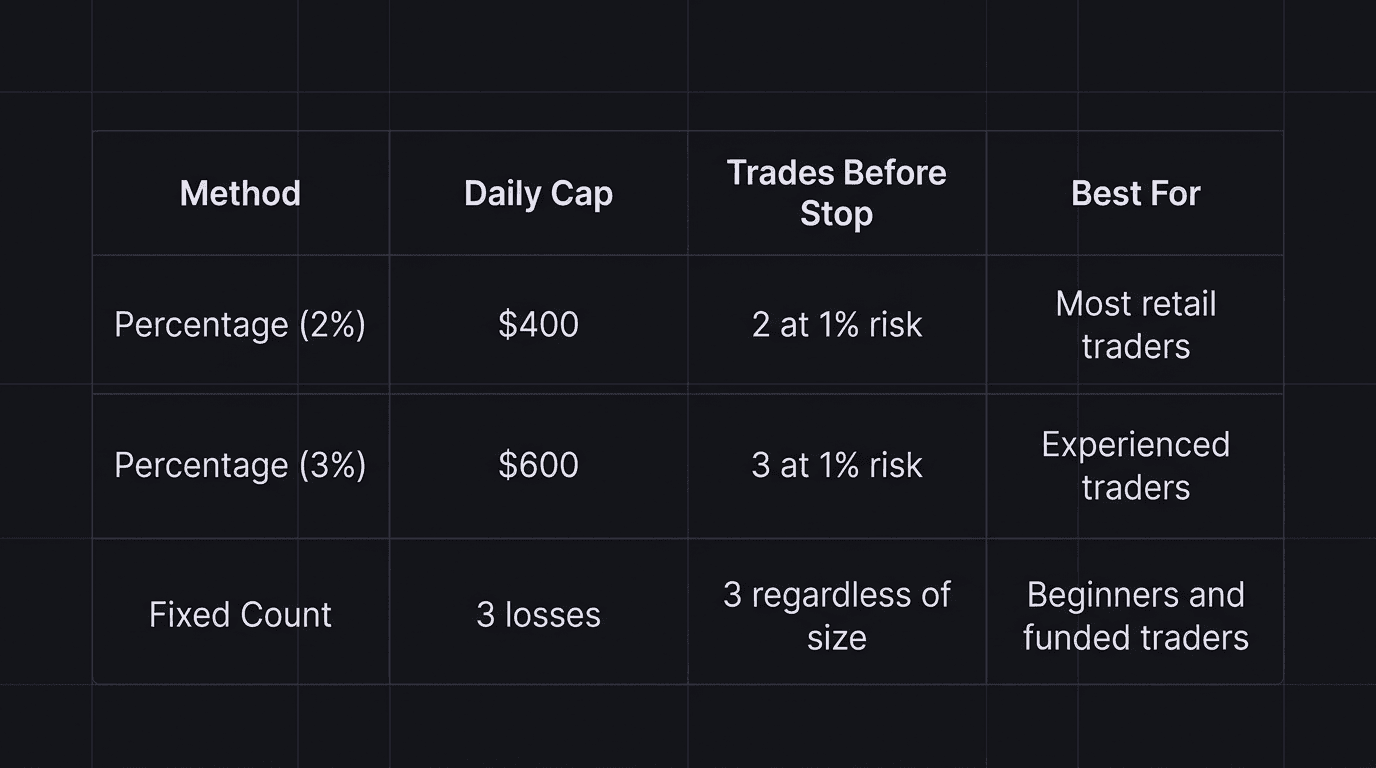
Set your limit at 2% to 3% of your account balance, or a fixed number of losing trades (like 3).
After hitting the limit, close your platform. Do not negotiate with yourself.
Prop firms enforce daily loss limits externally; smart traders enforce them on their own.
What a Max Daily Loss Rule Is
Your max daily loss is the maximum dollar amount (or percentage) you are willing to lose in one day before you stop trading. Once you hit that number, the session is over. Period.
For a $10,000 account with a 2% daily loss limit, that means you stop after losing $200 in a single day. For a $50,000 funded account with a 3% cap, you stop at $1,500.
The rule exists because your worst trading decisions happen after losses. Not before them. Not during a winning streak. After consecutive losses, when frustration is highest and judgment is lowest. A daily loss cap removes you from the screen before those bad decisions happen.
If you already have a daily loss limit in your plan but you have been ignoring it, this article will show you why enforcement is the part that matters.
How Losing Streaks Spiral Without a Cap
Here is how a typical losing day unfolds without a max daily loss rule:
You take your first trade. It hits your stop loss. Normal. You take a second trade. Also a loss. Frustrating, but your strategy has losing streaks built into its statistics.
Now the trouble starts. You feel behind. The day feels wasted. So you start scanning for setups that are not really there, taking trades that would not normally meet your criteria. This is overtrading, and it almost always follows a streak of losses.
The third and fourth trades lose too, but these were not even quality setups. You are now trading to recover, not to execute your plan. This is revenge trading, and it is the fastest way to turn a $200 loss into a $600 loss.
Walkthrough: A Day Without a Cap
A trader with a $20,000 account risks 1% per trade ($200 per trade). The first two trades hit stop loss: down $400. Instead of stopping, the trader takes three more aggressive trades outside the plan, increasing risk to 2% each ($400 per trade). All three lose. Total daily loss: $400 + $1,200 = $1,600. That is 8% of the account in one session.
With a 2% daily loss cap ($400), the trader would have stopped after the second loss. Total damage: $400 (2%). The other $1,200 in losses never happens.
This is why the rule matters. The first two losses were normal. The next three were emotional. A cap at 2% saves the trader $1,200 and keeps the account healthy enough to trade the next day without pressure.
If you have experienced this kind of spiral, read about losing streak trading to understand how streaks work statistically.
Setting Your Daily Loss Limit
There is no universal number. Your daily loss limit depends on your risk per trade, your strategy's expected losing streak length, and whether you are trading a personal or funded account.
Here are the most common approaches:
Percentage-based: Set the limit at 2% to 3% of your account. This works well for most retail traders. At 1% risk per trade, you get 2 to 3 trades before the day is done if they all lose.
Fixed-trade count: Some traders use a "three loss" rule. After three losing trades in a row, the session ends regardless of total dollar loss. This is simpler and harder to negotiate around.
Funded account alignment: If your prop firm enforces a 5% daily loss limit, set your personal cap at 2% to 3%. This gives you a buffer zone so you never accidentally breach the firm's hard limit. Protecting your capital is the core skill in capital preservation trading.
Choose one method. Write it down. Put it in your trading plan. The worst time to decide your daily limit is during a losing streak.
What to Do After You Hit the Limit
Hitting your daily loss cap is not a failure. It is the rule working exactly as designed. The hard part is what comes next, because every impulse tells you to keep trading.
Here is the protocol:
Step 1: Close your platform. Not minimize. Close. If the charts are still on your screen, you will find a reason to take one more trade.
Step 2: Do nothing for at least 30 minutes. Walk away from your desk. Get outside. Let the cortisol settle before you make any decisions about what went wrong.
Step 3: Review the session later. Not immediately after. Later that evening or the next morning. Look at each trade and ask: did it meet my entry criteria? Was my position sized correctly? Were the setups genuinely there, or was I forcing?
Step 4: Come back tomorrow at normal size. Do not double your risk to "make it back." Tomorrow is a new session with new setups. The losses from today are business expenses if the trades followed your plan.
The three loss rule works on the same principle: a fixed stopping point that removes you from the market before emotions compound the damage.
One more thing: some traders feel guilty after hitting their limit, as if stopping early means they are not working hard enough. Trading is not a job where more hours equals more output. Sometimes the best trading decision you make all day is closing the platform at 10:30 AM.
How EdgeFlo Enforces Your Daily Loss Limit
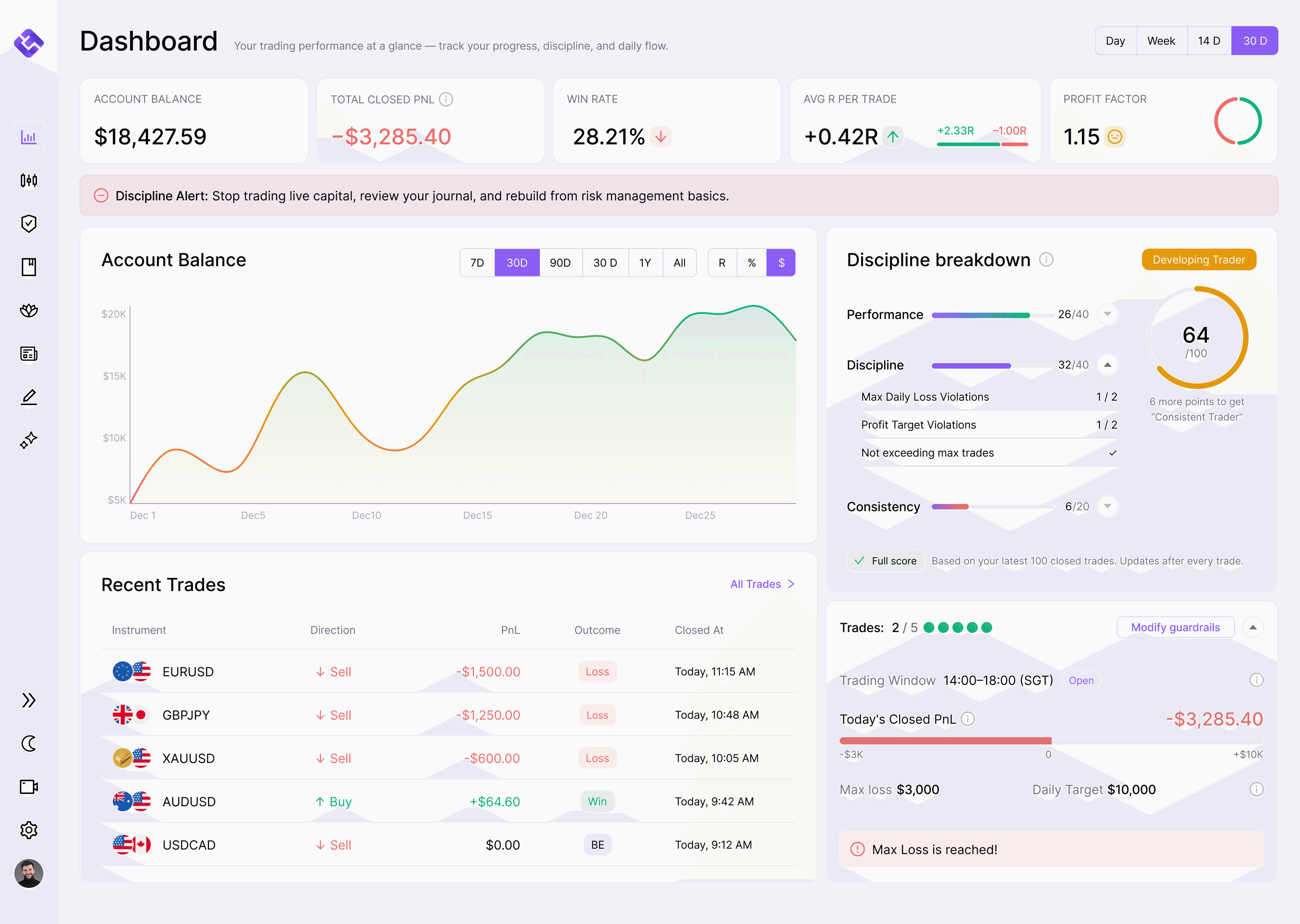
EdgeFlo includes a daily loss limit guardrail that tracks your session losses in real time. When you hit your preset cap, the platform warns you before your next trade. You can override it (because EdgeFlo gives you that choice), but you have to actively choose to keep going. That friction is the point.
Your trading dashboard shows your daily PnL alongside your cap, so you always know how close you are to the limit. No guessing, no mental math while you are in the middle of a trade.
After hitting the limit, your journal captures the session automatically. When you review later, every trade is already logged with timestamps, pairs, and outcomes. You can see exactly where the session went wrong without relying on memory.
The Edge Brief
Receive Insights on trading psychology, discipline, and the behavioral patterns that create consistent traders from our Founder and the EdgeFlo team, delivered to your inbox.
Think different. Trade different.
What is a good max daily loss limit for trading?
Should I keep trading after hitting my daily loss limit?
Do prop firms have max daily loss rules?
How many losing trades should trigger a stop for the day?

Turn discipline on.
Every session.
EdgeFlo is the environment serious traders operate inside.
Start 7-Day Free Trial
Cancel anytime.
No long-term commitment.

Think Different, Trade Different.