

Max Attempts Per Trade Setup: The 2-Strike Rule
Limit re-entry attempts to 2 per trade setup. After two failures, the setup is invalid. Learn why more attempts destroy accounts.
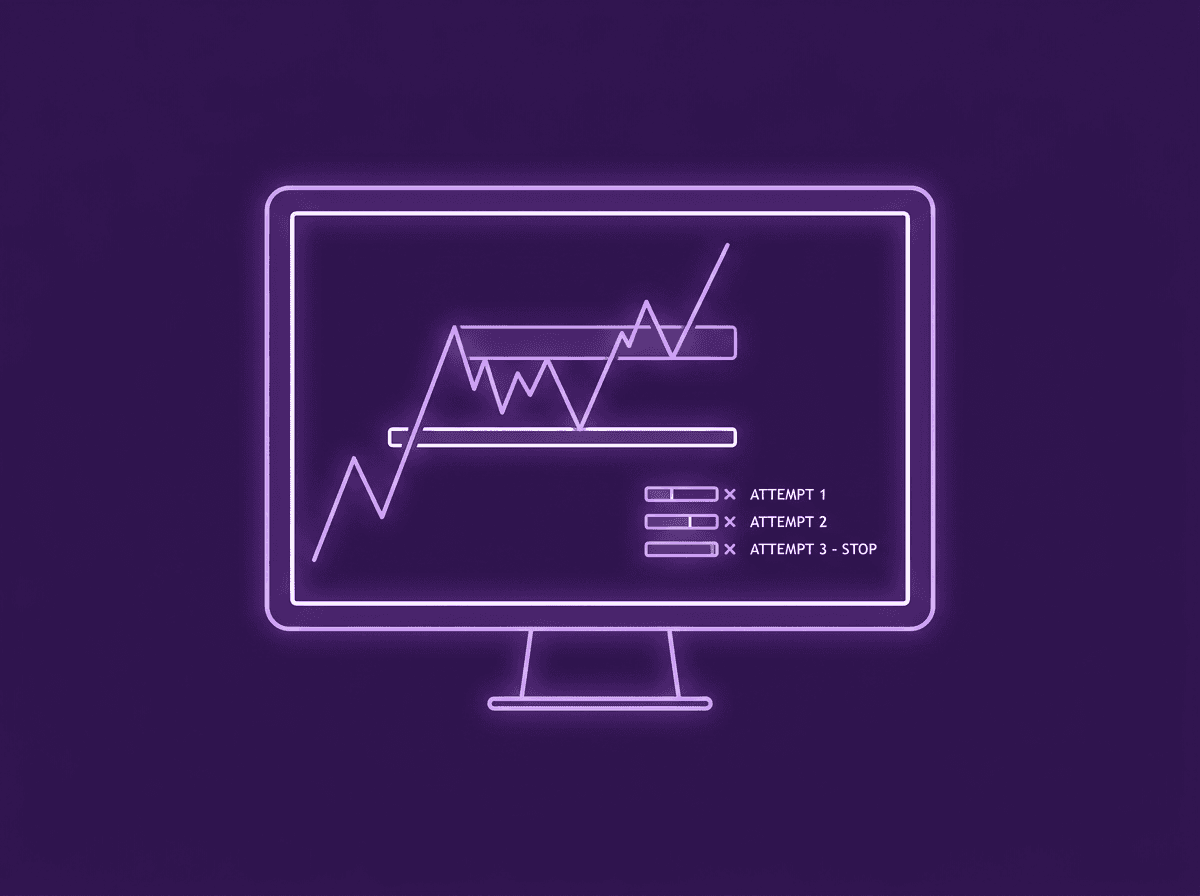
You found a high-quality supply zone. Price enters it, you short, and the trade loses. Price re-enters the zone, you short again, and it loses again. Now what?
You stop. Two attempts on a single trade setup is the maximum. If a point of interest fails twice, the market is telling you the level is dead. Anything beyond two re-entries is not strategy. It is ego, wishful thinking, or the early stages of a revenge spiral that will eat your capital.
This rule works because it forces you to accept invalidation before your emotions take the wheel. Most traders never set a hard cap on re-entry attempts, and that missing guardrail is exactly where overtrading starts.
TL;DR
Attack any single trade idea or point of interest a maximum of 2 times.
After 2 failures at the same level, accept that the setup is invalid and move on.
More than 2 attempts is wishful thinking that bleeds into revenge trading.
This rule protects your capital by cutting off the emotional spiral before it starts.
Track your re-entry patterns to catch yourself breaking the rule before it becomes habit.
Why Two Attempts Is the Limit
Think of each attempt on a trade setup like loading a round into a very specific gun. You get two shots at this level. If both miss, the target has moved, and firing more rounds into empty space is just wasting ammunition.
The logic behind two attempts is straightforward. On the first entry, you have your original thesis: price should respect this zone based on your analysis. If it fails, one failure does not necessarily invalidate the idea. Markets overshoot. Liquidity sweeps happen. A second attempt with fresh confirmation is reasonable.
But after two failures? The evidence has flipped. Price has now shown you, twice, that it does not care about your level. The supply zone has been mitigated. The demand area has been consumed. Whatever narrative you built around that point of interest, the market disagreed.
Two attempts also maps to sound risk math. If you risk 0.5% per trade, two failed entries at the same level cost you 1% of your account. That is a controlled loss. Three attempts costs 1.5%. Four costs 2%. And by that point, you are not managing risk anymore. You are hemorrhaging capital into a dead idea.
The math behind the cap
Say you are trading EUR/USD at a 4-hour supply zone near 1.0950. You risk 0.5% per attempt with a 1:5 risk-to-reward target.
Attempt 1: Short at 1.0950, stop at 1.0975 (25 pips). Loss = 0.5%.
Attempt 2: Price retests the zone, you short again at 1.0948, stop at 1.0973 (25 pips). Loss = 0.5%.
Total damage after 2 attempts: 1% of account.
That 1% drawdown from a single trade idea is recoverable. It preserves your capital to take the next high-quality setup when it appears. But if you take a third and fourth attempt, you are now down 2% on one idea that already told you it was broken.
The two-attempt cap is not arbitrary. It is the point where controlled risk-taking ends and compulsive re-entry begins.
After Two Misses, the Setup Is Dead
Ever watched price blow through your supply zone like it was not there? You entered short, got stopped out, re-entered, got stopped out again, and now price is 80 pips above your original entry. The zone is done. Cooked. Invalid.
Setup invalidation is not a feeling. It is a conclusion drawn from evidence. After two failed attempts at the same level, you have collected enough data to know that the conditions which made your idea valid have changed.
Here is what typically happens when a point of interest fails twice:
Liquidity has been cleared. The stop-loss orders clustered above or below the zone have been taken out. The fuel that would have driven price in your direction is gone.
The opposing side has won. Buyers absorbed all the selling pressure at your supply zone (or sellers absorbed the buying at your demand zone). The balance of power has shifted.
The timeframe narrative has changed. Your 4-hour supply zone might have been valid within a bearish daily structure, but if price is now closing above that zone, the daily bias may have flipped.
None of these things fix themselves by waiting five minutes and trying again. The setup is dead. Accept it.
Walkthrough: GBP/USD supply zone, the trap of attempt three
You have mapped a 1-hour supply zone on GBP/USD between 1.2710 and 1.2730 during London session. Your plan says: short on bearish engulfing confirmation inside the zone, stop above 1.2740, target 1.2610 (100 pips, roughly 1:5 R:R at 0.5% risk).
Attempt 1: Price enters the zone at 1.2715. You see a bearish engulfing candle on the 15-minute. You short. Price stalls, then pushes through your stop at 1.2740. Loss: 0.5%.
Attempt 2: Twenty minutes later, price pulls back to 1.2720. Another bearish reaction candle forms. You short again, stop at 1.2740. Price drives through the zone a second time, stops you out at 1.2740. Loss: 0.5%.
At this point, you are down 1% on this single idea. The zone has been tested twice and failed to hold. Buyers are clearly in control.
What the disciplined trader does: Closes the chart, logs both trades, and moves on. The 1% loss is within tolerance. There will be another setup tomorrow.
What the undisciplined trader does: Takes a third entry because "the zone should hold," gets stopped out again, and is now down 1.5%. Takes a fourth entry out of frustration, gets stopped out, and is down 2%. That is four losses on one dead idea. And the worst part? The trader knew after the second attempt that the zone was broken. They just could not accept it.
The Ego Trap of Trying Again
The reason you take attempt three, four, or five is almost never logical. It is ego.
Your analysis told you price should sell from that zone. You spent time marking it up, building a narrative around it, maybe even told yourself this was "the trade of the day." When it fails twice, accepting invalidation means accepting that you were wrong. And for most traders, being wrong feels like losing, even though controlled losses are a normal part of the game.
Sound familiar? That voice that says "the zone is still valid, price just swept liquidity, it will come back." That is not your trading plan talking. That is your ego protecting itself from the discomfort of being wrong.
Here is the uncomfortable truth: the market does not care about your analysis. It does not care how much time you spent on your chart markup. Price moves where liquidity takes it, and if your level failed twice, your job is to accept the new information and find the next opportunity.
The traders who struggle most with the two-attempt rule are the ones who tie their identity to individual trade ideas. Every loss feels personal. Every invalidation feels like a verdict on their skill. But your edge plays out over the law of large numbers, not on any single setup. One dead zone means nothing if your process is sound across 100 trades.
Killing your ego on a single trade is how you stay alive for the trades that actually work.
How ego disguises itself as logic
Ego is sneaky. It does not announce itself by saying "I refuse to be wrong." Instead, it shows up as reasonable-sounding justifications:
"Price just swept the liquidity above the zone. Now it will reverse." (Maybe. But your two attempts already tested this thesis.)
"The higher timeframe is still bearish, so this zone should hold." (If the higher timeframe bias was enough, the zone would not have failed twice.)
"I will take a smaller position this time." (Reducing size does not change the fact that the setup is invalid. You are still trading a dead level.)
Each of these sounds like analysis. But after two failed attempts, they are rationalizations. Your trading rules exist precisely for moments like this, when your brain invents reasons to keep going. The rule does not care about your justifications. Two attempts. Done.
When Re-Entry Becomes Revenge Trading
There is a thin line between a legitimate second attempt and a revenge trade. That line lives at attempt three.
A legitimate re-entry has structure behind it. You have a clear point of interest. Your confirmation model triggers again. Your risk is sized properly. You are following your plan. The first attempt failed, but the conditions that made the trade valid still exist.
A revenge trade has emotion behind it. You are re-entering because you lost money and you want it back. Your confirmation model may or may not have triggered, but you are not really checking anymore. You just want the level to work because you need it to work.
After two failures at the same level, the probability that your third entry is a legitimate re-entry drops close to zero. By that point, the emotional weight of two consecutive losses at the same spot has almost certainly compromised your judgment. You are not seeing the chart clearly anymore. You are seeing what you want to see.
This is how overtrading starts. Not with some dramatic blow-up, but with one extra re-entry on a level that already told you it was dead. Then another. Then you are four trades deep into a losing streak on a single idea, and the damage to your account is real.
The two-attempt rule is a circuit breaker. It forces you to stop before the emotional spiral takes hold. And that forced stop is worth more than any single trade, because the capital you preserve by walking away is the capital that lets you take the next valid setup with a clear head.
The opportunity cost nobody talks about
While you are hammering away at a dead zone with attempts three, four, and five, the market is generating other setups. Better setups. Ones you are missing because all your attention and capital are locked into a losing battle with one level.
Every additional attempt on a dead setup has a double cost: the direct loss on the trade, plus the opportunity cost of the setup you missed because you were busy being stubborn. This is where FOMO trading gets inverted. You are so afraid of missing the move at your broken level that you miss the actual move happening somewhere else.
How EdgeFlo Tracks Your Re-Entry Attempts
Knowing the rule is one thing. Following it during a live session, when two losses have your frustration spiking, is another.
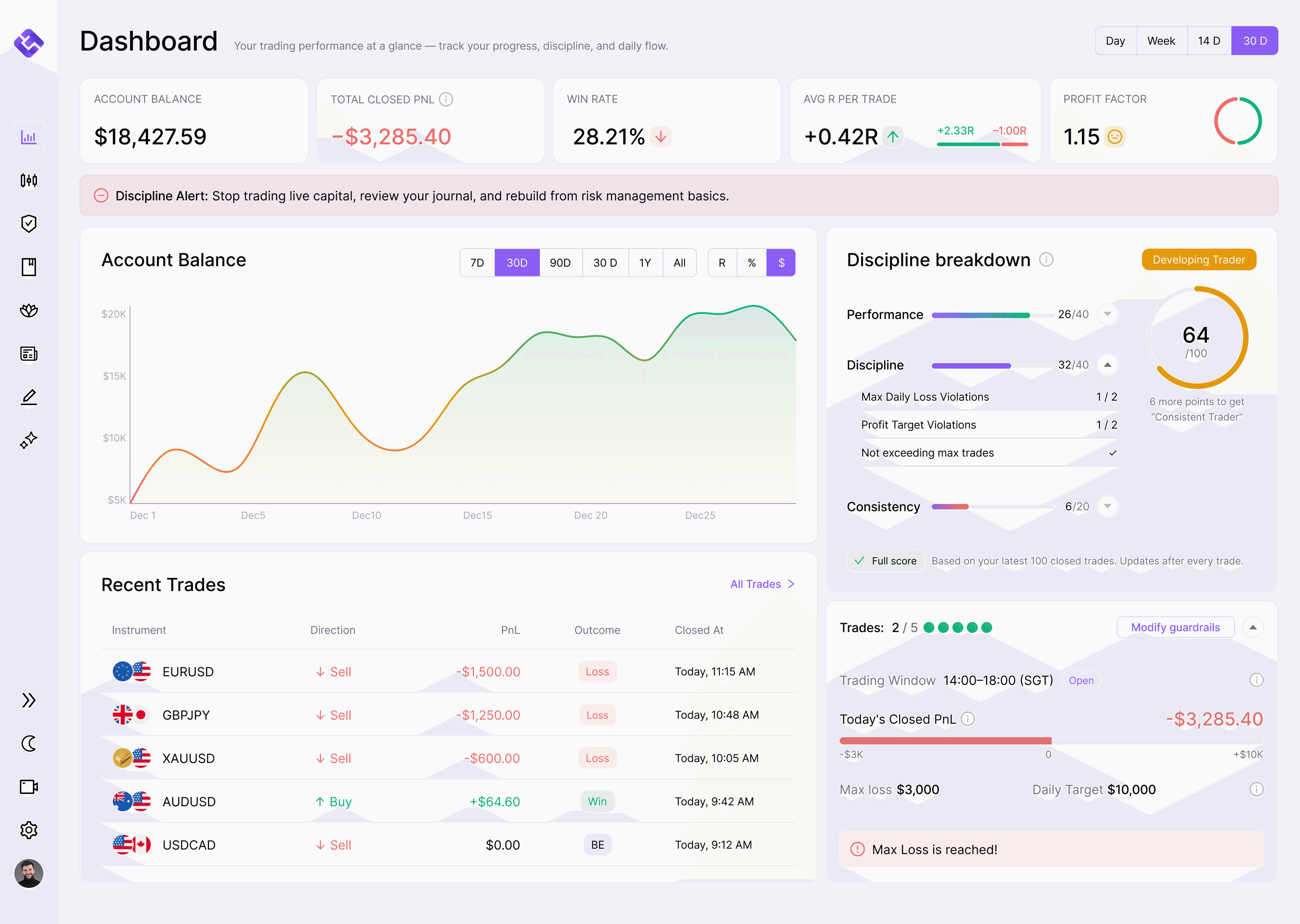
EdgeFlo's Trading Dashboard shows your trade frequency and re-entry patterns across sessions. You can see how many times you traded the same instrument in a single session, how your win rate changes on re-entries versus fresh setups, and whether your losing streaks cluster around repeated attempts at the same level.
This visibility matters because re-entry violations are hard to catch in the moment. Your ego is running the show, and you are not thinking about rules. But when you review your dashboard after the session, the pattern is obvious: three, four, five trades on the same pair in the same direction within a short window. That is the data telling you the two-attempt rule got broken.
Building awareness of this pattern is the first step toward internalizing the rule. When you see the damage from repeated re-entries laid out in your analytics, the abstract idea of "stop after two" becomes concrete. You can see exactly how much it cost you, and that makes it harder to rationalize attempt three next time.
The Edge Brief
Receive Insights on trading psychology, discipline, and the behavioral patterns that create consistent traders from our Founder and the EdgeFlo team, delivered to your inbox.
Think different. Trade different.
How many times should you re-enter the same trade setup?
Is re-entering a failed trade the same as revenge trading?
What does setup invalidation mean?
Should I always take a second attempt on the same setup?

Turn discipline on.
Every session.
EdgeFlo is the environment serious traders operate inside.
Start 7-Day Free Trial
Cancel anytime.
No long-term commitment.

Think Different, Trade Different.