

The Three Loss Rule: A Hard Stop for Your Trading Day
Three consecutive losses means laptop closed. Learn why this simple rule prevents spirals, how to implement it, and what to do the next morning.
You just took your third loss in a row. Your hands are still on the keyboard. You already see another setup forming on the chart. Everything in your brain says "take it, win it back."
That voice is the reason most traders spiral.
The three loss rule exists to override that voice with a hard, pre-committed decision: three consecutive losses, and you close the laptop. Done for the day. No exceptions, no negotiations, no "just one more."
TL;DR
Three consecutive losses in a single session means you stop trading for the day.
The rule prevents revenge trading spirals before they start.
You do not factor in earlier wins; three losses in a row triggers the stop regardless.
Write the rule into your trading plan before your next session, not during one.
Capital preserved today is capital available for high-quality setups tomorrow.
Why Three Losses Break Your Decision-Making
Losses are not just financial hits. They are emotional hits. After one loss, most traders can stay composed. After two, frustration starts bleeding into analysis. After three, something shifts.
Your logical brain steps aside. The emotional brain takes the wheel. And the emotional brain does not read charts. It reads pain.
Sound familiar? You start widening your criteria. Setups that you would normally skip suddenly look "good enough." Your stop-loss gets tighter because you want a bigger reward to recover faster. Your lot size creeps up because you want to make it all back in one trade.
This is the revenge trading spiral. And it almost always starts after the third consecutive loss. Not the first, not the second. The third is where discipline breaks for most traders.
The fix is brutally simple: remove yourself from the situation before the spiral begins.
How the Three Loss Rule Works
The rule has one condition and one action.
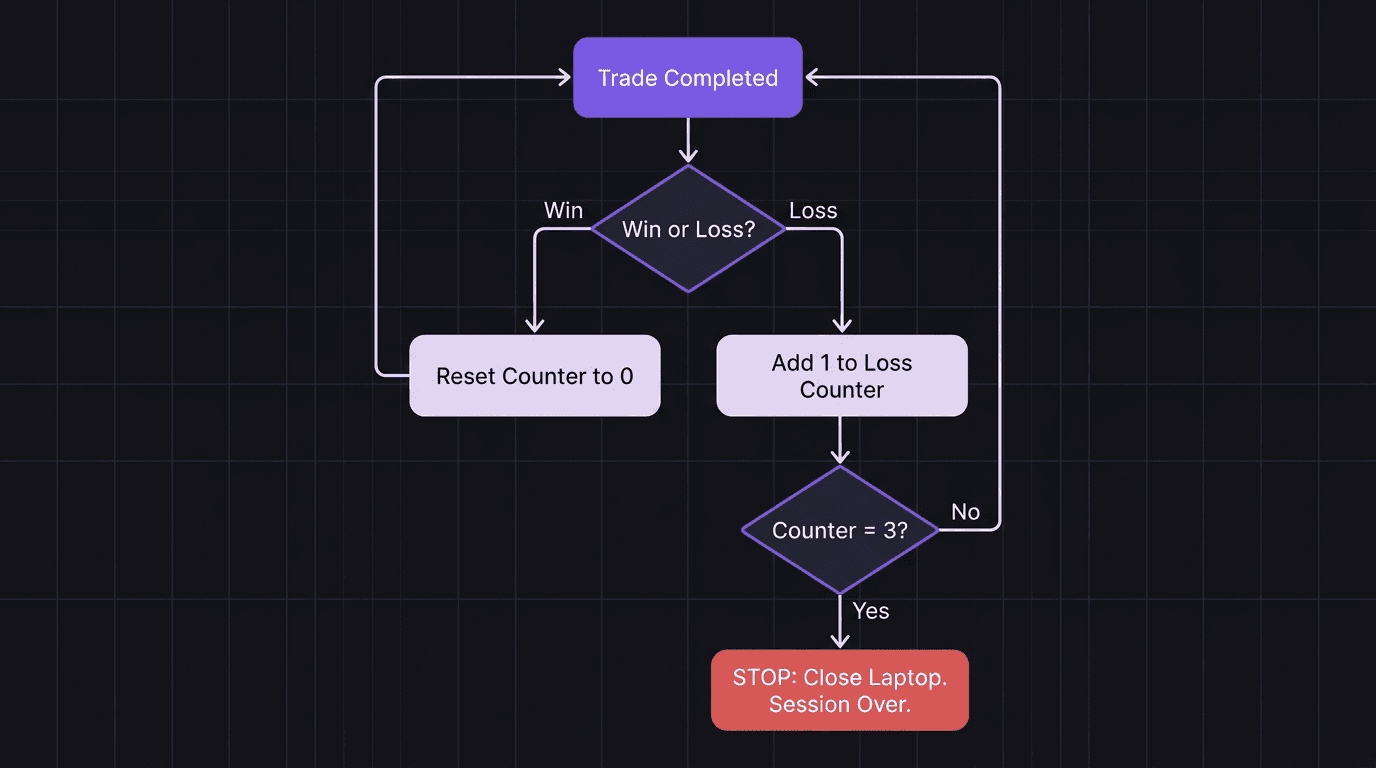
Condition: You take three consecutive losing trades in a single trading session.
Action: You close all charts, shut the laptop, and do not trade again until the next session.
That is the entire rule. No caveats, no wiggle room.
What Counts as a Loss
A loss is any trade that hits your stop-loss or that you close for a negative result. It does not matter whether the trade followed your plan perfectly (a valid loss) or whether you deviated from your rules (an invalid loss). Both count toward the three-strike limit.
What About Winning Trades Before the Losses?
Here is where traders try to negotiate with the rule. "I won four trades today, so I should get more room." No.
If you win four trades and then lose three in a row, you stop. The wins earlier in the session do not buy you extra attempts. The purpose of the rule is not to manage your daily P&L. It is to manage your emotional state. Three consecutive losses damage your judgment regardless of what happened before them.
Walkthrough: The Rule in Action
You are trading GBP/USD during the London session. Your plan says to look for sells from a supply zone at 1.2740. Your risk is 0.5% per trade on a $10,000 account, which means $50 per trade.
Trade 1: You short at 1.2738 with a 20-pip stop-loss. Price pushes through the zone and stops you out at 1.2758. Loss: $50.
Trade 2: Price returns to the zone. You short again at 1.2742 with a 20-pip stop. Stopped out at 1.2762. Loss: $50.
Trade 3: Price re-enters the zone a third time. You short at 1.2745 with a 20-pip stop. Stopped out at 1.2765. Loss: $50.
Total damage: $150 (1.5% of account). Three losses. Laptop closed. Session over.
Without the rule, here is what typically happens next. You take a fourth trade, frustrated and determined to recover. Your criteria loosens. Maybe you take a fifth. By the end of the session, those three $50 losses have turned into six or seven losses totaling $350 or more. You have given back an entire week of progress in one afternoon.
The three loss rule caps the damage at $150 instead of $350.
Walkthrough: What Happens Without the Rule
Same GBP/USD session, same supply zone. You lose the same three trades ($150 total). But this time, there is no rule.
Trade 4: You see a demand zone forming at 1.2680. It is not on your plan, but you are frustrated and want to recover. You go long with a 15-pip stop. Price drops. Loss: $37.50.
Trade 5: You switch to EUR/USD because GBP/USD "is not working today." You take a random breakout trade with a wider 30-pip stop. Loss: $75.
Trade 6: Back to GBP/USD. You double your lot size because you need to recover. 0.50 lots with a 20-pip stop. Loss: $100.
Total damage: $362.50 (3.6% of account). More than double what the three loss rule would have allowed.
How to Implement the Rule Today
Writing the rule down is step one. Making it enforceable is step two.
Step 1: Add It to Your Trading Plan
Open your trading plan document and add a section called "Session Stop Rules." Write the exact condition: "If I take 3 consecutive losing trades, I stop trading for the remainder of the session."
Do this right now, before your next session. Trading rules made during a losing streak are rules you will break during a losing streak.
Step 2: Track Consecutive Losses in Real Time
Keep a tally visible next to your charts. A sticky note, a whiteboard, a text file. After each loss, mark it. After a win, reset the count to zero.
The physical act of marking each loss creates a pause. That pause is where discipline lives.
Step 3: Define What "Next Session" Means
The rule says stop for the day. But what does "the next session" look like?
Here is a simple framework:
Close all charts. Not minimize. Close.
Do something unrelated to trading for at least 2 hours. Walk, exercise, cook, read. Your brain needs a full context switch.
Before the next session, review the three losses in your journal. Were they valid (plan-aligned) or invalid (off-plan)? This review is where the real learning happens. Three valid losses mean your system worked but the market did not cooperate. Three invalid losses mean your process broke before the market had a chance to prove anything.
Re-read your trading plan before opening charts. Cold start. Fresh mind.
Step 4: Journal the Rule Every Time It Triggers
Every time the three loss rule fires, log it. Date, time, the three trades, what you were feeling, and what you did after closing the laptop. Over 30 days of data, you will see patterns: which sessions trigger it most, which setups lead to streaks, and whether the rule is saving you money.
This data is your evidence. It is also what stops you from abandoning the rule during a good stretch when you think you do not need it anymore.
Common Objections (And Why They Are Wrong)
"Three losses is too conservative. I should have more room."
If you consistently hit three consecutive losses, the problem is not the rule. The problem is either your win rate, your setup selection, or your session timing. The rule is exposing that problem. Removing the rule hides it.
"What if the market turns right after I stop?"
It will. Sometimes. And that does not matter. One missed winner does not offset the damage from a revenge trading spiral. Over 100 sessions, the capital you preserve by stopping will far exceed the gains from "one more trade."
"I trade a system with a low win rate, so three losses in a row is normal."
If your system has a 30% win rate, three consecutive losses will happen roughly 34% of the time (0.7 x 0.7 x 0.7 = 0.343). That frequency means the rule will trigger often, which is fine. It means you take fewer trades per session, which forces you to be more selective about which setups you enter. If your R:R is 1:5, you only need one winner out of every three sessions to stay profitable.
The Spiral Math: Why Stopping Early Compounds
Consider two traders over a month. Both risk 0.5% per trade on a $10,000 account. Both use the same strategy with a 40% win rate and 1:3 R:R. Both encounter three consecutive losses at least once per week.
Trader A uses the three loss rule. When it triggers, the session ends. Maximum session damage: $150 (three trades at $50 each).
Trader B does not use the rule. After three losses, frustration leads to two or three additional off-plan trades per session. Average additional damage: $150 in extra losses.
Over four weeks, Trader A loses $600 on rule-trigger days (4 triggers x $150). Trader B loses $1,200 on those same days (4 triggers x $300).
That $600 difference is 6% of the account. Over a year, that gap becomes the difference between a growing equity curve and a flat one.
How EdgeFlo Supports the Three Loss Rule
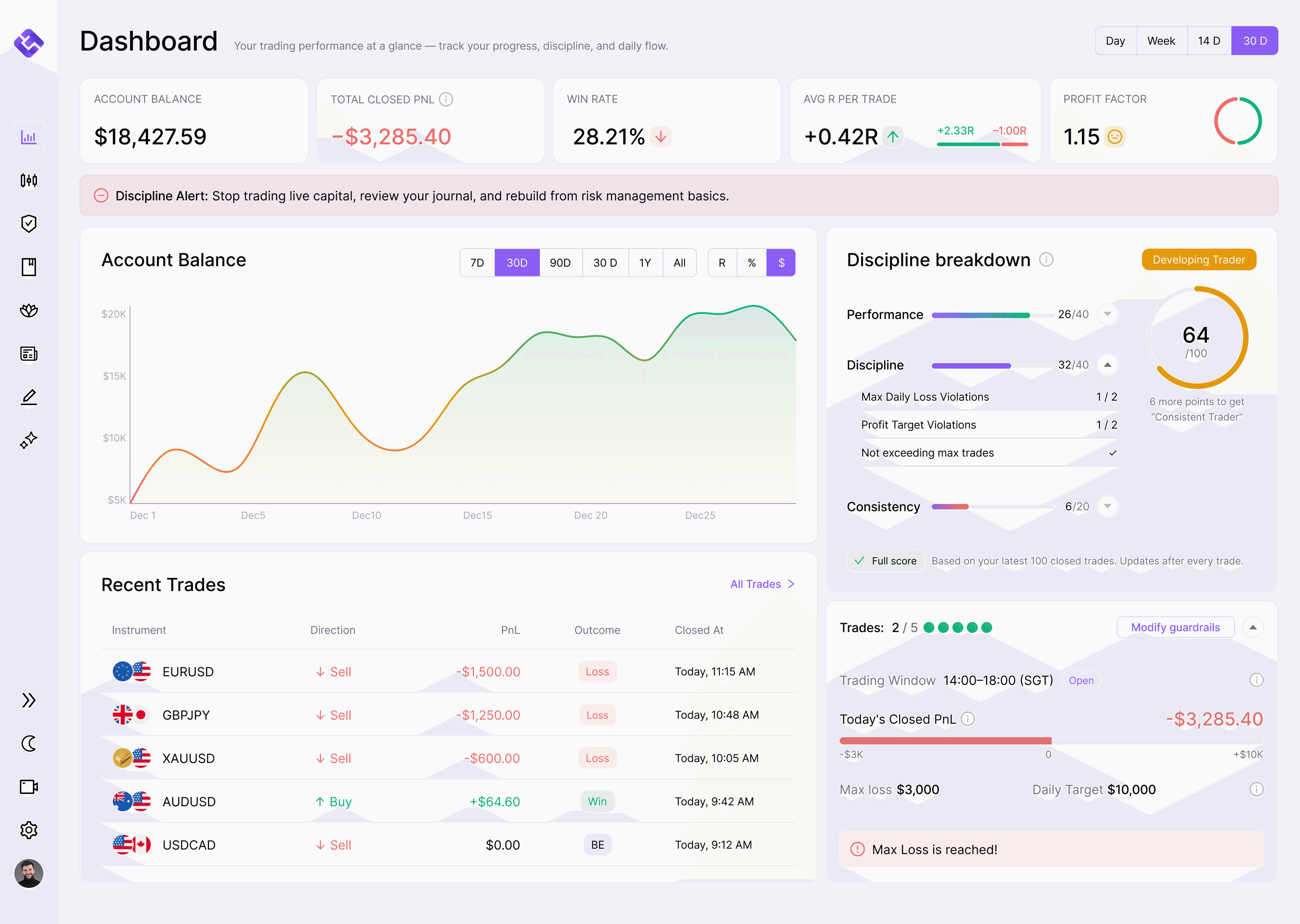
EdgeFlo's daily loss limit guardrail can enforce a session stop after a defined number of losses or a percentage drawdown. You set the threshold in your trading plan, and the platform restricts further trading when you hit it. You can override it (the choice is always yours), but the override requires a conscious decision, not a reflexive click.
Combined with EdgeFlo's journal, every trade that triggers the rule gets logged automatically. You do not have to remember to write it down. The data is already there for your next trading review.
The rule itself is simple. The hard part is following it when your emotions are screaming at you to keep going. That is exactly where environment design matters: make the default behavior the disciplined behavior, and make rule-breaking require effort instead of the other way around.
The Edge Brief
Receive Insights on trading psychology, discipline, and the behavioral patterns that create consistent traders from our Founder and the EdgeFlo team, delivered to your inbox.
Think different. Trade different.
Should I count winning trades before applying the three loss rule?
What if the third loss happens mid-session with a setup still forming?
Can I adjust the three loss rule to two or four losses?
Does the three loss rule apply to demo and backtesting too?

Turn discipline on.
Every session.
EdgeFlo is the environment serious traders operate inside.
Start 7-Day Free Trial
Cancel anytime.
No long-term commitment.

Think Different, Trade Different.