

5 Signs Your Lot Size Is Too Big
If you can't sleep with a trade open, your lot size is too big. Learn the sleep test, mood test, and 3 other signs that your position size needs to shrink.
If you cannot go to sleep with an open trade without waking up at 2 AM to check your phone, your lot size is too big. That is not discipline failure. That is a sizing problem.
The right position size is one where a full stop loss hit feels like a paper cut, not a car crash. You acknowledge it, journal it, and move on. When a single loss wrecks your mood, triggers revenge trading, or makes you question your entire strategy, the dollar amount on the line is doing the damage, not the market.
TL;DR
The sleep test is the fastest way to check if your position size is correct.
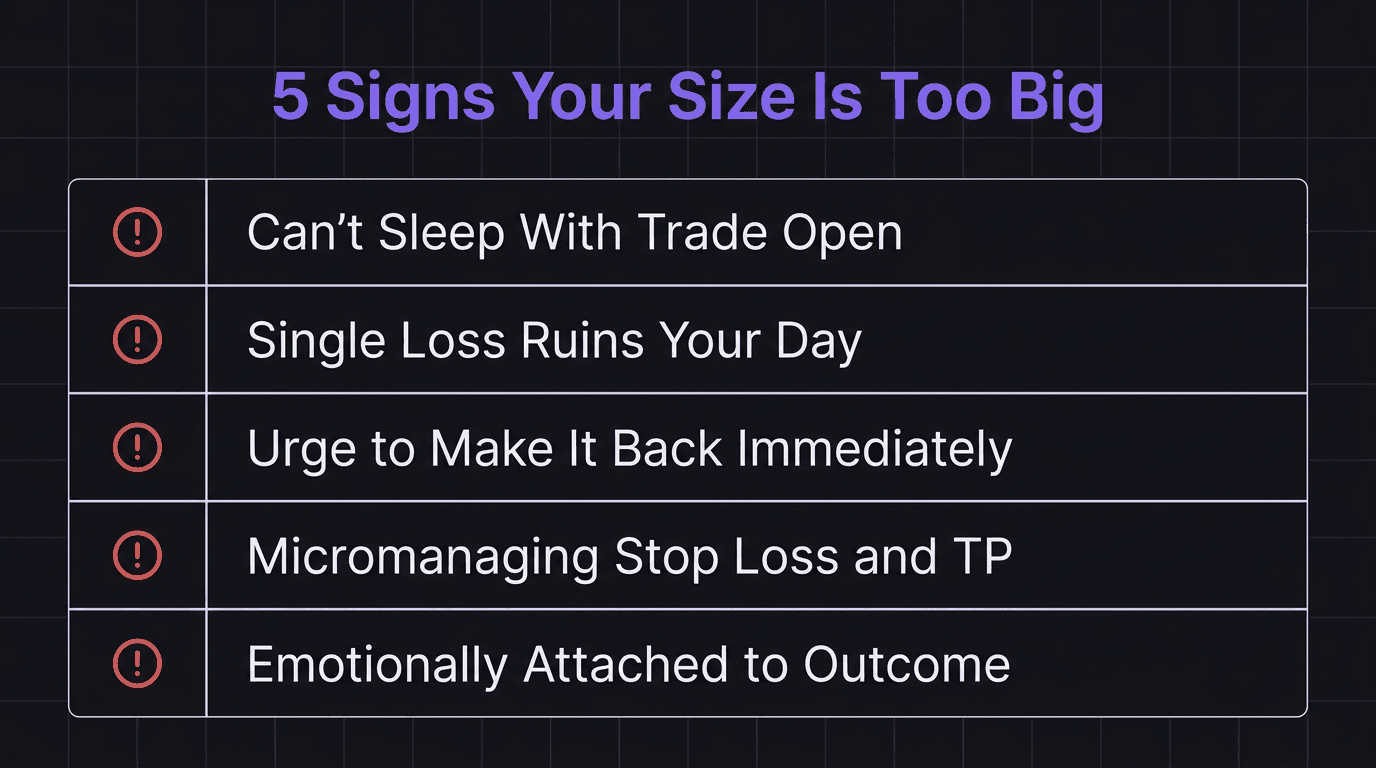
Five signs of oversizing: sleepless nights, mood swings, revenge impulses, micromanaging, and emotional attachment to outcome.
One trader lost $30,000 in a week partly because the dollar amounts were large enough to trigger ego-driven decisions.
Right-sizing means risking an amount that does not change your behavior when you lose.
Detaching from the dollar amount and focusing on R multiples keeps your decisions clean.
The Sleep Test for Position Size
Here is the simplest diagnostic in trading. Open a position with your normal lot size. Go to bed. If any of these happen, your size is wrong:
You check your phone before falling asleep.
You wake up in the middle of the night to look at the chart.
You worry about the trade while doing non-trading activities.
You feel relief when you close the trade, regardless of outcome.
The sleep test works because it measures what your risk tolerance actually is, not what you think it should be. You might tell yourself "I am comfortable risking 2%." But if 2% of a $100,000 account is $2,000 and that $2,000 keeps you awake, then your real risk tolerance is lower than 2%.
This is not about being soft. It is about being honest. A trader who reviewed his own worst month identified that part of the reason he made impulsive decisions after losses was the sheer dollar amount at stake. At $10,000 per trade risk, every loss felt personal. The money was big enough to trigger his ego, his need to prove himself, and his urge to make it back immediately.
Five Signs Your Size Is Too Big
1. You Cannot Sleep With a Trade Open
We covered this already, but it is the clearest indicator. If you have to close a trade before bed not because of your plan but because of anxiety, your lot size is creating emotional pressure that interferes with execution.
2. A Single Loss Ruins Your Entire Day
Everyone prefers winning. But if one stop loss hit makes your afternoon sour, makes you snap at people, or kills your motivation to analyze the next setup, the loss is too large relative to your emotional capacity. The goal is indifference to individual outcomes.
3. You Feel the Urge to Make It Back Immediately
This is where oversizing feeds directly into revenge trading. When you lose $500, you might shrug. When you lose $10,000, you feel compelled to take another trade right now to recover. That compulsion is proportional to the dollar amount, not to the quality of your next setup.
4. You Micromanage the Trade
Constantly adjusting your stop loss, moving your take profit, or staring at the 1-minute chart when your system runs on the 4-hour. These are symptoms of caring too much about a single trade's outcome. And caring too much almost always traces back to risking too much.
5. You Get Emotionally Attached to the Outcome
The key to consistent execution is detaching from individual results. If you find yourself saying "I need this trade to win" rather than "I will execute my plan and accept the result," your position size is making you trade your emotions instead of the chart.
Right-Size Your Risk
Position sizing is not just math. It is psychology management. Here is how to find the right level.
Start with 0.5% to 1% of your account. This is the standard starting point. On a $10,000 account, that is $50 to $100 per trade. On a $100,000 account, that is $500 to $1,000.
Then run the sleep test for two weeks. If you pass it every night, your size is correct. If you fail it even once, drop your risk per trade by half and test again.
Only increase size with a system rule, not a feeling. "I have been profitable for three consecutive months and my equity curve shows consistent growth" is a system reason. "This setup looks really good" is not. The moment you size up based on conviction instead of a rule, you are one bad trade away from the exact spiral that turns a $30,000 loss into a destroyed month.
Walkthrough: How Oversizing Amplified a Losing Week
Setup: A trader was risking roughly 1R per trade ($10,000) on GBP/JPY. After a profitable previous month, he entered June without reviewing his plan. On June 3, he went long on GBP/JPY during the 1H timeframe before his entry model confirmed. Price was up $3,500 in unrealized profit, then reversed and hit his stop loss. Loss: $10,000. He took a second trade the same week, driven by ego and the need to recover. Loss: $10,000. A third trade followed his plan but still lost to choppy conditions. Loss: $10,000. Total drawdown in one week: $30,000 (3R).
The dollar amount mattered. At $10,000 per trade, each loss was large enough to trigger emotional responses: ego, revenge impulses, and self-doubt. After the third loss, the trader said his "confidence in his abilities started dropping" and he was "filled with constant self-doubt."
Compare that to a trader risking $200 per trade. Three consecutive $200 losses ($600 total) still sting, but they rarely trigger a psychological spiral. The strategy is the same. The risk math is the same. The emotional impact is completely different.
That is why daily loss limits exist. They cap not just the financial damage but the emotional damage that leads to compounding mistakes.
Detach from the Dollar Amount
The most practical shift you can make is to stop thinking in dollars and start thinking in R.
When you risk $10,000, losing "ten thousand dollars" hits different than losing "1R." Both describe the same event, but the dollar framing triggers loss aversion. The R framing keeps it abstract and statistical.
After the $30,000 losing week, when the trader came back and took two trades for $58,000, he described it in R terms: "I made about 1.5R for the month." Five trades, three losses, two wins, net positive 1.5R. That framing keeps the focus on process instead of P&L.
Here is how to practice this:
Set your platform to display R, not dollars. If your platform cannot do this, calculate R manually and record it in your journal.
Review your monthly stats in R. "I made 1.5R this month" is more useful than "I made $27,000" because R adjusts for account size and tells you about edge quality.
When someone asks how your month went, answer in R. This trains your brain to evaluate performance by process quality rather than dollar outcomes.
If you notice yourself overtrading because you are chasing a dollar target, that is another sign your sizing is distorting your decisions. The fix is always the same: reduce until the outcome does not change your behavior.
How EdgeFlo Helps You Size Correctly
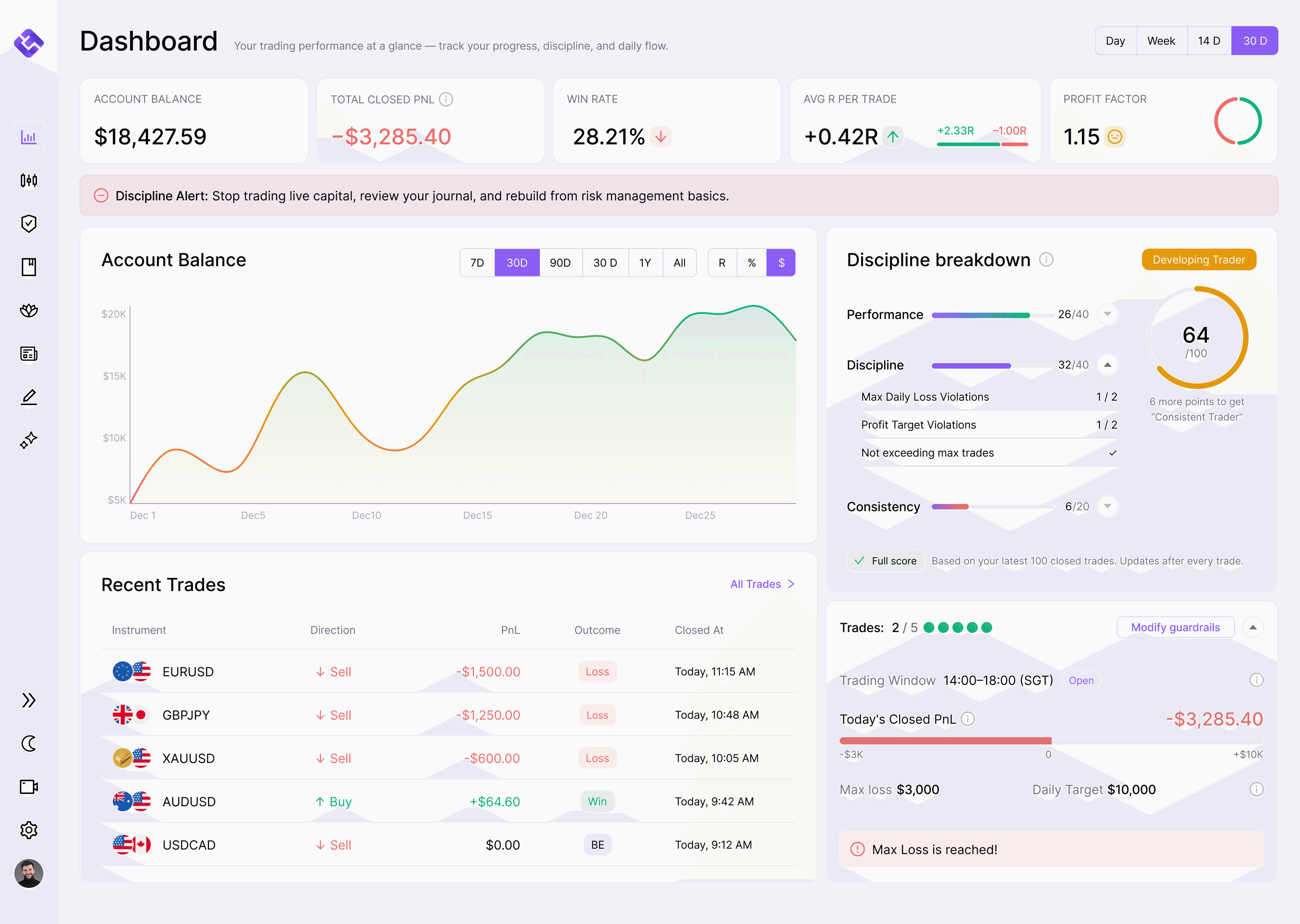
EdgeFlo's auto risk calculator computes the correct lot size before every entry based on your account balance, stop loss distance, and risk percentage. You enter your stop loss level, and the calculator tells you exactly how many lots to trade.
This removes the temptation to manually bump up size on trades that "feel good." The number comes from your system, not from your last three wins. And because the calculator is built into the execution flow, you see the correct size right before you place the trade, which is exactly when the temptation to oversize is strongest.
When you feel fear about a trade, the calculator also provides a reality check. If 1% risk on your account equals $100 and that amount still triggers anxiety, you know your account size or risk percentage needs adjustment before you take another trade.
The Edge Brief
Receive Insights on trading psychology, discipline, and the behavioral patterns that create consistent traders from our Founder and the EdgeFlo team, delivered to your inbox.
Think different. Trade different.
How do I know if my lot size is too big?
What is the sleep test in trading?
How much should I risk per trade?
Why do traders increase lot size too fast?

Turn discipline on.
Every session.
EdgeFlo is the environment serious traders operate inside.
Start 7-Day Free Trial
Cancel anytime.
No long-term commitment.

Think Different, Trade Different.