

Learning From Losing Trades: Change Behavior, Not Just Notes
Losing trades only teach you something if you change what you do next. Learn the review process that turns losses into lasting behavior change.
Every trader loses. That part is guaranteed. The part that separates traders who improve from traders who stay stuck is what happens after the loss.
Most people think they learn from losing trades by remembering what went wrong. They tell themselves "I won't do that again" and move on. But the same mistake shows up two days later. Then again the following week. The lesson was memorized. The behavior never changed.
Learning from losing trades means changing what you actually do, not just what you know. It means building a review process that forces you to confront your patterns, then deliberately practicing different actions until the old habits break. That is the work that compounds.
TL;DR
Memorizing a lesson is not the same as learning it. If your behavior doesn't change, the lesson didn't stick.
Most traders repeat the same trading mistakes because they never review trades with enough honesty to see the pattern.
A structured review process, not just journaling, is what turns losses into behavioral data.
Consistent actions come before consistent profits. Fix the process, and the P&L follows.
The goal is not to stop losing. The goal is to stop losing the same way twice.
Why Most Traders Repeat the Same Mistakes
Here is something uncomfortable: most traders already know what they're doing wrong. They know they overtrade. They know they chase entries. They know they move their stop loss. But knowing and doing are completely different skills.
The problem is not a knowledge gap. It is a behavior gap.
Think about it like this. You take a bad trade, maybe you entered GBP/USD on impulse during London open without waiting for your setup. You lose $150. You feel annoyed. You tell yourself "next time I'll wait for confirmation." Two days later, price starts running without you, and you jump in again. Same impulse. Same result.
The "lesson" was in your head. But it never reached your hands.
Brad Goh, who went from a $20 trading account to consistent six-figure months over seven years, puts it bluntly: he didn't learn from reading books or watching videos. He learned by doing, by failing, by blowing accounts, and then by reviewing those mistakes continuously. The doing and reviewing together, that is the loop.
Most traders complete only half of that loop. They do the reps, they lose the money, they take all the trades. But they never sit down and review the trades with real honesty. Without that second step, you just repeat the same unconscious patterns over and over again.
Sound familiar?
Learning Means Changing Behavior
Here is a definition worth writing on a sticky note: learning is changing behavior. Not memorizing information. Not collecting insights. Changing what you actually do.
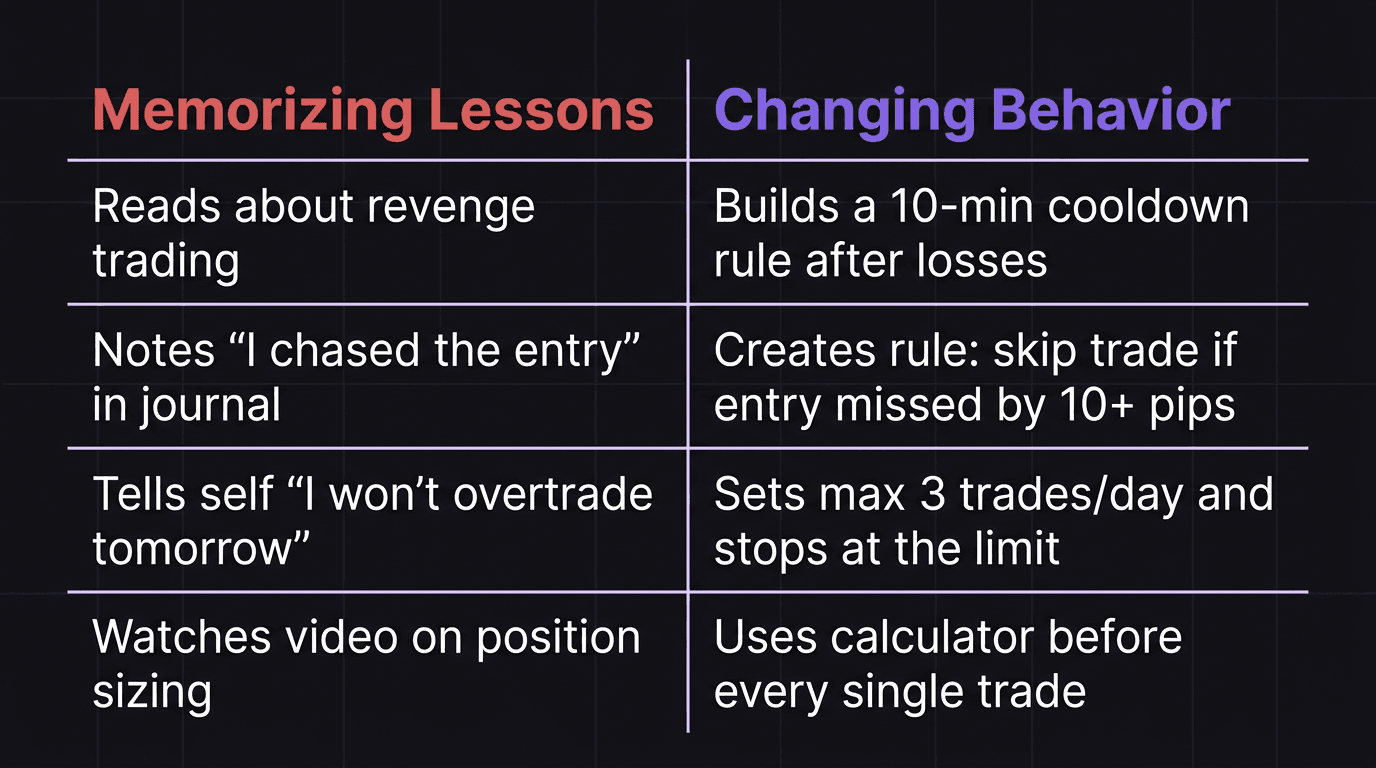
If you read an article about revenge trading and nod along, that is consuming information. If you read that article and then, the next time you take a loss, you actually walk away from the screen for 10 minutes before placing another trade, that is learning.
The distinction matters because traders fool themselves constantly. They watch a video about risk management and feel like they've improved. They read about position sizing and believe they've gotten better. But the next live session looks exactly like the last one.
The Knowing-Doing Gap in Practice
A trader studies that chasing entries after missing a setup is a losing habit. She marks it in her journal three weeks in a row. But she never builds a concrete rule like "if I miss my entry by more than 10 pips, I skip the trade entirely." Week four, she chases another entry on EUR/USD at 1.0920 after her planned entry was 1.0905. She loses $80 when price reverses. The journal note says "chased again." The behavior is identical to week one. Nothing was learned, only documented.
The fix is not more awareness. The fix is a specific behavioral rule, practiced deliberately until it becomes automatic. Learning happens when the next similar situation produces a different action, not just a different journal entry.
The Review Process That Actually Works
Journaling and reviewing are not the same thing. A lot of traders keep a journal, they write down what pair they traded, when they entered, where their stop was. That is record-keeping. Useful, but not enough.
Reviewing means going back to those records and asking harder questions. Not "what happened?" but "why did I do that?" and "what will I do differently in the exact same situation?"
Here is a review process that actually produces behavior change:
Step 1: Record While the Emotion Is Fresh
Right after you close a trade, win or lose, write down how you felt. Not tomorrow. Not at the end of the week. Immediately, while the emotion is raw and honest.
Were you anxious before entry? Relieved when you closed? Angry that you didn't hold longer? Those emotional tags are the data that matters most, because emotions drive the behaviors you're trying to change.
Step 2: Review at End of Day
At the end of your trading session, go back through every trade. For each one, answer three questions:
Did I follow my plan? (Yes or no, no explaining away)
What emotion drove my decision at entry and exit?
If I see this exact setup tomorrow, what will I do differently?
Question three is where behavior change lives. Not "what should I do differently" in theory. What will I do. Write it as a specific action.
Step 3: Weekly Pattern Scan
Once a week, read your daily reviews in one sitting. You are looking for repeating patterns, not individual trades. Maybe you notice that every Monday you overtrade during London session. Or that you always move your stop to breakeven too early on GBP pairs. Or that your worst losses happen in the first 30 minutes.
These patterns are invisible on a trade-by-trade basis. They only emerge when you look at the week as a whole.
A beginner trader reviews his week and discovers that 4 out of 5 losing trades happened after he was already up on the day. He was giving back profits by taking extra trades he didn't need. The pattern was clear in the weekly view but invisible in the moment. His behavioral fix: once he hits his daily target, he closes the platform. No exceptions for the next two weeks. His loss rate on "bonus trades" drops to zero because he stopped taking them entirely.
Step 4: Track Whether the Fix Worked
The following week, check whether your behavioral fix actually stuck. Did you close the platform after hitting your target, or did you override yourself? If you overrode, why?
This is where most traders drop the process. They identify a pattern, propose a fix, and never check whether they followed through. Without that follow-up, the review was just another note that changed nothing.
Consistent Actions Before Consistent Profits
There is a sequence that traders get backwards. They want consistent profits first, and they believe consistency in behavior will follow naturally once they start winning. It works the other way around.
Consistent actions produce consistent data. Consistent data reveals what actually works. And what actually works, executed repeatedly without emotional interference, produces consistent profits. But if your actions vary from day to day, your results are noise. You cannot tell whether your strategy works because you're never executing it the same way twice.
Brad puts it simply: "You are not consistently profitable because your actions are not consistent. So start by becoming more consistent in your actions."
That means showing up to your post-trade review every single day, not just after bad days. It means following the same pre-market routine whether you're on a hot streak or a losing streak. It means risking the same percentage whether your last trade was a winner or a loser.
The work is boring. Reviewing trades is not exciting. Logging emotions is not fun. Checking whether you followed yesterday's behavioral fix feels tedious. But that boring, repetitive work is the only thing that compounds.
Anyone can show up when they're motivated. The traders who improve are the ones who do the review when nobody's watching and nothing feels urgent. Day after day. For months.
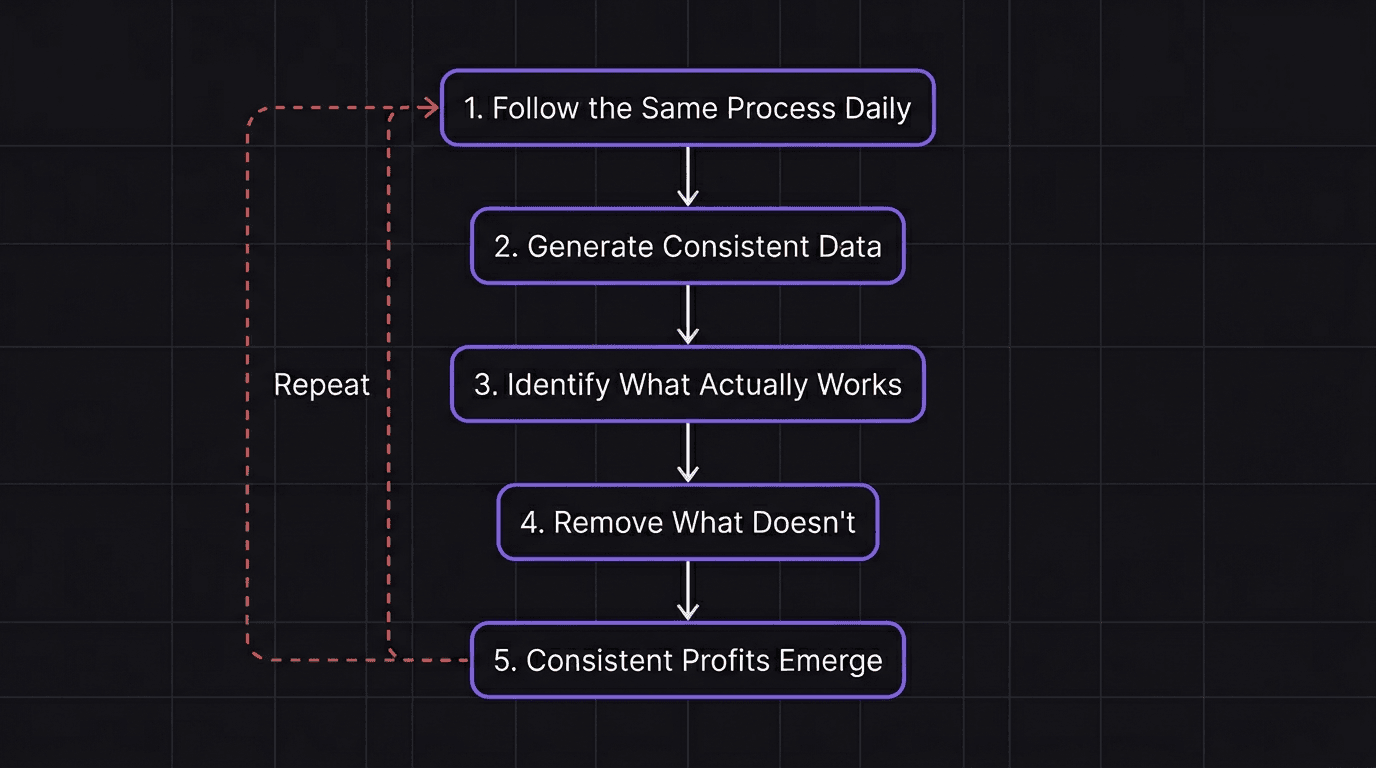
The traders who skip the review step don't just stay stuck, they actively reinforce bad habits. Every unreviewed trading loss is a missed data point. Every repeated mistake that goes unexamined becomes more automatic. The cost of not reviewing is not zero growth. It is negative growth.
How EdgeFlo Surfaces Your Patterns
One reason traders skip reviews is friction. You have to open a separate journal, screenshot your charts, manually log your entries, write up your emotions, then somehow remember to read it all back at the end of the week. Most people start strong and quit within two weeks.
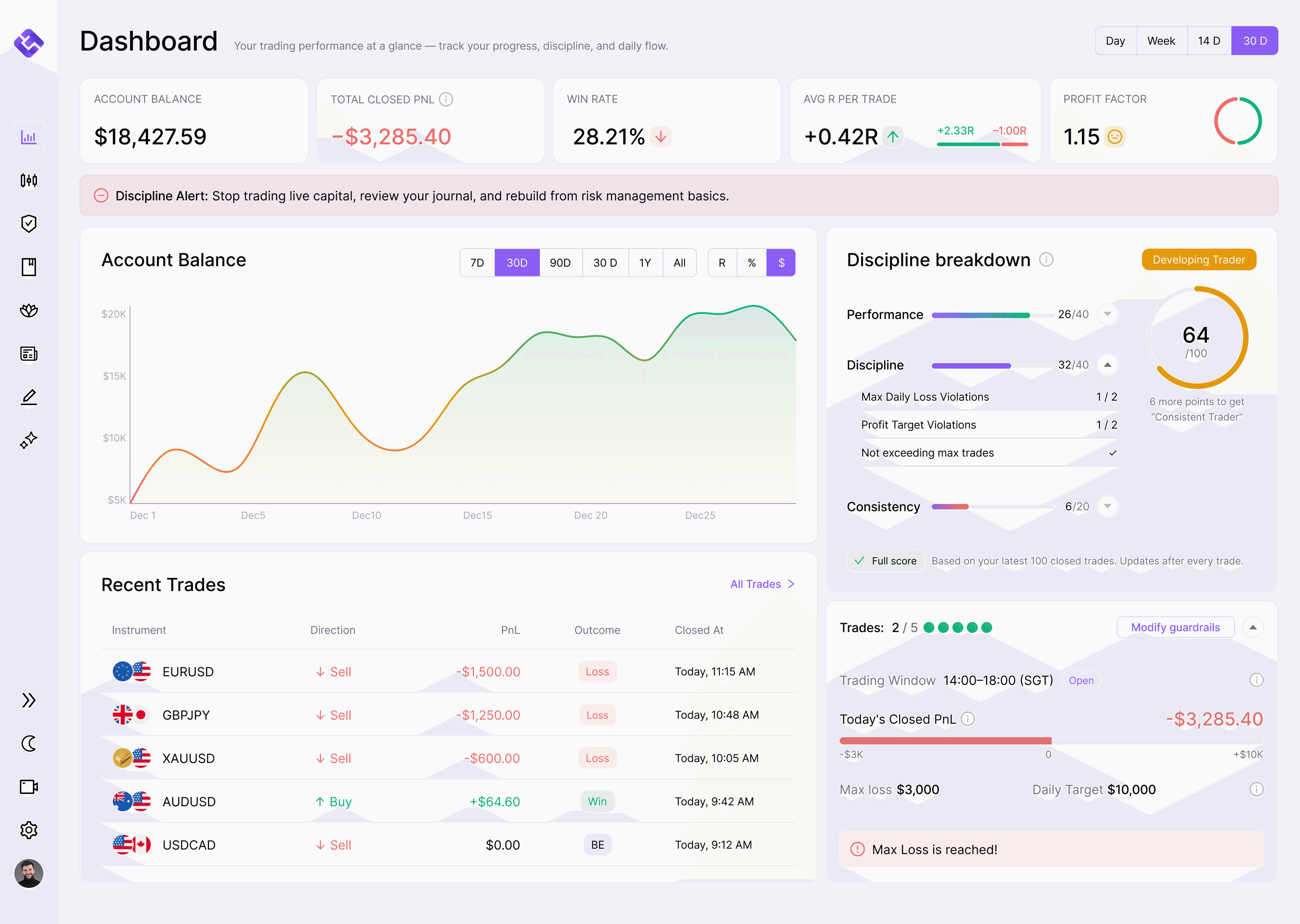
EdgeFlo collapses that friction. When you close a trade, it immediately asks how you felt, right when the emotion is real, not hours later when you've rationalized everything. That emotion tag gets auto-logged into your journal alongside the trade data, so you never have to rebuild context from memory.
But the feature that connects directly to behavior change is the AI weekly report (available on Plus). FloAI reads your journal entries from the past week and highlights the patterns you might miss on your own, which emotions showed up before your worst trades, which sessions produced the most off-plan entries, where your behavioral fixes are holding and where they are slipping. It does the pattern scan for you, so you can spend your review time on deciding what to change rather than digging through data.
The review still belongs to you. FloAI surfaces patterns, but you decide what to do about them. That is where the actual learning happens, not in the report, but in the behavioral rule you build from it.
The Edge Brief
Receive Insights on trading psychology, discipline, and the behavioral patterns that create consistent traders from our Founder and the EdgeFlo team, delivered to your inbox.
Think different. Trade different.
How many losing trades should I review?
What's the difference between journaling and reviewing?
How long before reviewing trades improves my results?
Can I learn from losing trades without a journal?

Turn discipline on.
Every session.
EdgeFlo is the environment serious traders operate inside.
Start 7-Day Free Trial
Cancel anytime.
No long-term commitment.

Think Different, Trade Different.