

Learning Means Changing: Why Information Without Behavior Change Fails
If your behavior did not change, you did not learn. Discover how to close the gap between trading knowledge and actual improvement using your journal.

You have watched 50 videos on revenge trading. You can explain exactly why it destroys accounts. You know the triggers, the psychology, and the solutions.
Then you take a loss on Tuesday afternoon and immediately enter a second trade to win it back.
If your behavior did not change, you did not learn. You memorized information. That is a different thing entirely.
Most traders are drowning in knowledge. They can recite risk management rules, draw supply and demand zones, and explain why overtrading costs money. But their account balance tells a different story because their actions have not caught up with their understanding. The gap between knowing and doing is where trading profits go to die.
TL;DR
Learning is not memorizing information. Learning is changing behavior.
Most traders consume endless content but repeat the same mistakes because behavior stays the same.
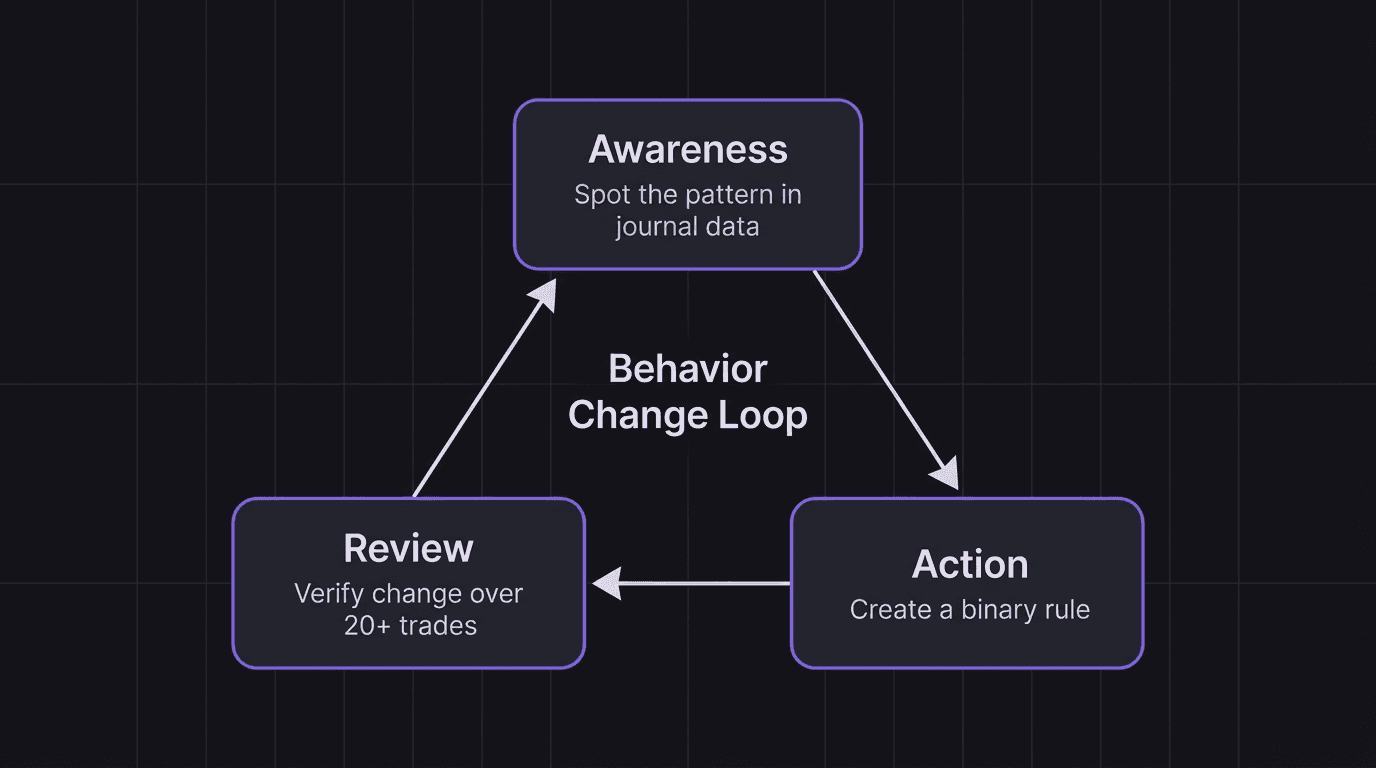
The behavior change cycle: awareness (spot the pattern), action (implement a rule), review (verify the change).
Your journal is the only tool that proves whether you actually changed.
If your trading results have not improved despite studying more, the problem is not information. It is implementation.
Information Is Not Learning
Here is a test. Think about the last trading concept you studied. A video, a book, a course module. Now ask yourself: did your trading behavior actually change because of it?
Not "did you understand it." Not "did you agree with it." Did you do something differently in your next 20 trades because of what you learned?
If the answer is no, that content was entertainment, not education. It felt productive. You spent time on it. You nodded along. But it produced zero change in your actions, which means it produced zero change in your results.
This is not a moral judgment. It is a mechanical observation. Your account balance is a direct output of your actions. Your actions are driven by your habits. Your habits only change through deliberate, repeated correction. Reading about a better habit does not install it.
A trader who reads one article about the trading review process and then actually reviews every trade for a month will outperform a trader who reads ten books but reviews nothing.
How to Tell If You Actually Learned Something
The proof is behavioral change over a meaningful sample. Not one trade. Not one day. At least 20 trades where the new behavior is visible.
Here are concrete examples:
Before: You revenge trade after every loss. After learning: You stop trading after two consecutive losses. Proof: In the last 30 trades, you stopped after two losses on 4 occasions instead of taking additional trades.
Before: You move your stop loss away from price to "give it room." After learning: You set your stop and do not touch it. Proof: Zero stop-loss adjustments in 20 trades.
Before: You enter trades without checking your plan. After learning: You consult your checklist before every entry. Proof: Every journal entry for the last two weeks includes a checklist screenshot.
If you cannot point to a specific behavior that changed, and you cannot show data proving it, the learning did not happen. You just accumulated more information on top of the information you were already ignoring.
The Behavior Change Cycle: Awareness, Action, Review
Behavior change in trading follows a predictable cycle. Skip any step and the change will not stick.
Step 1: Awareness
You cannot change a pattern you do not see. This is why journaling exists. When you review 20 journal entries and notice that 6 of them say "entered too early, before confirmation candle closed," you have identified an unconscious pattern.
Without the journal, that pattern stays invisible. You might sense that "something is off" but you cannot name it, measure it, or fix it.
Use your journal template to record not just trade data but the decisions behind the data. Entry reason, emotional state, plan adherence. The patterns live in the qualitative notes, not just the P&L column.
Step 2: Action
Awareness without action is useless. Once you see the pattern, you need a specific, concrete rule to address it.
Bad: "I need to be more patient." Good: "I will not enter until the confirmation candle closes above the zone. If it does not close, I skip the trade."
Bad: "I should stop overtrading." Good: "I will set a maximum of 3 trades per session. After 3 trades, I close the platform."
The rule has to be binary. You either followed it or you did not. Vague intentions produce vague results.
Step 3: Review
After 20 trades with the new rule, check the data. Did you follow the rule? What was your win rate on trades where you followed it versus trades where you did not? Did the behavior actually change, or did you fall back into the old pattern after a few days?
This review closes the loop. Without it, you have no proof that the change stuck. And without proof, you will eventually drift back to the old behavior because there is no accountability.
Walkthrough: The Behavior Change That Worked
A trader notices from her journal that she takes an average of 7 trades per day, but trades 4 through 7 have a combined win rate of 18%. Her first 3 trades have a 52% win rate. The data is clear: she overperforms early and underperforms as fatigue and frustration set in.
She implements a hard rule: maximum 3 trades per session.
Over the next month (62 trades total), she follows the rule on 19 out of 22 trading days. On the 3 days she broke it, she averaged a 1.2R loss on the extra trades. On the 19 days she followed it, her average daily result was +1.8R.
The change was not about motivation or willpower. It was about identifying a pattern, creating a rule, and verifying the result.
Common Behaviors That Never Change Without Intervention
Some patterns are so deeply wired that traders repeat them for years without realizing it. Here are the behaviors that resist change the hardest:
Revenge trading after losses. This is the most common and most destructive pattern. It feels like taking action to fix a problem, but it is actually compounding the damage.
Moving stop losses. Traders who adjust stops during live trades rarely stop doing it on their own. The relief of avoiding a stop-out reinforces the behavior, even when it leads to larger losses on average.
Skipping the journal. After a losing trade, the last thing you want to do is write about it. So you skip it. Then you skip the next one. Within a week, you have stopped journaling entirely. The pattern that caused the losses remains invisible.
Strategy hopping. After a short losing streak, many traders abandon their current plan and adopt a new one. They never run a full sample on any strategy, so they never discover whether their edge is real.
Every one of these behaviors has the same root cause: the trader does not have a feedback loop that makes the pattern visible and measurable. Without measurement, there is no awareness. Without awareness, there is no change.
How EdgeFlo Tracks Behavior Change Through Journal Patterns
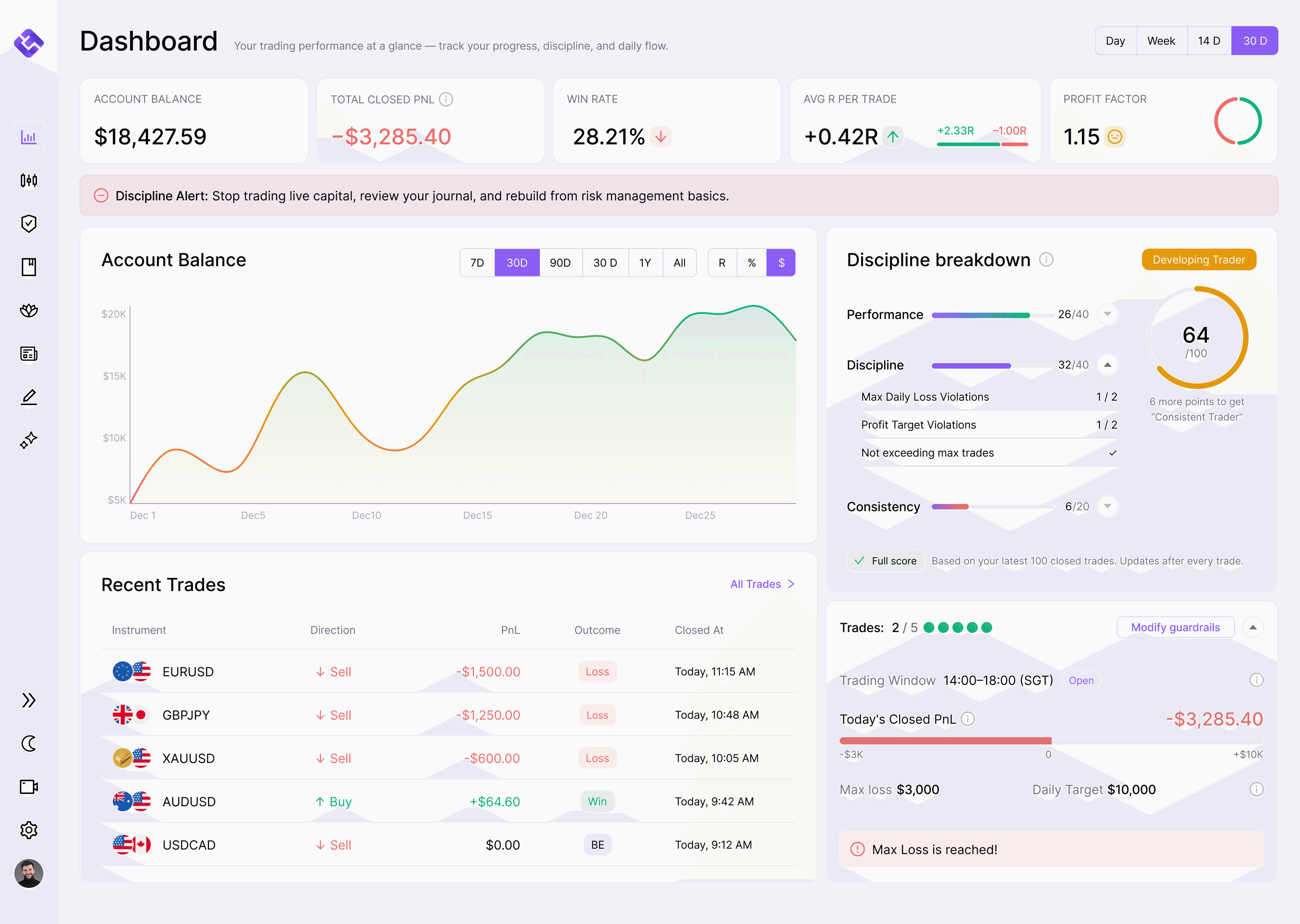
Seeing your own behavioral patterns requires data that most traders do not collect. You need emotion tags, plan adherence scores, and trade-by-trade notes, all in one place where you can filter and compare.
EdgeFlo's AI reports identify recurring behavioral patterns in your journal data. When you log the same emotional trigger before losing trades three weeks in a row, the report flags it. When your win rate drops every time you take more than 4 trades in a session, the data surfaces it.
The AI does not tell you what to do. It shows you what you are doing. The awareness step of the behavior change cycle, which is the hardest part because it requires you to see your own blind spots, becomes automatic.
From there, you still need to create the rule, follow it, and review the results. But the hardest part (seeing the pattern clearly enough to act on it) is handled by a system that reads every journal entry you write and connects the dots you would miss on your own.
A mechanical trading plan gives you the rules. Your journal gives you the data. The behavior change cycle connects the two. And changed behavior, not more information, is what changes your results.
The Edge Brief
Receive Insights on trading psychology, discipline, and the behavioral patterns that create consistent traders from our Founder and the EdgeFlo team, delivered to your inbox.
Think different. Trade different.
Why do traders keep making the same mistakes?
How do you know if you actually learned something in trading?
What is the behavior change cycle in trading?
Can reading trading books improve your results?

Turn discipline on.
Every session.
EdgeFlo is the environment serious traders operate inside.
Start 7-Day Free Trial
Cancel anytime.
No long-term commitment.

Think Different, Trade Different.