

Journal Your Mental State: The Missing Trade Data
Most journals track entries and exits. The missing data is your mental state. Learn to log energy, mood, and focus alongside every trade for better patterns.
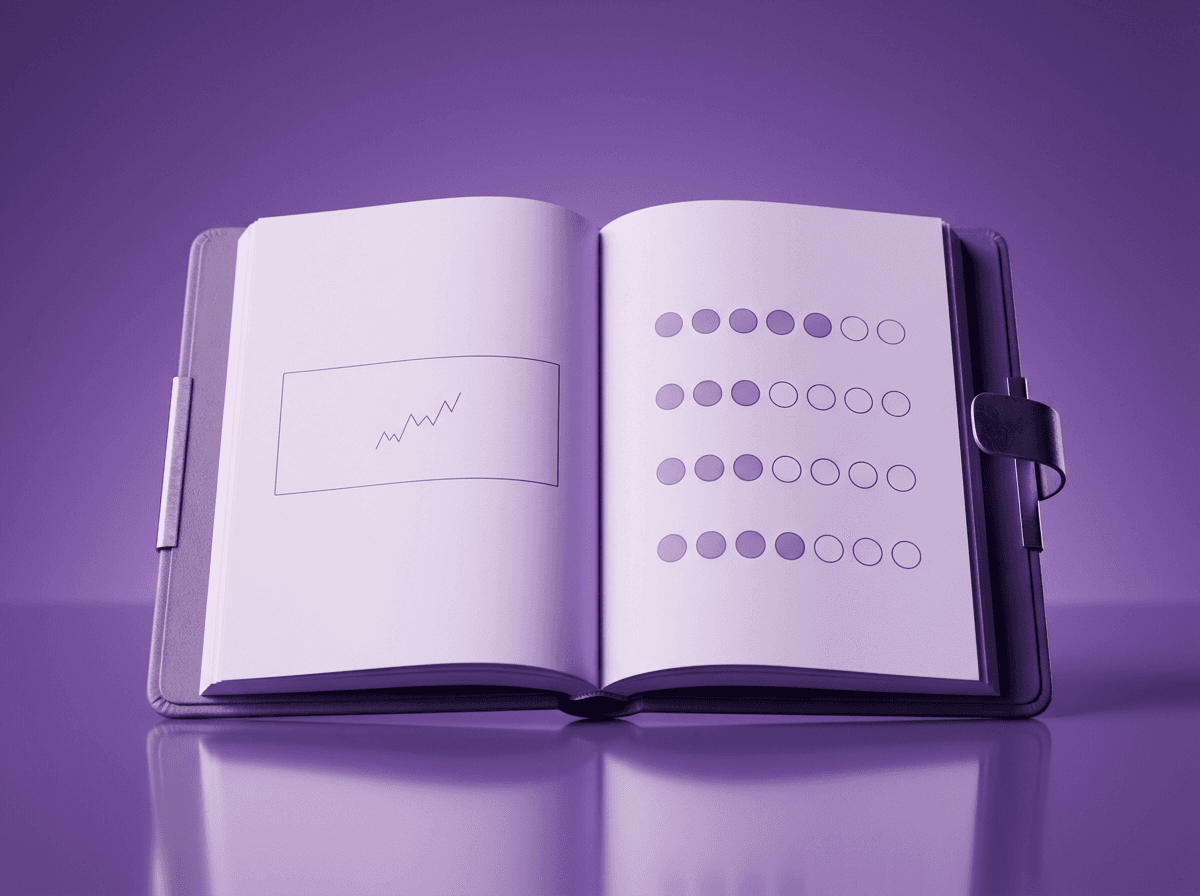
Your trading journal probably tracks entries, exits, risk-to-reward, win or loss, and maybe a screenshot. That covers what you did in the market. It completely misses why you did it and what was happening inside your head when you pulled the trigger.
The missing trade data is your mental state. And until you start logging it, you are making decisions about a dataset that is only half complete.
TL;DR
Standard journals capture trade mechanics but miss the internal conditions that drive execution quality.
Tracking sleep, energy, mood, and focus alongside every trade reveals patterns that P&L alone cannot show.
Most traders discover that 60% to 80% of their worst trades happen on days with below-baseline mental state scores.
Adding 3 to 4 mental state fields to your existing journal takes 10 seconds per trade and pays off after 30 to 40 entries.
This is not psychology work. It is data work that happens to measure the operator, not just the system.
The Gap in Your Trade Data
Think about what you track right now. Entry price, exit price, pair, timeframe, lot size, risk amount, result. Maybe you add notes about the setup quality. All of that is market data filtered through your strategy.
Now think about what you do not track. How many hours you slept. Whether you were anxious before the session. Whether you ate breakfast or ran on caffeine. Whether you were angry from a previous loss or overconfident from a previous win.
These factors do not show up in any trade log, but they directly influence every decision you make. A trader who slept four hours and skipped breakfast is not the same operator as one who slept eight and ate well. The strategy might be identical. The execution will not be.
Ever had a week where your setups were clean but your results were terrible? You review the trades and the entries look fine. The logic was sound. But something was off. You held a winner too long, you cut a trade too early, you second-guessed an entry you normally take without blinking.
That "something" was your mental state. And without data, you cannot diagnose it. You are left blaming the market or questioning your strategy when the actual problem was that you traded on four hours of sleep with a stress headache.
The Four Fields That Change Everything
You do not need a complex psychological assessment before every session. You need four simple data points:
1. Sleep hours (number). Not "good" or "bad." The actual number. 4, 6, 7.5, 8. This is objective and takes one second to log.
2. Energy level (1 to 5). A quick gut check before the session starts. 1 means dragging. 5 means sharp and alert. Do not overthink it. First instinct is correct.
3. Pre-session mood (one word). Calm, anxious, frustrated, confident, neutral, tired. Pick the word that describes your state right now, before you look at a chart. If yesterday's loss is still on your mind, the word is "frustrated," not "neutral."
4. Focus quality (1 to 5). Log this after each trade, not before. How present were you during the trade? 5 means fully locked in. 1 means you were checking your phone, toggling between charts randomly, or zoning out.
That is it. Four fields. Ten seconds per trade on top of what you already log. After 30 to 40 entries (roughly 4 to 6 weeks for most traders), you have enough data to run your first mental state review.
Walkthrough: What the Data Reveals
A trader adds these four fields to his journal template. After 42 trades over 5 weeks, he pulls the data into a simple spreadsheet and sorts by result.
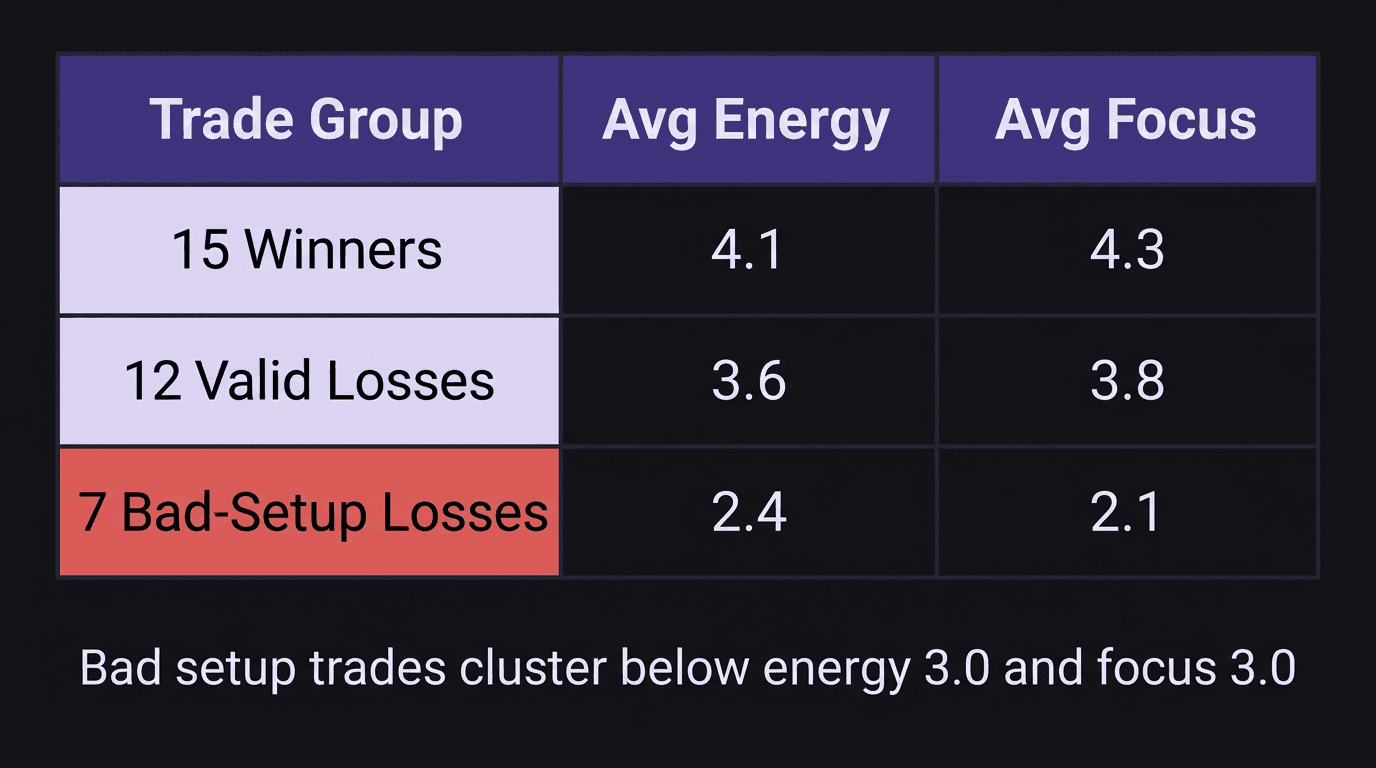
His 15 winning trades have an average energy score of 4.1 and an average focus score of 4.3. His pre-session moods are mostly "calm" or "confident."
His 12 losing trades on good setups (valid entries that hit stop) have an average energy score of 3.6 and focus score of 3.8. Normal variance. The system lost. That happens.
His 7 losing trades on bad setups (entries he should not have taken) have an average energy score of 2.4 and focus score of 2.1. Pre-session moods: "tired" (3 times), "frustrated" (3 times), "anxious" (1 time). Average sleep: 5.2 hours.
The pattern is impossible to miss. His worst trades cluster on low-energy, low-focus days. The bad setup trades are not random failures. They are execution errors that happen almost exclusively when his mental state is below baseline.
Without the mental state data, those 7 trades look like strategy failures. With it, they look like operator failures, and operator failures have a different fix than strategy failures.
How to Use the Data (The Monthly Review)
Collecting the data is step one. The power comes from the review process.
At the end of each month, sort your trades into three buckets:
Good trades, good mental state. These are your baseline. This is what your trading looks like when you are operating well. Note the common mental state scores.
Bad trades, good mental state. Normal system losses. Your strategy has a win rate, and these are the losing side of it. No action needed.
Bad trades, bad mental state. These are your operator errors. Count them. Calculate how much they cost you. Then look at the mental state scores and moods that preceded them.
Most traders find that bucket three is responsible for 40% to 60% of their total losses by dollar value but only 15% to 25% of their total trade count. A small number of trades taken in poor mental states accounts for a disproportionate share of the damage.
The actionable takeaway is simple: set a personal rule. If your energy is below 3 and your sleep was under 6 hours, do not trade that session. That one rule, derived from your own data, might eliminate half your unnecessary losses.
The Lifestyle Connection
Mental state tracking eventually points back to lifestyle. It always does.
If your energy scores consistently drop on Mondays, check what you do on weekends. Late nights? Alcohol? Poor sleep schedule? The chart does not care about your weekend. Your brain does.
If your focus scores crash after 2 PM, you know your session window closes at 2 PM. Trading past that point is not "getting extra reps." It is trading in a diminished state, and your own data proves it.
Trading on four hours of sleep is like trading after two drinks. Your reaction time drops, your pattern recognition weakens, and your impulse control erodes. The difference is that nobody would brag about trading drunk, but plenty of traders brag about pulling all-nighters to catch the Asian session.
Your strategy is your technical edge. Your mental state is your operational edge. Tracking both gives you the complete picture. One without the other is like maintaining a race car engine but never checking the driver's condition before a race.
Beyond the Basics: Emotion Tagging
Once you are comfortable with the four core fields, consider adding a post-trade review tag for the emotion you felt during the trade. Not before it (that is your mood field), but during. Were you anxious while the trade was open? Impatient? Detached? Confident?
This layer connects your emotional state during execution to the outcome. You might discover that your best trades (clean entry, proper management, full target) are the ones where you felt calm or bored during the hold. And your worst management decisions (moving stops, closing early, adding to losers) happen when you felt anxious or impatient mid-trade.
This is not therapy. This is correlation analysis on a data set that every trader generates but almost nobody captures. The traders who do capture it have a permanent informational advantage over those who only track price.
How EdgeFlo Makes Mental State Tracking Automatic
EdgeFlo's journal is built for exactly this workflow. It auto-imports your trades so you do not have to type entry and exit prices manually, freeing up the few seconds you need for mental state fields. Emotion tagging is a core feature, not an afterthought bolted onto a spreadsheet.
The weekly AI report (available on Plus) surfaces patterns across your mental state data and trade outcomes. After 4 to 6 weeks, it can identify your personal high-performance windows and your danger zones, the specific combinations of sleep, mood, and energy that predict your worst execution days.
This is the feedback loop that turns journaling from a chore into a competitive advantage. You collect the data. The system highlights what you would miss scanning a spreadsheet manually. You make one small rule change. Your next month improves because you stopped trading on the days your own data said not to.
The Edge Brief
Receive Insights on trading psychology, discipline, and the behavioral patterns that create consistent traders from our Founder and the EdgeFlo team, delivered to your inbox.
Think different. Trade different.
What mental state data should I track in my trading journal?
How does tracking mental state improve trading results?
Can I add mental state tracking to an existing trading journal?
Is mood tracking just for traders with psychology problems?

Turn discipline on.
Every session.
EdgeFlo is the environment serious traders operate inside.
Start 7-Day Free Trial
Cancel anytime.
No long-term commitment.

Think Different, Trade Different.