

Trading After a Loss: The 3-Step Reset
What to do immediately after a trading loss. Learn the 3-step reset process that stops one bad trade from becoming five.

You just took a loss. Your chest tightens, your jaw clenches, and your cursor drifts toward the next trade before you have even closed your journal. Stop. What you do in the next 60 seconds determines whether this is one loss or the start of five. The single most important skill in trading is not your entry strategy. It is knowing how to handle the moment right after a trade goes against you, because that moment is where most account damage actually happens.
TL;DR
The first 60 seconds after a loss are the highest-risk window for emotional trading.
One loss becomes five through revenge trading, not through bad strategy.
Use a 3-step reset: step away, classify the loss, then re-qualify before your next trade.
A planned loss that followed your rules requires no emotional response at all.
Set a daily loss limit before you trade, not after you start losing.
The First 60 Seconds After a Loss
Your brain does something unhelpful the moment you lose money. It treats the loss like a physical threat. Your amygdala fires, cortisol spikes, and your decision-making shifts from the prefrontal cortex (logic) to the limbic system (survival). In plain terms, you stop thinking and start reacting.
This is why you have probably reopened a trade within seconds of closing a loser. Not because you saw a new setup. Because your brain demanded you fix the pain.
Sound familiar?
Here is what actually happens in those 60 seconds for most traders:
0 to 10 seconds: Frustration hits. You stare at the closed trade.
10 to 30 seconds: Your eyes scan for another entry. Any entry.
30 to 60 seconds: You click. No plan, no checklist, just a need to get even.
That second trade is almost never your best work. It is usually the one that turns a manageable $150 loss into a $600 hole.
What Yousef Learned the Hard Way
Yousef, a 52-year-old trader from France, spent his first months burning through accounts. His wife watched him lose money and asked, "You are burning accounts, what are you doing?" He was trading GBP/USD on the 15-minute chart during London session, taking a clean 1R loss on a valid setup, then immediately jumping back in with double the lot size on a lower-quality setup. The second trade stopped out. Then a third. One planned loss became three emotional ones, and his daily drawdown hit 4% before noon. The pattern repeated for weeks until he made a decision: "I woke up and said I will change everything the way I'm doing."
The fix was not a better strategy. It was a better response to losing.
Why One Loss Becomes Five
A single loss on a valid setup costs you 0.5% to 1% of your account. That is nothing. Prop firms expect it. Your equity curve can absorb it without flinching.
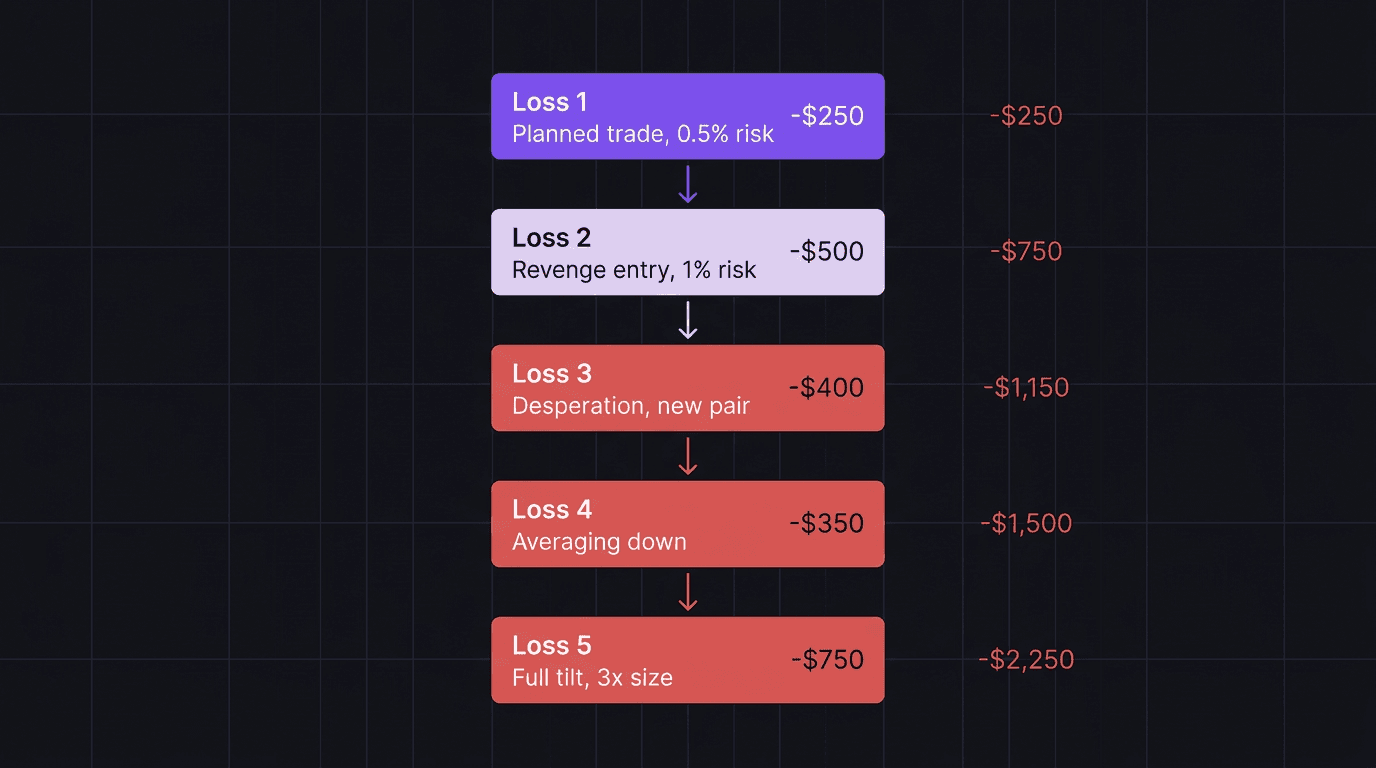
But one loss rarely stays one loss when you skip the reset. Here is the sequence that drains accounts:
Loss 1: Planned trade, valid setup, normal size. This is fine.
Loss 2: Revenge entry. Larger size, weaker setup. You are trying to recover, not trade.
Loss 3: Desperation. You switch pairs or timeframes because "this one is moving." No plan.
Loss 4: Averaging down or moving your stop. You are negotiating with the market.
Loss 5: Full tilt. Position size is 3x your normal. You have abandoned every rule you wrote down.
The common thread in trading mistakes is not ignorance. It is emotional momentum. Each loss makes the next loss more likely because your decision quality degrades with each hit.
This is exactly how revenge trading works. It is not one bad decision. It is a cascade where each trade lowers the bar for the next one.
The Math That Should Scare You
Suppose your normal risk is 0.5% per trade on a $50,000 funded account.
One planned loss: Down $250. You need a 0.5% gain to recover. Easy.
Five cascading losses (with increasing size): Down $1,800 to $2,500. You are now near your daily drawdown limit, possibly in violation of prop firm rules, and you need a 4% to 5% gain just to get back to even.
The problem is not the first loss. The problem is the four trades you took to "fix" it.
The 3-Step Reset Process
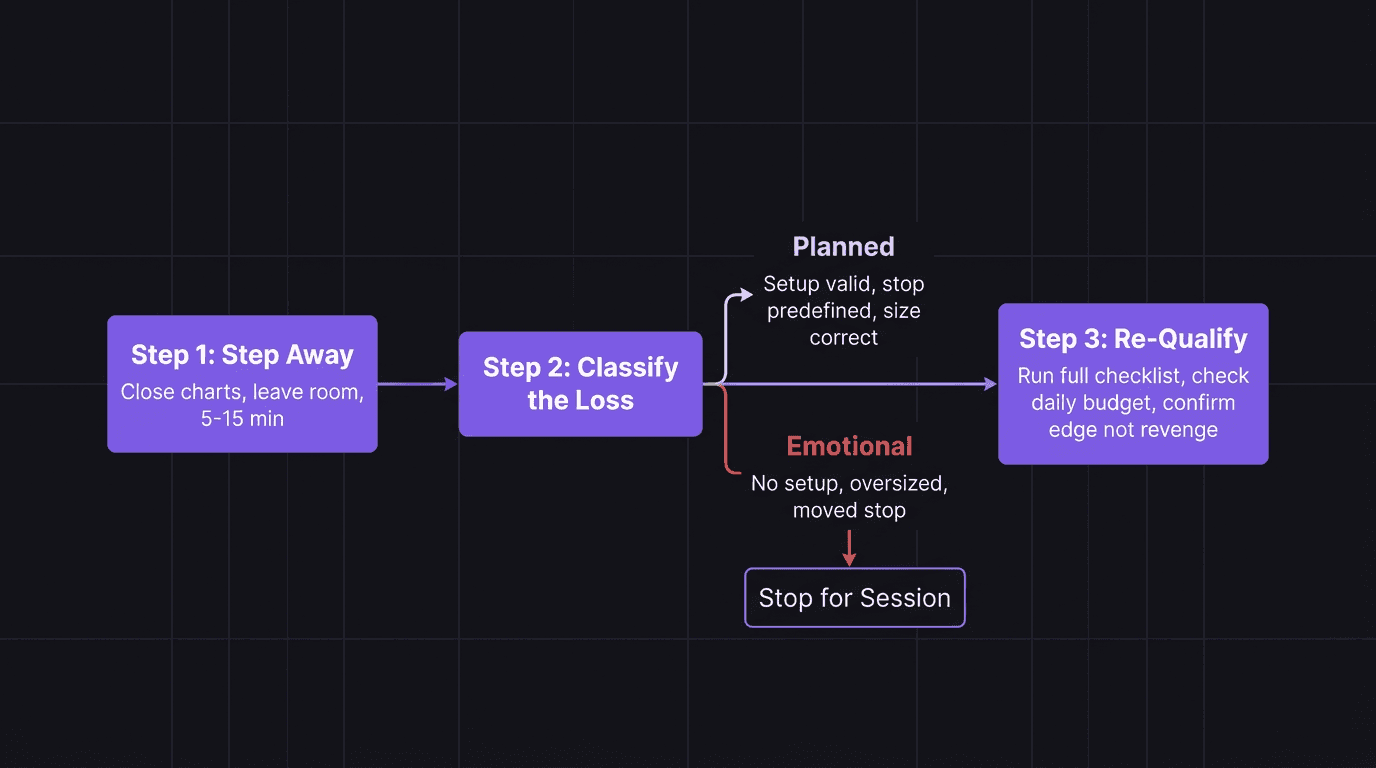
This is the protocol that separates traders who have one bad trade from traders who have one bad day.
Step 1: Step Away (Physical Reset)
Close your charts. Stand up. Leave the room for at least 5 minutes.
This is not motivational advice. This is neurochemistry. Your cortisol spike needs roughly 5 to 15 minutes to clear. Trading before it clears means you are making decisions with impaired judgment.
Drink water.
Walk outside if you can.
Do not check your phone for price alerts.
If stepping away feels impossible, that is precisely why you need to do it. The stronger the urge to stay, the more compromised your state.
Step 2: Classify the Loss
When you sit back down, answer one question: Was this a planned loss or an emotional loss?
Setup matched your entry criteria
Stop loss was predefined before entry
Position size followed your risk rules
You did not move your stop
If all four are true, this was a cost of business. You executed correctly and the market did not cooperate. No adjustment needed. Move to Step 3.
You entered without a clear setup
You sized up to recover from the previous trade
You moved your stop or had no stop
You traded outside your session window
If any of those apply, you have a process violation, not a market problem. Consider stopping for the session. The trade was not the issue. Your state was.
Step 3: Re-Qualify Before the Next Trade
Before placing another trade, run your full pre-trade checklist. Not a mental scan. Your actual, written checklist.
Answer these three questions out loud or in your journal:
Does this setup meet every criterion in my plan?
Am I within my daily loss budget?
Am I trading this because I see an edge, or because I want to recover?
If the answer to question 3 is recovery, stop trading. No setup is good enough to justify trading from a revenge mindset. Yousef discovered this the hard way: "If I got money from London, I don't want to give it back to New York." He stopped trying to trade every session and started protecting what he earned.
When to Trade Again After Losing
There is no universal timer. "Wait 30 minutes" is a reasonable starting point, but the real answer depends on your classification from Step 2.
After a Planned Loss
You have completed the 3-step reset
A valid setup appears on your watchlist
You are within your daily loss budget
A planned loss requires no emotional recovery because nothing went wrong. You followed your process and the outcome was negative. That is how probability works.
Yousef got to $850,000 in funded accounts because he internalized this: "If I made $3K once, I can do it thousands of times. Why stress?" He stopped treating individual losses as problems to solve and started treating them as expected statistical events.
After an Emotional Loss
Consider these options, in order of severity:
Take a longer break (30 to 60 minutes) and return only if a clean setup appears.
Stop trading for the session. Switch to review mode: journal the loss, mark up what went wrong, study the chart.
Stop for the day. If you have hit or approached your daily loss limit, the math says more trading makes things worse.
The fear of trading after losses is actually a useful signal when it comes from a genuine emotional loss. It means your brain is telling you to slow down. Listen to it.
The Session Discipline Rule
One of the most effective guardrails is the session boundary. Pick one session (London or New York) and commit to it. If you win during that session, protect the profit by not trading the next session. If you lose, you have a natural stopping point built into your day.
This is not about missing opportunities. It is about recognizing that your best trades happen when you are fresh and focused, not when you are grinding through hour six trying to get back to breakeven.
A losing streak often happens not because your strategy stopped working, but because you kept trading past the point where your focus and discipline held up.
How EdgeFlo Supports Your Post-Loss Process
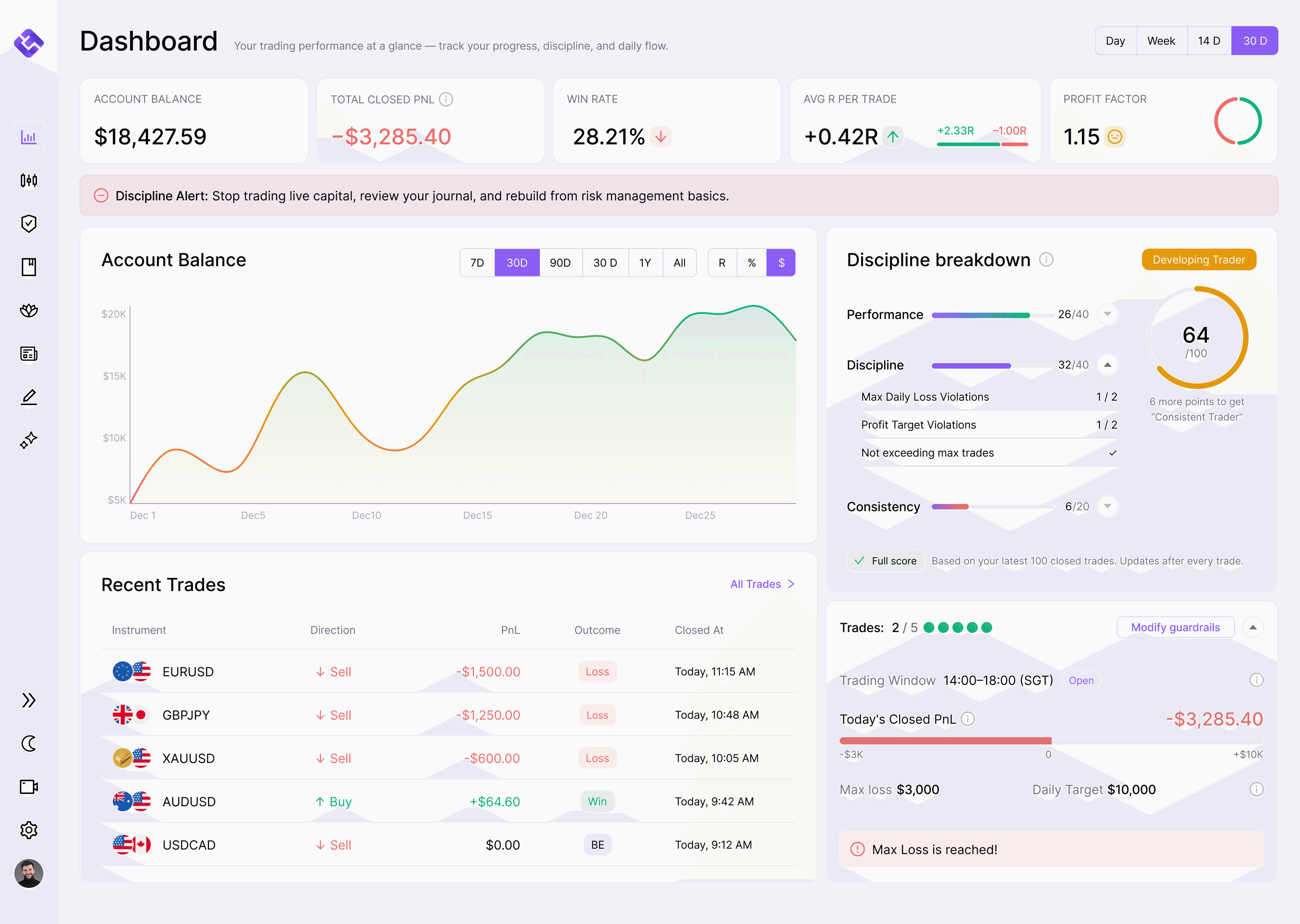
EdgeFlo builds the reset process directly into your trading environment. The Guardrails feature lets you set a daily loss limit that flags or blocks the trade button when you hit your threshold. You can override it, but you have to make a conscious choice to do so. That friction is the point: it interrupts the autopilot revenge cycle.
Sanctuary, EdgeFlo's guided reset tool, offers short recovery sessions designed specifically for the post-loss window. Instead of staring at charts while your cortisol clears, you get a structured 5-minute reset that brings you back to baseline faster.
Your trading journal auto-imports each trade with emotion tagging, so when you sit down to classify a loss (Step 2), the data is already there. You can see whether your last three losses were planned executions or emotional entries, and that pattern recognition is what turns the 3-step reset from a one-time exercise into a permanent habit.
The Edge Brief
Receive Insights on trading psychology, discipline, and the behavioral patterns that create consistent traders from our Founder and the EdgeFlo team, delivered to your inbox.
Think different. Trade different.
How long should I wait to trade after a loss?
Is it normal to want to trade immediately after losing?
Should I reduce my position size after a losing trade?
What is the difference between a planned loss and a bad loss?

Turn discipline on.
Every session.
EdgeFlo is the environment serious traders operate inside.
Start 7-Day Free Trial
Cancel anytime.
No long-term commitment.

Think Different, Trade Different.