

How Prop Firms Work: Evaluations, Payouts, and the Real Path
Prop firms give you trading capital after you pass an evaluation. Learn how the phases work, what the rules are, and why strategy comes before funding.

A prop firm (proprietary trading firm) gives you access to a funded trading account after you prove you can trade profitably within strict risk rules. You pay an evaluation fee, pass one or two test phases, and then trade the firm's capital. You keep the majority of the profits (typically 80%), and the firm absorbs the trading losses. It is the fastest realistic path for a retail trader to access serious capital without saving six figures first.
TL;DR
Prop firms fund traders with accounts ranging from $10,000 to $200,000 or more after you pass an evaluation.
Evaluations usually have two phases: hit a profit target (often 8 to 10% in Phase 1, 5% in Phase 2) without breaching the drawdown limit.
You keep 80% of the profits you generate on the funded account. The firm takes 20%.
Rushing to get funded without a tested strategy is the fastest way to waste evaluation fees.
The realistic path is: test your plan on demo, prove an edge with data, then challenge for funding.
What a Prop Firm Is
A proprietary trading firm provides capital to traders in exchange for a share of the profits. Unlike a traditional brokerage account where you deposit and risk your own money, a prop firm lets you trade with theirs.
Here is how the business model works from the firm's side. They charge an evaluation fee upfront (anywhere from $100 to $500+ depending on account size). They set strict rules around maximum daily loss, maximum total drawdown, and minimum trading days. Traders who cannot follow these rules fail the evaluation and lose their fee. Traders who pass get access to a funded account. The firm profits from evaluation fees paid by unsuccessful traders and from their 20% cut of successful traders' profits.
From your side, the math is compelling. Instead of needing $100,000 of your own capital to trade meaningfully, you can access a $100,000 account by paying a $400 to $500 evaluation fee and demonstrating that you can trade within rules. That is a fraction of the capital you would need to produce the same results on a personal account.
But there is a catch most beginners overlook: you need a proven, tested strategy before any of this works. The evaluation fee is real money. If you do not have an edge, you are paying to gamble with the firm's money under a time limit. That is expensive practice.
How Evaluation Phases Work
Most prop firms use a two-phase evaluation process. The specific numbers vary by firm, but the structure is nearly universal.
Phase 1: The Challenge
Phase 1 is the harder phase. You receive a simulated account (not real money yet) and must hit a profit target, often 8% to 10% of the account balance, within a set number of trading days (typically 30 calendar days). While pursuing that target, you must stay within two drawdown limits:
Maximum daily loss: Usually 5% of the starting balance. If you lose more than this in a single day, you fail immediately.
Maximum total drawdown: Usually 8% to 10% of the starting balance. If your account drops below this threshold at any point, you fail.
On a $100,000 challenge, a 10% profit target means you need to grow the account to $110,000. The daily loss limit of 5% means you cannot lose more than $5,000 in one day. The total drawdown limit of 10% means your account cannot dip below $90,000 at any point.
Phase 2: Verification
If you pass Phase 1, you move to Phase 2. This phase has a lower profit target (usually 5%) and the same drawdown rules. It exists to verify that your Phase 1 performance was not a fluke. The same risk management discipline applies.
On the same $100,000 account, Phase 2 requires you to reach $105,000 without breaching the same drawdown limits.
Funded Account
Pass both phases and you receive a funded account with real capital. You trade under the same drawdown rules, but now your profits are real. Most firms pay out on a bi-weekly or monthly schedule, and you keep 80% of what you earn. Some firms offer scaling plans where you get access to more capital and a higher profit split (up to 90%) after consistently profitable months.
Walkthrough: A Clean Challenge Path on a $100K Account
Your starting balance is $100,000. You risk 1% per trade ($1,000). Your strategy averages a 1:3 risk-to-reward ratio. You take one trade per day.
Week 1: You win 3 trades and lose 2. Wins: 3 x $3,000 = $9,000. Losses: 2 x $1,000 = $2,000. Net: +$7,000. Balance: $107,000. Week 2: You win 2 trades and lose 3. Wins: 2 x $3,000 = $6,000. Losses: 3 x $1,000 = $3,000. Net: +$3,000. Balance: $110,000.
You passed Phase 1 in two weeks with a 5-out-of-10 win rate (50%) because your 1:3 ratio carried you. The math works not because you won every trade, but because your winners were three times your losers.
Why You Need a Proven Strategy First
The number one reason traders fail prop firm challenges is not the profit target. It is the drawdown limit. They enter the evaluation with an untested strategy, take oversized positions, and breach the daily or total loss limit within the first week. Evaluation fee gone. No refund.
Consider the numbers. If you pay $500 for a $100K evaluation and fail four times before figuring out your strategy, you have spent $2,000 with nothing to show for it. That $2,000 could have funded a small personal trading account where you learn the same lessons without a deadline.
The fix is straightforward: do not buy an evaluation until your strategy has been backtested on at least 50 historical trades and forward-tested on demo for at least one month. Your testing data should show:
A positive win rate (above 40% with a minimum 1:2 R-ratio, or above 30% with a minimum 1:3 R-ratio)
A positive expectancy (average win x win rate minus average loss x loss rate is greater than zero)
No single losing streak that would breach the challenge's total drawdown limit
If your data does not show this, you are not ready. Keep testing. The evaluation will still be there next month.
Walkthrough: What Rushing to Funded Looks Like
A beginner watches a few strategy videos and immediately buys a $50K evaluation for $300. Day 1: enters EUR/USD at 1.0 lots with a 50-pip stop. Risk per trade: $500, which is 1% of $50K. Fine so far. The trade loses. Day 2: frustrated, he doubles position size to 2.0 lots to "make it back." Risk per trade: $1,000 (2%). Loses again. Day 3: enters 3.0 lots. Risk: $1,500 (3%). The trade moves 30 pips against him before he even gets to check the chart. Loss: 30 x $30 = $900 (on 3.0 lots, each pip is $30). Total losses after three days: $500 + $1,000 + $900 = $2,400, which is 4.8% of the $50K account. He is one bad trade away from the 5% daily loss limit. He has not even traded a full week. This is what happens without a tested plan and a funded challenge budget.
The Realistic Path From Small Account to Funded
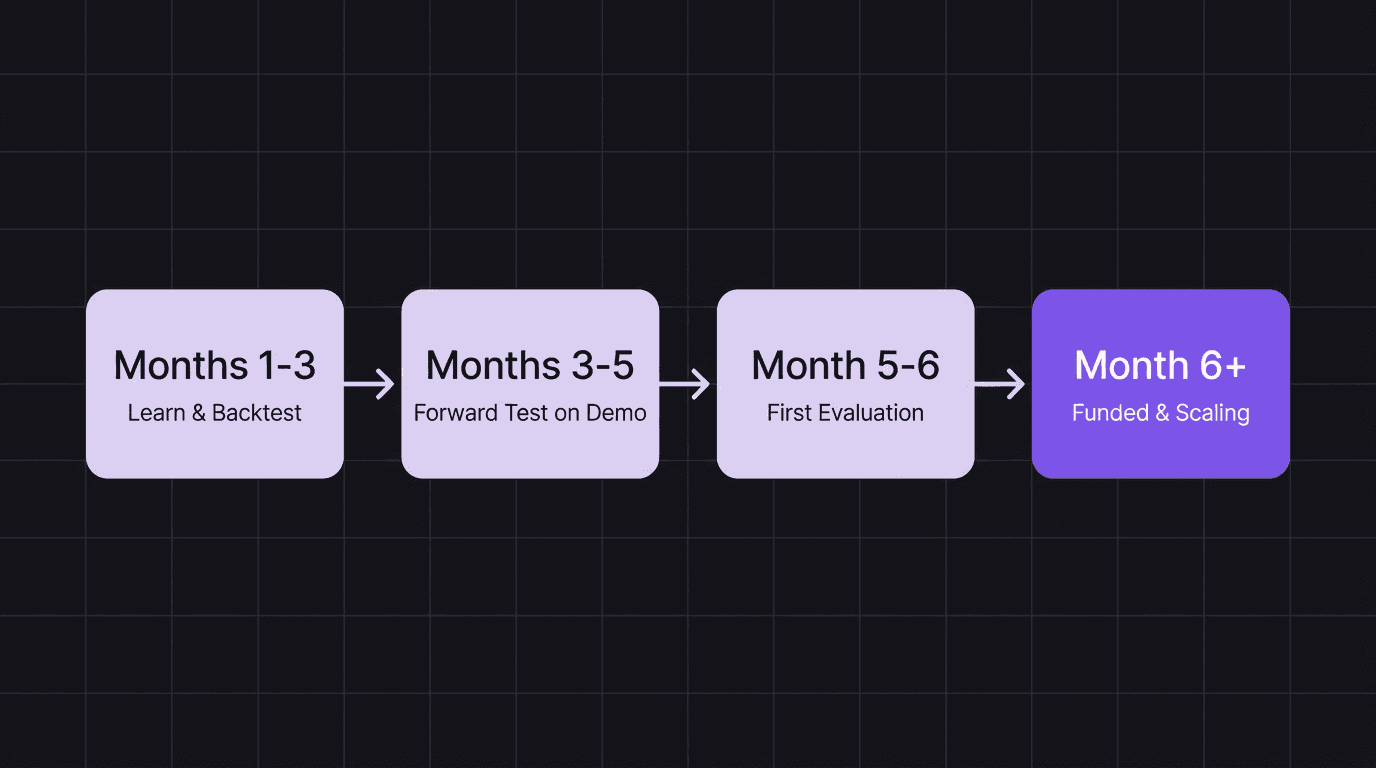
Getting funded is not the first step. It is the reward for the work you do before it. Here is the realistic timeline that actually works.
Months 1 to 3: Learn and test. Pick a strategy. Study it deeply. Backtest it on 50 to 100 historical setups. Track your win rate, average R, and expectancy. Do not spend money on evaluations during this phase.
Months 3 to 5: Forward-test on demo. Trade your strategy on a demo account in real market conditions. Execute exactly the way you would on a funded account, including lot sizing, stop placement, and session timing. Journal every trade. After 30 to 60 demo trades, your data will tell you if the edge is real or theoretical.
Month 5 to 6: First evaluation. Buy the smallest account size evaluation to limit your fee risk. Treat it exactly like your demo month. Same risk per trade, same rules, same journal process. If you pass, great. If you fail, review your journal, identify what went wrong, and try again.
Month 6+: Scale. Once you have a funded account, trade conservatively for the first two to three payout cycles. Prove to yourself (and the firm) that you can generate consistent returns under real conditions. Then consider challenging for a larger account or adding a second funded account from a different firm.
This path takes six months. Most traders want to skip to month 5 on day one. That impatience is the single biggest reason the majority of evaluation fees go to waste.
How EdgeFlo Supports Your Funded Journey
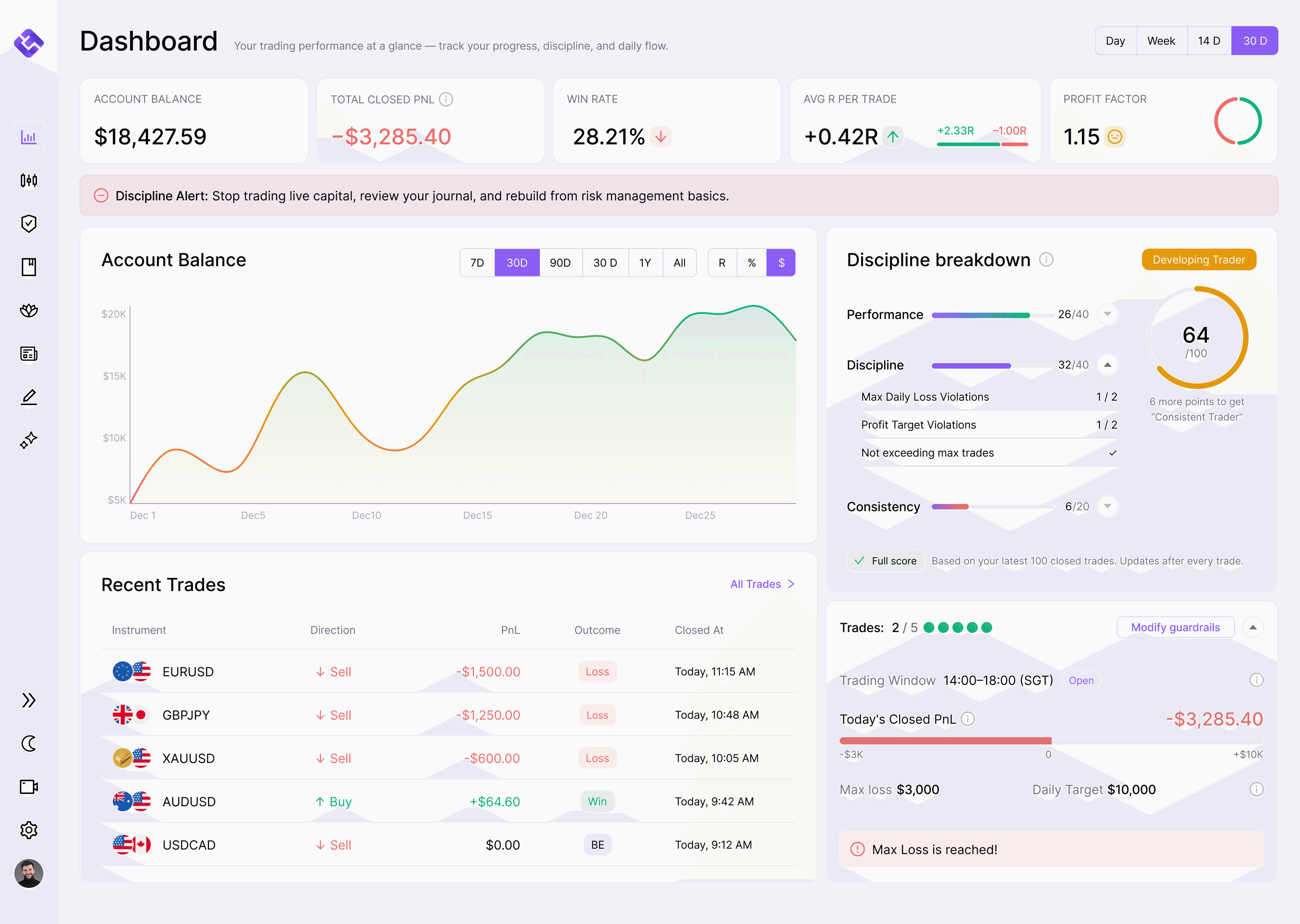
Prop firms require consistent execution and strict rule adherence. That is exactly what EdgeFlo is built for. You define your risk rules inside the app (1% per trade, daily loss cap, maximum number of trades per day), and the guardrail system warns you when you are about to break them. You can still override, but you have to make that choice consciously.
The journal automatically tracks your demo and live trades, so when you are ready for an evaluation, you already have months of data proving your edge. You know your win rate. You know your average R. You know which sessions produce your best setups. That data is the difference between walking into a prop firm challenge prepared and walking in hoping for the best.
Trading someone else's capital is a privilege you earn through proof. EdgeFlo helps you build that proof before the evaluation clock starts ticking.
The Edge Brief
Receive Insights on trading psychology, discipline, and the behavioral patterns that create consistent traders from our Founder and the EdgeFlo team, delivered to your inbox.
Think different. Trade different.
How much does it cost to get a prop firm account?
What happens if you fail a prop firm evaluation?
How much of the profit do you keep with a prop firm?
Can you lose money you did not deposit with a prop firm?

Turn discipline on.
Every session.
EdgeFlo is the environment serious traders operate inside.
Start 7-Day Free Trial
Cancel anytime.
No long-term commitment.

Think Different, Trade Different.