

How Prop Firms Make Money (And Why You Should Care)
Prop firms profit from challenge fees, copy trading, and profit splits. Understanding their business model helps you trade smarter inside their rules.

How Prop Firms Actually Make Their Money
Prop firms are not charities. They are businesses with a revenue model designed around one uncomfortable fact: most traders fail. If you want to trade inside their system without getting blindsided by the rules, you need to understand how that system makes money.
There are three revenue streams. Challenge fees come first. Copy trading comes second. Profit splits come third. The order matters because it tells you where the firm's real incentive sits.
TL;DR
Prop firms earn most of their revenue from challenge fees paid by traders who fail, not from profit splits.
Your challenge and verification accounts are demo accounts, not real capital.
Profitable funded traders get their trades copied onto the firm's live accounts.
Profit splits (typically 80/20) are the smallest revenue stream for the firm.
Understanding this model changes how you approach rules, risk, and patience during the challenge.
Challenge Fees: The Biggest Revenue Driver
When you apply for a $100,000 funded account, you pay roughly $600 in fees. For a $50,000 account, that drops to around $345. For a $10,000 account, some firms charge under $100.
That fee is not buying you a funded account. It is buying you the right to attempt the challenge. Big difference.
If you pass both phases (the challenge and the verification), the fee gets refunded. If you fail either one, the firm keeps it. And here is the number that matters: somewhere between 70% and 90% of traders who attempt these challenges fail.
Do the math. If a firm signs up 10,000 traders in a month at $600 each, and 80% fail, that is $4.8 million in kept fees from a single account tier. Multiply that across every account size and every month.
This is not a side income for prop firms. It is the engine. They are quite literally betting that most retail traders will not pass the challenge phases, and the statistics prove them right over and over.
Copy Trading: The Silent Revenue Stream
Here is the part most traders miss entirely. When you pass the challenge, when you pass verification, when you finally get "funded," you are still trading a demo account. You never touch real capital.
The firm is not handing a stranger $100,000. That would be insane. Instead, they give you a demo environment with simulated capital and watch your results.
When you are profitable, the firm copies your trades onto their own live accounts. Your winning EUR/USD long? It gets replicated by the firm's internal team on accounts backed by actual money.
Think of it as performance auditing. You prove you can trade. They mirror the proof with real capital. You never see or touch their live accounts.
This means the firm has a direct financial interest in you being profitable after you pass. But they also have a structural advantage: they only copy the traders who survived the challenge filter. The losing traders already paid their fees and left.
Profit Splits: The Smallest Piece
When you generate profits on your funded demo account, the firm takes a cut. Typically 20% goes to them, 80% stays with you. On some scaling plans, the firm's share drops to 10%.
This sounds like the obvious revenue source, but it is actually the least significant. Here is why:
The pool of funded traders is tiny compared to the pool of challengers. If 80% of traders fail the challenge, and another chunk fail verification, and another chunk blow their funded accounts, the firm might have a few hundred consistently profitable traders out of tens of thousands of applicants.
The profit split revenue from that small group is real, but it is dwarfed by the challenge fees flowing in from the 80%+ who never made it.
Walkthrough: The Revenue Math on 1,000 Challengers
Suppose a prop firm gets 1,000 new $100,000 account challengers in a single month.
Challenge fees collected: 1,000 traders x $600 = $600,000
Traders who pass both phases (assume 15%): 150 traders, fees refunded = $90,000 returned
Net challenge fee revenue: $600,000 minus $90,000 = $510,000
Funded traders who are profitable in month 1 (assume 50% of the 150): 75 traders
Average monthly profit per funded trader: $3,000
Firm's 20% profit split: 75 x $3,000 x 0.20 = $45,000
Total revenue: $510,000 (fees) + copy trading gains + $45,000 (splits) = $555,000+ before copy trading
The challenge fees alone are more than 10x the profit split revenue. That is the business model in one table.
Why This Matters for Your Trading
Understanding where the money comes from changes how you think about funded account rules. Those strict drawdown limits and daily loss caps are not arbitrary. They are profit protection for the firm.
Tight rules filter out weak traders faster. Every trader who blows a 5% daily loss limit in week one paid a fee that the firm keeps. The stricter the rules, the faster the filter works.
The firm wants you to pass, eventually. A trader who fails four challenges and passes the fifth has paid $3,000 in fees before the firm ever owes a refund. And once that trader is funded and profitable, the firm copies their trades and takes a split. Everyone wins, but the firm won on the first four attempts too.
Demo capital means zero risk for the firm during challenges. Your $100,000 account is simulated. The firm risks nothing while you prove yourself. Their only cost is platform infrastructure.
This is why patience matters more than most traders realize. The firm's model profits from rushed, underprepared traders who pay the fee, fail fast, and try again. If you show up fully prepared with a tested plan and proper risk management, you are playing a different game than the 80% who fund the model.
What Happens After You Get Funded
Once you pass, the dynamic shifts. The firm now has skin in the game through copy trading. They want your trades to work because they are mirroring them.
But you are still on a leash. Break the drawdown rules on your funded account and you lose it. The firm does not care about your track record at that point. Rules are rules, and your funded account can vanish in a single bad day.
This is why funded account management is an entirely separate skill from passing the challenge. The challenge tests whether you can generate returns under rules. Staying funded tests whether you can sustain those returns without ever having a catastrophic day.
The profit split only matters if you survive long enough to collect payouts. Many traders pass, get funded, and blow the account within the first month because they relax their discipline the moment the challenge pressure disappears.
How EdgeFlo Helps You Trade Inside the Rules
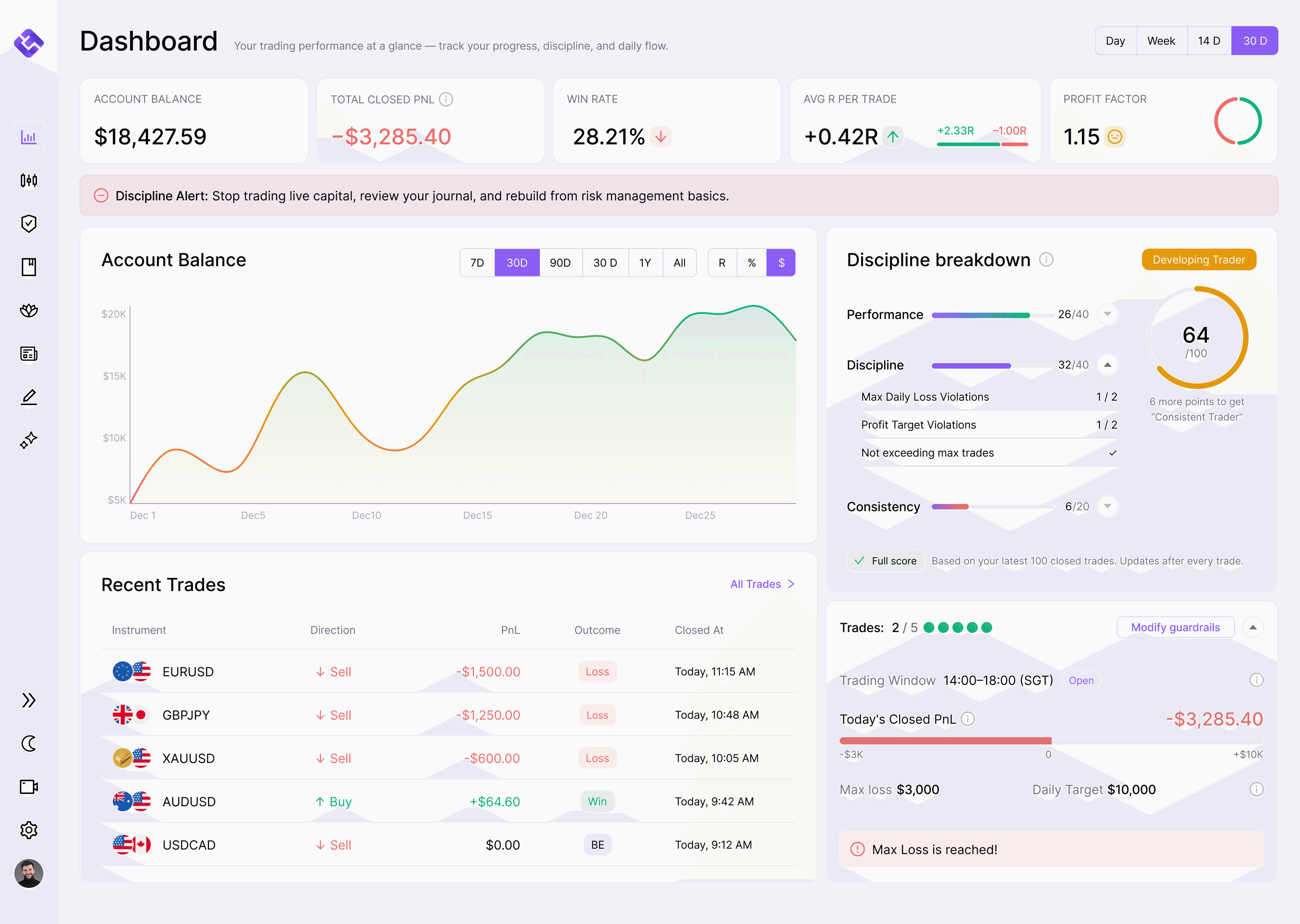
EdgeFlo's dashboard tracks the consistency metrics that funded accounts demand: win rate, average R, and discipline score across sessions. When you can see your drawdown and daily loss limit in real time, you stop guessing whether you are close to a rule violation.
The Edge plan builder lets you document your funded account strategy in one place. Your entry criteria, risk limits, and session rules stay visible next to your charts so you are not relying on memory during high-pressure trading sessions.
Funded trading is not about finding a secret strategy. It is about executing your existing strategy inside a strict rule set, day after day, without drifting. That is exactly the environment EdgeFlo is built to support.
The Edge Brief
Receive Insights on trading psychology, discipline, and the behavioral patterns that create consistent traders from our Founder and the EdgeFlo team, delivered to your inbox.
Think different. Trade different.
Do prop firms use real money for challenges?
What is the main revenue source for prop firms?
Do prop firms copy my trades?
Is the challenge fee refundable?

Turn discipline on.
Every session.
EdgeFlo is the environment serious traders operate inside.
Start 7-Day Free Trial
Cancel anytime.
No long-term commitment.

Think Different, Trade Different.