

Prop Firm Challenge: Pass Both Phases on Your First Try
Pass a prop firm challenge by hitting profit targets while staying under loss limits. This guide covers both phases, the rules that fail most traders, and a de-risking strategy that works.
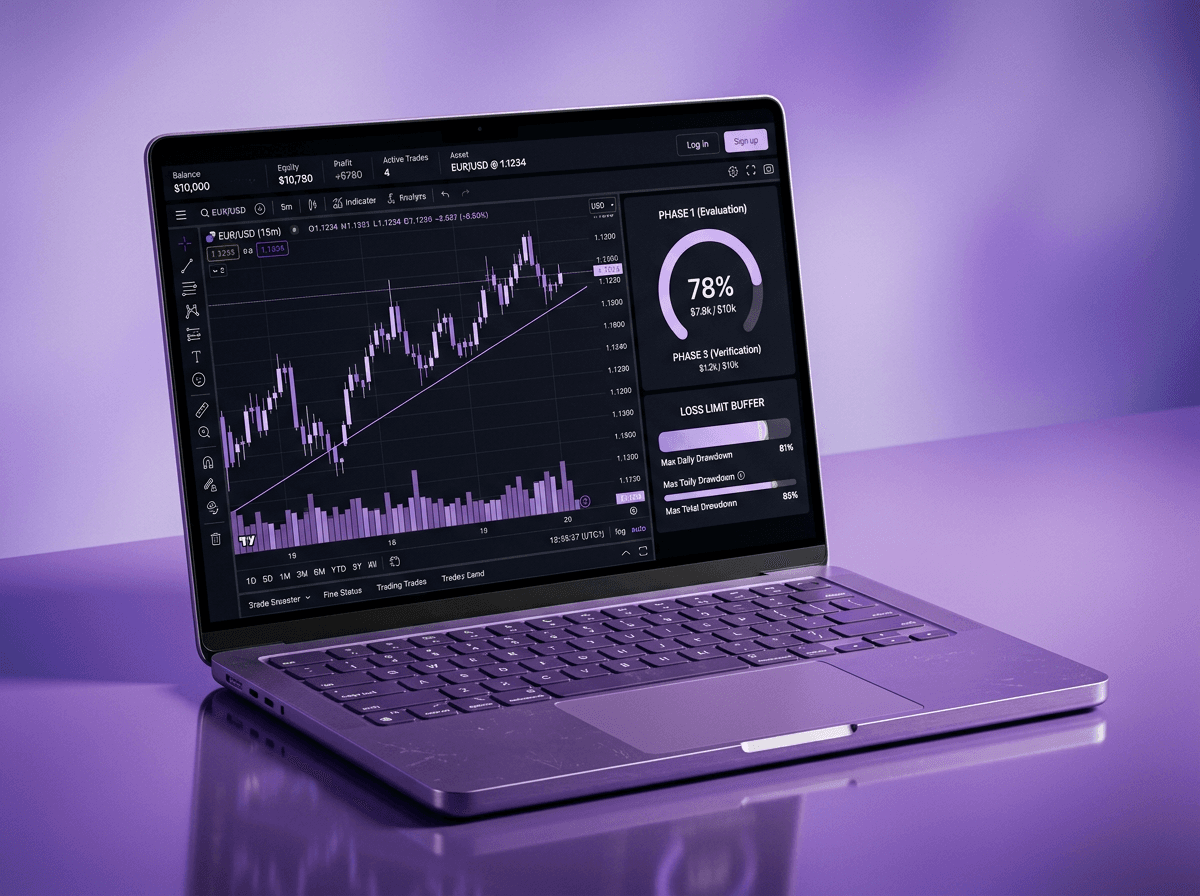
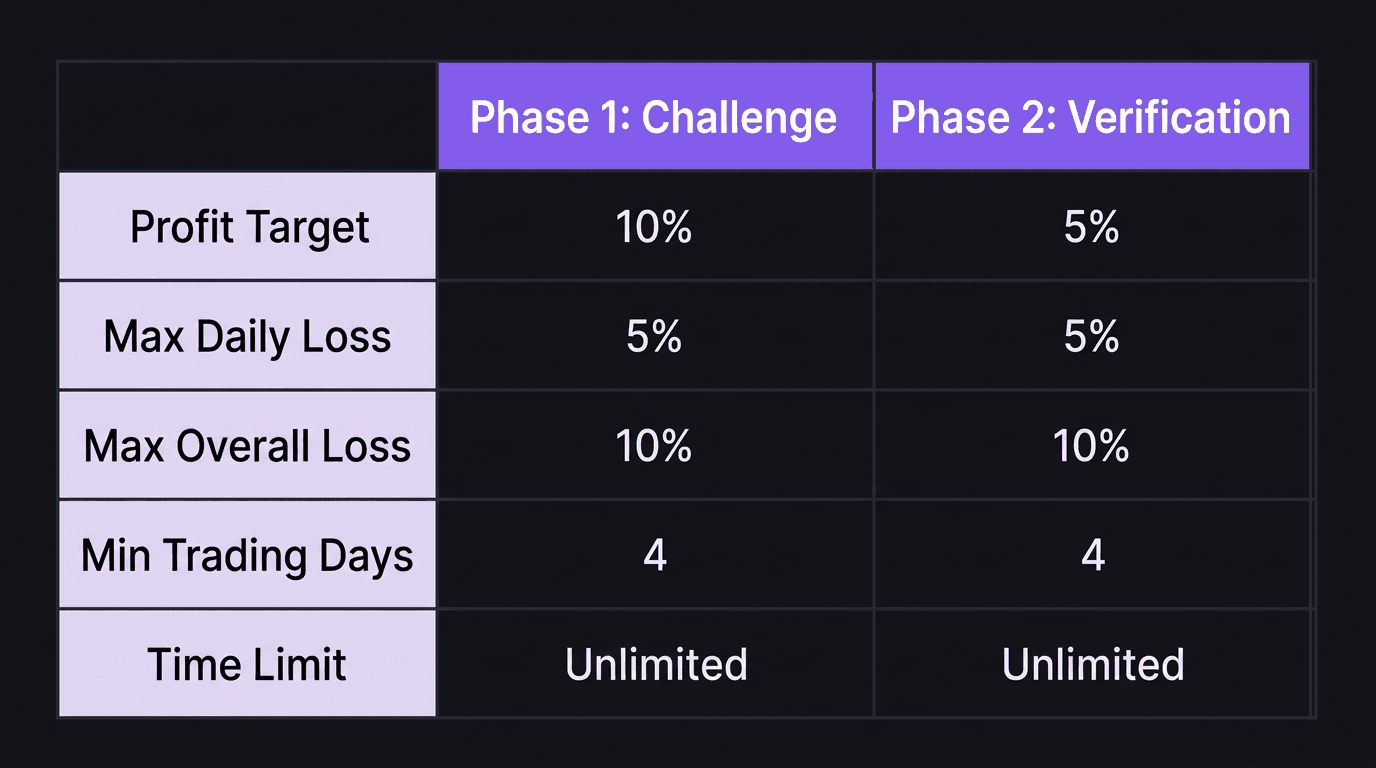
A prop firm challenge is a two-phase evaluation where you prove you can trade profitably without blowing up. Phase 1 requires hitting a 10% profit target. Phase 2 (verification) requires 5%. Both phases enforce a 5% maximum daily loss and 10% maximum overall loss. Pass both, and the firm gives you real capital to trade, typically with a 60/40 or 80/20 profit split in your favor.
The reason prop firms exist is simple: most retail traders are under-capitalized. If you have a $100 account and risk 1% per trade, your risk is $1. Even a great trade at 3:1 R:R nets you $3. That math does not produce a living. But 1% of $100,000 is $1,000. Same strategy, same risk percentage, completely different outcome.
TL;DR
Prop firm challenges have two phases: 10% profit target (Phase 1) then 5% profit target (Phase 2).
The kill rules are 5% max daily loss and 10% max overall loss on both phases.
Most failures come from risk management violations, not inability to find trades.
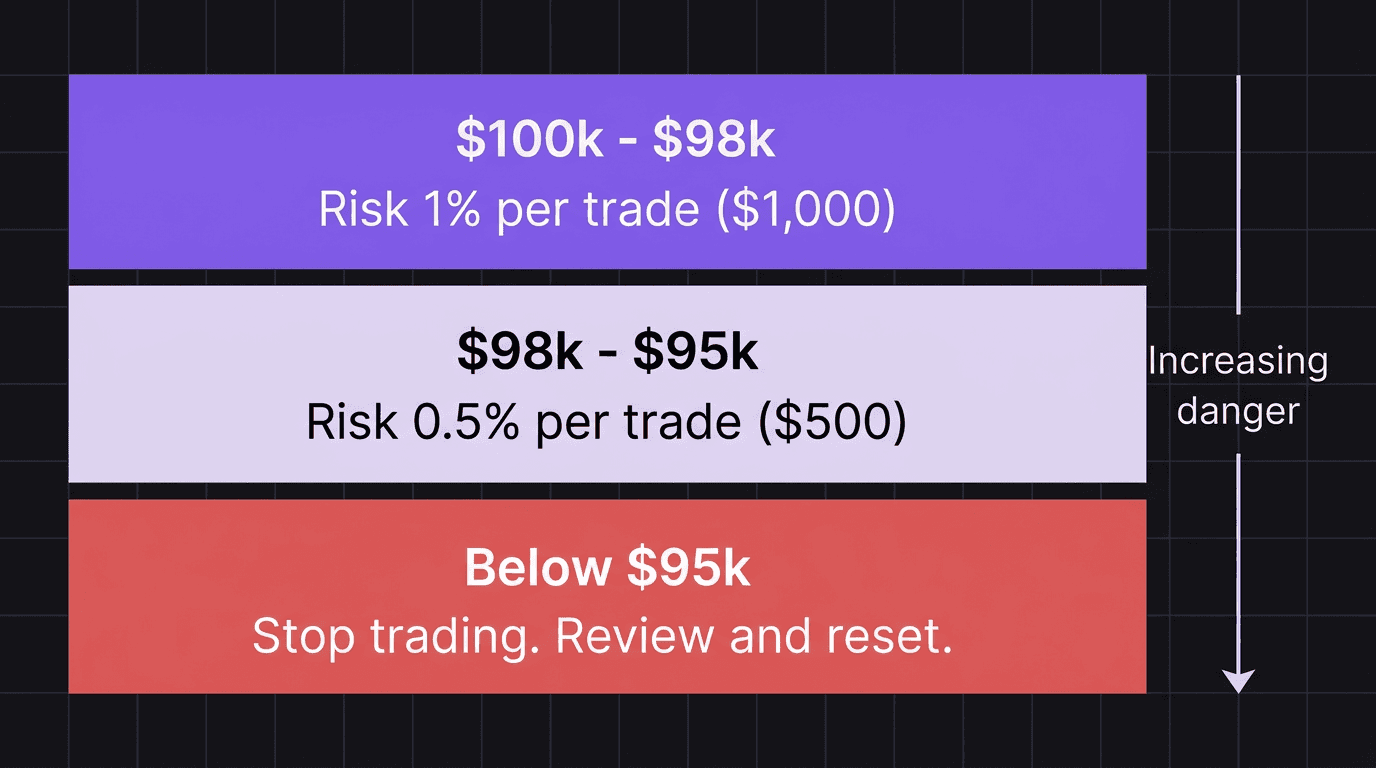
De-risk as you approach the loss limit: drop from 1% to 0.5% risk when your balance dips below $98k on a $100k account.
After funding, shift your goal from 10% to 5% monthly and focus on keeping the account alive.
What a Prop Firm Challenge Actually Tests
Forget what you think the challenge is testing. It is not testing whether you can pick winning trades. It is testing whether you can manage risk while being profitable.
Any trader can hit 10% in a week if they size up aggressively. But can you do it without ever breaching a 5% daily loss? Without letting your equity drop below 90% of the starting balance? That is a different skill entirely.
The challenge filters for consistency and discipline. The profit target is the carrot. The loss limits are the actual test.
Here is a useful comparison. Think of it like a driving test. The examiner does not care if you can go 120 mph. They care if you can drive safely, follow the rules, and still get from point A to point B. The prop firm feels the same way about your trading.
What are the most common reasons traders fail? Not bad entries. Not bad analysis. Trading mistakes rooted in poor risk management: oversizing, revenge trading after a loss, and ignoring the daily loss limit. The strategy is almost never the problem.
Phase 1: Hit the Profit Target (10%)
Phase 1 is the main challenge. You get a demo account at your chosen balance ($10k, $25k, $50k, $100k, or $200k) and need to grow it by 10%.
On a $100,000 account, that means reaching $110,000 in equity.
The rules during Phase 1:
Profit target: 10%
Maximum daily loss: 5% ($5,000 on a $100k account)
Maximum overall loss: 10% ($10,000, meaning equity cannot drop below $90,000)
Minimum trading days: 4
Time limit: unlimited (at most major firms)
The unlimited time is critical. There is no reason to rush. Traders who try to hit 10% in the first week almost always oversized to get there, and they blow the account the next week when the market turns.
Walkthrough: Phase 1 on a $100k Account
> You start with $100,000. Your strategy is trading GBP/USD during London session, taking liquidity sweep setups into demand zones on the 15-minute chart. You risk 1% per trade ($1,000) with a standard 1:3 risk-to-reward target. > > Week 1: 4 trades. 2 wins at 3R ($6,000), 1 loss ($1,000), 1 breakeven. Balance: $105,000. Daily loss never exceeded $1,000. > > Week 2: 5 trades. 2 wins ($6,000), 2 losses ($2,000), 1 small win at 1R ($1,000). Balance: $110,000. Challenge passed. > > Total: 9 trades over 10 trading days. No single day breached 5%. No drawdown below $90k. That is the pace. Not explosive. Methodical.
The key insight? At 1% risk with a 3:1 R:R, you only need to win 4 out of every 10 trades to be profitable. You do not need a high win rate. You need controlled position sizing and patience.
Phase 2: Verification (5%)
Phase 2 is the same rules, same loss limits, but the profit target drops to 5%. On a $100k account, that means reaching $105,000.
Most traders find Phase 2 easier because the target is lower. But there is a psychological trap: overconfidence from passing Phase 1.
The trap works like this: you passed Phase 1, so you feel good. You size up a little. Take a few extra trades. One bad day later, you have breached the daily loss limit and failed the verification.
Treat Phase 2 exactly like Phase 1. Same risk per trade. Same setups. Same daily routine. The only thing that changed is the finish line is closer. Do not change your process to match.
The Rules That Get People Kicked Out
Two rules end more challenges than anything else: the maximum daily loss and the maximum overall loss. Understanding exactly how they work is the difference between passing and failing.
Maximum daily loss (5%): This includes open positions, closed trades, commissions, and swaps. On a $100,000 account, your daily loss cannot exceed $5,000. But here is the detail most traders miss: if you closed trades that lost $4,000 today, your open positions cannot go below negative $1,000 more. The firm calculates it across everything, not just closed trades.
There is a flip side. If you profited $5,000 in closed trades today, you could technically afford to lose $10,000 in open positions before hitting the daily limit. The buffer grows with intraday profit.
Maximum overall loss (10%): Your account equity cannot drop below 90% of the initial balance at any point. On a $100k account, that means $90,000 is the hard floor.
The daily loss resets at midnight Central European Time (CET). If you trade in a different timezone, know exactly when your day resets. A trade held overnight carries its unrealized P&L into the next day's calculation.
Ever held a trade overnight and woken up to find your daily loss already used up before you even sat down? That happens when the daily reset catches you with a losing swing position.
Your trading journal should track daily P&L against these limits in real time. If you reach 3% daily loss, stop trading for the day. No exceptions.
The De-Risking Strategy That Keeps You Alive
This is the single most important concept in challenge trading: reduce your risk as your buffer shrinks.
Here is the framework:
Balance above $98k (on a $100k account): Risk 1% per trade ($1,000).
Balance drops below $98k: Cut risk to 0.5% per trade ($500).
Balance drops below $95k: Stop taking new trades for the day. Review what went wrong.
Why 0.5% specifically? Because one winning trade at 0.5% risk with a 3:1 R:R recovers $1,500. If you are at $97,500 (down 2.5%), that single trade brings you back to $99,000. One good trade at reduced risk recovers multiple bad trades.
The mistake most traders make? They keep risking 1% all the way down to $91,000, then one more loss blows the 10% overall limit. By that point, they need a massive recovery just to break even. Fear takes over. They either freeze or revenge trade. Neither works.
Walkthrough: De-Risking in Action
> You are on a $100k challenge. After a rough Tuesday, your balance sits at $97,200. You are down $2,800 from the start. The 10% overall limit ($90,000) is $7,200 away. Sounds like plenty, but at 1% risk, seven consecutive losers would end you. > > You drop to 0.5% risk ($500 per trade). Wednesday comes. EUR/USD sweeps below London session lows, taps a 15-min demand zone, and shifts market structure bullish. You enter long at 1.0845 with a 15-pip stop. Target: 45 pips (3:1). > > Price hits your target at 1.0890. Profit: $1,500 (3R at 0.5%). Balance: $98,700. You are back above the $98k threshold. > > Thursday you return to 1% risk. By Friday you are at $101,400. The de-risk saved the challenge.
After passing both phases and getting funded, the mindset shift matters even more. The fee gets refunded. You have real capital. But the biggest mistake is treating the funded account like a challenge and gunning for 10% monthly. Aim for 5% monthly instead. The firm is not going anywhere. Capital preservation is the game now.
Only take high-probability setups. Look for confirmation: a market shift plus a liquidity sweep before entry. And journal every single trade, because the funded account has the same loss limits as the challenge.
How EdgeFlo Helps You Pass Challenges
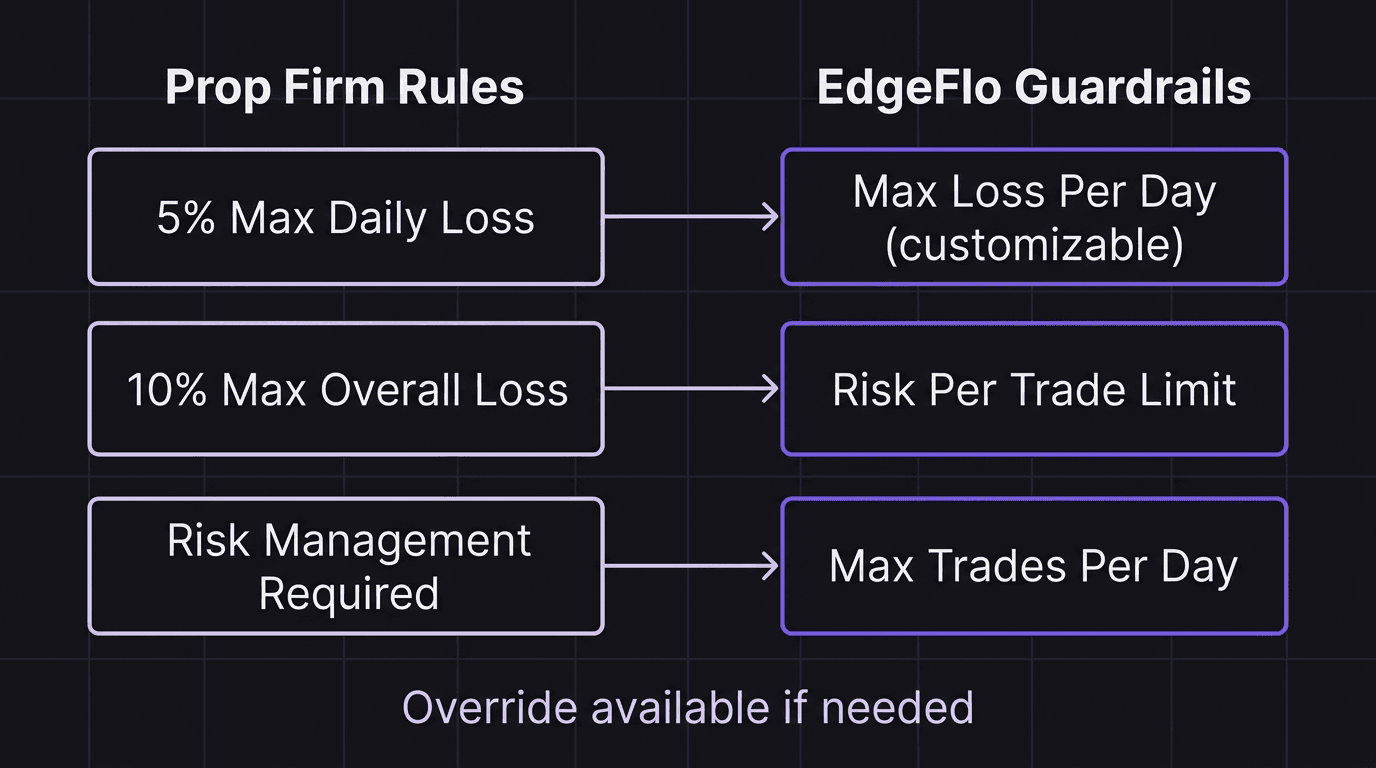
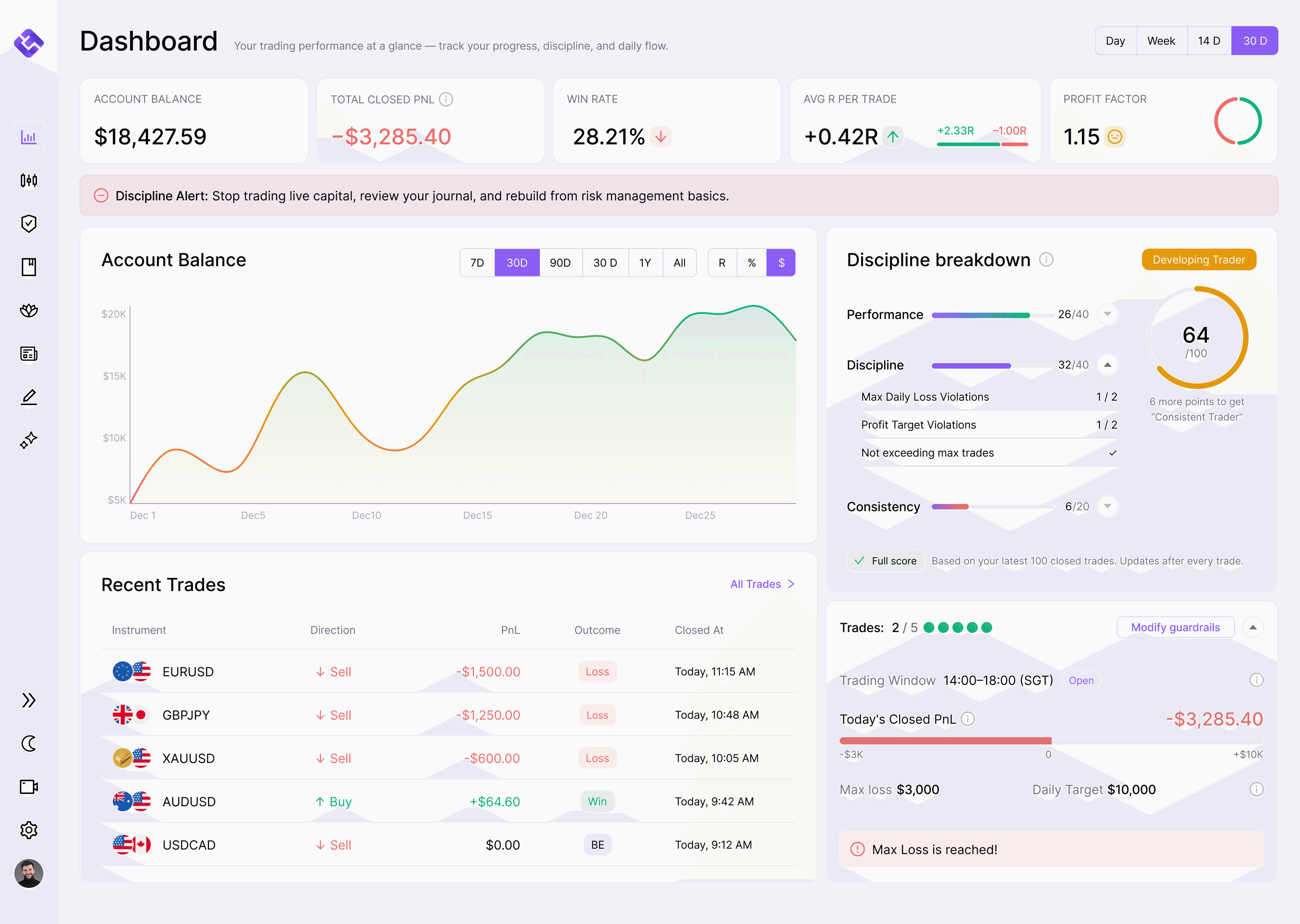
EdgeFlo's guardrails enforce max trades per day, daily profit target, risk per trade, and max loss per day, with an override option if you need it. These guardrails map directly to prop firm rules. Set your daily loss limit to 4% (leaving a 1% buffer below the 5% firm limit), and EdgeFlo flags you before you cross the line.
The lot size calculator auto-calculates position size based on your account balance, risk percentage, and stop loss distance. No more mental math errors at 7 AM that accidentally put 2% on the line instead of 1%.
Combined with the auto-journal (every trade logged with entry logic, markups, and mistakes), you build the review habit that keeps you funded long after the challenge is over. Because passing the challenge is step one. Keeping the account is the real game.
The Edge Brief
Receive Insights on trading psychology, discipline, and the behavioral patterns that create consistent traders from our Founder and the EdgeFlo team, delivered to your inbox.
Think different. Trade different.
How hard is it to pass a prop firm challenge?
How long does a prop firm challenge take?
What happens if I fail a prop firm challenge?
How much does a prop firm challenge cost?

Turn discipline on.
Every session.
EdgeFlo is the environment serious traders operate inside.
Start 7-Day Free Trial
Cancel anytime.
No long-term commitment.

Think Different, Trade Different.