

Test Your Plan Before the Funded Challenge
A funded challenge is not the place to discover your strategy has holes. Learn the exact testing sequence (backtest, forward test, demo, small live) before risking your fee.
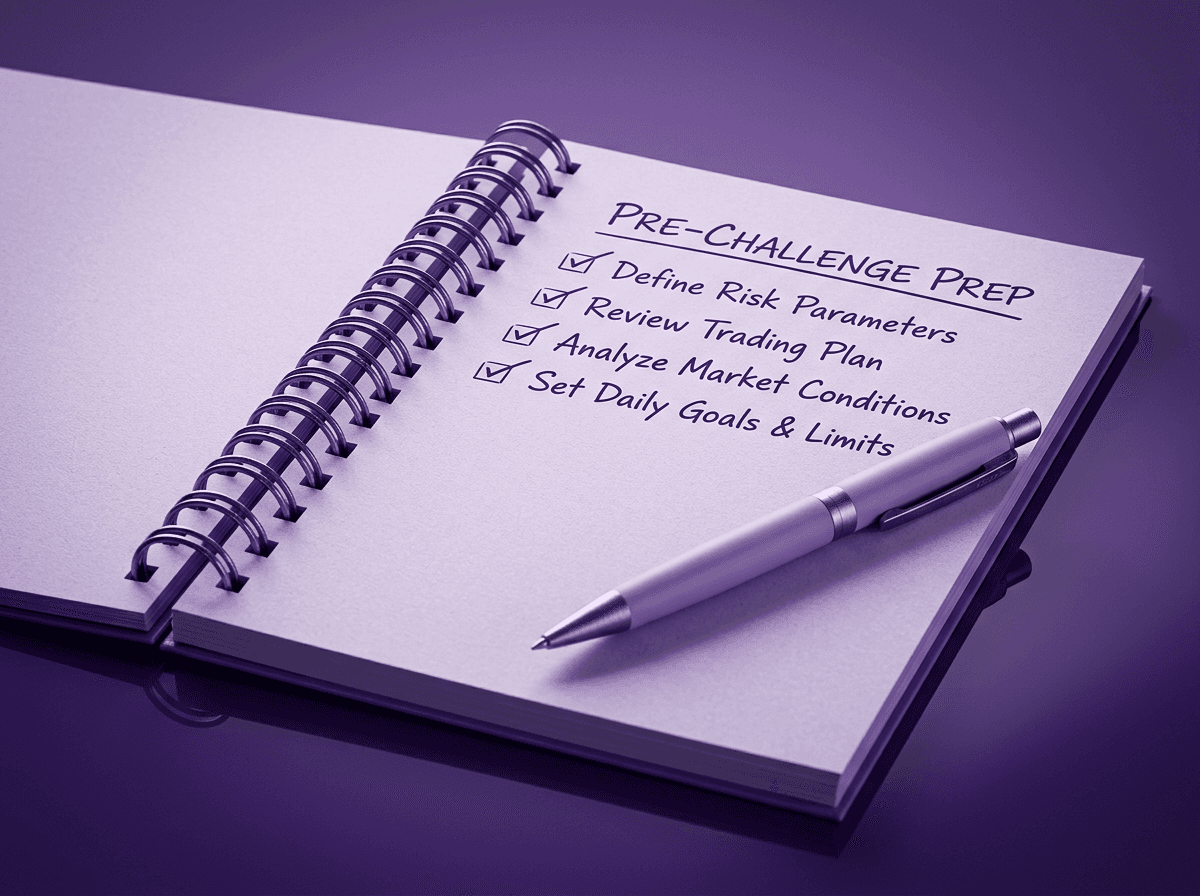
Why Untested Plans Fail Funded Challenges
A funded challenge is a test. Not of your strategy in theory. Of your strategy under pressure, with real money on the line, inside strict drawdown rules, on a deadline.
If you have not tested your plan across multiple phases before that moment, you are paying $600 to discover what is broken. That is an expensive debugging session.
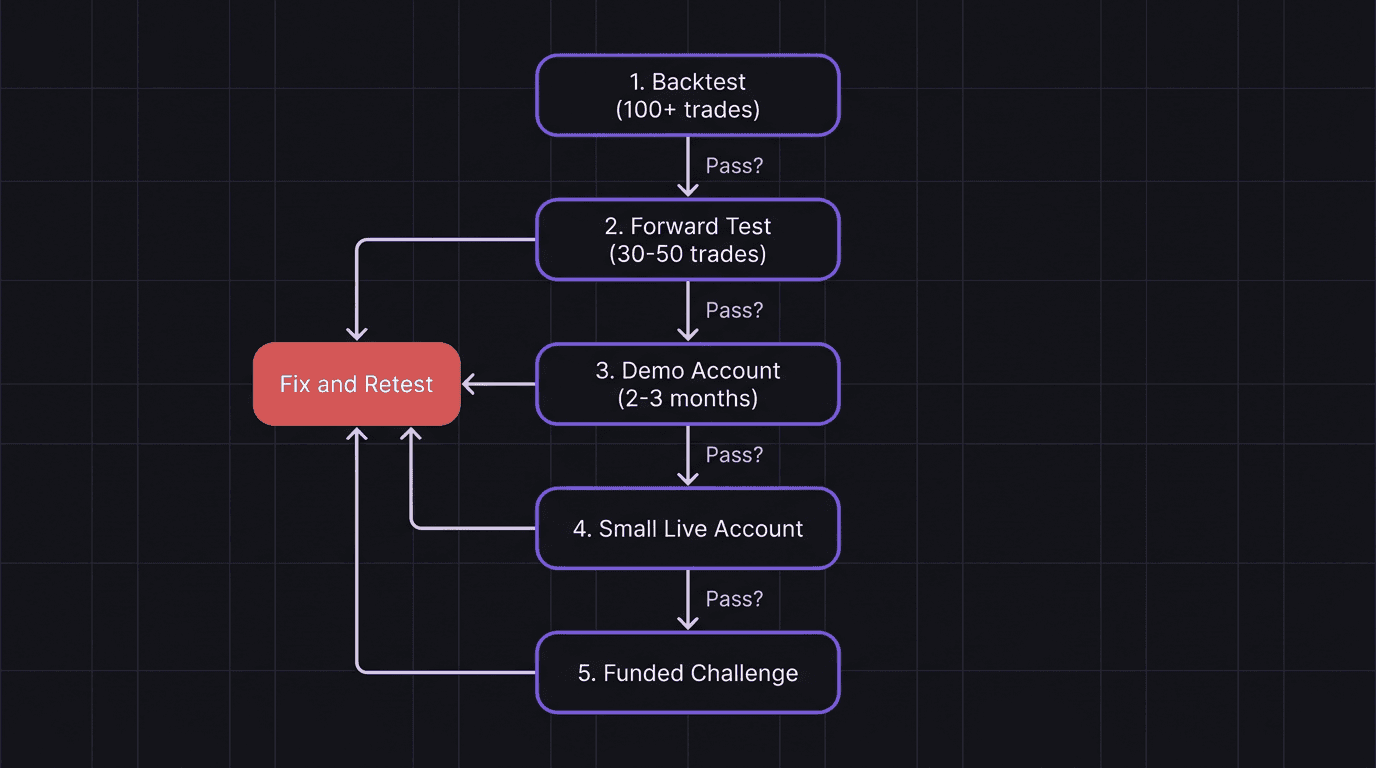
The fix is a testing sequence: backtest, forward test, demo, small live. Each phase confirms something the previous one cannot. Skip a phase and you carry an unknown into the challenge.
TL;DR
Backtesting proves your strategy has a mathematical edge over a large sample.
Forward testing proves you can execute that edge in real time, not just in hindsight.
Demo trading proves you can follow your rules when the market is moving live.
A small live account proves your psychology holds when real money is at risk.
Attempting a challenge before completing all four phases is spending money to find out what you should have tested for free.
Phase 1: Backtest at Least 100 Trades
Backtesting is the cheapest form of evidence. You scroll through historical charts, apply your rules, and record every entry, stop, and target as if you had traded it live.
The minimum sample is 100 trades. Anything less and random variance can make a bad strategy look profitable. At 100 trades, patterns start to stabilize: win rate, average R, maximum drawdown, and longest losing streak all become statistically reliable enough to trust.
What you are looking for is not perfection. You are looking for a positive expectancy. If your win rate is 40% and your average winner is 3R while your average loser is 1R, the math works.
Quick expectancy check: (0.40 x 3R) minus (0.60 x 1R) = 1.2R minus 0.6R = 0.6R per trade. Positive. The strategy has an edge.
If that number is negative or zero after 100 trades, the strategy is not ready. Going into a funded challenge with a negative-expectancy plan is gambling with extra fees attached.
Record everything in a spreadsheet: date, pair, timeframe, entry price, stop loss, take profit, outcome, and R multiple. This data becomes your proof that the plan works.
Phase 2: Forward Test in Real Time
Backtesting has a built-in flaw: you already know what happened. It is easy to cherry-pick entries when the right side of the chart is visible.
Forward testing strips that advantage away. You apply your rules on live charts, in real time, without knowing what happens next. The only difference from live trading is that no real money is at risk.
This phase exposes execution gaps:
Can you actually identify your setup when price is moving?
Do you hesitate at entries because the candle looks different in real time?
Do you manage trades according to your plan, or do you start improvising?
Run your forward test for at least 30 to 50 trades. Compare the results against your backtest. Some slippage in performance is normal because execution in real time is harder than reviewing history. A win rate drop of 5% to 10% from backtest to forward test is typical.
If the drop is larger than that, your rules might not be mechanical enough. Discretionary judgment that works when you know the future breaks down when you do not.
Phase 3: Demo Account With Full Discipline
Forward testing and demo trading sound similar, but they serve different purposes. Forward testing validates your read of the market in real time. Demo trading validates your full routine: pre-market analysis, trade management, journaling, and session limits.
Trade the demo account exactly as you would trade the funded challenge. Same session times. Same risk per trade. Same daily loss limit. Same maximum trades per day.
The goal is 2 to 3 months of consistent results. Not every week needs to be green. But the equity curve should trend upward, and your rule adherence should be near 100%.
If you catch yourself taking trades outside your plan on demo, that behavior will not magically disappear on a funded account. It will get worse, because the pressure is higher.
Walkthrough: What a Good Demo Phase Looks Like
You trade EUR/USD and GBP/USD on the 1-hour chart during London session, 3:00 AM to 8:00 AM Eastern.
Your rules: 1% risk per trade, maximum 2 trades per day, only A+ setups from supply/demand zones with liquidity confirmation.
Month 1 results: 18 trades taken, 8 wins, 10 losses. Win rate: 44%. Average winner: 2.8R. Average loser: 1R. Net: (8 x 2.8R) minus (10 x 1R) = 22.4R minus 10R = +12.4R.
Month 2 results: 20 trades taken, 9 wins, 11 losses. Win rate: 45%. Average winner: 3.1R. Average loser: 1R. Net: (9 x 3.1R) minus (11 x 1R) = 27.9R minus 11R = +16.9R.
Combined: +29.3R over 2 months, 38 trades, consistent rule adherence. This is challenge-ready data.
Phase 4: Small Live Account (The Psychology Check)
Demo results and live results are not the same. The moment real money is at risk, your brain changes. Hesitation appears. Fear of loss intensifies. The urge to move stop losses kicks in.
A small live account ($200 to $500, whatever you can genuinely afford to lose) bridges the gap. You are trading with your plan, in real time, with real consequences, but at a scale where a total wipeout would not hurt.
This phase is about psychology, not profit. If your live results match your demo results within a reasonable margin, your plan is ready. If live trading exposes panic exits, revenge trades, or rule-breaking, those issues need to be resolved before you spend $600 on a funded challenge.
The Testing Sequence Saves You Money
Every phase is free or nearly free. Backtesting costs nothing but time. Forward testing costs nothing. Demo trading costs nothing. A small live account costs $200 to $500 that you are going to lose some of anyway as tuition.
Compare that to repeatedly paying $600 challenge fees while discovering, under pressure, that your plan has holes you could have found for free.
The traders who pass funded challenges on their first or second attempt almost always share one trait: they tested exhaustively before they paid. The traders who fail four, five, six times almost always share the opposite trait: they rushed.
How EdgeFlo Supports Your Testing Process
EdgeFlo's Edge plan builder lets you document your strategy rules in one place so every testing phase uses the same criteria. When your rules are written and visible, you stop relying on memory and start building evidence that the plan actually works.
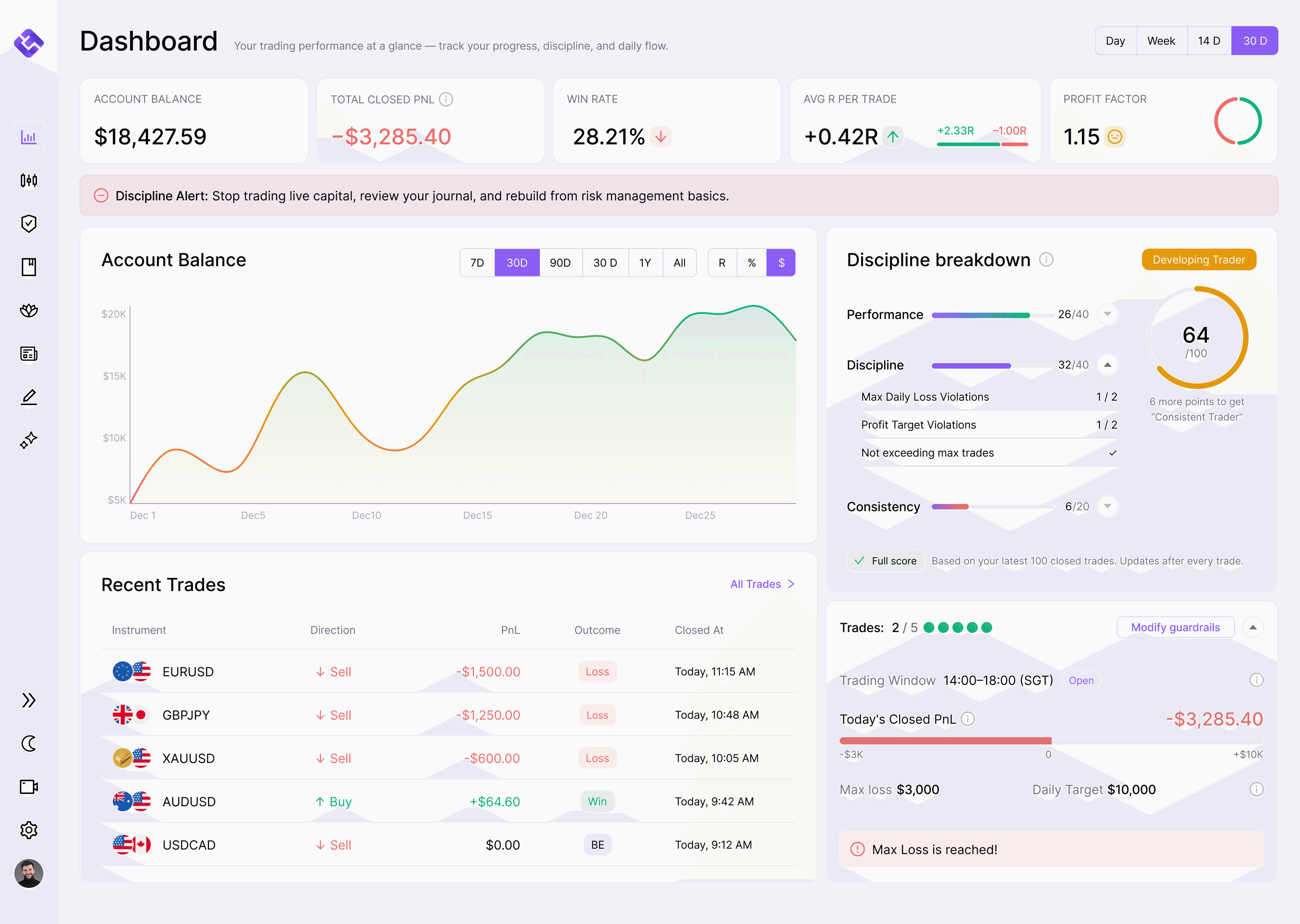
The journal tracks every trade across demo and live accounts with auto-import and custom tags. Over 2 to 3 months of demo trading, your journal becomes the proof that your plan is challenge-ready. You can review session-by-session performance, catch rule violations, and measure whether your live execution matches your backtest expectations.
Testing is not a delay. It is the foundation that makes the challenge attempt worth the fee.
The Edge Brief
Receive Insights on trading psychology, discipline, and the behavioral patterns that create consistent traders from our Founder and the EdgeFlo team, delivered to your inbox.
Think different. Trade different.
How many backtests should I complete before a funded challenge?
Can I skip forward testing and go straight to live?
How long should I demo trade before attempting a challenge?
What if my forward test results are worse than my backtest?

Turn discipline on.
Every session.
EdgeFlo is the environment serious traders operate inside.
Start 7-Day Free Trial
Cancel anytime.
No long-term commitment.

Think Different, Trade Different.