

How Much Capital to Make $10K Per Month Trading
Making $10K per month from trading requires $100K to $200K in capital at 5-10% monthly returns. Learn the real math and how funded accounts close the gap.
To make $10,000 per month from trading with proper risk management, you need a minimum of $100,000 in trading capital (targeting 10% monthly returns) or $200,000 for a more conservative 5% monthly target. Most retail traders do not have six figures sitting in a brokerage account, which is exactly why funded accounts through prop firms have become the most realistic path to reaching this income level without saving for years.
TL;DR
$10K/month on a $10K account requires 100% monthly returns. That is not trading. That is gambling.
At 1% risk per trade with a 1:3 reward ratio, you need $100K to $200K in capital to produce $10K/month sustainably.
Funded prop firm accounts let you trade $100K to $200K in capital for a fraction of the cost.
The math is simple, but most traders skip it and chase unrealistic returns from small accounts.
Build the skill first, then get the capital. Not the other way around.
The Math Most Traders Skip
Most people who search "how much capital to make $10K per month" are hoping the answer is $5,000 or $10,000. It is not. And understanding why it is not is the first step toward actually reaching that goal.
Here is the basic formula:
Monthly income target / Monthly return percentage = Required capital.
$10,000 / 0.10 (10% return) = $100,000. $10,000 / 0.05 (5% return) = $200,000. $10,000 / 1.00 (100% return) = $10,000.
That last number looks appealing, right? Flip $10K into $20K every month. The problem is that a 100% monthly return requires either massive leverage, no stop losses, or both. Even with a genuinely profitable strategy, the drawdowns that come with that level of aggression will blow the account within one to three months. You will have one incredible month followed by a total wipeout.
Here is what realistic trading math looks like with proper risk management.
You risk 1% of your account per trade. Your strategy averages a 1:3 risk-to-reward ratio. You take about 15 to 20 trades per month (roughly one per day during your best session).
With a 45% win rate on a 1:3 ratio over 20 trades per month:
Wins: 9 trades x 3% gain each = 27% in gains.
Losses: 11 trades x 1% loss each = 11% in losses.
Net monthly return: 27% minus 11% = 16%.
A 16% month sounds incredible. And some months, it happens. But trading is a probability game, and your results will not be 16% every single month. Some months will be 5%. Some months will be negative 3%. The average over a year for a consistently profitable trader is closer to 5% to 10% per month, accounting for losing streaks, flat periods, and the psychological impact of drawdowns.
That is why the capital requirement is real. You need enough money in the account so that a realistic monthly return produces the income you want.
Why $10K Per Month Requires Six Figures
Here is what different account sizes actually produce at various monthly return rates:
Account Size | 3% Monthly Return | 5% Monthly Return | 10% Monthly Return |
|---|---|---|---|
$10,000 | $300 | $500 | $1,000 |
$25,000 | $750 | $1,250 | $2,500 |
$50,000 | $1,500 | $2,500 | $5,000 |
$100,000 | $3,000 | $5,000 | $10,000 |
$200,000 | $6,000 | $10,000 | $20,000 |
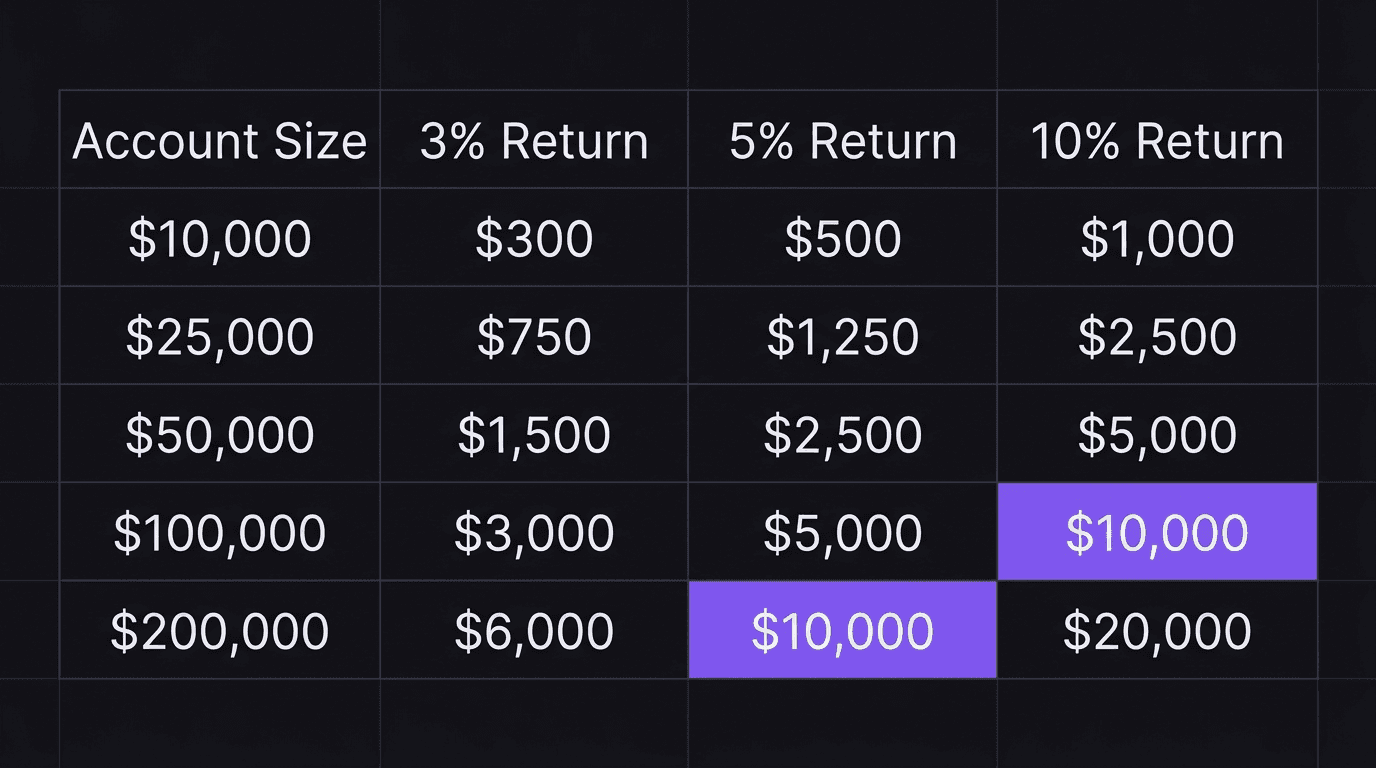
Look at the $10,000 row. Even at an aggressive 10% monthly return, you are making $1,000 per month. That is a long way from $10K. To hit $10K per month from a $10K account, you would need to generate 100% returns every single month. No professional trader does this consistently.
Now look at the $100,000 row. At 10% monthly, you hit $10K. At 5%, you need $200K to reach the same target. Both of those return levels are achievable for a disciplined trader with a tested strategy and solid position sizing.
Walkthrough: Why Compounding $10K Does Not Work the Way You Think
You start with $10,000 and commit to risking 1% per trade ($100 risk). Your strategy averages 1:3 R-ratio with a 45% win rate. In month 1, you take 20 trades: 9 wins at $300 each = $2,700 profit, 11 losses at $100 each = $1,100 loss. Net: +$1,600. Account: $11,600. Sounds good.
Month 2: same strategy, now risking 1% of $11,600 = $116 per trade. 20 trades, same ratios. Net: roughly +$1,856. Account: $13,456.
At this pace, reaching $100K takes roughly 16 months of uninterrupted 16% returns with no losing months. In reality, losing months happen. A two-month drawdown can set you back three months of gains. The honest compounding path from $10K to $100K takes two to three years, not six months. That is real, and it is fine. But if you need $10K per month now, compounding a small account is not the answer.
How Funded Accounts Solve the Capital Problem
If you do not have $100,000 to $200,000 in personal savings, you are not stuck. Prop firms solve the capital gap. You pay an evaluation fee (typically $300 to $500 for a $100K account), pass the evaluation phases, and then trade the firm's capital. You keep 80% of the profits.
Here is the math with a funded account:
You pass a $100K evaluation. You trade with 1% risk per trade. You generate a 5% return in your first payout month. That is $5,000 in gross profit. At an 80/20 split, you take home $4,000.
To reach $10K per month in take-home pay at an 80% split, you need to generate $12,500 in gross monthly profit. On a $100K account, that is 12.5% per month, which is on the aggressive side. On a $200K account, that is 6.25% per month, which is more realistic.
The practical play is to get funded on a $200K account (or two $100K accounts from different firms) and target a 5% to 7% monthly return. That produces $10,000 to $14,000 in gross profit, which nets you $8,000 to $11,200 after the firm's cut.
Walkthrough: Two Funded Accounts at $100K Each
You pass two separate $100K evaluations. Total evaluation cost: roughly $1,000. Each month, you trade both accounts identically, risking 1% per trade on each. In a good month, each account generates 5% return ($5,000 gross). Combined gross: $10,000. After the 80/20 split, you keep $8,000. In a great month at 8% return each, combined gross is $16,000, and you keep $12,800. Even in a modest 3% month, combined gross is $6,000, and you take home $4,800. The evaluation cost paid for itself in the first payout.
A Realistic Monthly Target at Different Account Sizes
Stop fixating on $10K per month as the starting goal. Start with a monthly income target that matches your current account size, and work up from there.
Account Size | Conservative Target (3%) | Moderate Target (5%) | Aggressive Target (10%) |
|---|---|---|---|
$10,000 (personal) | $300/month | $500/month | $1,000/month |
$50,000 (funded, 80% split) | $1,200/month | $2,000/month | $4,000/month |
$100,000 (funded, 80% split) | $2,400/month | $4,000/month | $8,000/month |
$200,000 (funded, 80% split) | $4,800/month | $8,000/month | $16,000/month |
If you currently have a $10,000 personal account, your realistic monthly target is $300 to $500. That is not exciting. But it is honest. Your job with a small account is not to generate income. It is to build the skill and the data that qualifies you for a prop firm challenge.
Think of your small account as the training ground. Every trade you execute, every journal entry you complete, every month you survive without blowing the account adds to your track record. When you eventually sit down to take a funded evaluation, you are not guessing. You have proof.
The traders who reach $10K per month are not the ones who tried to compound $1,000 into six figures in six months. They are the ones who spent six months building a strategy, six months proving it on demo, and then used funded capital to turn a real edge into real income.
How EdgeFlo Helps You Scale to Funded Income
The path from small account to funded trader income requires one thing above all: consistent execution over hundreds of trades. EdgeFlo is built for exactly that. Your trading plan lives inside the app. Your risk per trade is calculated automatically. Your journal captures every trade without manual entry.
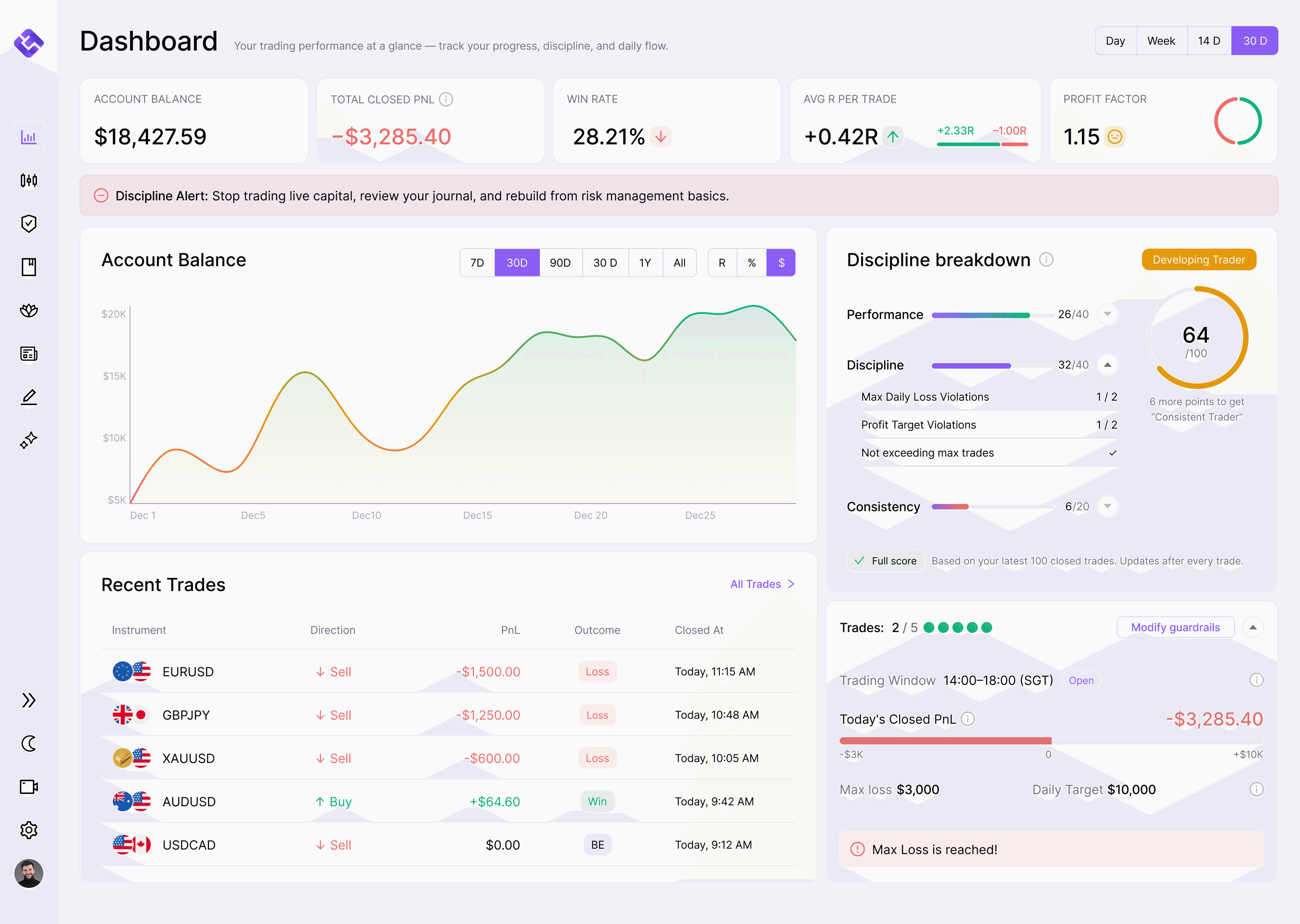
After a few months of trading, your dashboard shows your real numbers: win rate, average R-multiple, profit factor, and monthly return percentage. Those numbers tell you exactly which account size you need to hit your income target. No guessing, no hoping, just data.
The guardrail system keeps you within the same drawdown rules that prop firms enforce (you can override, but you have to choose to). Training with guardrails on a small account means you are already operating under funded-account discipline before you ever pay an evaluation fee. When the challenge starts, nothing changes except the account balance.
The Edge Brief
Receive Insights on trading psychology, discipline, and the behavioral patterns that create consistent traders from our Founder and the EdgeFlo team, delivered to your inbox.
Think different. Trade different.
Can you make $10K per month with a $10,000 account?
What monthly return is realistic for a forex trader?
Do funded accounts count as your own capital?
How long does it take to make $10K per month from trading?

Turn discipline on.
Every session.
EdgeFlo is the environment serious traders operate inside.
Start 7-Day Free Trial
Cancel anytime.
No long-term commitment.

Think Different, Trade Different.