

How 1% Risk Turns Into Five-Figure Profits
Risking 1% sounds small until your account is six figures. Learn the math of how fixed-percentage risk scales and why consistent sizing creates outsized returns.
Risking 1% of your account per trade sounds cautious. Almost boring. On a $10,000 account, that is $100 at risk. A winning trade at 3R pays you $300. Not exactly life-changing.
But the 1% rule was never designed for small accounts. It was designed to scale. And when it scales, the numbers get serious fast.
On a $200,000 account, 1% risk is $2,000 per trade. A 3R winner pays $6,000. A 5R winner pays $10,000. String together six winning trades in a month (with a couple of losses mixed in), and you are looking at five-figure monthly returns from the same boring 1% rule.
The math does not change. Your account size does.
TL;DR
The 1% rule produces small dollar amounts on small accounts, but the same percentage generates serious income at scale.
On a $200,000 account, a 3R winner at 1% risk pays $6,000 per trade.
Consistent percentage-based risk means your position size grows automatically as your account grows.
The compounding effect of fixed-percentage risk is the real engine behind five-figure months.
The discipline of consistent position sizing matters more than finding the "right" percentage.
The Scaling Math Most Traders Miss
Everyone learns the 1% rule early. Risk no more than 1% of your account on any single trade. It is the first real risk management lesson most traders encounter.
But most traders only ever calculate it once, at their current account size. They see $50 or $100 at risk and think "this is too slow." So they bump it to 3%, 5%, or worse. And they blow up.
The traders who stick with 1% and survive long enough to grow their accounts discover something the impatient ones never see: percentage-based risk auto-scales. You do not need to change your rules as you grow. The math does the work for you.
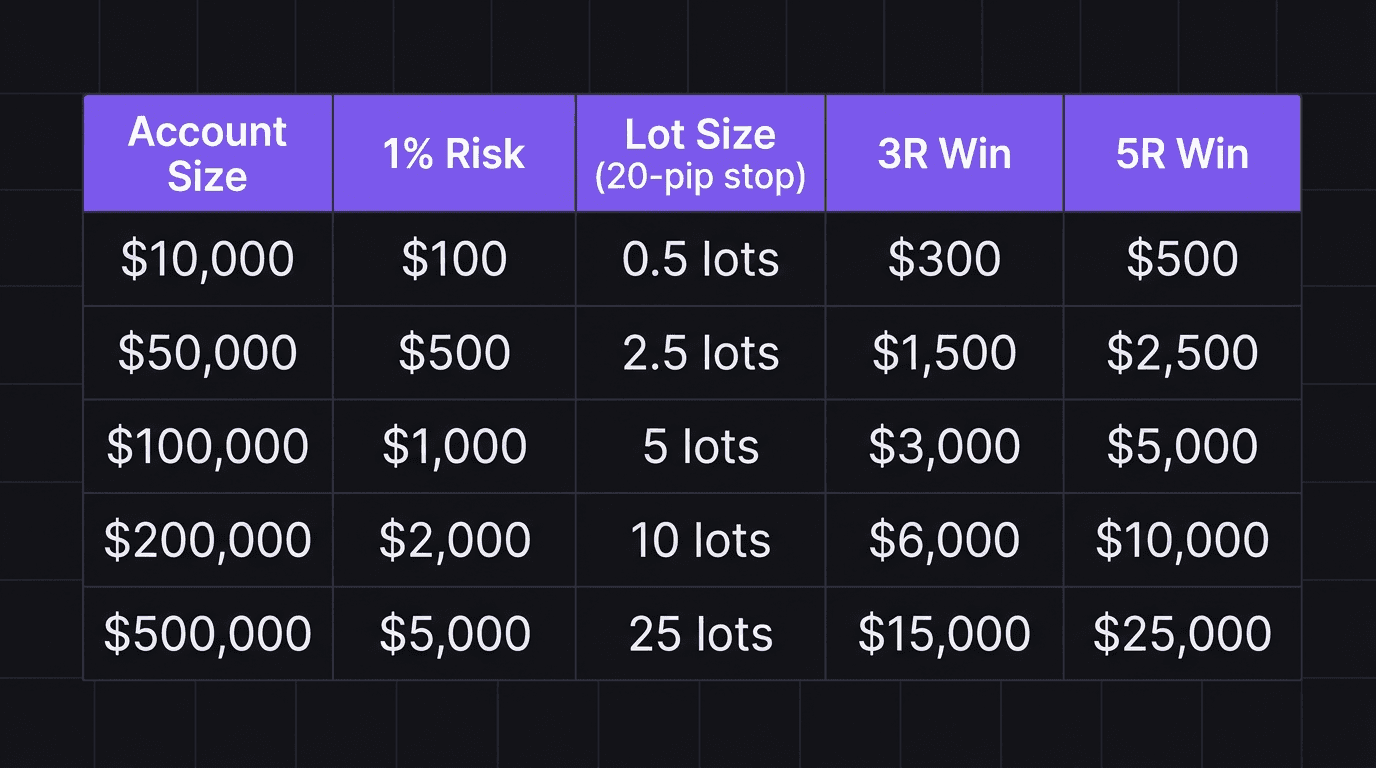
Here is what 1% risk looks like across different account sizes, assuming you trade EUR/USD (where 1 standard lot equals $10 per pip):
Account Size | 1% Risk | Max Loss (pips at 1 lot) | 3R Win | 5R Win |
|---|---|---|---|---|
$10,000 | $100 | 10 pips | $300 | $500 |
$50,000 | $500 | 50 pips | $1,500 | $2,500 |
$100,000 | $1,000 | 100 pips | $3,000 | $5,000 |
$200,000 | $2,000 | 200 pips | $6,000 | $10,000 |
$500,000 | $5,000 | 500 pips | $15,000 | $25,000 |
The strategy does not change. The risk-per-trade decision does not change. The percentage stays the same. Only the dollar output changes, and it changes dramatically.
Walkthrough: A Month at $200,000 With 1% Risk
Suppose you are trading a $200,000 account. You risk 1% per trade ($2,000) and your strategy produces a mix of wins and losses across the month. You trade EUR/USD with a 20-pip stop loss. At $10 per pip per standard lot, you need $100 per pip to risk $2,000. That means 10 standard lots per position.
Here is a realistic month with 8 trades:
Trade | Pair | Result | Pips | R Multiple | Dollar Result |
|---|---|---|---|---|---|
1 | EUR/USD | Win | +60 | +3R | +$6,000 |
2 | GBP/USD | Loss | -20 | -1R | -$2,000 |
3 | EUR/USD | Win | +100 | +5R | +$10,000 |
4 | GBP/USD | Win | +40 | +2R | +$4,000 |
5 | EUR/USD | Loss | -20 | -1R | -$2,000 |
6 | GBP/USD | Win | +60 | +3R | +$6,000 |
7 | EUR/USD | Win | +50 | +2.5R | +$5,000 |
8 | GBP/USD | Loss | -20 | -1R | -$2,000 |
Monthly result: $25,000 profit on a $200,000 account. A 12.5% return. Five wins, three losses, 62.5% win rate. Nothing extraordinary in terms of skill. Just consistent 1% risk and a strategy with a positive expectancy.
Now run the same trades on a $50,000 account at 1% risk ($500 per trade). Every number divides by four. The monthly result is $6,250 instead of $25,000. Same skill, same win rate, same R multiples. Different account size.
Why Consistency Beats Aggressive Sizing
The temptation is always to skip ahead. "If I just risk 3% instead of 1%, I triple my returns." And on paper, that is true. But 3% risk also triples your drawdowns.
Three consecutive losses at 1% risk costs you 3% of your account. Uncomfortable but survivable. Three consecutive losses at 3% risk costs you nearly 9%. That is the kind of drawdown that triggers panic, revenge trading, and the emotional spiral that turns a normal losing streak into an account blowup.
The traders who reach six-figure accounts, the ones where 1% risk starts producing five-figure trades, are the ones who protected their capital during the growth phase. They did not try to shortcut the process with oversized positions. They let compounding do the work.
Capital preservation is not a defensive strategy. It is the strategy that gets you to the account size where 1% risk actually pays well.
The Compounding Effect
Fixed-percentage risk has a built-in compounding mechanism. As your account grows, 1% represents a larger dollar amount. You are automatically trading larger positions on winners and smaller positions after drawdowns.
On a $100,000 account, 1% = $1,000 risk. You win 5R ($5,000). Your account is now $105,000. Next trade, 1% = $1,050. Your risk grew by $50 without any decision on your part.
After a losing trade, your account drops to $103,950. 1% = $1,039.50. Your risk automatically decreased. You are taking less exposure when you can least afford more.
This is the opposite of what emotional traders do. They size up after wins (greed) and size up after losses (revenge). Fixed-percentage sizing does the opposite, mechanically, every time.
What This Means for You Right Now
If you are trading a small account and feeling frustrated by the dollar amounts, understand that the 1% rule is not about today's paycheck. It is about building the habit and the track record that eventually leads to larger capital.
Whether that capital comes from your own compounded growth, a funded account, or investor allocation, the skill that gets you there is the same: consistent position sizing, consistent risk per trade, and the patience to let the math work.
The traders making $10,000 on a single trade are not using a secret strategy. They are using the same 1% rule you learned on day one. They just have a bigger account and the discipline track record to prove they deserve it.
How EdgeFlo Handles Risk Sizing
EdgeFlo's auto risk calculator computes your exact lot size based on your account balance, risk percentage, and stop loss distance. You enter your stop level, and the calculator tells you exactly how many lots to trade to stay within your 1% (or whatever percentage you set).
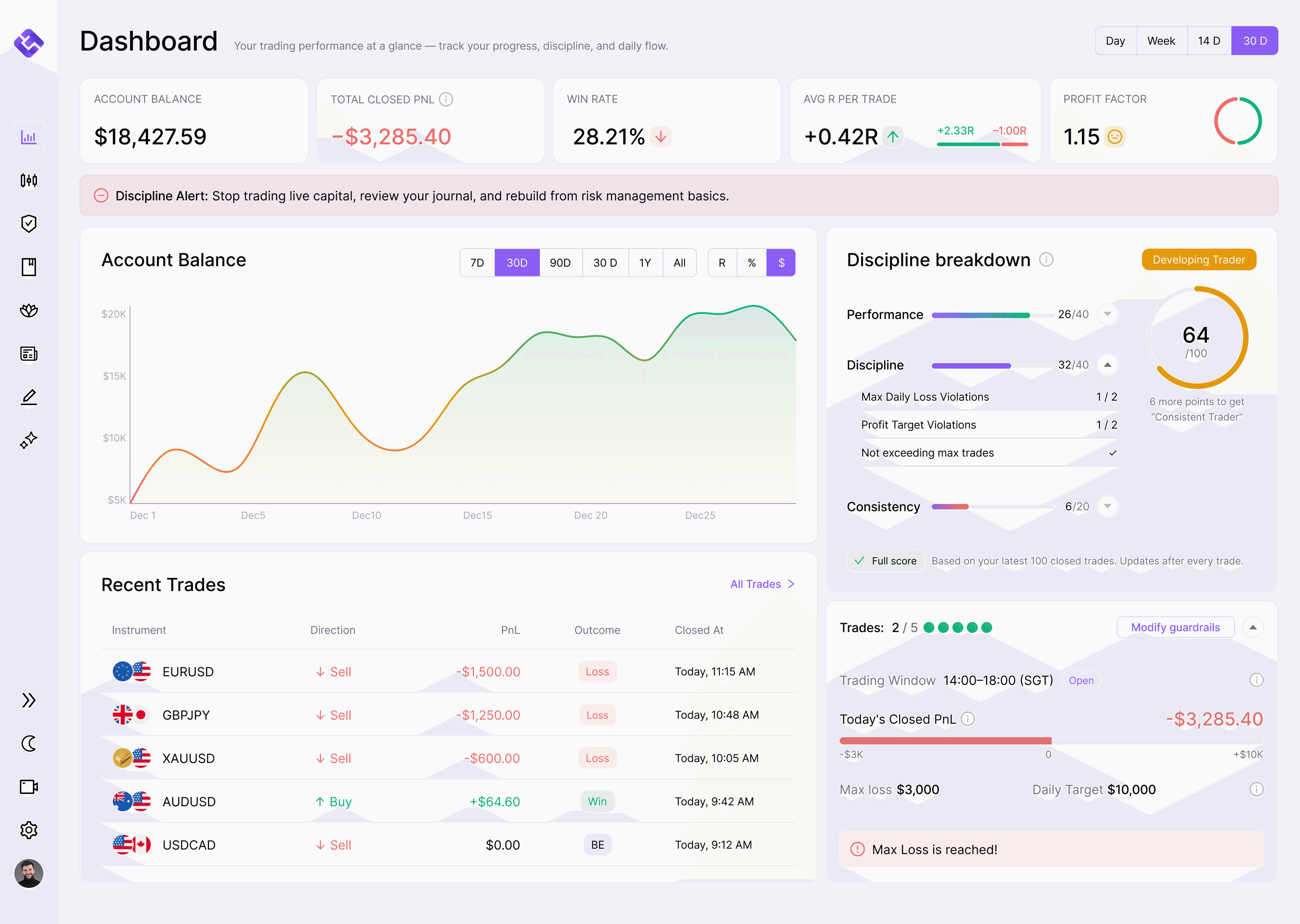
The dashboard tracks whether your actual risk per trade stays consistent over time. If you start drifting (taking 2% on "confident" trades and 0.5% on uncertain ones), the data shows it. Consistent sizing is the foundation. EdgeFlo makes it visible.
The Edge Brief
Receive Insights on trading psychology, discipline, and the behavioral patterns that create consistent traders from our Founder and the EdgeFlo team, delivered to your inbox.
Think different. Trade different.
How much money can you make risking 1% per trade?
Is 1% risk too conservative for a small account?
How does 1% risk compound over time?
Should I ever risk more than 1% per trade?

Turn discipline on.
Every session.
EdgeFlo is the environment serious traders operate inside.
Start 7-Day Free Trial
Cancel anytime.
No long-term commitment.

Think Different, Trade Different.