

Funded Accounts: Only High Probability Setups
With a 10% max drawdown and 5% daily loss limit, every trade on a funded account matters. Learn why quality over quantity is the only viable funded strategy.
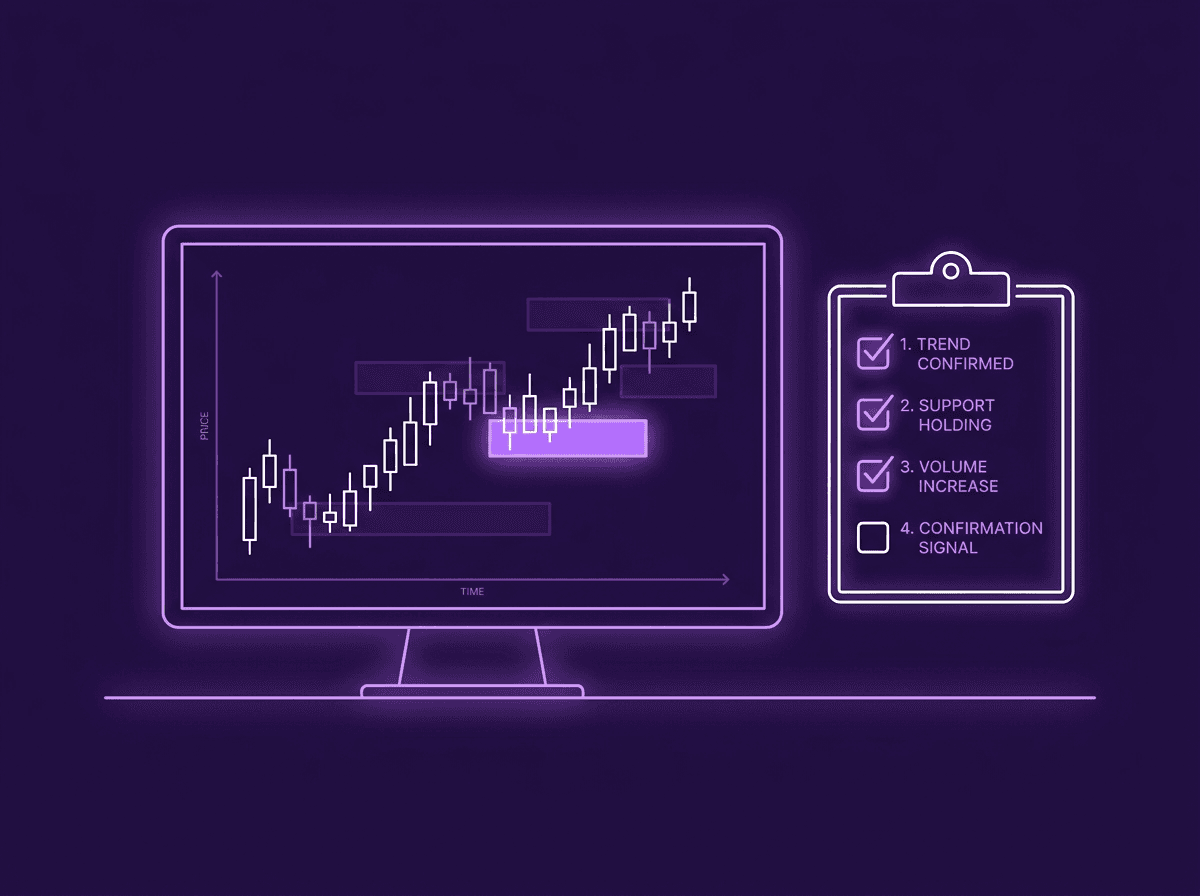
You passed the challenge. You got funded. And now the rules are tighter than anything you traded under before.
On most funded accounts, you get a 10% maximum drawdown and a 5% daily loss limit. That is your entire margin of error. Every low quality trade chips away at a buffer that does not refill overnight.
So the question is not "how many trades can I fit into this session?" The question is "does this setup deserve my funded capital?"
TL;DR
Funded accounts punish volume trading because the drawdown limits are fixed and unforgiving.
One good trade per session protects your account better than five mediocre ones.
A high probability setup must pass every filter in your plan before you click.
If nothing meets your criteria, the best trade is no trade at all.
Patience is not a virtue on funded accounts. It is a survival skill.
Why Funded Rules Change the Math
On a personal live account, a bad day costs you money. On a funded account, a bad day can cost you the entire account.
Here is the difference in plain numbers. Say you have a $100,000 funded account. Your daily loss limit is 5%, which gives you $5,000 of room before the platform shuts you down for the day. Your total drawdown cap is 10%, or $10,000 total.
Now imagine you take four trades in a morning, each risking 1% ($1,000). Two win, two lose. On your personal account, that is a normal day. On your funded account, you just used 40% of your daily loss budget on the losers alone.
If the winners only covered the losers, you burned capital, time, and mental energy for zero progress. But if you had waited for one A+ setup and hit a 3R winner, you would be up $3,000 with only $1,000 of risk used from your daily budget.
The funded environment rewards selectivity because the penalty for quantity is permanent.
What "High Probability" Actually Means Under Pressure
Traders throw around "high probability" without defining it. On a funded account, you need a concrete definition that you can check before every entry. Otherwise, desperation will convince you that a weak setup qualifies.
A high probability setup on a funded account meets all of these conditions:
Multi-timeframe alignment. The higher timeframe structure supports your trade direction. If the daily chart is bearish and you are buying a 15-minute pullback, that is not aligned.
Confirmed point of interest. You are trading from a supply or demand zone that has confluence (liquidity sweep, flip zone, order block stacked with another factor). Not a random level you drew this morning.
Entry confirmation. Price entered your zone and gave you a secondary signal: a break of internal structure, a rejection candle, an order flow shift. You are not buying blindly at a line.
Your trading plan says yes. Every rule in your mechanical checklist is checked. Not "most of them." All of them.
If any of these filters fails, the setup is not high probability. Walk away.
Walkthrough: The Trade You Should Have Skipped
A trader on a $100,000 funded account spots EUR/USD approaching a demand zone on the 15-minute chart during London session. The 4-hour chart is bearish, printing lower highs and lower lows. But the 15-minute zone "looks strong," so the trader enters long, risking 1% ($1,000) with a 30-pip stop.
Price wicks into the zone, bounces 10 pips, then breaks straight through. The trade hits full stop loss. The trader is down $1,000, which is 20% of their daily loss budget, on a trade that violated multi-timeframe alignment.
The fix: check the 4-hour and daily structure first. If the higher timeframe is pushing against you, no 15-minute zone is strong enough. That $1,000 loss was avoidable.
One Trade at a Time: The Funded Mindset
The single hardest adjustment for funded traders is doing less. On a demo or personal account, you could always take another shot. On a funded account, every shot has a price that compounds against you.
"One good trade at a time" is not motivational fluff. It is risk math.
When you limit yourself to high quality entries, your daily loss limit stretches further. If you risk 1% per trade and only take one or two trades per day, you can absorb two full losses and still have 60% of your daily budget intact. But if you take five trades, two losses already consume 40%, and the psychological pressure of being down pushes you toward a sixth, seventh, eighth trade to "make it back."
That is how funded accounts die. Not from one bad trade, but from the cascade of mediocre trades that follows it. Trading rules exist for this exact scenario: to hold the line when your emotions push for more.
Grading Your Setups Before Entry
Before you enter any trade on a funded account, score it against your plan. If you do not have a grading system, build one today. A simple version:
Grade A (take the trade): All filters pass. Multi-timeframe aligned. Point of interest confirmed. Entry model triggered. Risk-to-reward is at least 2:1.
Grade B (consider skipping): Most filters pass, but one is weak. Maybe the higher timeframe is ranging instead of trending. Maybe the point of interest is untested. On a personal account, you might take this. On a funded account, skip it.
Grade C (no trade): Two or more filters fail. Walk away. Come back tomorrow.
Your daily loss limit does not care whether you feel like you "should be trading." It only counts dollars lost.
Walkthrough: One Good Trade vs Three Average Ones
Trader A takes three B-grade setups on GBP/USD during New York session, risking 0.5% ($500) each. Two lose, one wins at 3R. Two losses cost $1,000 total. The 3R winner returns $1,500. Net result: plus $500.
Trader B waits for a single A-grade setup on the same pair. The 4-hour structure is bullish, price sweeps liquidity below a daily demand zone, and the 15-minute breaks structure to the upside. Trader B enters risking 1% ($1,000) and hits a 3R target. Net result: plus $3,000.
Trader A used $1,500 of total risk exposure to make $500. Trader B used $1,000 to make $3,000.
Both traders were right about direction. But Trader B's patience turned the same market move into six times the profit with the same risk budget.
When Nothing Qualifies, Do Nothing
This is where most funded traders fail. You sit down, open your charts, and nothing meets your criteria. The market is ranging. Your zones are untested. The session is slow.
Every instinct screams "take something." Your challenge fee is gone. Your funded status is on the line. Doing nothing feels like wasting the opportunity. But trading patience is what separates funded traders who last from those who blow up in week one.
But doing nothing when nothing qualifies is the highest-skill decision a funded trader makes. It is the trade that protects your account without costing you a single pip.
Set a rule for yourself: if no A-grade setup appears within your chosen session, close the platform. Do not scroll to other pairs. Do not drop to lower timeframes looking for "something." The prop firm challenge tested your ability to trade well, not your ability to trade constantly.
How EdgeFlo Helps You Stay Selective
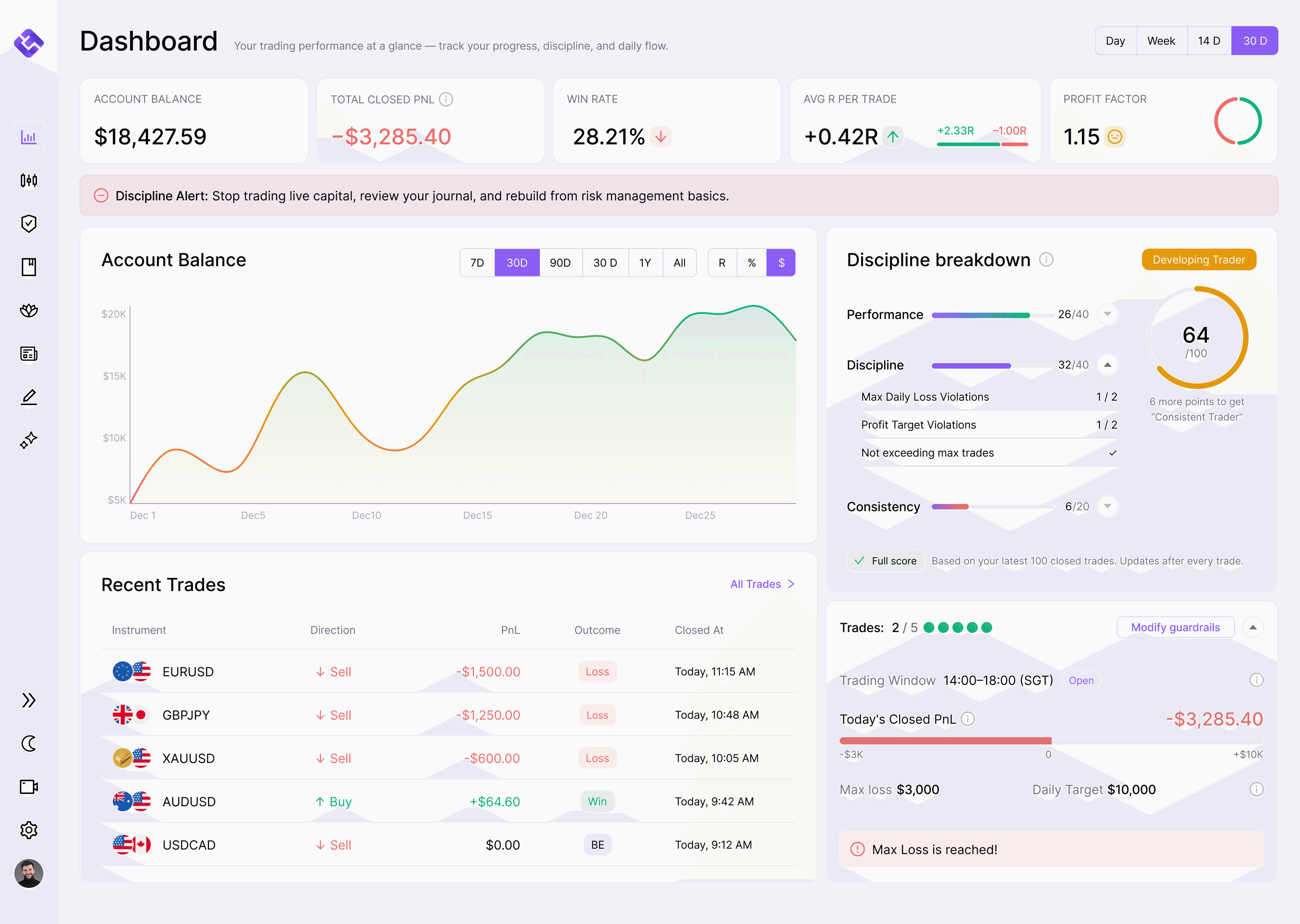
EdgeFlo's guardrails make selectivity easier by restricting your maximum trades per day (with the option to override if you choose). When you set a trade limit, you force yourself to be choosier. You cannot burn through five mediocre setups if your guardrail stops you at two.
The pre-market checklist prompts you to define your session plan before the market opens. You write down which pairs, which sessions, and which setups you will trade. That written plan sits next to your chart as a reminder that anything outside the plan is a C-grade trade.
And when a loss does happen, EdgeFlo's journal lets you tag the trade quality after the fact: was this an A-grade loss (plan-compliant, just did not work) or a B/C-grade loss (broke a rule or forced the setup)? Over time, that data shows you exactly where your drawdown comes from.
The Edge Brief
Receive Insights on trading psychology, discipline, and the behavioral patterns that create consistent traders from our Founder and the EdgeFlo team, delivered to your inbox.
Think different. Trade different.
How many trades should I take per day on a funded account?
What makes a setup high probability on a funded account?
Can I scalp on a funded account?
What happens if I take too many low quality trades on a funded account?

Turn discipline on.
Every session.
EdgeFlo is the environment serious traders operate inside.
Start 7-Day Free Trial
Cancel anytime.
No long-term commitment.

Think Different, Trade Different.