

Funded Challenge Breakeven: The Reset That Saves You
Breakeven in a funded challenge is not zero progress. It is a tactical reset. Learn the recovery math, mindset shift, and protocol to rebuild from breakeven.

Getting back to breakeven during a funded challenge is not treading water. It is the single most important reset point in the entire process. When your equity curve dips and then climbs back to zero, you have just proven that your edge still works under pressure. You did not blow the account. You did not spiral. You survived, and now you get to start clean.
Most traders treat breakeven like nothing happened. That is the mistake. Breakeven after a drawdown is a tactical event that deserves its own protocol: pause, review, reset your mindset, and resume at standard risk. Skip any of those steps and the next drawdown hits harder.
TL;DR
Breakeven after a drawdown is a win, not a neutral result. You proved your edge survived pressure.
Two wins at 0.5% risk with a 3R target erase a 3% drawdown (each win recovers 1.5%).
At breakeven, pause for at least one session to review your plan and reset your psychology.
Resume trading at 1% risk per trade. Do not escalate risk to "make up for lost time."
Journal every trade during the drawdown and recovery so you can study what actually broke.
Breakeven Is Not Nothing (It's a Win)
Ever watched your funded account drop 2%, then 2.5%, then 3%, and felt the walls closing in? That slow bleed is where most traders crack. They start revenge trading, doubling lot sizes, abandoning their plan. And then the account is gone.
But if you held your rules, de-risked to 0.5% per trade, rode out the losing streak, and clawed back to your starting balance, you just did something most challenge traders never do. You survived a drawdown without breaking.
That is not nothing. That is the hardest thing you will do in the entire challenge.
Think about what breakeven actually means in context. You took losses. Your confidence dropped. The emotional pressure to overtrade or quit was real. And you still followed your process. The account balance says zero progress, but your discipline record says everything.
Here is the shift that matters: treat breakeven as a fresh starting line, not the middle of an old race. The trades that caused the drawdown are finished. The emotions that came with them should be finished too. You are not "recovering" anymore. You are starting over with a clean account and a tested plan.
Why Most Traders Waste the Reset
The biggest mistake at breakeven is acting like the losing streak never happened. Traders feel relief, jump straight back to 1% risk, and take the first setup they see. No review. No pause. No plan check.
Sound familiar? That relief trade is one of the most dangerous entries in a funded challenge. Your psychology is still bruised, your pattern recognition might be off, and you have not figured out whether the drawdown came from bad execution or just bad luck. Skipping the review means you carry the same vulnerabilities into the next set of trades.
The Math: How 3R Wins Erase 0.5% Losses
The recovery math from a drawdown is straightforward once you understand how the de-risking framework works. When your account drops to a 2% loss, you cut risk from 1% to 0.5% per trade. At a minimum 1:3 risk-to-reward ratio, each win at 0.5% risk returns 1.5%.
Walkthrough: Recovering a 3% Drawdown on a $100,000 Account
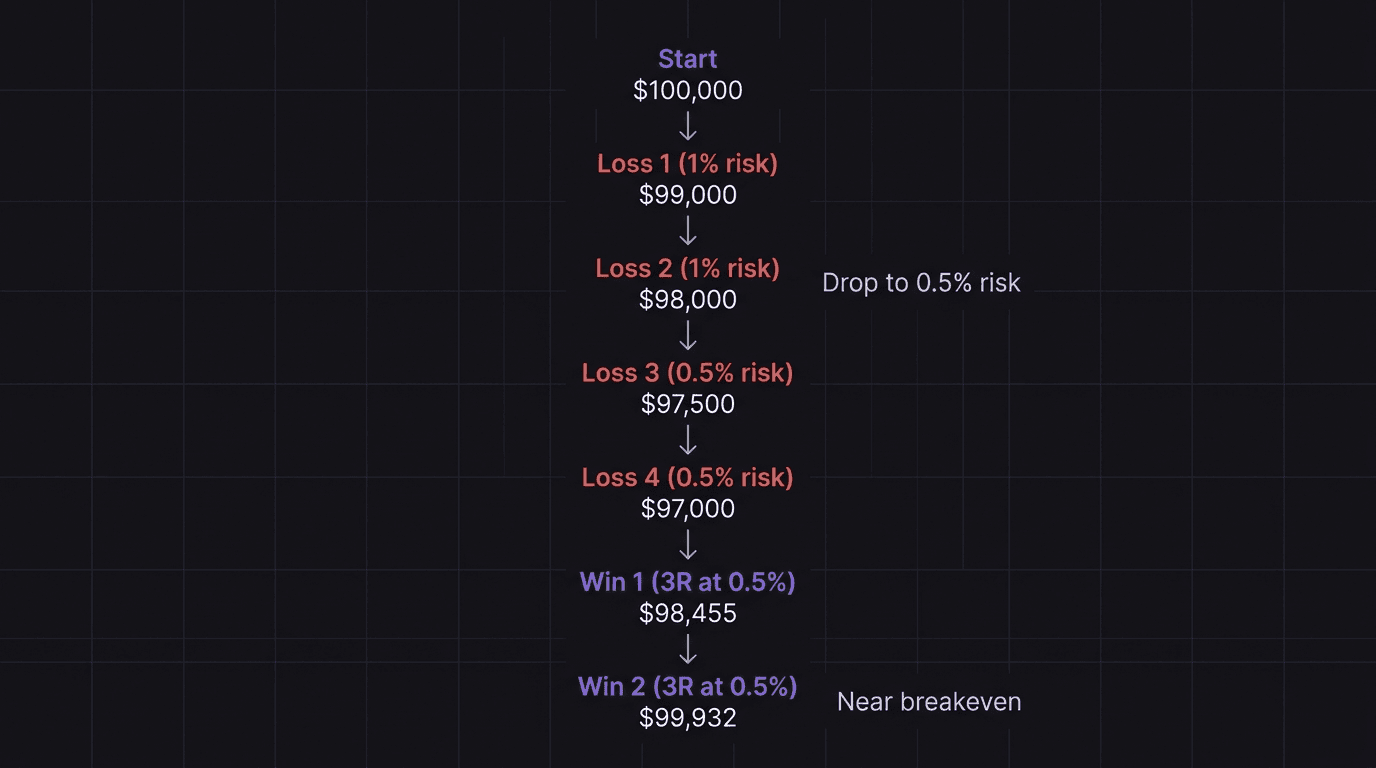
You start a $100,000 funded challenge. You lose two trades at 1% risk each. Account balance: $98,000 (down 2%). You drop risk to 0.5% per trade.
You lose two more trades at 0.5% risk. Each loss costs $500. Account balance: $97,000 (down 3%).
Then you win a trade at 0.5% risk with a 3R target. That is 0.5% times 3, which equals 1.5%. On a $97,000 balance, 1.5% is $1,455. Account balance: approximately $98,455.
You win another trade. 0.5% of $98,455 is $492.28. Times 3R equals $1,476.83. Account balance: approximately $99,932.
Two winning trades brought you from a 3% drawdown back to within $68 of breakeven.
That is the power of the 3R minimum. Even at half your normal risk, two good setups erase four consecutive losses. You do not need a miracle win streak. You need two clean trades.
What If the Win Rate Is Lower?
Even a 30% win rate works with a 1:3 risk-to-reward ratio if you manage the risk per trade correctly. The math is slower, but the de-risking at 0.5% keeps you alive long enough for the wins to arrive. At 30% win rate with 3R targets, expectancy per trade is still positive.
The Mindset Reset at Breakeven
The account is back to $100,000. Or $50,000. Or whatever you started with. The number is the same as day one. But you are not the same trader you were on day one.
You have been through a losing streak. You have felt the fear of breaching the maximum drawdown limit. You have experienced the temptation to throw extra size at the market just to "get it back faster." And you resisted.
That experience is worth something, but only if you process it properly. Here is the protocol.
Step 1: Stop Trading for at Least One Session
Do not place another trade the same day you hit breakeven. The relief rush is real, and it distorts your judgment just as much as the fear from the drawdown did. Take the rest of the session off. Walk away from the screen.
Step 2: Review Every Trade From the Drawdown
Open your journal and go through each trade from the losing streak, one by one. Separate them into two categories:
Good losses: You followed your plan, the setup was valid, price just did not cooperate. These are acceptable.
Bad losses: You deviated from your plan. You entered outside your session, forced a setup, skipped your checklist, or sized incorrectly. These are the ones that need fixing.
If most of your losses were good losses, your strategy is fine. You just hit a rough patch in the probability distribution. If most were bad losses, you have a discipline problem to solve before you resume.
Step 3: Re-read Your Trading Plan
Not skim it. Read it. Every rule, every entry condition, every exit criterion. After a drawdown, traders develop subtle drift in how they interpret their own rules. Re-reading the plan resets those interpretations back to the original standard.
Step 4: Confirm Your Plan Is Still Valid
Has anything changed in the market that invalidates your strategy? Are you trading the right sessions? Is your edge still present in current conditions? If you are unsure, take a few micro-lot trades (0.01 lots) to rebuild pattern recognition before going back to standard size.
Resume 1% Risk and Rebuild
Once you are back at breakeven and you have completed the mindset reset, go back to 1% risk per trade. Not 2%. Not 1.5%. Standard 1%.
The temptation to accelerate is strong here. You just spent days or weeks grinding back from a drawdown, and now you want to "make up for lost time." But there is no lost time. Most funded challenges have unlimited duration. The clock is not running.
Walkthrough: The First Three Trades After Breakeven
You are back at $100,000 on your funded challenge after a 3% drawdown and recovery. You resume at 1% risk per trade with a minimum 1:3 R target.
Trade 1: Win. 1% risk times 3R = 3% gain. Account balance: $103,000.
Trade 2: Loss. 1% risk = 1% loss. Account balance: $101,970 (1% of $103,000 = $1,030).
Trade 3: Win. 1% risk times 3R on $101,970 = $3,059.10. Account balance: $105,029.10.
After three trades (two wins, one loss), you are up 5% from breakeven. You went from recovery mode to halfway through the phase 1 profit target.
That is the value of patience. Two clean 3R wins at 1% risk move the needle fast when you are not also digging out of a hole. Breakeven gave you that clean starting point.
What Not to Do After Breakeven
Do not increase your lot size to "catch up." There is nothing to catch up to. You are at your starting balance with a proven strategy and a fresh psychological state. That is the best possible position.
Do not skip your pre-market routine because you feel confident. Confidence after a recovery is fragile. One sloppy entry can send you right back into the drawdown cycle.
Do not change your strategy. You just proved it works by recovering from a deficit. Switching systems now is the definition of strategy hopping, and it is the fastest way to destroy the edge you just validated.
How EdgeFlo Marks Your Recovery Milestones
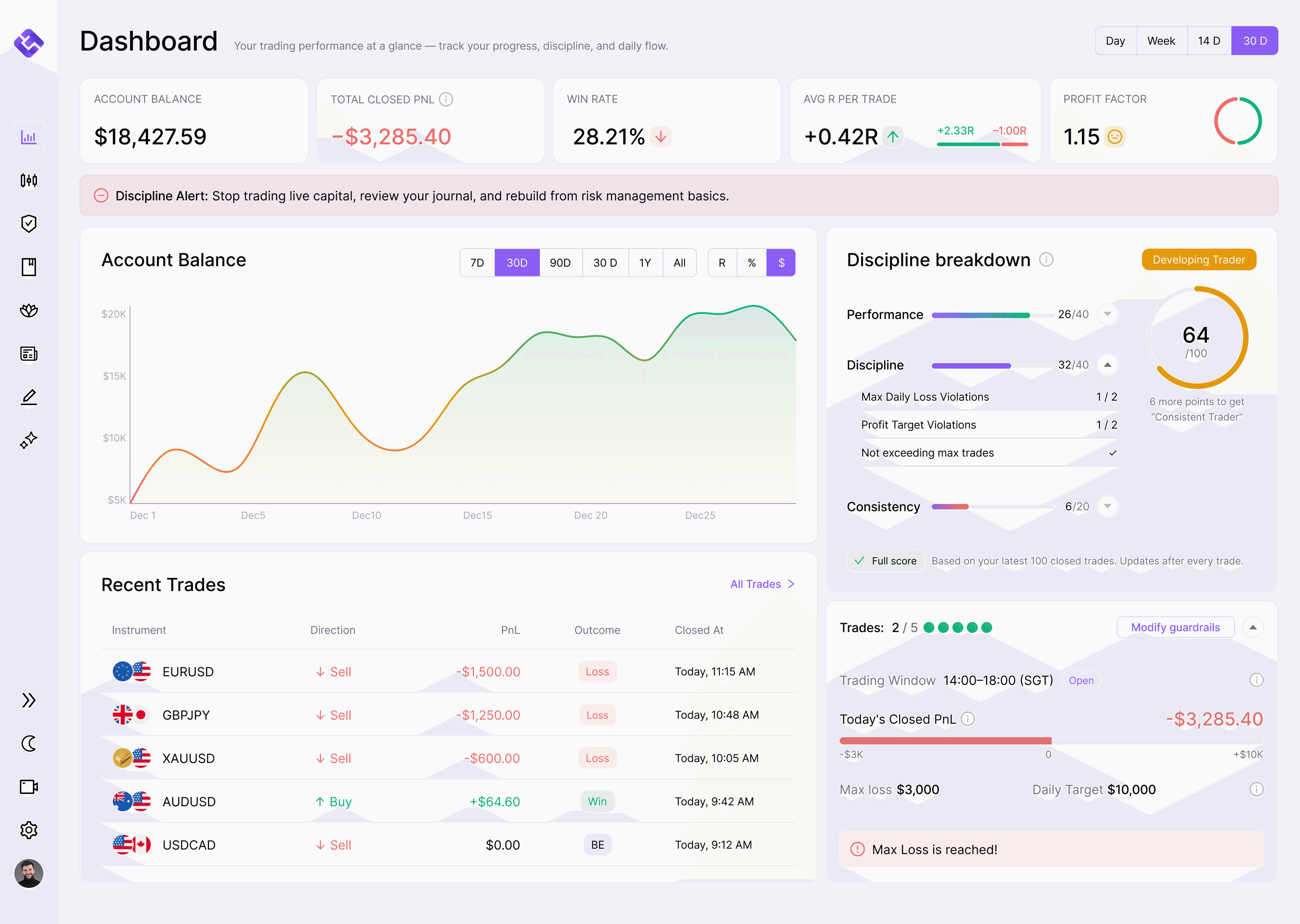
EdgeFlo's trading dashboard shows your equity curve with a clear breakeven line. When your curve dips and climbs back to that line, you can see the recovery visually, not just as a number in your broker statement. That visual feedback matters. It turns an abstract "$100,000" balance back into a story you can read: here is where you struggled, here is where you held your process, and here is where you earned the reset.
The journal captures every trade from the drawdown, tagged with the emotion you selected at entry and exit. During your breakeven review, you can filter for trades taken during the losing streak and see exactly which ones were plan trades and which ones were emotional deviations. That separation between good losses and bad losses is faster when the data is already tagged.
Your funded account management gets simpler when the dashboard tracks your risk tier automatically. When you dropped to 0.5% during the drawdown, EdgeFlo's risk calculator reflected that adjustment. When you return to 1% at breakeven, the calculator updates again. You do not have to remember which tier you are on. The system shows you.
The Edge Brief
Receive Insights on trading psychology, discipline, and the behavioral patterns that create consistent traders from our Founder and the EdgeFlo team, delivered to your inbox.
Think different. Trade different.
Is breakeven in a funded challenge a failure?
Should I increase risk after recovering to breakeven?
How long should I pause at breakeven before trading again?
What if I keep dropping back below breakeven?

Turn discipline on.
Every session.
EdgeFlo is the environment serious traders operate inside.
Start 7-Day Free Trial
Cancel anytime.
No long-term commitment.

Think Different, Trade Different.