

Funded Account Survival During News Events
News events are the top funded account killer. Learn the pre-news checklist, position management rules, and risk controls that keep your funded account alive.
A single FOMC announcement. A 90-pip whipsaw. A funded account gone in under two minutes.
This is not a rare story. It is the most common way funded accounts die. Not from a bad strategy, not from poor analysis, but from a news event that turned a normal trading day into an account-ending spike.
If you are trading a funded account, news events are not just high-risk sessions. They are the single greatest threat to your account survival. And surviving them is not about being a better trader. It is about having better rules.
TL;DR
News events (FOMC, NFP, CPI) are the number one funded account killer.
A 100-pip spike can breach your daily loss limit before you can close the trade.
Most prop firms restrict or ban trading within a window around high-impact events.
A pre-news checklist protects your account better than any technical skill.
The best news-day trade is often no trade at all.
Why News Events Kill More Funded Accounts Than Bad Trades
Bad trades lose pips. News events lose accounts.
The difference is speed and magnitude. A bad trade might cost you 1% of your account over a few hours. A news whipsaw can cost you 3% to 5% in seconds. And most funded accounts have strict drawdown rules: a 5% daily loss limit, a 10% max drawdown, or tighter.
Here is the math that kills accounts:
A trader on a $100,000 funded account has a 5% daily loss limit ($5,000). They are in a 0.5-lot GBP/USD position with a 30-pip stop. At $10/pip per standard lot, that is $5/pip at 0.5 lots. Risk on the trade: $5 times 30 pips = $150. Perfectly safe.
Then NFP drops. Price spikes 100 pips against the position before the stop executes. Slippage fills the stop 70 pips past the intended level. Actual loss: $5 times 100 pips = $500.
That is manageable. But what if the trader was running 2 lots? At $20/pip, a 100-pip spike is $2,000. Add slippage and the loss could be $2,500 or more, which is half the daily drawdown on a $100,000 account from a single event.
And that is just one position. Traders running multiple correlated positions (long EUR/USD and long GBP/USD, for example) can see their entire daily drawdown budget evaporate in one news release.
Prop Firm Rules You Must Know Before Any News Day
Every prop firm has specific rules about news trading. Violating them is not just risky. It is grounds for account termination. Before any news day, verify these:
Trading window restrictions. Many firms prohibit opening new trades within 2 to 5 minutes before and after high-impact news events. Some extend this to 15 minutes. Know your window.
Open position rules. Some firms require you to close all positions before news events. Others allow holding but require tighter stops. Check whether your firm differentiates between opening new trades and holding existing ones.
Restricted events list. FOMC, NFP, CPI, and central bank rate decisions are almost universally restricted. Some firms also restrict ECB, BOE, BOJ announcements, and GDP releases. Get the full list from your firm.
Slippage and gap policy. Understand whether your firm accounts for slippage in drawdown calculations. A stop at -30 pips that fills at -80 pips due to a news gap still counts as an -80 pip loss on most platforms.
Violation consequences. Some firms issue a warning. Others immediately fail the challenge. Know the penalty before you risk it.
Walkthrough: How a Trader Lost a $200K Funded Account in 90 Seconds
A trader on a $200,000 funded account (8% max drawdown, $16,000 total drawdown budget) enters a 1-lot long on EUR/USD at 1.0850 with a 25-pip stop at 1.0825. Risk: $10/pip times 25 pips = $250. CPI releases. Price drops 120 pips in 45 seconds. The stop fills at 1.0730 due to slippage (120 pips from entry, not the intended 25). Loss: $10 times 120 = $1,200. The trader panics, enters a revenge trade on GBP/USD (1 lot short), which immediately moves 80 pips against them during the whipsaw. Second loss: $10 times 80 = $800. Total: $2,000 in 90 seconds. The daily drawdown flag triggers and the account is locked for the day.
The trader was already down $6,000 for the week from earlier losses. The $2,000 news-day loss brought total drawdown to $8,000 of their $16,000 budget (50% of max drawdown consumed). One more bad day and the account is gone. All from a single news event they should not have been trading.
The revenge trade is the real killer here. The news loss was survivable. The emotional reaction turned a bad day into a near-terminal one.
The Pre-News Checklist for Funded Traders
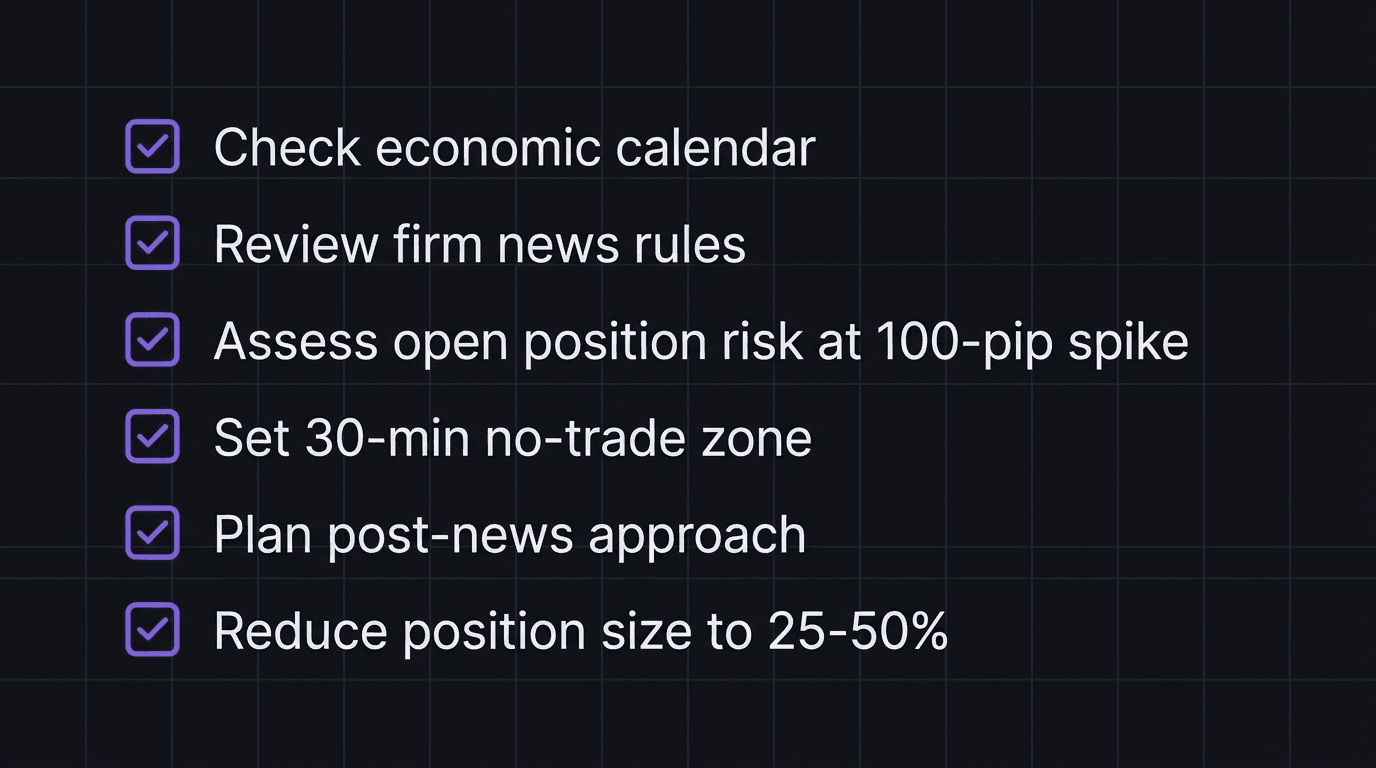
Build this into your pre-market routine on any day with high-impact events:
1. Check the economic calendar. Before your session starts, identify every high-impact event for the day, including the exact time and the affected currencies.
2. Review your firm's news rules. Confirm the restricted trading window and whether you need to close positions.
3. Assess open positions. If you have open trades, calculate the maximum loss if price moves 100 pips against you instantly. If that exceeds your comfortable daily loss, reduce position size or close.
4. Set a no-trade zone. Mark the 30 minutes before and 30 minutes after the event as a no-trade zone on your chart or in your plan. This is wider than most firm requirements, but the extra buffer protects you from the whipsaw.
5. Plan your post-news approach. Decide in advance: will you trade after the event or sit out the entire session? If you will trade, define the conditions (structure shift, second move confirmation, minimum 15-minute wait).
6. Reduce active position size. If you choose to hold through the event, cut your position size to 25% to 50% of your normal size. This limits the maximum damage from slippage.
Position Management When the Spike Hits
If you are holding a position when news drops, your options depend on how prepared you were:
Prepared (followed the checklist): Your position is already reduced. Your stop is already set wider than the expected spike range. You wait. The spike hits, your stop holds (or clips you for a small, planned loss), and you reassess after 15 minutes.
Unprepared (no checklist): You are at full size with a tight stop. The spike blows through your stop with slippage. You are now in damage control mode.
For prepared traders, the rules during the spike are:
Do not move your stop. The spike is temporary. Moving your stop wider during the event increases your risk at the worst possible time.
Do not add to the position. Averaging into a losing position during a news whipsaw is how funded accounts die. See news event stop loss strategies for specifics.
Do not enter new trades. Even if the spike creates what looks like a setup, wait. The first move is almost always the liquidity sweep, not the real direction.
Wait for the dust to settle. Give the market 15 to 30 minutes after the release. Then assess whether the post-spike structure offers a valid entry.
For unprepared traders, the only rule is: close everything and walk away. Take the loss. Do not try to recover it in the same session. News days that start with unexpected losses almost always end worse when traders try to fight back.
Walkthrough: Proper News-Day Position Management
A funded trader on a $100,000 account (5% daily loss limit = $5,000) holds a 0.3-lot long on EUR/USD at 1.0860. Normal stop at 1.0830 (30-pip risk). Before NFP at 8:30 AM ET, the trader follows the checklist:
Step 1: Reduce to 0.1 lots. New risk at 30-pip stop: $10/pip times 0.1 = $1/pip. $1 times 30 = $30. Step 2: Widen stop to 1.0800 (60 pips). Risk: $1 times 60 = $60. Step 3: Mark 8:00 to 9:00 AM as no-trade zone.
NFP drops. Price spikes to 1.0920, then reverses to 1.0810. The stop at 1.0800 holds. The position is down 50 pips ($50). At 9:05 AM, the trader assesses: price is at 1.0815, and 5-minute structure has shifted bearish. The trader closes the long at 1.0815 for a 45-pip loss ($45) and evaluates short setups. The total loss is $45, well within the daily budget.
Compare that to a trader at full 0.3-lot size with the original 30-pip stop: $3/pip times 30 = $90 intended risk. But the spike fills the stop at 1.0810 (slippage of 20 pips past the stop). Actual loss: $3 times 50 = $150. Survivable, but $150 versus $45 is a meaningful difference over repeated news days.
How EdgeFlo Protects Your Funded Account on News Days
News-day protection is where EdgeFlo's guardrails shine brightest.
The economic calendar is watchlist-aware, filtering events to the pairs you actually trade. On Plus plans, the News Block guardrail restricts new trade entries during high-impact news windows. You can override it (the override is always available), but the default is protection. That single feature prevents the most common funded-account mistake: entering a new position right before the spike.
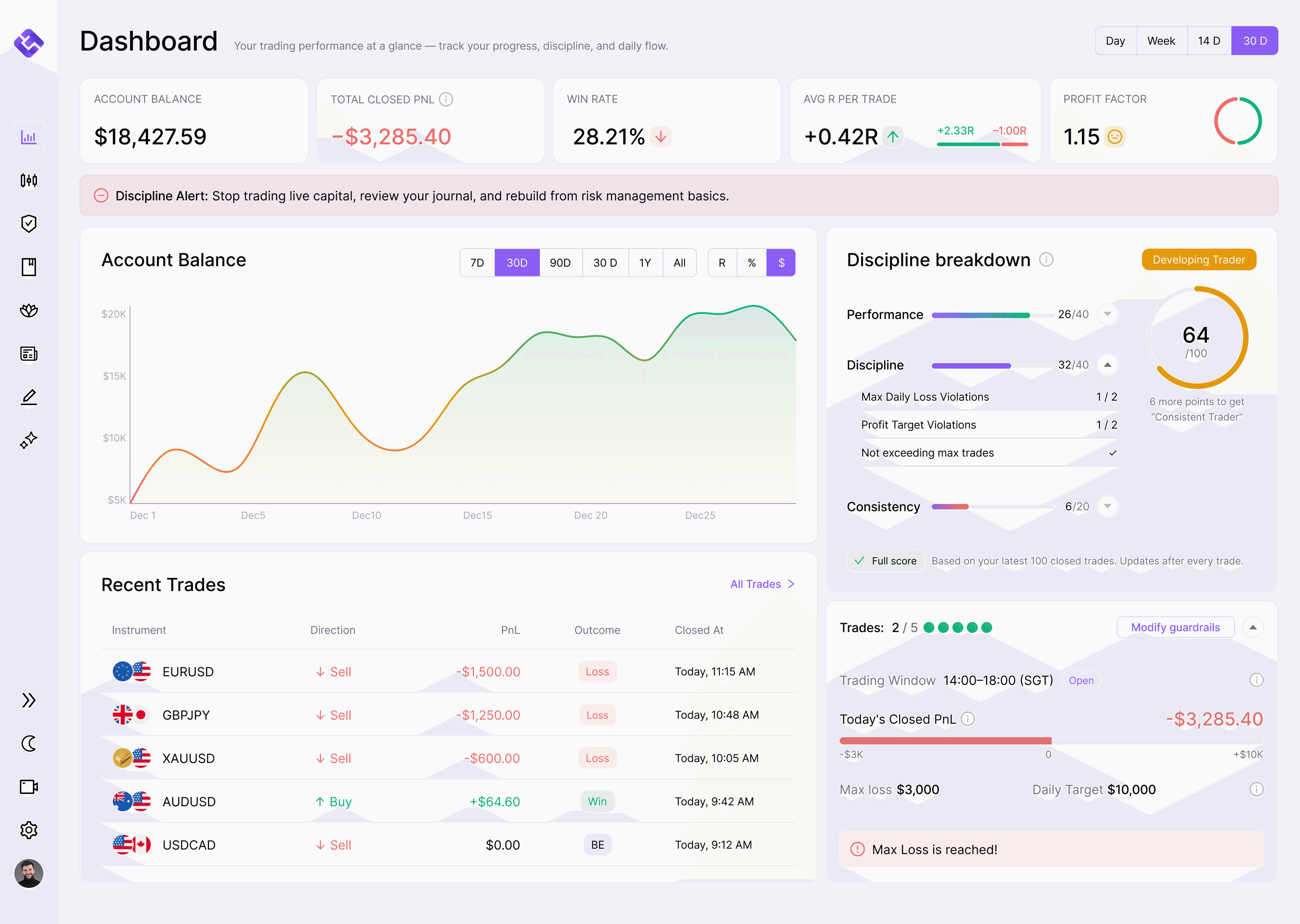
The daily loss limit guardrail also acts as a safety net. If the news whipsaw puts you near your firm's drawdown limit, EdgeFlo restricts further trading. Again, override is available, but the friction forces a conscious decision instead of an emotional one.
Your pre-market routine in EdgeFlo prompts you to check the economic calendar before every session. On news days, this check becomes your first line of defense. The funded traders who survive long-term are not the ones with the best setups. They are the ones who check the calendar, reduce their exposure, and sit out the spike while everyone else donates their drawdown to the market.
The Edge Brief
Receive Insights on trading psychology, discipline, and the behavioral patterns that create consistent traders from our Founder and the EdgeFlo team, delivered to your inbox.
Think different. Trade different.
Why do news events kill funded accounts?
Should I close all trades before major news?
Do most prop firms ban news trading?
What is the safest way to trade on a news day?

Turn discipline on.
Every session.
EdgeFlo is the environment serious traders operate inside.
Start 7-Day Free Trial
Cancel anytime.
No long-term commitment.

Think Different, Trade Different.