

Entry Rules That Pass Funded Challenges: Quality Over Quantity
Learn entry rules that protect funded accounts. Use a confluence checklist to take fewer, better trades and avoid overtrading during funded challenges.

Funded challenges are not about finding more trades. They are about finding better trades. The math is simple: a $200,000 funded account with a 5% maximum drawdown gives you $10,000 to work with. Take 8 trades a day at 1% risk each and a single bad session can eat half that drawdown. Take 2 trades a day with strict entry rules and your account survives the losing streaks that every strategy produces.
The traders who pass funded challenges consistently share one trait. They are selective. They have an entry process that filters out low-quality setups before the trade reaches the execution stage. And they follow it without exception.
TL;DR
Funded accounts penalize overtrading more than any other mistake because drawdown limits are fixed.
A confluence checklist filters setups before you click the button, reducing trade count and improving quality.
Require at least 3 out of 5 confluence factors before entering any trade during a challenge.
Match your entry model to the prop firm challenge rules (time limits, drawdown type, lot restrictions).
Track your confluence score per trade to identify which factors predict winners.
Why Funded Accounts Demand Better Entries
A personal $5,000 account can survive sloppy entries because you control the drawdown rules. If you lose 20%, you add more money or take a break. Nobody kicks you out.
A funded account is different. Hit the daily loss limit or the maximum drawdown, and the challenge is over. Your fee is gone. You start from scratch.
This means every trade carries an opportunity cost that is not just financial but existential for the account. A bad entry is not just a loss. It is one step closer to disqualification.
The math makes this clear. A $100,000 funded challenge with a 10% max drawdown gives you $10,000. If you risk 1% per trade ($1,000), you can take 10 consecutive losses before the account is dead. But 10 consecutive losses at 1% risk is well within normal variance for a 40% win rate strategy. That means your survival depends on not taking low-quality trades that erode the buffer.
Fewer, higher-quality entries mean each trade has a stronger expected value. You are not trying to make money on every trade. You are trying to make sure every trade deserves to be in your account.
The Confluence Checklist for A-Grade Setups
A confluence checklist is your entry filter. Before you place a trade, every item on the list must be checked. If the setup does not meet enough criteria, you skip it.
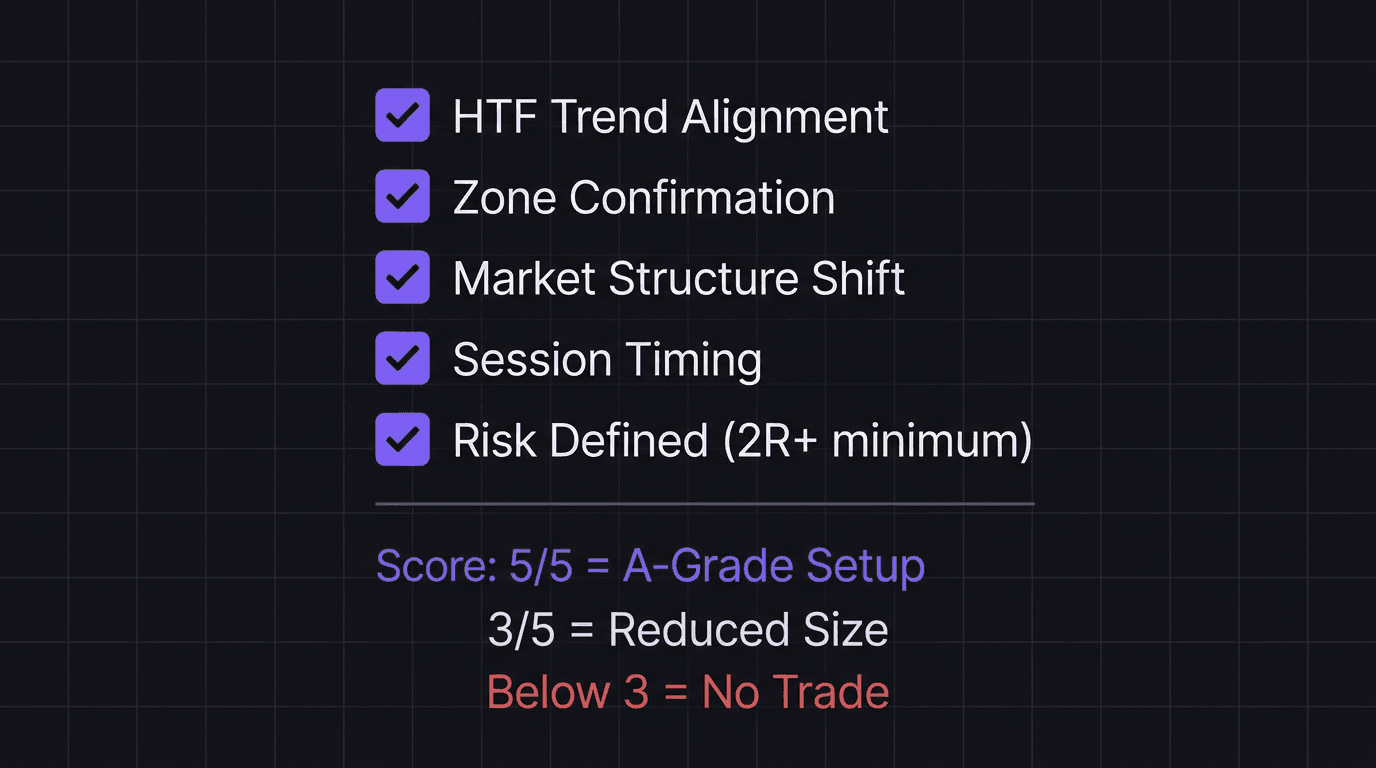
Here are five confluence factors that work for most entry models:
Higher-timeframe trend alignment. Is the higher timeframe (daily or 4-hour) trending in the direction of your trade? If you are buying, the higher timeframe should show bullish order flow.
Zone confirmation. Is price reacting from a valid supply or demand zone? Not a random level, but a zone where order flow previously shifted or where unmitigated orders sit.
Market structure shift or continuation. Has the lower timeframe confirmed the move? A break above the last lower high (for longs) or below the last higher low (for shorts) validates the entry.
Session timing. Are you trading during your planned session? London open and New York overlap produce the best volume. Entries during the Asian session or low-volume hours carry more risk of false moves.
Risk definition. Is your stop-loss at a structural level (below the flip zone, below the sweep low) and does the risk-to-reward ratio meet your minimum (2:1 or better)?
Grade your setups. If a trade hits 5 out of 5, it is an A-grade setup. If it hits 3 out of 5, it might be worth taking with reduced size. Below 3, skip it entirely.
Walkthrough: Confluence Checklist in Action
You are trading a $200,000 FTMO challenge with a 5% max drawdown ($10,000) and a 10% profit target ($20,000). Your plan says 0.5% risk per trade ($1,000).
GBP/USD, London session. The 4-hour chart shows bullish order flow with higher highs and higher lows. Price has pulled back to a demand zone at 1.2650 to 1.2670. On the 15-minute chart, price sweeps below 1.2645, then pushes back up and breaks above the last lower high at 1.2680. The flip zone sits at 1.2655.
Higher-timeframe trend alignment: Yes, 4-hour is bullish. Check.
Zone confirmation: Yes, demand zone at 1.2650 to 1.2670 is valid. Check.
Market structure shift: Yes, break above 1.2680. Check.
Session timing: London open. Check.
Risk definition: Stop at 1.2640 (below sweep low), entry at 1.2660, target at 1.2740. Check.
That is 5 out of 5. You take the trade.
With a 20-pip stop and an 80-pip target, that is a 4:1 risk-to-reward ratio. At 0.5% risk ($1,000 on the $200,000 account), you need 5 lots ($50 per pip). Risk is $1,000 and the potential reward is $4,000. One winning trade like this covers four full losses at the same risk level.
How Overtrading Fails Funded Challenges
Overtrading is the number one reason traders fail funded challenges. Not bad analysis. Not wrong direction. Too many trades.
Here is the problem in numbers. A trader with a 45% win rate and a 2:1 reward-to-risk ratio has positive expectancy. But if they take 10 trades a day, variance alone can produce 7 consecutive losses. On a $100,000 funded account risking 1% per trade, 7 losses in a row costs $7,000. That is 70% of their drawdown limit gone in a single day.
The same trader taking 2 trades a day with the same stats will rarely see more than 2 consecutive losses in a session. The daily damage stays manageable. The account survives the natural variance of the system.
Sound familiar? You know overtrading is a problem. You have probably done it during a challenge, felt the drawdown shrinking, and started taking worse setups to "make it back." That cycle is what blows funded accounts.
The fix is mechanical. Set a maximum trade count per day in your plan. Most funded traders who pass consistently cap themselves at 1 to 3 trades per day. If you reach your cap, you are done for the day. No exceptions.
Walkthrough: Overtrading a Funded Challenge
A trader takes an FTMO $100,000 challenge with 10% max drawdown ($10,000) and risks 0.8% per trade ($800). On Monday, they take 6 trades. They win 2 and lose 4.
Wins: 2 trades at 2.5R each. 2 times $2,000 = $4,000 gained. Losses: 4 trades at 1R each. 4 times $800 = $3,200 lost. Net for Monday: $4,000 minus $3,200 = $800 profit. Day looks okay.
On Tuesday, confidence is high. They take 8 trades. Win 3, lose 5.
Wins: 3 trades at 2R each. 3 times $1,600 = $4,800 gained. Losses: 5 trades at 1R each. 5 times $800 = $4,000 lost. Net for Tuesday: $4,800 minus $4,000 = $800 profit.
On Wednesday, they take 9 trades. Win 2, lose 7.
Wins: 2 trades at 2R each. 2 times $1,600 = $3,200 gained. Losses: 7 trades at 1R each. 7 times $800 = $5,600 lost. Net for Wednesday: $3,200 minus $5,600 = negative $2,400.
Three-day total: $800 plus $800 minus $2,400 = negative $800. The overtrading on Wednesday wiped out two days of progress. One more bad day and the daily loss limit gets breached.
If the trader had capped at 3 trades per day, the damage on Wednesday would have been 1 win and 2 losses at most: $1,600 minus $1,600 = breakeven. The account stays healthy.
Matching Your Entry Model to Challenge Rules
Different funded challenges have different rules, and your entry model needs to account for them.
Daily loss limits. If the firm has a 5% daily loss limit, your risk per trade multiplied by your maximum daily trade count must stay under that limit with room for a full losing streak. At 1% risk and 3 trades max, your worst possible day is 3% (well under the 5% limit).
Time restrictions. Some firms restrict trading during high-impact news or require you to close positions before the weekend. If your entry model relies on holding through news events, adjust it or skip those days.
Drawdown type. Some firms use balance-based drawdown (calculated from your highest closed balance) and others use equity-based drawdown (which includes open positions). If your firm uses equity-based drawdown, a trade that goes 3% against you before turning profitable can breach the limit even if you eventually win. Tighter stops matter more under equity-based rules.
Profit targets. If you need 10% profit in 30 days, you need an average of 0.33% per day. That is achievable with 1 to 2 quality trades at 2R or better. Do not force extra trades to hit the target faster. Compounding small wins inside the time limit is safer than swinging for the fences.
Use your pre-trade checklist to verify every trade meets both your entry criteria and the specific rules of the challenge you are trading.
How EdgeFlo Guards Your Funded Account
Discipline breaks down when the account is on the line. You know your limit is 3 trades per day. But after two losses, the urge to take a third and fourth trade to recover is overwhelming.
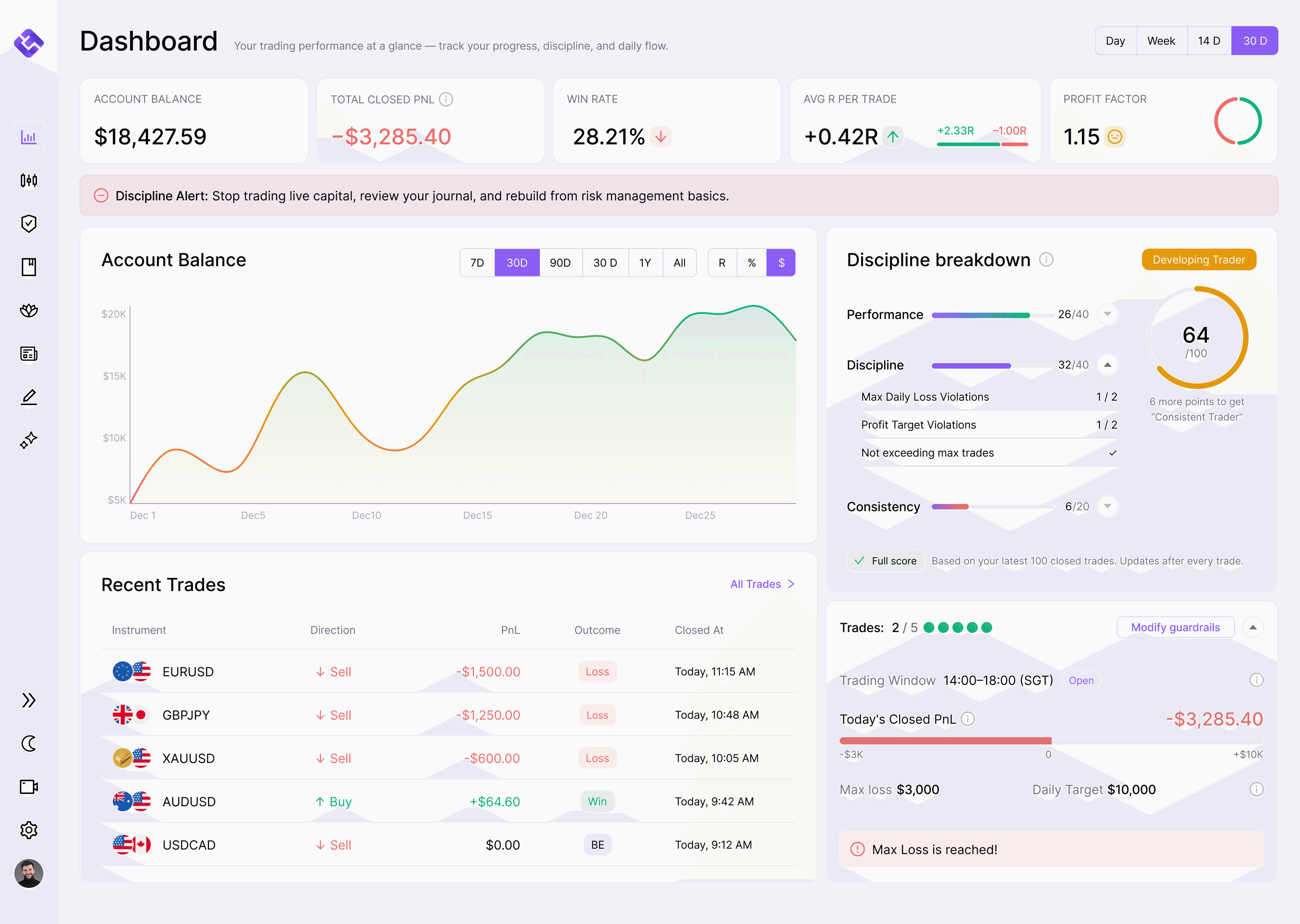
EdgeFlo's guardrails let you set daily trade limits and loss limits that match your funded challenge rules. Hit your max trade count and the platform restricts the trade button. You can override it, but you have to make a conscious choice. That friction is the difference between an impulsive revenge trade and a deliberate decision.
The guardrails do not make the decision for you. They make the wrong decision harder. When every trade in a funded account carries the weight of potential disqualification, that extra layer of protection is worth more than any strategy.
The Edge Brief
Receive Insights on trading psychology, discipline, and the behavioral patterns that create consistent traders from our Founder and the EdgeFlo team, delivered to your inbox.
Think different. Trade different.
What entry rules help pass funded challenges?
How many trades should you take per day in a funded challenge?
Why does overtrading fail funded challenges?
What is a confluence checklist for trade entries?

Turn discipline on.
Every session.
EdgeFlo is the environment serious traders operate inside.
Start 7-Day Free Trial
Cancel anytime.
No long-term commitment.

Think Different, Trade Different.