

End of Day Trading Routine: 4 Steps to Close
An end of day trading routine locks in lessons and resets your mind. Follow these 4 steps after every session to close properly.
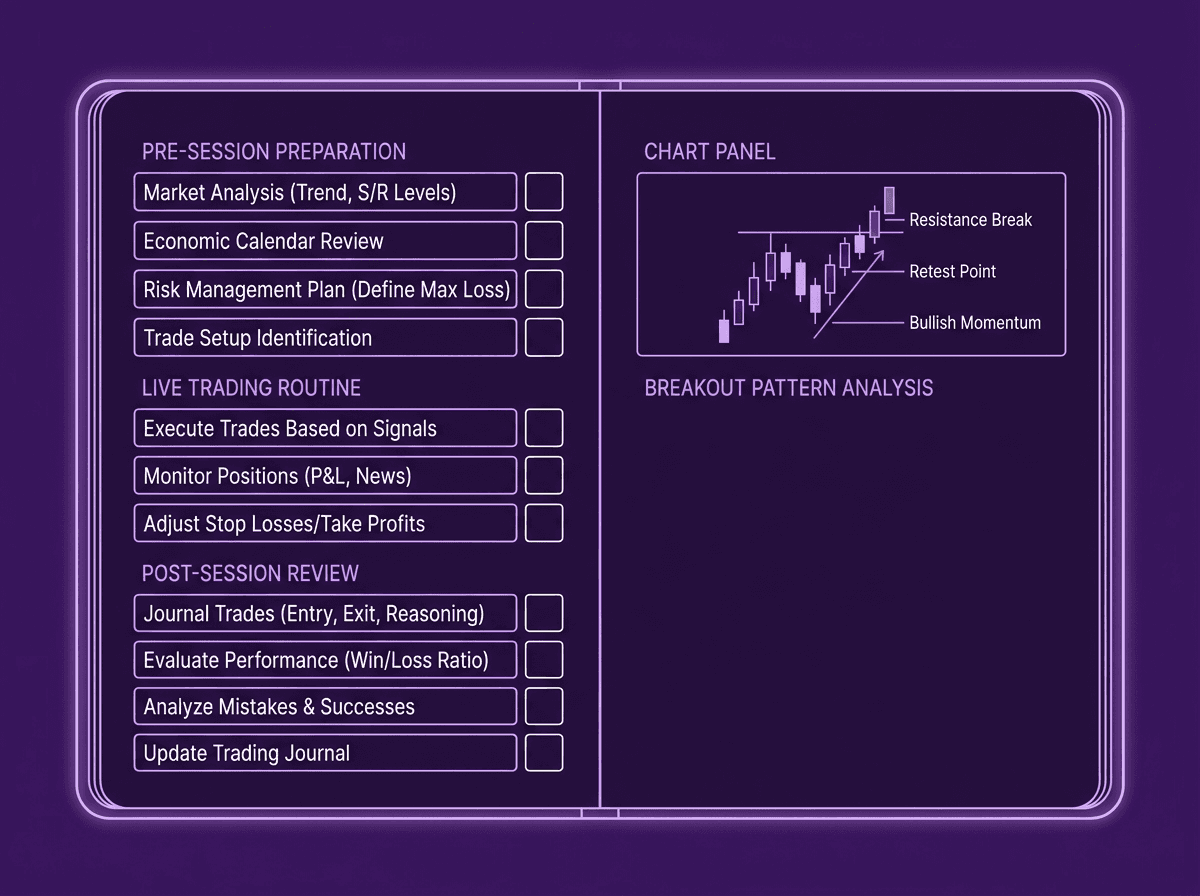
An end of day trading routine is a short process you run after every session to log your trades, score your execution, and reset mentally before closing your platform. It turns raw screen time into lessons that compound. Without it, you repeat the same mistakes because you never stopped to notice them.
Most traders obsess over entries. They build pre-market routines, mark up charts, set alerts. But when the session ends, they just close the laptop. Everything they experienced disappears into a blur of green and red candles. The close of day is where the real learning happens, and skipping it is like running experiments without recording the results.
TL;DR
Log every trade you took and every setup you skipped, including the reason for each decision.
Score your process execution on a simple scale, not your P&L.
Write down one specific lesson you will carry into tomorrow's session.
Shut down your platform and disconnect from charts completely until the next pre-market window.
Consistent traders build feedback loops. The end of day routine is the loop.
Why the End of Day Matters More Than the Open
The source of most trading problems is not poor analysis. It is poor feedback. Consistent action leads to consistent results, and the only way to know whether your actions were consistent is to review them.
Think about it like this. You journal your trades (or you plan to). You have a trading journal template ready. But if you only fill it in "when you feel like it," you are building an incomplete dataset. Incomplete data gives you incomplete feedback. Incomplete feedback means you cannot identify what to fix.
The end of day routine is the process that forces the feedback loop to close. Every session. Not just the bad ones.
Here is what happens without it: you win three trades on Monday, feel great, skip the review. Tuesday you overtrade because Monday's confidence carried over. Wednesday you revenge trade after Tuesday's losses. By Thursday you are wondering why your account is down for the week. Sound familiar?
The cycle is predictable (win, get overconfident, take stupid trades, lose, doubt your strategy, get afraid, miss good setups, revenge trade) and it is exactly what a missing end of day routine allows. The routine breaks the cycle by inserting a pause between session and emotion.
Step 1: Log Every Trade Taken and Skipped
Open your journal and record every trade from the session. Not just the ones you executed. The ones you skipped, too.
For each trade taken, log: the pair, the direction, your entry and exit, the result in R, and whether it matched your plan. For each trade skipped, log: the pair, what you saw, and why you did not take it.
Walkthrough: The Skipped Trade That Teaches More
You are reviewing your EUR/USD session. You took one long at 1.0845, hit your 2R target at 1.0875, clean execution. But you also saw a second setup at 1.0890 that matched your playbook. You did not take it because you were still riding the high from the first win and did not want to "push your luck."
The trade ran to 1.0920 without you.
Without logging the skip, you would never notice the pattern. Three weeks later, your journal shows you have skipped 7 valid setups after winners. That is not discipline. That is fear of giving back profits, and it is costing you 1.5R per week on average.
Logging skips is where the real edge lives. Most traders only track what they did. The best traders also track what they chose not to do.
This step takes 3 to 5 minutes. If you use a journal that auto-imports your trades, you only need to add the skips and the reasoning manually.
Step 2: Score Your Process Execution
This is not about profit or loss. It is about whether you followed your rules.
Give yourself a simple score from 1 to 5:
5: Followed every rule. Entries, exits, position sizing, and patience all matched the plan.
4: Minor deviation. Moved a stop 2 pips early, or hesitated on a valid entry but still took it.
3: One significant rule break. Took a trade outside your plan, or doubled position size on impulse.
2: Multiple rule breaks. Overtraded, revenge traded, or abandoned the plan mid-session.
1: No process followed. Pure emotion.
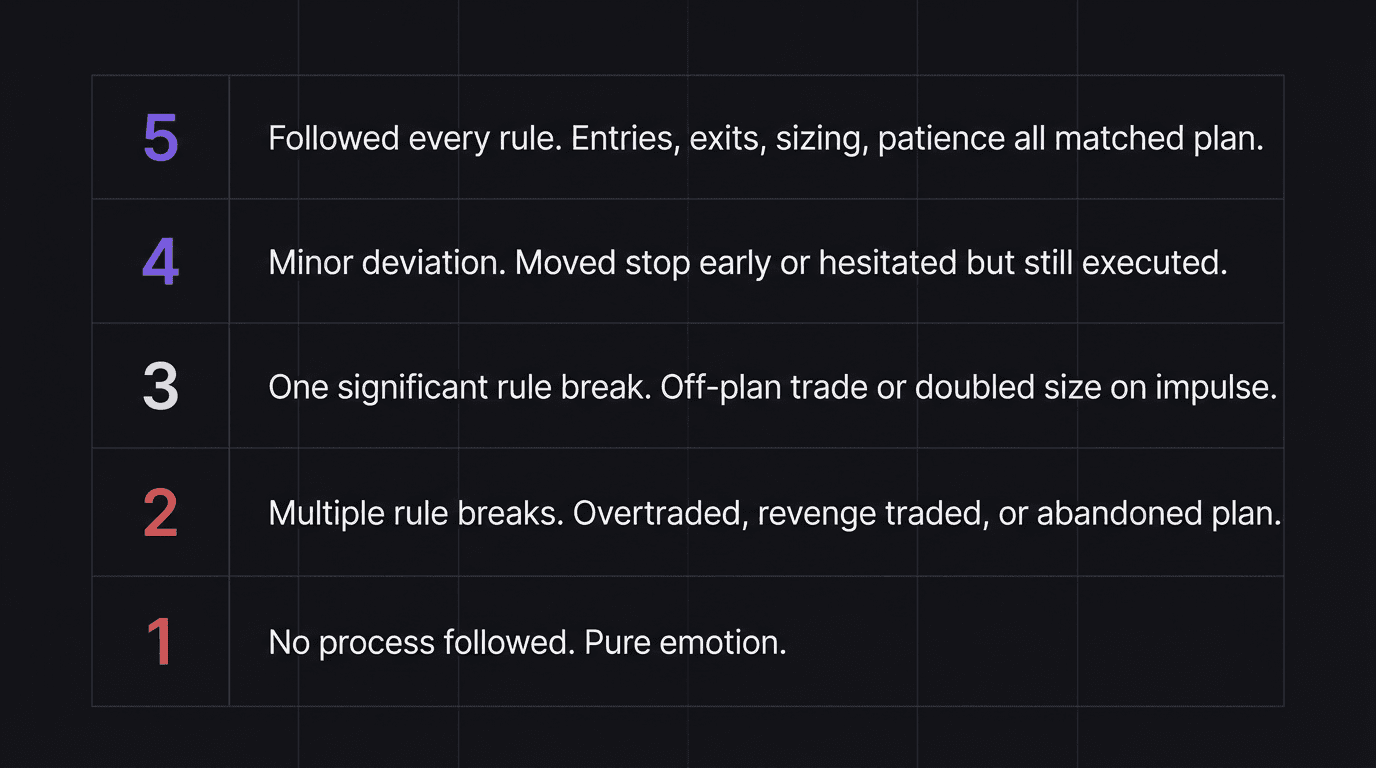
The score matters more than the P&L. A day where you lost 1R but scored a 5 is a better day than a day where you made 3R but scored a 2. The 5 is repeatable. The 2 is a gamble that happened to work.
Over time, this score becomes your most powerful metric. Track it weekly. You will see that your best equity curve stretches happen during weeks with average scores of 4 or above. The data proves what every experienced trader already knows: consistency in process creates consistency in results.
Walkthrough: The Profitable Day That Scores a 2
You traded GBP/USD during London open. Your plan said one trade max today because you were on a 3-day losing streak and operating under reduced risk rules. You took your planned setup at 1.2640, hit 1.5R. Good.
Then you saw "one more setup" at 1.2680. Not on your watchlist. You took it anyway because you were feeling better after the win. It ran 1R in your favor before reversing to breakeven. No harm done, right?
Wrong. The outcome was fine, but the process was broken. You violated your one-trade-max rule. You traded a pair not on your watchlist. Your score is a 2, even though you ended the day green. If you do not log this honestly, you will do it again. And next time, that second trade might not stop at breakeven.
Step 3: Note One Lesson for Tomorrow
Not three lessons. Not a paragraph. One sentence.
The constraint is deliberate. If you try to capture everything, you capture nothing. One lesson forces you to prioritize. What was the single most important thing today's session taught you?
Good examples:
"I need to wait for the candle close before entering, not the wick."
"My GBP/USD entries are clean, but my exits are too early. Review exit criteria before tomorrow."
"I traded during news. Do not do that again."
Bad examples:
"Need to be more disciplined." (Too vague. Discipline about what?)
"Market was choppy today." (That is an observation, not a lesson.)
"Should have taken more trades." (More trades is almost never the answer.)
Write the lesson where you will see it tomorrow. In your journal. On a sticky note next to your screen. In your daily planner. The point is that tomorrow's version of you reads it before the session starts.
The feedback loop concept applies perfectly here. Inputs (your time, attention, and execution) go through your process (trading plan and rules) to produce outputs (results). But without the feedback loop, you never improve the inputs. The one-lesson step is the simplest version of that feedback loop. It takes 30 seconds and it compounds over weeks.
Step 4: Shut Down and Disconnect
Close your charts. Close your broker. Close your trading Telegram groups. Step away.
This is not optional and it is not soft advice. The shutdown is a process boundary. It tells your brain that the trading day is over. Without a clear boundary, you carry the session's emotions into the rest of your day. You check charts during dinner. You re-analyze trades at midnight. You start tomorrow already fatigued.
The shutdown also prevents late-session impulse trades. If you trade the New York session and your routine says you close at 4pm, then 4:01pm is not trading time. It does not matter if EUR/USD is "about to break out." That trade is not yours. Your session is over.
Practical shutdown checklist:
Close all chart tabs and broker windows.
Turn off price alerts until your next pre-market window.
Write tomorrow's session time in your planner so you know exactly when you will return.
Do something non-trading for at least 30 minutes (walk, cook, exercise, anything away from screens).
The post-trade review happens within steps 1 through 3. The shutdown is what follows. It draws a hard line between "trader you" and "rest-of-life you." Traders who skip the shutdown end up staring at charts for 14 hours, which is how burnout and overtrading feed each other.
How EdgeFlo Structures Your End of Day
EdgeFlo's journal auto-imports your trades at the end of each session, so step 1 is half-done before you even sit down. You add emotion tags and notes for each trade, including the skipped setups, through post-trade self-reporting in Edge (the trade plan builder).
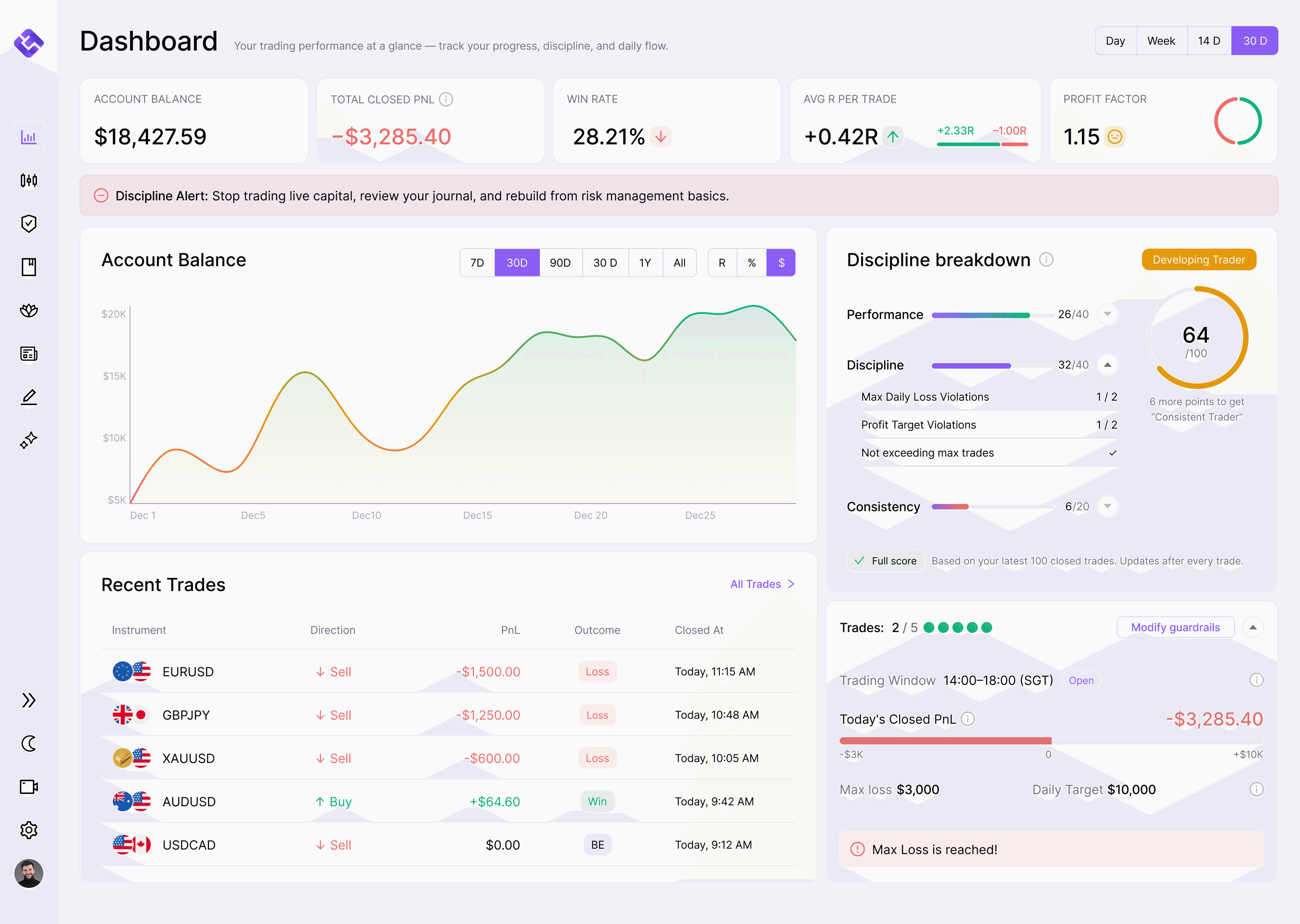
The discipline summary on your dashboard gives you a process score without manual math. It pulls from your plan adherence data, so the number reflects what actually happened, not what you remember happening. Over time, you can track your process scores against your equity curve and see exactly where discipline breaks cost you money.
FloAI (available on the Plus plan) can help you draft your one-lesson note by reflecting on your session data. It does not tell you what to trade or predict outcomes. It asks you questions about your execution so you can articulate the lesson yourself. Think of it as a coach prompting you to think, not a signal provider handing you answers.
The Edge Brief
Receive Insights on trading psychology, discipline, and the behavioral patterns that create consistent traders from our Founder and the EdgeFlo team, delivered to your inbox.
Think different. Trade different.
How long should an end of day trading routine take?
What if I did not take any trades today?
Should I review charts during my end of day routine?
Can I do my end of day routine the next morning instead?

Turn discipline on.
Every session.
EdgeFlo is the environment serious traders operate inside.
Start 7-Day Free Trial
Cancel anytime.
No long-term commitment.

Think Different, Trade Different.