

Forex vs Futures: Which Fits Your Trading Style
Forex and futures both offer leverage and fast execution, but they punish different mistakes. Compare leverage, sizing, sessions, and risk to pick your market.
How Forex and Futures Actually Differ
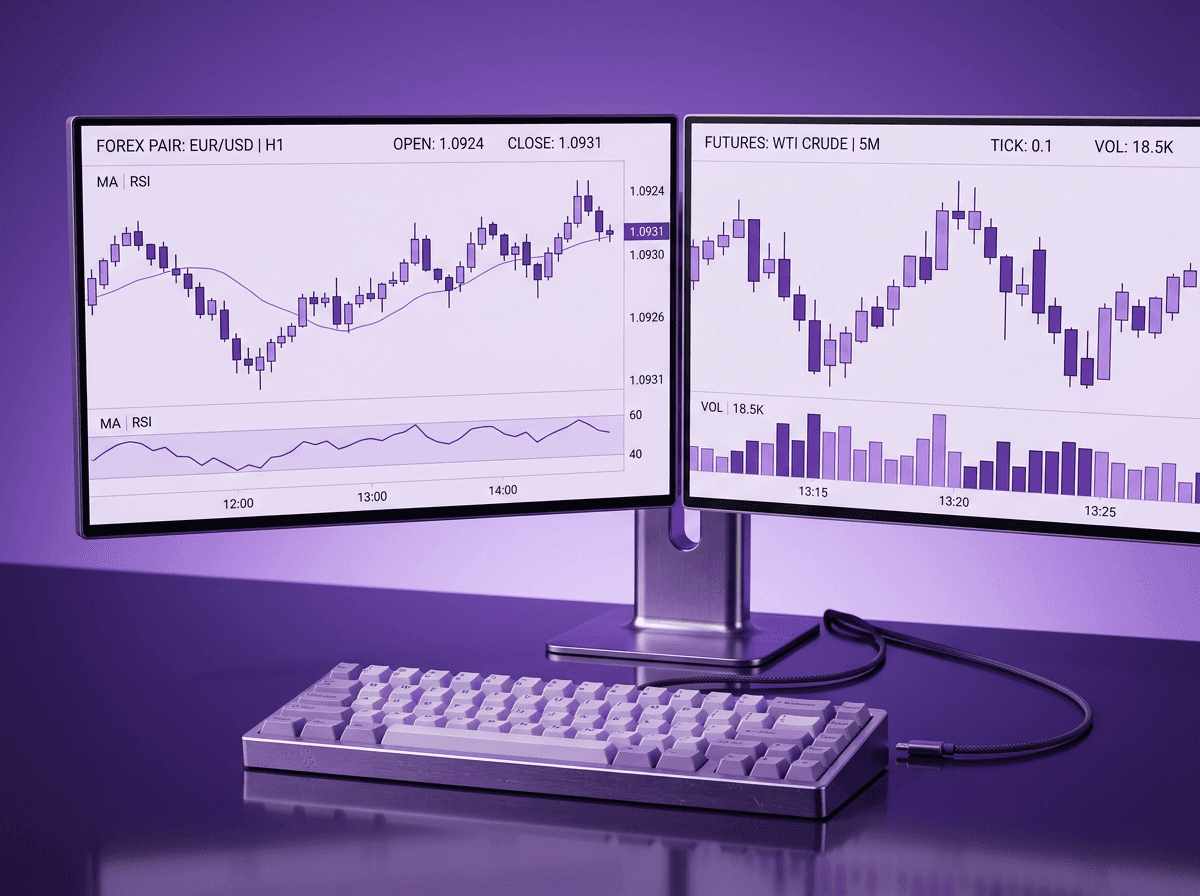
Forex and futures attract the same type of trader: someone who wants leverage, fast feedback, and the ability to go long or short. On the surface, they look similar. Both have active session windows. Both reward discipline. Both will humble you if you ignore risk management.
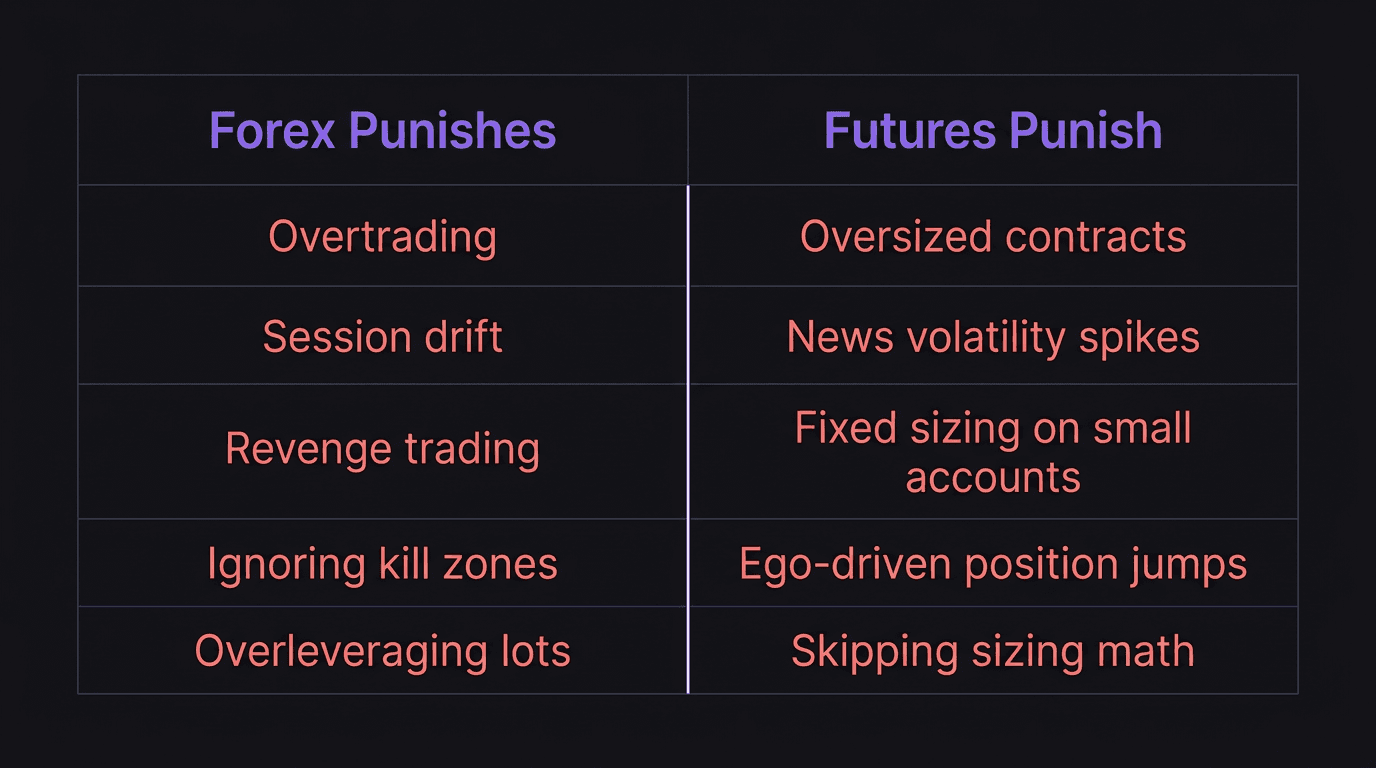
But under the hood, the mechanics are different enough that each market punishes a distinct set of mistakes. Forex punishes indiscipline. Futures punish bad sizing. Understanding that difference helps you pick the game whose rules match your personality.
If you have been trading forex and keep eyeing futures (or the other way around), this comparison breaks down what actually matters: leverage mechanics, contract structure, session behavior, and risk profiles.
TL;DR
Forex offers flexible lot sizes and high leverage, making it easier to scale position size precisely to your risk tolerance.
Futures use fixed contracts with built-in margin, which means one contract already controls a large dollar amount per tick.
Forex sessions (Asian, London, New York) create predictable daily rhythms. Futures follow the cash market open and close.
Forex punishes indiscipline (overtrading, revenge trading, ignoring sessions). Futures punish bad sizing (one contract too many can wipe a day).
Both markets work. The question is which type of mistake you can manage better.
Leverage and Margin: Forex Flexibility vs Futures Contracts
In forex, leverage is a ratio offered by your broker. A 100:1 account lets you control $100,000 with $1,000 in margin. A 500:1 account lets you control the same $100,000 with just $200.
This sounds dangerous, and it can be. But the real advantage of forex leverage is precision. You can trade micro lots, mini lots, or standard lots. You can size your position to risk exactly 1% of your account on any trade, down to the pip.
In futures, leverage works differently. Each contract has a fixed value. One NQ (Nasdaq 100 E-mini) contract moves roughly $20 per point. One ES (S&P 500 E-mini) contract moves $12.50 per tick ($50 per point). You cannot buy half a contract. You trade 1, 2, 3 contracts or more, and each one adds a fixed dollar exposure.
This fixed sizing is both a strength and a weakness. It simplifies decisions (you trade contracts, not lots), but it also means a small account has limited options for precise position sizing. A $5,000 futures account trading one NQ contract might be risking 4% per trade on a normal day and 8% on a volatile day, simply because the contract size does not scale down.
Feature | Forex | Futures |
|---|---|---|
Leverage | Broker-set ratio (50:1 to 500:1) | Built-in margin per contract |
Position sizing | Flexible (micro to standard lots) | Fixed (1 contract = set $ per tick) |
Minimum sizing | 0.01 lots (~$0.10/pip) | 1 micro contract (varies by product) |
Scaling precision | Very high | Lower (step-function) |
For a trader with a $2,000 to $10,000 account, forex gives more room to size precisely. For a trader with $25,000 or more, futures contracts become more manageable.
Session Structure and Volume Patterns
Forex has three distinct sessions: Asian, London, and New York. Each session has its own personality. Asian is quiet. London is where volume lives. New York brings volatility, especially during the overlap with London.
You can pick one session and trade the same 2 to 3 hour window every day. The rhythm repeats. The same pairs move at the same times. That repetition builds pattern recognition faster than any other market structure.
Futures are tied more closely to the equity cash market. The most liquid window is the first 1 to 2 hours after the New York Stock Exchange opens (9:30 AM to 11:30 AM Eastern). Pre-market and after-hours futures trading exists, but volume drops and spreads widen.
If your schedule fits the New York morning, futures work well. If you need flexibility to trade the London session, the Asian session, or evenings, forex gives you more options.
Key difference: Forex volume is distributed across three global sessions. Futures volume is concentrated in one (the US cash session). This means forex offers more trading windows but also more dead periods where price does nothing.
Walkthrough: Same Risk, Different Markets
Trader with a $10,000 account. Risk tolerance: 1% per trade ($100).
Forex (EUR/USD): She identifies a trade with a 25-pip stop-loss. At 1% risk, she needs to figure out lot size. $100 risk / 25 pips = $4 per pip. $4 per pip = 0.4 standard lots (since 1 standard lot = $10/pip for EUR/USD). She enters 0.4 lots. Her risk is exactly $100.
Math check: 0.4 lots x $10/pip = $4/pip. $4/pip x 25-pip stop = $100 risk. Correct.
Futures (NQ): He identifies a trade with a 10-point stop on NQ. One NQ contract moves $20 per point. 1 contract x $20/point x 10 points = $200 risk. That is 2% of his $10,000 account, double his target. To hit 1%, he would need half a contract, which does not exist on the standard NQ. He could trade 1 Micro NQ contract ($2/point), which would give him $20 risk (0.2%), or 5 Micro NQ contracts ($10/point), which would give him $100 risk (1%).
Math check: 5 Micro NQ x $2/point = $10/point. $10/point x 10-point stop = $100 risk. Correct.
The forex trader sized precisely with one calculation. The futures trader had to use micro contracts and do more math to hit the same risk target. Both are valid, but forex is more forgiving for small accounts.
Forex Punishes Indiscipline, Futures Punish Bad Sizing
This is the core personality difference between the two markets.
Forex is available 24 hours a day, five days a week. That access is a trap for undisciplined traders. You can overtrade, chase setups outside your session window, revenge trade after a loss, and take B-grade entries because the market is always "open." The leverage amplifies every mistake. Most forex traders lose because they cannot follow their own rules, not because their strategy is bad.
Futures are more concentrated. The best window is 2 to 3 hours. The issue is not overtrading across sessions; it is the impact of each individual trade. One NQ contract can swing $500 in minutes during volatile conditions. If you sized correctly, that swing is within your risk budget. If you sized wrong, it blows your daily loss limit in a single candle.
Futures traders who fail tend to fail fast. They size up too aggressively, get caught on the wrong side of a news event, and lose 5% in 20 minutes. The market does not give you time to recover the way a slow forex drawdown does.
Ask yourself:
Do you struggle more with overtrading and session discipline? Forex will expose that faster.
Do you struggle more with sizing and wanting to "go big"? Futures will expose that faster.
The market that punishes your specific weakness is the one you should trade. Not because you want punishment, but because confronting that weakness is the fastest path to fixing it.
How EdgeFlo Adapts to Both Markets
Whether you trade forex or futures, the discipline problems are the same: sizing errors, emotional entries, and lack of structured review. The instrument changes. The human mistakes do not.
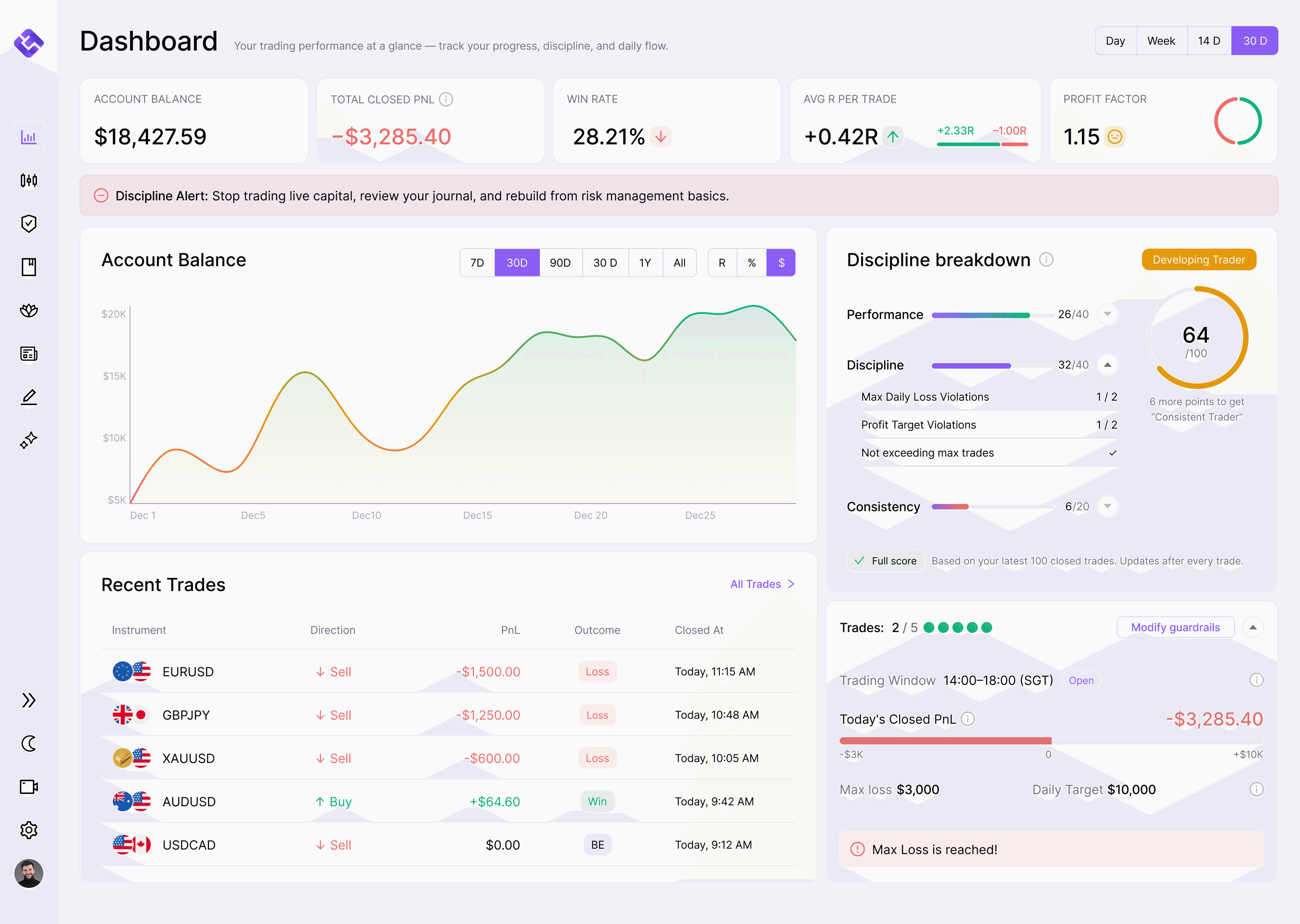
EdgeFlo's auto risk calculator works with both forex pairs and futures contracts. Enter your account size, your risk percentage, and your stop distance. The calculator tells you the exact position size. No mental math under pressure. No "I will just round up to the next contract."
The guardrails system (with override) lets you set daily loss limits, max trades per day, and risk per trade thresholds. These limits apply regardless of which market you are in. If you hit your 2% daily loss limit on NQ, the system warns you before you enter trade number four. You can override it, but you have to consciously choose to.
The journal tracks every trade with timestamps, session tags, and emotional notes. After a month, you can filter by market and session to see where your edge actually lives.
The Edge Brief
Receive Insights on trading psychology, discipline, and the behavioral patterns that create consistent traders from our Founder and the EdgeFlo team, delivered to your inbox.
Think different. Trade different.
Is forex or futures better for day trading?
Which has more leverage, forex or futures?
Can I trade both forex and futures?
Why do futures punish bad sizing more than forex?

Turn discipline on.
Every session.
EdgeFlo is the environment serious traders operate inside.
Start 7-Day Free Trial
Cancel anytime.
No long-term commitment.

Think Different, Trade Different.