

Forex Trading Sessions: When to Trade and When to Wait
Learn the three forex sessions (Asian, London, New York), when each one moves, and why 70% of forex is sideways. Trade the right window or lose to noise.
When Forex Actually Moves
The forex market is open 24 hours a day, five days a week. But that does not mean it is worth trading 24 hours a day. Roughly 70% of the time, price goes sideways. It chops, it wicks, it fakes direction. The other 30% is where the real moves happen, and those moves are concentrated in specific session windows.
If you trade during the wrong hours, you are not trading. You are donating. The sideways market will bait you into mediocre setups, bleed you with small losses, and destroy your confidence before the real move even starts.
Understanding the three forex sessions (and more importantly, when to sit out) is the single most underrated edge a beginner can build.
TL;DR
The forex market has three sessions: Asian, London, and New York, each with different pairs and volume profiles.
London produces the most volume and the cleanest directional moves for major pairs.
The New York/London overlap (1:00 PM to 5:00 PM GMT) is the highest-volatility window of the day.
About 70% of forex price action is sideways noise between sessions.
Trading one session well beats trading all three poorly.
Asian Session: The Quiet Setup
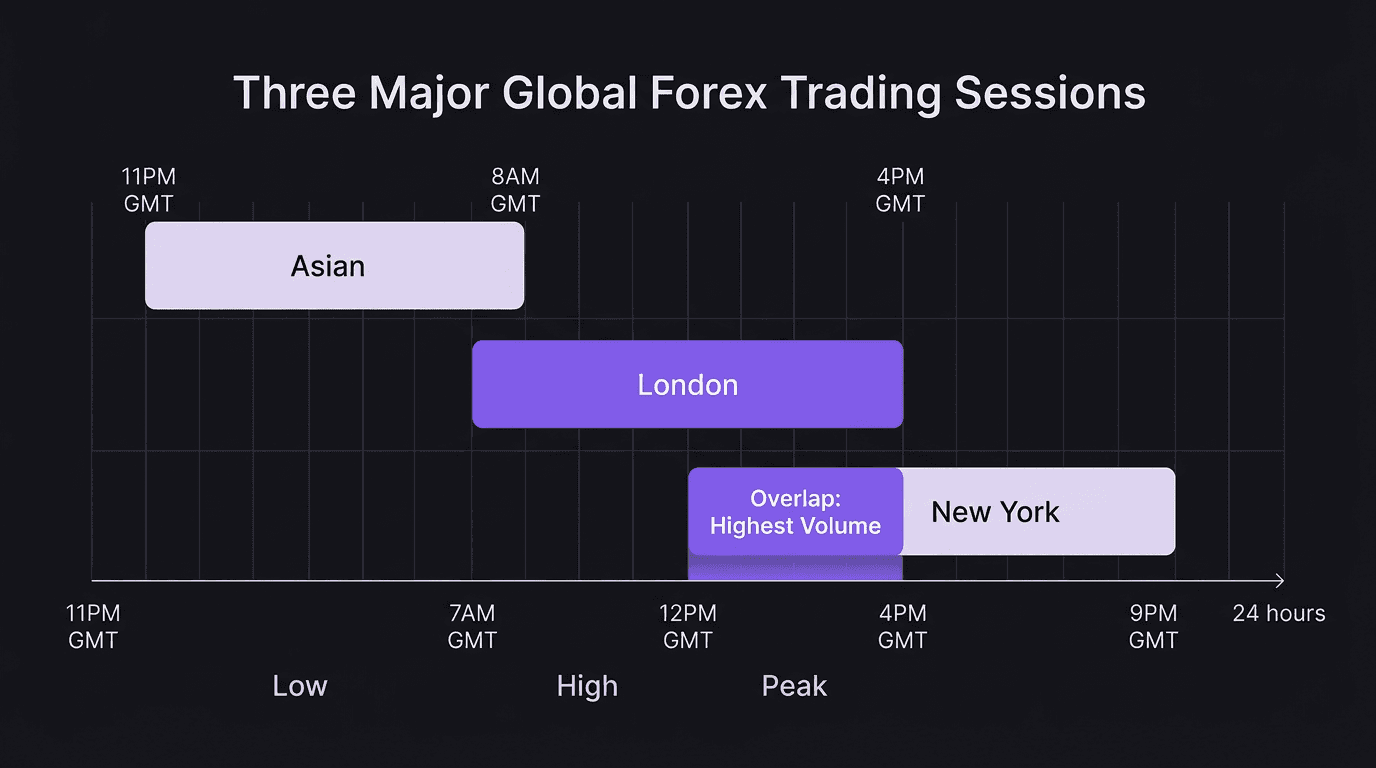
Hours: Roughly 11:00 PM to 8:00 AM GMT (Tokyo open to Tokyo close).
The Asian session is the quietest of the three. Volume is low, ranges are tight, and most major pairs barely move. This is not the session for aggressive entries or breakout trades.
But it is not useless. The Asian session sets the range that London will break. Think of it as the loading phase. Price consolidates, builds liquidity on both sides, and waits for the volume that arrives with London.
Pairs that move: USD/JPY, AUD/USD, NZD/USD. These pairs have natural flow during Asian hours because of economic activity in Japan, Australia, and New Zealand.
Pairs that sleep: EUR/USD, GBP/USD. These barely move until London opens. If you are trading GBP/USD during the Asian session, you are trading noise.
Walkthrough: Asian Session Range Trap
A trader sees GBP/USD moving 15 pips up during the Asian session and enters long, expecting a breakout. Price stalls, reverses, and stops them out for a 10-pip loss. Then it reverses again and stalls. After two more attempts, they are down 25 pips before London even opens.
Math check: Trade 1: 10-pip loss. Trade 2: 8-pip loss. Trade 3: 7-pip loss. Total: 25 pips lost. At 0.5 lots ($5/pip): 25 x $5 = $125 lost before the real session starts.
The move they were looking for? It happened 3 hours later during the London open, but they had already used up their daily loss limit chasing Asian noise.
London Session: Where Volume Lives
Hours: 7:00 AM to 4:00 PM GMT.
London is the center of the forex world. More volume passes through London than any other financial center. When London opens, the market wakes up. Tight Asian ranges break. Trends form. Moves that matter begin.
This is where most professional forex traders focus their attention. The first two hours of the London session (7:00 AM to 9:00 AM GMT) typically produce the highest-quality setups because institutional money is entering and breaking the overnight structure.
Pairs that move: EUR/USD, GBP/USD, EUR/GBP, USD/CHF. Any pair with a European currency comes alive.
Why it works for beginners: London is predictable in its rhythm. The session tends to sweep Asian session liquidity early, establish a daily bias, and then trend. If you learn to read that pattern, you have a repeatable setup every single day.
If you can only trade one session, trade London. The data supports it.
New York Session: Volatility and Overlap
Hours: 12:00 PM to 9:00 PM GMT (with overlap from 12:00 PM to 4:00 PM GMT).
The New York session brings a second wave of volume. On its own, New York is solid. But the real action happens during the London/New York overlap (roughly 1:00 PM to 5:00 PM GMT), when both financial centers are active simultaneously.
During the overlap, you get the highest volatility of the entire day. Moves are fast, ranges expand, and both continuations and reversals happen with conviction. This is the window where most day traders look for their best setups.
After London closes at 4:00 PM GMT, New York continues but volume drops. The last few hours of the New York session are similar to the Asian session: quieter, choppier, and less reliable.
Pairs that move: EUR/USD, GBP/USD, USD/CAD, USD/JPY (all dollar pairs pick up).
Risk during overlap: Speed cuts both ways. If you are wrong, you are wrong fast. Pre-market preparation matters more during the overlap than at any other time of day because there is less room to recover from a bad entry.
Why 70% of Forex Is Sideways
Here is a number that changes how you think about trading: roughly 70% of forex price action in any given day is sideways movement between sessions or during low-volume windows.
That means if you are trading without session discipline, seven out of ten candles you act on are noise. You are not finding setups. You are manufacturing them from randomness.
Sideways markets have killed more traders than bad strategies. When price chops, you overtrade. You take B and C setups because you are bored. You revenge trade after a stop-out that only happened because the market had no direction in the first place.
The fix is brutally simple: trade during the 30% that matters and do nothing during the rest.
How to identify sideways conditions:
Price is ping-ponging inside a 20 to 30 pip range with no higher highs or lower lows.
Volume on your platform is below its session average.
You have already checked your kill zone hours and the current window is not one of them.
If all three are true, close the chart. The market is not paying today during this window. Come back for the next session.
Walkthrough: What Happens When You Ignore Session Timing
A trader with a $10,000 account trades EUR/USD for 8 straight hours, from the middle of the Asian session through London. He risks 1% ($100) per trade.
During the Asian session (3 hours), he takes 4 trades. All sideways chop. Results: 1 win (+$300 at 3R), 3 losses (3 x $100 = $300 lost). Net: $0.
During the London open (2 hours), he takes 2 trades. Clean moves. Results: 1 win (+$300 at 3R), 1 loss ($100). Net: +$200.
During the London mid-session (3 hours), he takes 3 more trades. Moves slow down. Results: 0 wins, 3 losses ($300 lost). Net: negative $300.
Math check: Total trades: 9. Total wins: 2 x $300 = $600. Total losses: 7 x $100 = $700. Net: $600 minus $700 = negative $100. Win rate: 2/9 = 22%.
If he had only traded the London open window: 1 win, 1 loss, net +$200. Same skill, better timing.
How EdgeFlo Tracks Your Session Performance
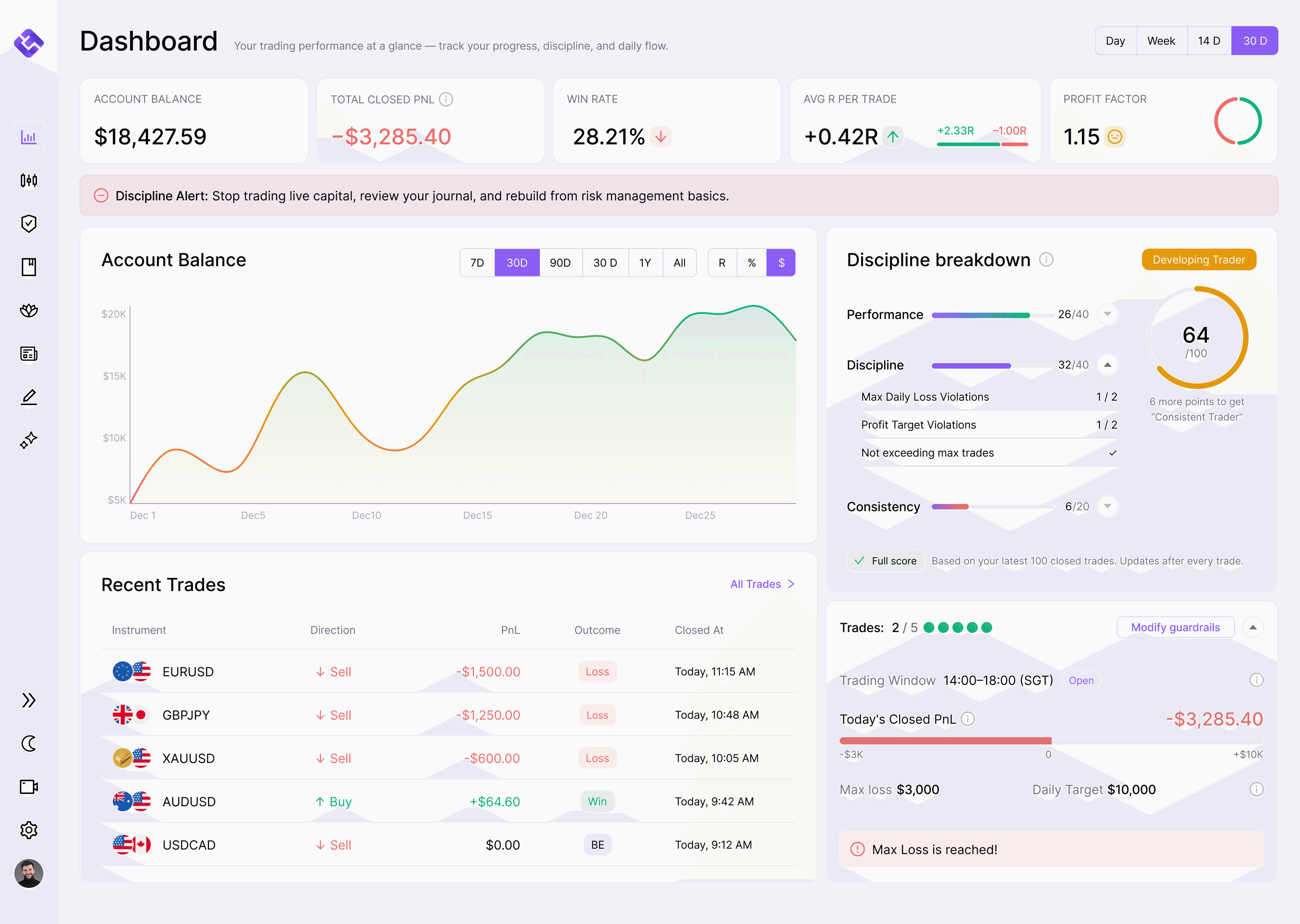
Knowing which sessions work for you is different from guessing. EdgeFlo's trading dashboard lets you filter your performance data by the session window you traded in.
After a month of logging trades, you can pull up your win rate, average R, and discipline score for each session. Most traders discover they perform significantly better in one window and significantly worse in another. That data tells you where to focus and where to stop showing up.
The dashboard also surfaces patterns you might miss on your own, like whether you tend to overtrade in the last hour of a session or whether your Asian session entries consistently get stopped before London confirms the real direction.
The Edge Brief
Receive Insights on trading psychology, discipline, and the behavioral patterns that create consistent traders from our Founder and the EdgeFlo team, delivered to your inbox.
Think different. Trade different.
What are the three forex trading sessions?
What is the best forex session to trade?
Why is 70% of forex sideways?
Can I trade forex during the Asian session?

Turn discipline on.
Every session.
EdgeFlo is the environment serious traders operate inside.
Start 7-Day Free Trial
Cancel anytime.
No long-term commitment.

Think Different, Trade Different.