

Forward Testing Your Strategy: The Bridge to Live Trading
Forward testing validates your backtested edge in real-time market conditions. Learn the protocol for running a proper forward test on demo before going live.
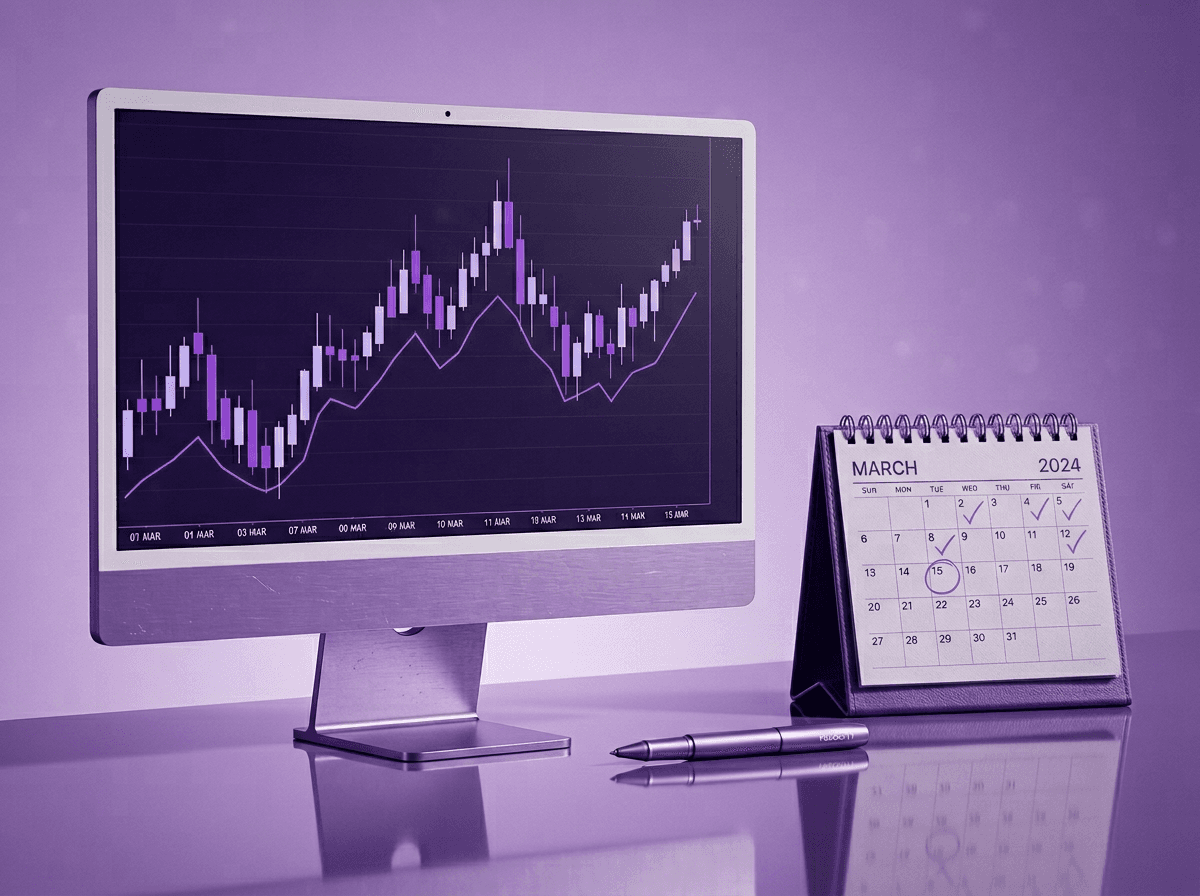
Forward testing is where you take your backtested strategy and trade it in real time on a demo account, marking up charts each day and executing setups as the market moves. It bridges the gap between historical replay and live capital. If your backtest shows a positive edge, forward testing confirms that edge holds when you cannot see what comes next and when real-time emotions enter the picture.
Most traders either skip forward testing entirely or treat demo accounts as a playground with no structure. Both approaches waste time. The point of a forward test is not "practice." It is data collection under live conditions, tracked and measured just as seriously as your backtest.
TL;DR
Forward testing means trading your strategy in real time on a demo account, one day at a time, with no knowledge of what comes next.
It validates whether your backtested edge survives real market conditions, execution delays, and your emotional responses.
Run your forward test for at least two to four weeks, logging every trade with the same detail as your backtest.
Compare your forward test win rate, expectancy, and R-multiple against your backtest numbers to confirm consistency.
Only move to live trading when your forward test results match your backtest within a reasonable margin.
What Forward Testing Is
Here is the simplest way to think about it. Backtesting is like studying for an exam with the answer key in front of you. Even with bar replay hiding future candles, your brain catches subtle patterns. You have seen charts like this before. You know, at some level, how the story ends.
Forward testing is the actual exam. Price is unfolding in real time. You mark up your charts in the morning, identify potential setups, and then wait. If a setup triggers, you execute it on demo. If it does not, you walk away. The next day, you check the results and log them.
Every single day, you are answering one question: does my strategy produce the results I expected?
The tool is a demo account on cTrader/ TradeLocker, or whatever platform your broker provides. But the tool is not the process. The process is structured, measured, and intentional. Without structure, demo trading becomes aimless clicking, which is exactly the mistake most demo traders make.
How Forward Testing Differs From Backtesting
The difference is not just speed. It is psychology.
In a backtest, you can test 10 trades in 30 minutes. The emotional weight is zero. You are clicking through candles. If a trade goes against you, you feel nothing because you already know 47 more trades are coming.
In a forward test, you mark a setup at 8 AM, enter the trade, and then sit with it for hours. Price goes against you. Your palms get a little sweaty. You think about moving your stop. This is real, even though the money is fake. And that is exactly the point.
Forward testing reveals things your backtest cannot:
Execution gaps. Can you actually enter at the price you planned, or do you hesitate and miss the entry by 5 pips?
Time pressure. Your backtest might show a setup at London open, but in real time, three pairs are setting up simultaneously. Can you handle that?
Emotional leakage. After two consecutive losses on demo, do you start widening your stop or taking setups that do not meet your criteria? Your trading journal will reveal this pattern if you are honest about logging it.
Session-specific behavior. Some strategies look great on historical data but fall apart during low-volume sessions. Forward testing exposes this because you are trading in real time during real sessions.
Running a Forward Test the Right Way
Here is the protocol. Follow it exactly.
Before the Market Opens
Open your charts and mark up the key levels, zones, and structure for the day. Identify where your strategy would look for entries. Write down your plan: "If price pulls back to 1.0850 and gives a bullish signal, I enter long with a 20-pip stop and a 60-pip target."
Do this before the session starts. Not during. Making decisions in advance is the entire point.
During the Session
Trade on demo exactly as you would with real money. Same lot size relative to your demo balance (use 1% risk). Same stop loss placement. Same trade management. Do not take trades you would not take on a live account, and do not skip trades because "it is just demo."
If a setup triggers, enter it. If price does not reach your zone, do nothing. Patience on demo is practice for patience on live.
After the Session
Log every trade:
Pair, direction, entry, stop, target
Result and R-multiple
Whether you followed your rules
Any emotional notes (hesitated, felt fear, felt confident)
Also log the trades you did not take. If a setup met your criteria but you skipped it, that is data. If you took a trade that did not meet your criteria, that is also data. Both reveal something about the gap between your plan and your execution.
Walkthrough: A Forward Test Week on GBP/USD
Monday. You mark a supply zone at 1.2740 on the 1-hour chart. Price rallies into the zone at 10:15 AM London time. You see a bearish engulfing candle, which is your entry trigger. You enter short at 1.2738 with a stop at 1.2758 (20 pips) and a target at 1.2678 (60 pips, 3:1). By 2 PM, price has dropped to 1.2695 but stalls. You hold because your plan says set and forget. By end of day, price is at 1.2710. Still open.
Tuesday. Price resumes the drop and hits your target at 1.2678. You log: GBP/USD, short, win, +3R, rules followed.
Wednesday. No setup triggers. You do nothing. You log: "No valid setup. Stayed out." That entry matters. It proves you have the discipline to sit on your hands.
Thursday. You mark a demand zone at 1.2650. Price drops into it at 9:30 AM. You see a bullish pin bar, enter long at 1.2652, stop at 1.2632 (20 pips), target at 1.2712 (60 pips). Price drops to 1.2630 and stops you out. You log: GBP/USD, long, loss, -1R, rules followed.
Friday. Another setup at a supply zone. You hesitate after yesterday's loss and miss the entry. Price drops 50 pips without you. You log: "Setup met criteria. Did not enter due to hesitation after Thursday loss."
That Friday entry in your journal is gold. It tells you that after a loss, you freeze. That is a forward-testing insight that no backtest would ever reveal.
Reading Your Forward Test Results
After two to four weeks (or at least 30 trades), pull your data and compare it to your backtest.
Win rate comparison. If your backtest showed 35% and your forward test shows 33%, that is within range. If your backtest showed 35% and your forward test shows 18%, something is off. Either your execution is inconsistent, or your backtest was contaminated by hindsight bias.
Expectancy comparison. This is the number that matters. If your backtest expectancy was 0.32R per trade and your forward test expectancy is 0.28R, you are in the zone. If it has flipped negative, stop and diagnose the problem before going live.
Rule adherence. What percentage of your trades followed the plan? If it is below 80%, your forward test data is unreliable because too many trades were discretionary decisions, not strategy executions.
Example: 30 forward test trades. 11 wins (37%), 19 losses (63%). Average win: 2.9R. Average loss: 1R. Expectancy = (0.37 times 2.9) minus (0.63 times 1) = 1.073 minus 0.63 = 0.44R per trade.
Compare this to a backtest expectancy of, say, 0.32R. Your forward test is actually performing slightly better. That is a green light. Your edge translates from historical replay to live markets. Your sample size is still small, so continue tracking, but the initial validation is positive.
Your trading dashboard should show both your backtest and forward test data side by side. When those two lines converge, you know your strategy is real.
Walkthrough: What Failing a Forward Test Looks Like
You backtested 80 trades with a 40% win rate and 0.40R expectancy. Solid numbers. Then you forward test for three weeks and log 25 trades. Win rate: 24%. Average win: 2.1R. Average loss: 1.3R (because you kept moving your stop loss further away on several trades).
Expectancy = (0.24 times 2.1) minus (0.76 times 1.3) = 0.504 minus 0.988 = negative 0.484R per trade.
Your edge evaporated. The culprit is obvious from the data: your average loss jumped from 1R (in the backtest) to 1.3R because you moved your stop. That single behavioral change turned a profitable strategy into a losing one. Fix the behavior, re-run the forward test, and do not go live until the numbers match again.
How EdgeFlo Supports Your Forward Test
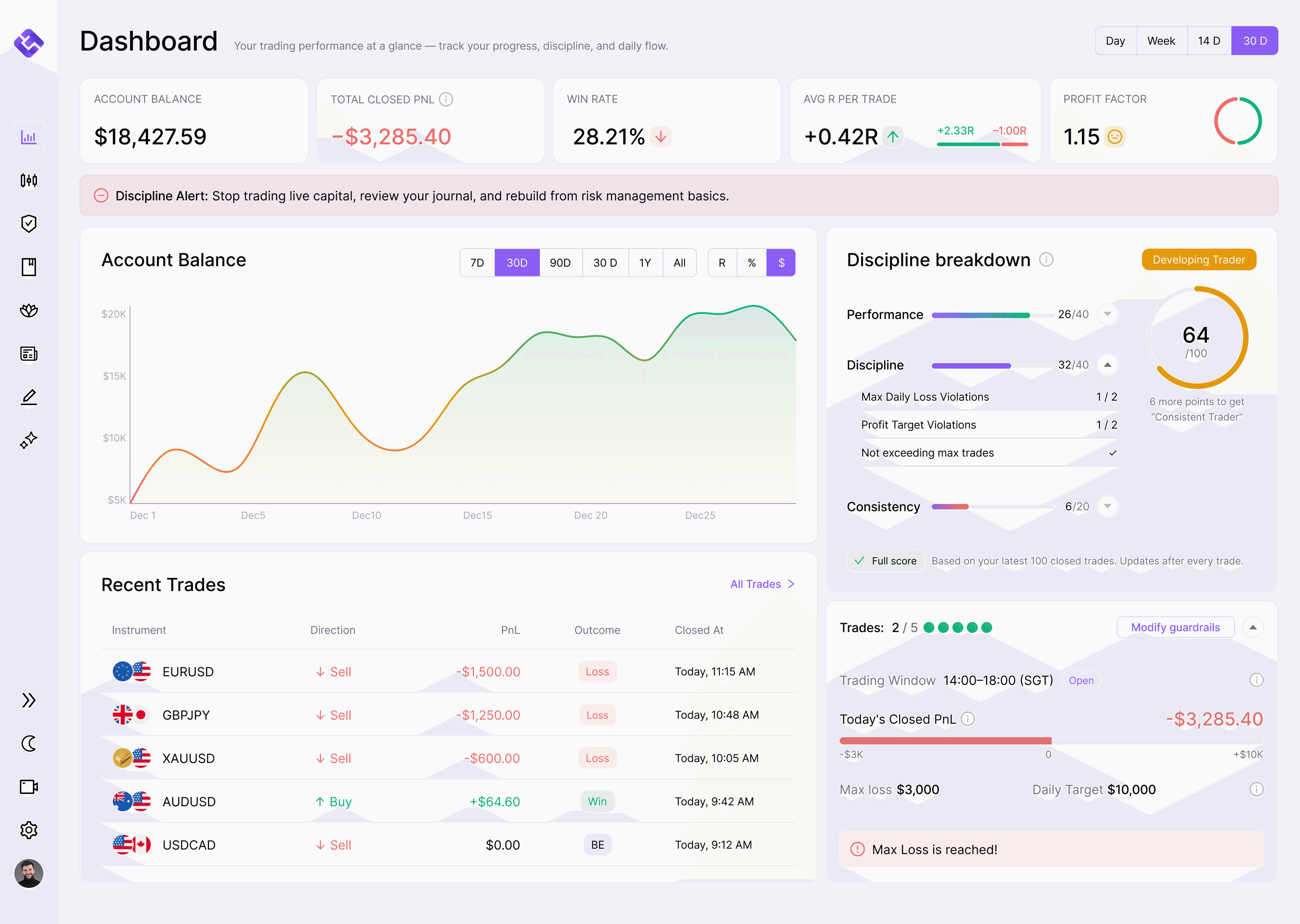
Forward testing generates daily data that needs a home. EdgeFlo's trading journal auto-imports your demo trades and lets you tag each one with your strategy name, session, and whether you followed your rules. The dashboard calculates your expectancy in real time, so you do not need to run formulas in a spreadsheet.
More importantly, EdgeFlo lets you compare testing phases directly. Your backtest data sits next to your forward test data, and you can see at a glance whether the edge is holding. If your average loss creeps up or your win rate drops, the dashboard shows it before you notice it yourself.
That kind of visibility turns forward testing from a vague "practice period" into a structured validation process with clear pass/fail criteria.
The Edge Brief
Receive Insights on trading psychology, discipline, and the behavioral patterns that create consistent traders from our Founder and the EdgeFlo team, delivered to your inbox.
Think different. Trade different.
How long should I forward test before going live?
Is forward testing the same as demo trading?
Can I skip forward testing if my backtest looks good?
What should I do if my forward test results are worse than my backtest?

Turn discipline on.
Every session.
EdgeFlo is the environment serious traders operate inside.
Start 7-Day Free Trial
Cancel anytime.
No long-term commitment.

Think Different, Trade Different.