

The 5R Review Process: Record, Review, Reflect, Refine, Reassess
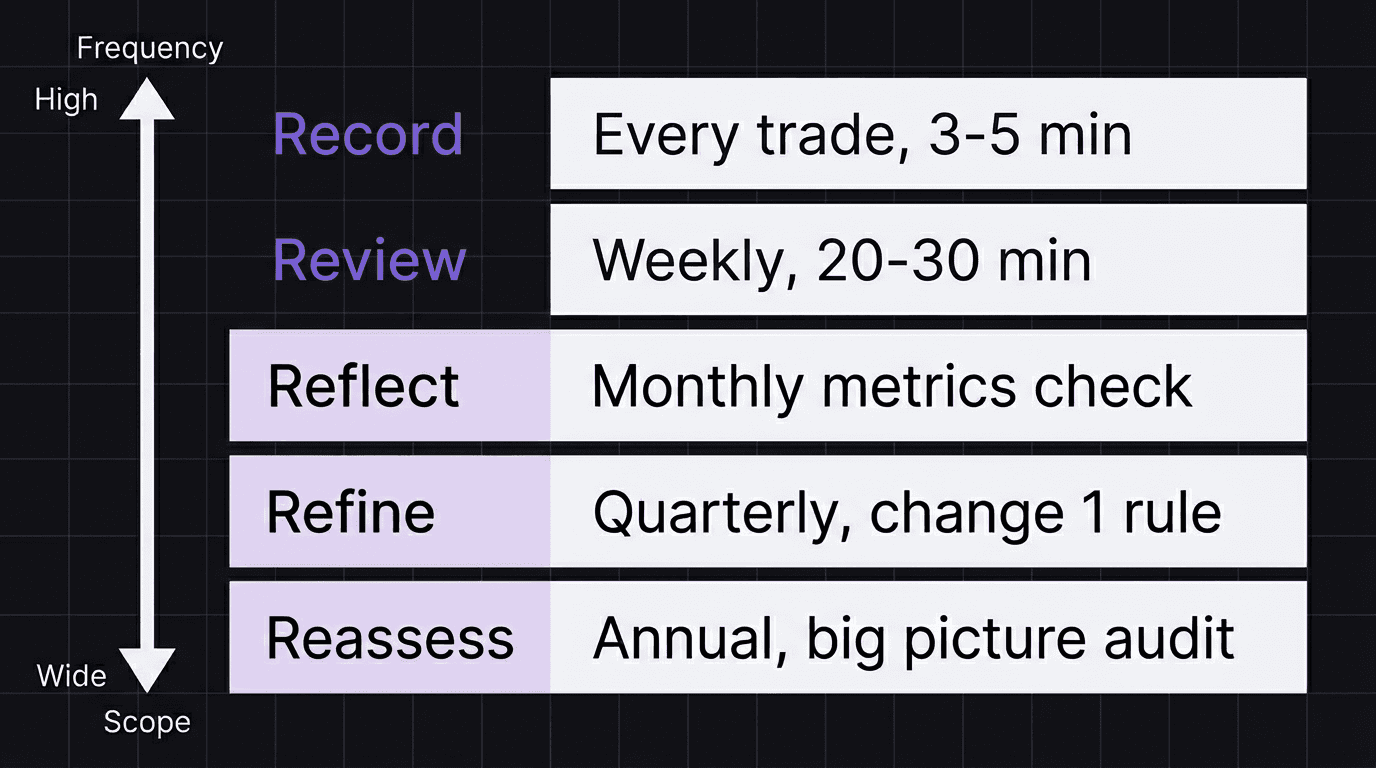
Build a repeatable review system: record trades daily, review weekly, reflect monthly, refine quarterly, reassess annually. Each tier with specific actions.

Record: Log Every Trade Daily
Consistent actions do not guarantee consistent results. But inconsistent actions guarantee inconsistent results. The 5R review process turns trading from guesswork into a structured skill-building loop: Record daily, Review weekly, Reflect monthly, Refine quarterly, Reassess annually.
Most traders skip the review entirely. They trade, they win or lose, and they show up tomorrow to do it again with no feedback. That is like going to the gym every day but never tracking your reps, your weight, or your progress. You are putting in the work but you have no idea if it is working.
Recording is the foundation. If you do not record, the other four tiers have nothing to work with.
TL;DR
Record every trade within 5 minutes of closing it (3 to 5 minutes per entry).
Review your trades weekly to spot behavioral patterns you cannot see in the moment.
Reflect monthly on performance metrics: win rate, average R, discipline score.
Refine your rules quarterly by adjusting one variable at a time based on data.
Reassess annually to evaluate whether your market, style, and goals still align.
What to Record
Every trade gets a journal entry with these fields:
Date and session. When did you trade? Which session window?
Pair/instrument. What did you trade?
Direction and entry reason. Long or short? What was the setup?
Stop-loss and take-profit. Where were your exits before entry?
Outcome. Win, loss, or breakeven? What R-multiple?
Emotional state. Were you calm, anxious, frustrated, bored, or confident before entry?
Plan adherence. Did you follow your rules, or did you improvise?
The whole entry should take 3 to 5 minutes. If it takes longer, you are overcomplicating it.
The rule: record within 5 minutes of closing the trade. If you wait until the end of the day, you will forget the emotional context. You will retroactively justify bad entries and downplay impulsive decisions. The journal only works if it captures the truth in real time.
Walkthrough: What a Daily Record Looks Like
Trade date: March 14, 2026 Session: London (7:15 AM GMT entry) Pair: EUR/USD Direction: Long Entry reason: Bullish BOS on M15, price swept Asian low, entered at demand zone retest Stop-loss: 1.0845 (22 pips below entry at 1.0867) Take-profit: 1.0933 (66 pips above entry, 3R target) Outcome: Hit TP. +3R. Emotion before entry: Slightly anxious (first trade after two consecutive losses) Plan adherence: Followed all entry criteria. Did not move stop.
Math check: Entry: 1.0867. Stop: 1.0845. Distance: 22 pips. Entry: 1.0867. Target: 1.0933. Distance: 66 pips. 66 / 22 = 3R. Correct.
That entry took 4 minutes. It is enough to build on during the weekly review.
Review: Find Patterns Weekly
The daily record captures raw data. The weekly review turns that data into insight.
Set aside 20 to 30 minutes once a week (ideally on the weekend when the market is closed). Pull up your trade journal for the week and ask these specific questions:
How many trades did I take? Compare this to your target. If your plan says 3 to 5 trades per week and you took 12, that is overtrading, regardless of results.
How many were plan-adherent? Count the trades that followed every entry criterion. Divide by total trades. That is your plan adherence rate. Below 80% means your execution is drifting.
What was my emotional pattern? Look at the emotion tags. Did you trade frustrated on Wednesday after a Tuesday loss? Did boredom on Thursday drive two extra entries?
What time of day produced my best results? Check whether your wins cluster in a specific session window and your losses spread across other hours.
What is one thing I would do differently? Just one. Not five. One adjustment for next week.
The weekly review is not about judging your P&L. A week is too short for P&L to mean anything. It is about catching behavioral patterns before they become habits.
Walkthrough: Weekly Review Catches a Session Problem
A trader reviews her week. She took 8 trades total.
London session trades (5): 3 wins, 2 losses. Win rate: 60%. Average R: 1.8R. New York session trades (3): 0 wins, 3 losses. Win rate: 0%. Average R: negative 1R.
Math check (weekly net): London: (3 x 1.8R) minus (2 x 1R) = 5.4R minus 2R = +3.4R. New York: 0 minus (3 x 1R) = negative 3R. Total: 3.4R minus 3R = +0.4R.
She barely broke even, but the data shows her London results are strong. Her New York trades are dragging her down. Without the review, she would have seen "+0.4R" and thought the week was mediocre. With the review, she sees a clear fix: stop trading New York.
Reflect: Measure Progress Monthly
Monthly reflection zooms out from individual trades to overall performance metrics. This is where you measure whether you are actually improving.
At the end of each month, calculate:
Win rate. Total wins divided by total trades. Track the trend month over month.
Average R. Sum of all R-multiples divided by total trades. This shows whether your winners are big enough relative to your losers.
Plan adherence rate. What percentage of trades followed your rules exactly?
Best and worst day. What happened on each? What can you learn?
Emotional trend. Are you trading calmer than last month? Are your anxiety entries decreasing?
The monthly reflection answers one question: am I getting better? Not "did I make money this month" (variance can make profitable months look bad and losing months look good), but "are my process metrics improving?"
If your win rate is stable, your average R is growing, and your plan adherence is above 80%, you are building an edge even if P&L is flat. If your win rate is dropping and adherence is below 70%, something in your process is breaking and needs attention.
Refine and Reassess: The Quarterly and Annual Checkpoints
Quarterly: Refine One Variable
Every three months, review the previous quarter's data and make one adjustment to your trading plan.
Not five. One. The goal of quarterly review is surgical improvement, not a complete overhaul.
Good quarterly adjustments:
Tightening your stop-loss distance by 5 pips based on data showing you get stopped out just before the move.
Removing one session window that consistently underperforms.
Adding a mandatory 10-minute break after any loss, based on data showing your second trade after a loss has a 15% win rate.
Adjusting your take-profit target from 3R to 4R because your backtest shows the extended target gets hit 65% as often but produces higher expectancy.
Bad quarterly adjustments:
Switching your entire strategy.
Adding a new market.
Changing multiple rules at once (you will not know which change made the difference).
Annual: Reassess the Big Picture
Once a year, step back from the details and ask:
Is this still the right market for me? After 12 months of data, you have real evidence. If your edge is positive, stay. If it is consistently negative despite good process metrics, consider a market change.
Is my trading style working with my life? If day trading is burning you out, a shift to swing trading might preserve your edge while improving your quality of life.
Are my goals realistic? If you targeted 10% monthly and averaged 3%, the goal needs adjusting. Unrealistic goals create frustration, and frustration creates bad trades.
The annual reassessment is the only time you should seriously consider changing your market or style. Everything else (daily, weekly, monthly, quarterly) is about refining what you already have.
How EdgeFlo Automates the 5R Cycle
The 5R process works because it creates a feedback loop. But most traders skip their journal because manual tracking is tedious. That is where the system breaks.
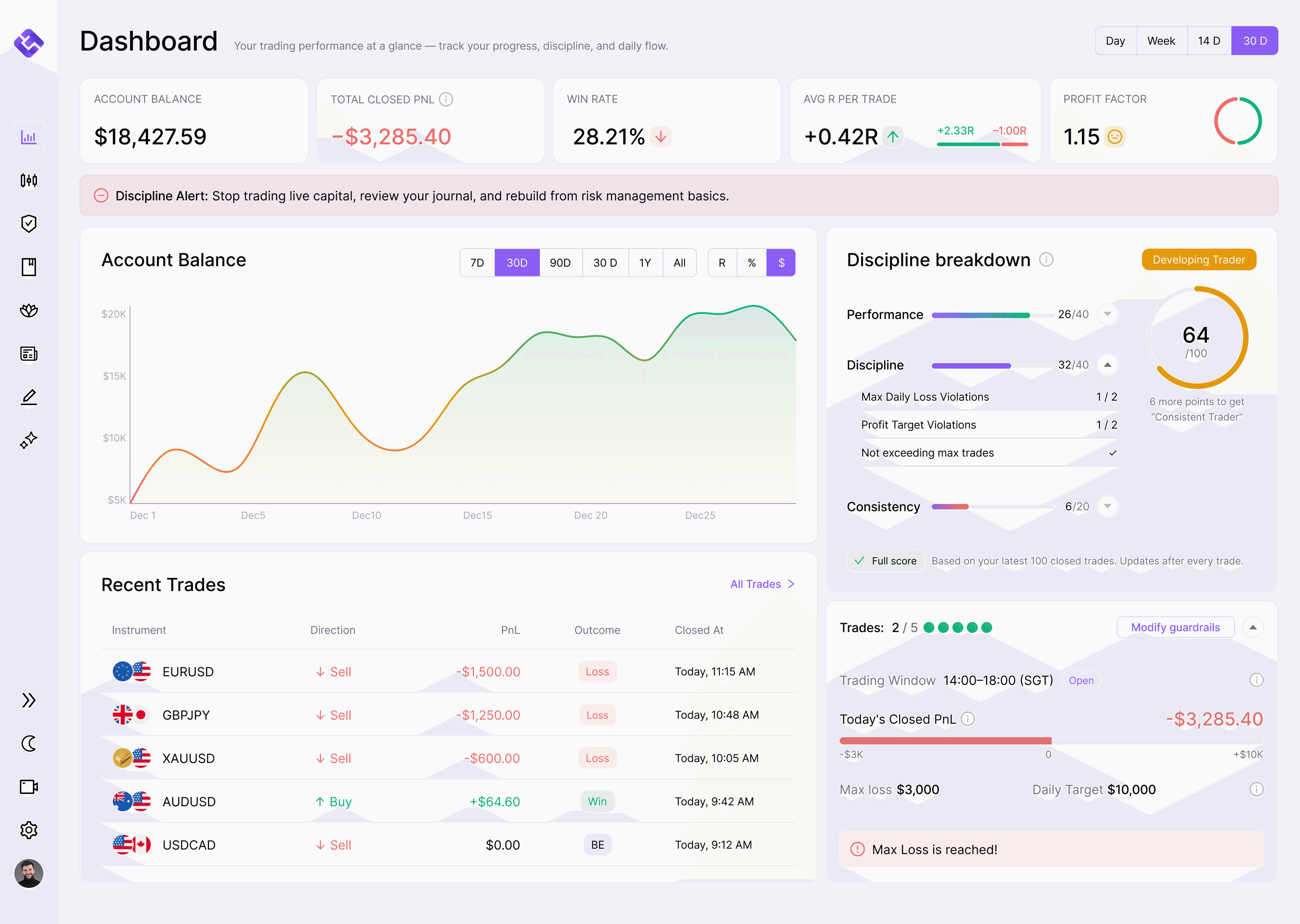
EdgeFlo's trading journal auto-imports your trades, so the Record step takes seconds instead of minutes. Emotion tagging is one tap. Plan adherence is a yes/no checkbox. The friction that kills journaling habits is almost eliminated.
For the Review and Reflect tiers, the dashboard generates weekly and monthly summaries automatically. Win rate by session, average R over time, plan adherence percentage, emotional patterns by day of week. You do not have to build spreadsheets or run formulas. The data is waiting when you sit down for your 20-minute review session.
For Refine and Reassess, the Plus plan includes weekly AI reports (via FloAI) that flag patterns you might miss: declining adherence on Fridays, a session window that has gone cold, or a widening gap between planned and actual risk. These are suggestions, not instructions. You decide what to change. FloAI surfaces what to look at.
The Edge Brief
Receive Insights on trading psychology, discipline, and the behavioral patterns that create consistent traders from our Founder and the EdgeFlo team, delivered to your inbox.
Think different. Trade different.
What is the 5R review process in trading?
How long should a daily trade record take?
How often should I review my trading journal?
What is the difference between review and reflect?

Turn discipline on.
Every session.
EdgeFlo is the environment serious traders operate inside.
Start 7-Day Free Trial
Cancel anytime.
No long-term commitment.

Think Different, Trade Different.