

The 0.5% Risk Rule: Why It Beats 1% for Most Traders
The 0.5% risk rule keeps most traders alive longer than 1%. See the drawdown math, survival rates, and position sizing at half-percent risk.
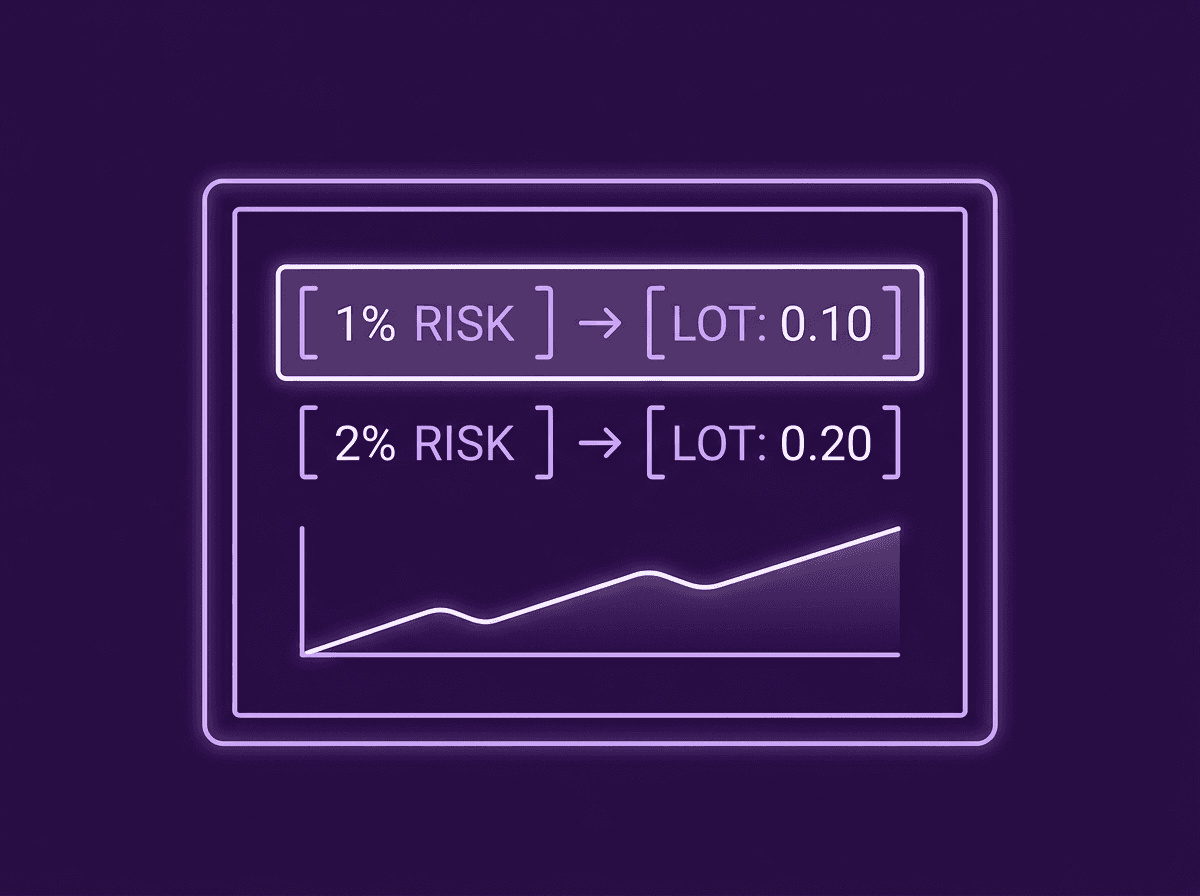
The trading industry preaches 1% risk per trade as the golden rule. For most traders, that is still too much. The half percent risk rule (0.5% per trade) gives you double the runway, cuts your emotional reaction to losses in half, and lets you survive the losing streaks that are guaranteed to come.
Survival comes before profitability. You cannot compound an edge on a blown account.
TL;DR
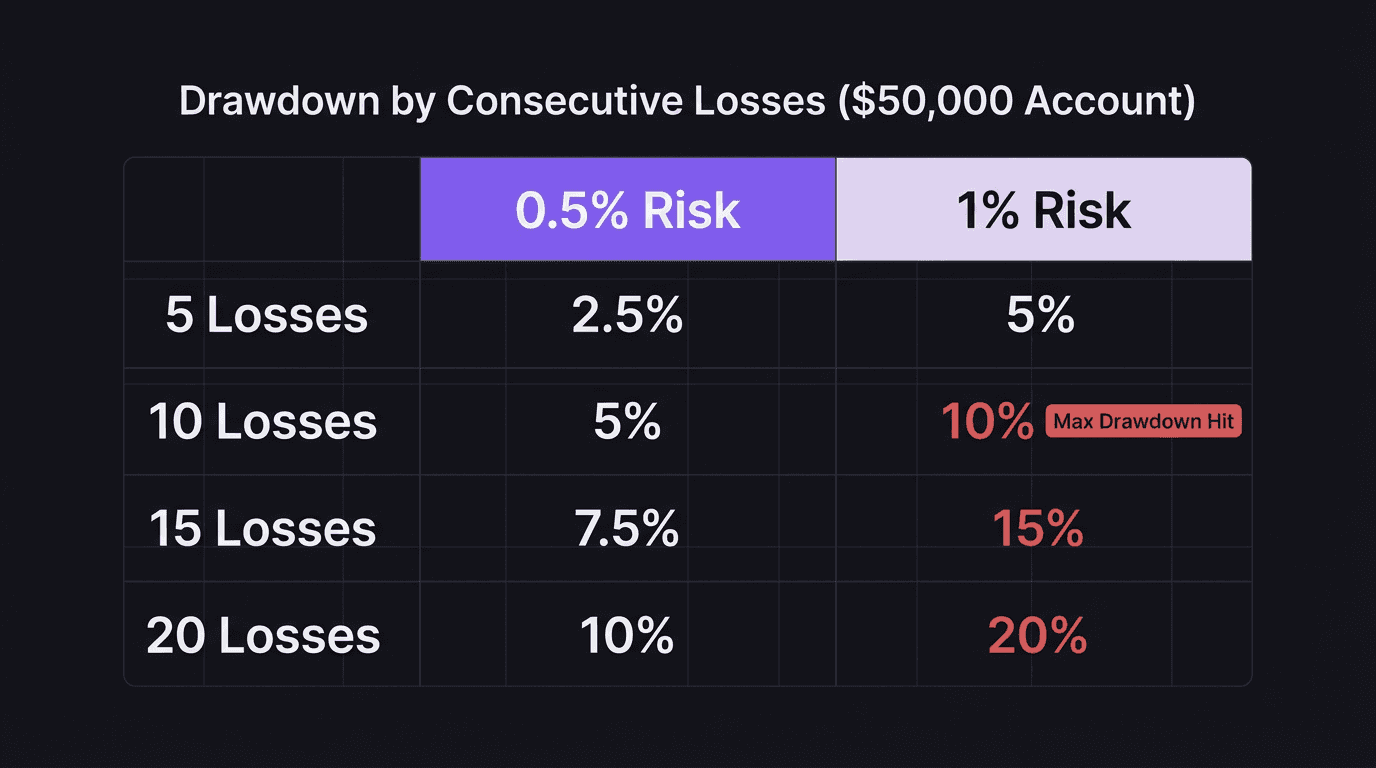
Risking 0.5% per trade gives you 20 consecutive losses before hitting a 10% drawdown, versus 10 at 1%.
Smaller risk per trade reduces the emotional weight of each loss, making it easier to execute consistently.
On a $50,000 account, 0.5% risk is $250 per trade. A 3R winner still returns $750.
Graduate to 1% only after your journal data proves you can handle the psychological load.
Why 0.5% Beats 1% for Most Traders
The 1% rule exists for good reason. It prevents account wipeouts from a single bad day. But here is what nobody tells you: 1% assumes you have the emotional capacity to handle ten consecutive 1% losses without changing your behavior. Most traders do not.
After five 1% losses in a row, you are down 5%. That is where the panic starts. You widen your stop on the next trade. You skip a valid setup because you are scared. You cut a winner early to "lock in" something. All because the losses feel too heavy.
At 0.5% per trade, those same five consecutive losses put you down 2.5%. That is a mild drawdown, not a crisis. You still feel comfortable executing. Your behavior stays consistent. And consistency is what makes edges work.
The math is straightforward:
10 consecutive losses = max drawdown hit.
That is extremely tight. A 40% win rate strategy can easily produce 8 to 10 loss streaks in normal conditions.
20 consecutive losses = max drawdown hit.
That gives you double the buffer. A 20-loss streak is exceptionally rare for any strategy with a positive edge.
For funded traders, this is not theoretical. Most prop firm challenges enforce a 10% maximum drawdown. Trading at 1% means you are 10 trades from failure at any point. Trading at 0.5% means 20. That extra breathing room is the difference between passing the challenge and losing your fee.
The Survival Math at 0.5%
Here is a concrete comparison on a $50,000 account.
5-loss streak: down $2,500 (5% drawdown).
10-loss streak: down $5,000 (10% drawdown).
To recover from 10%: you need an 11.1% gain just to get back to even.
5-loss streak: down $1,250 (2.5% drawdown).
10-loss streak: down $2,500 (5% drawdown).
To recover from 5%: you need a 5.3% gain to get back to even.
The recovery math is the killer. At 1%, a 10-loss streak puts you in a hole that requires an 11.1% gain to escape. At 0.5%, the same streak only requires 5.3%. That is less than half the climb.
This matters because drawdown recovery is not just a math problem. It is a psychology problem. The deeper the hole, the more desperate you feel, the more likely you are to break rules, increase size, or revenge trade. Keeping drawdowns shallow keeps your decision-making clean.
Walkthrough: The Funded Challenge at 0.5%
A trader enters a $100,000 funded challenge with a 10% max drawdown ($10,000). They risk 0.5% per trade, which is $500 per trade.
Week 1: They take 8 trades. Win 3, lose 5. Each win averages 3R ($1,500). Each loss is $500.
Wins: 3 times $1,500 = $4,500. Losses: 5 times $500 = $2,500. Week 1 net: +$2,000. Drawdown used: $2,500 at the lowest point (5 losses came first before the wins). That is 2.5% of the account. Plenty of room.
Week 2: 7 trades. Win 3, lose 4. Wins: 3 times $1,500 = $4,500. Losses: 4 times $500 = $2,000. Week 2 net: +$2,500.
After two weeks: +$4,500 total. Max drawdown touched was 2.5%. The trader never felt pressure. They executed calmly because each loss was only $500, a number that does not trigger emotional responses on a $100,000 account.
Now imagine that same scenario at 1% risk ($1,000 per trade). The five consecutive losses in week one would have been a $5,000 hit (5% drawdown). That is halfway to the max. By trade six, the trader is stressed, second-guessing every entry, and likely breaking rules. The strategy is identical. The risk per trade changed everything.
When to Upgrade to 1%
The 0.5% rule is not meant to be permanent for every trader. It is a starting point. The right time to increase your risk per trade depends on your data, not your desire to make more money.
Here is the upgrade checklist:
1. At least 100 live trades at 0.5% risk. Not backtested trades. Not demo trades. Live trades where real money was on the line. This is your proof that you can execute consistently under real conditions.
2. Positive expectancy confirmed. Your average winning R times your win rate must exceed your average losing R times your loss rate. If the math is not positive after 100 trades, do not increase risk.
3. Maximum drawdown stayed below 5%. If you hit 5% or more at 0.5% risk, going to 1% would have put you at 10% or worse. That is not safe.
4. No emotional breakdowns during losing streaks. This is the subjective one. If a 5-loss streak at 0.5% makes you feel like quitting, you are not ready for 1%. The dollar amounts double, and so does the emotional pressure.
5. You have a daily loss limit rule that you follow. Before increasing per-trade risk, you need a circuit breaker. A common rule: stop trading after 3 consecutive losses in a day. This prevents a bad day from becoming a catastrophe at higher risk levels.
Position Sizing at 0.5% Risk
The formula for calculating lot size at 0.5% risk is simple:
Lot size = (Account balance x 0.005) / (Stop loss in pips x Pip value per lot)
Here is an example on a $10,000 account trading EUR/USD with a 30-pip stop loss:
Risk amount: $10,000 x 0.005 = $50.
Pip value for EUR/USD: $10 per pip per standard lot.
Lot size: $50 / (30 x $10) = $50 / $300 = 0.17 lots.
Another example on a $50,000 account trading USD/JPY with a 40-pip stop loss:
Risk amount: $50,000 x 0.005 = $250.
Pip value for USD/JPY: approximately $6.60 per pip per standard lot.
Lot size: $250 / (40 x $6.60) = $250 / $264 = 0.95 lots.
Notice how the lot size adjusts automatically based on your stop distance. A wider stop means a smaller position. A tighter stop means a larger position. But the dollar risk stays constant at 0.5% of your account.
This is position sizing at its most mechanical. There is no room for "I feel confident on this trade so I will go bigger." Every trade risks the same percentage. Every trade gets the same emotional weight.
The half percent risk rule is not exciting. It will not turn a $500 account into $50,000 overnight. But it will keep you in the game long enough for your edge to work. And in trading, survival is the only prerequisite for success.
How EdgeFlo Handles Position Sizing
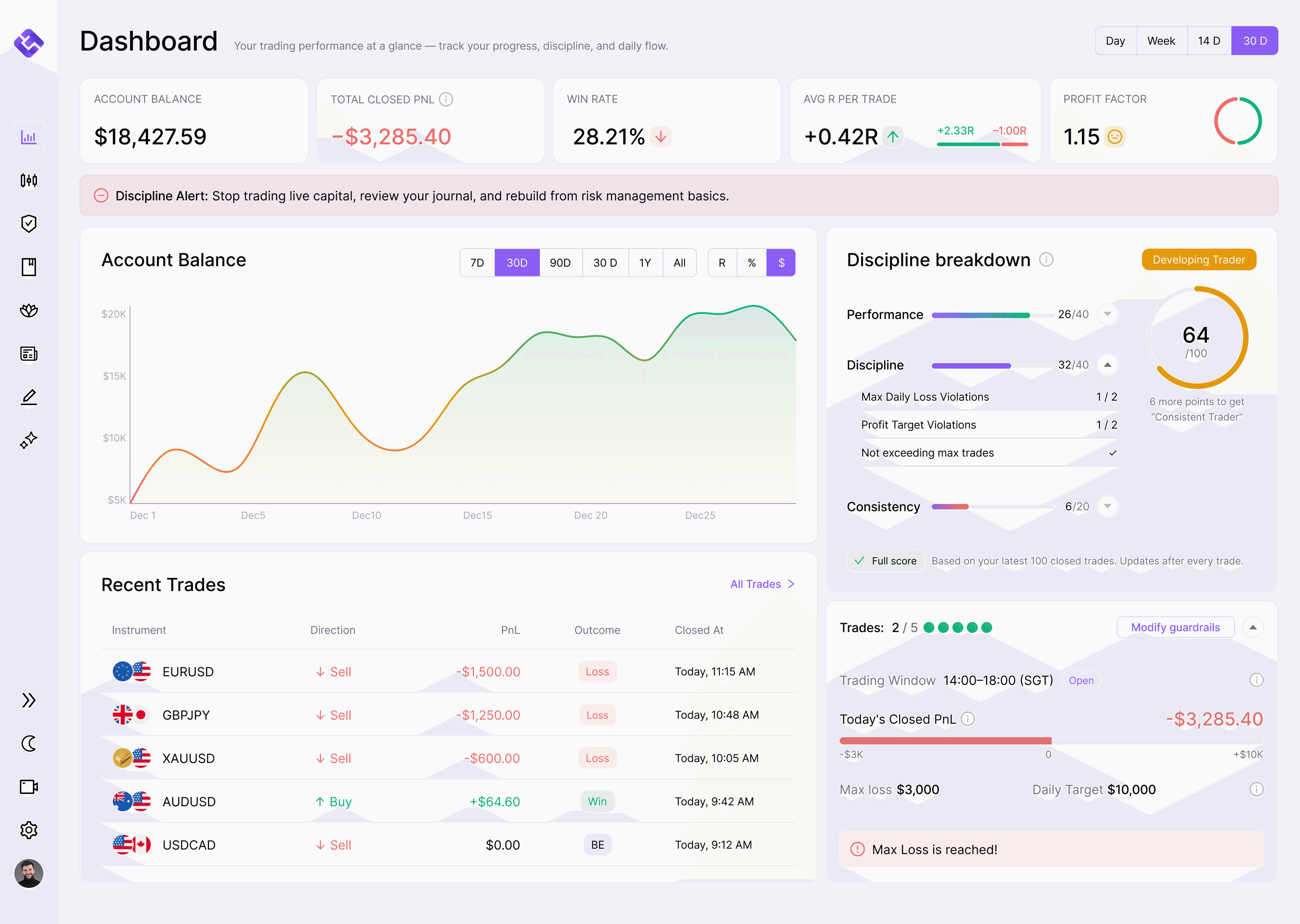
EdgeFlo's built-in risk calculator does this math for you before every trade. Enter your stop loss distance and the calculator shows your exact lot size based on your account balance and your risk percentage setting. No manual math. No room for error.
The guardrail system in EdgeFlo also flags trades that exceed your risk setting. If you accidentally enter a lot size that risks more than 0.5%, the platform warns you before execution. You can override it (the choice is always yours), but the warning makes rule-breaking a conscious decision instead of an accident.
For traders who struggle with the temptation to size up after a winning streak, this kind of structural protection is worth more than any willpower exercise.
The Edge Brief
Receive Insights on trading psychology, discipline, and the behavioral patterns that create consistent traders from our Founder and the EdgeFlo team, delivered to your inbox.
Think different. Trade different.
Is 0.5% risk too small to make real money?
When should I move from 0.5% to 1% risk?
Does 0.5% risk work for prop firm challenges?
How do I calculate lot size for 0.5% risk?

Turn discipline on.
Every session.
EdgeFlo is the environment serious traders operate inside.
Start 7-Day Free Trial
Cancel anytime.
No long-term commitment.

Think Different, Trade Different.