

The 10-Minute Buffer: Cool Down Before Your Next Trade
After a loss, wait 10 minutes before touching the charts. This buffer lets your rational brain catch up with your emotions so the next trade is plan-based, not pain-based.
You just got stopped out. The chart moved against you, your stop hit, and now there is a number on your screen that was not there five minutes ago.
What do you do next?
If you are like most traders, you scan for another setup immediately. You tell yourself the next trade will fix it. You convince yourself you are calm, rational, totally fine. Then you enter something you would never touch on a normal day, and the loss doubles.
That second trade is not about the market. It is about pain. Your brain just took a hit, and it wants the discomfort to stop. So it pushes you to act. Fast. Without thinking. The 10-minute buffer is the simplest guardrail you can place between that emotional spike and your next entry. Close the chart. Set a timer. Do not touch anything for 10 minutes. When the timer goes off, your rational brain has caught up with your emotions, and the next trade (if there even should be one) comes from your plan instead of your pain.
TL;DR
After any loss, close your charts and set a 10-minute timer before looking at another setup.
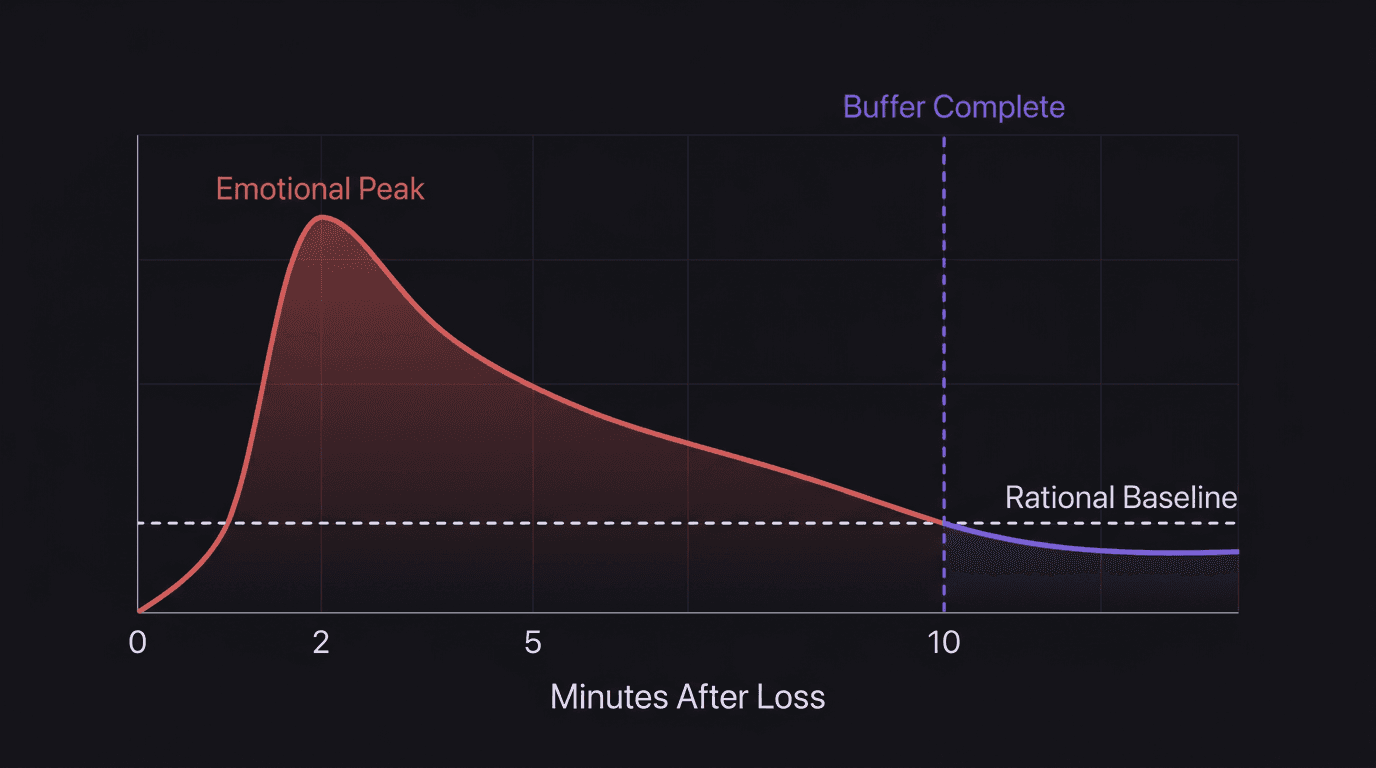
The emotional spike after a loss peaks in the first 2 to 3 minutes, then fades. Ten minutes lets it pass.
Use the buffer to write one sentence about what happened and whether you followed your plan.
The buffer does not fix bad strategy. It stops you from compounding a single loss into a spiral.
If you still feel agitated after 10 minutes, extend the break. The market will still be there.
What Happens Inside Your Brain After a Loss
Ever notice that your hands move faster after a loss? You scroll quicker. You click without pausing. That is not discipline. That is your fight-or-flight response hijacking your decision-making.
When a trade goes against you, your brain registers it as a threat. The emotional center fires before the logical center can process what actually happened. You feel the urge to act before you have thought about whether acting makes sense. This is the same wiring that kept humans alive around predators. Useful in the wild. Terrible in front of a chart.
The rational part of your brain needs roughly 10 to 15 minutes to catch back up after an emotional spike. During that gap, every decision you make is colored by the loss you just took. You are not reading the chart objectively. You are looking for confirmation that the market owes you something.
Sound familiar? You have probably entered a revenge trade during that exact window and only realized it after the damage was done.
The 10-Minute Buffer Protocol
The protocol is dead simple. That is the point. When emotions are high, complex rules get ignored. Simple ones stick.
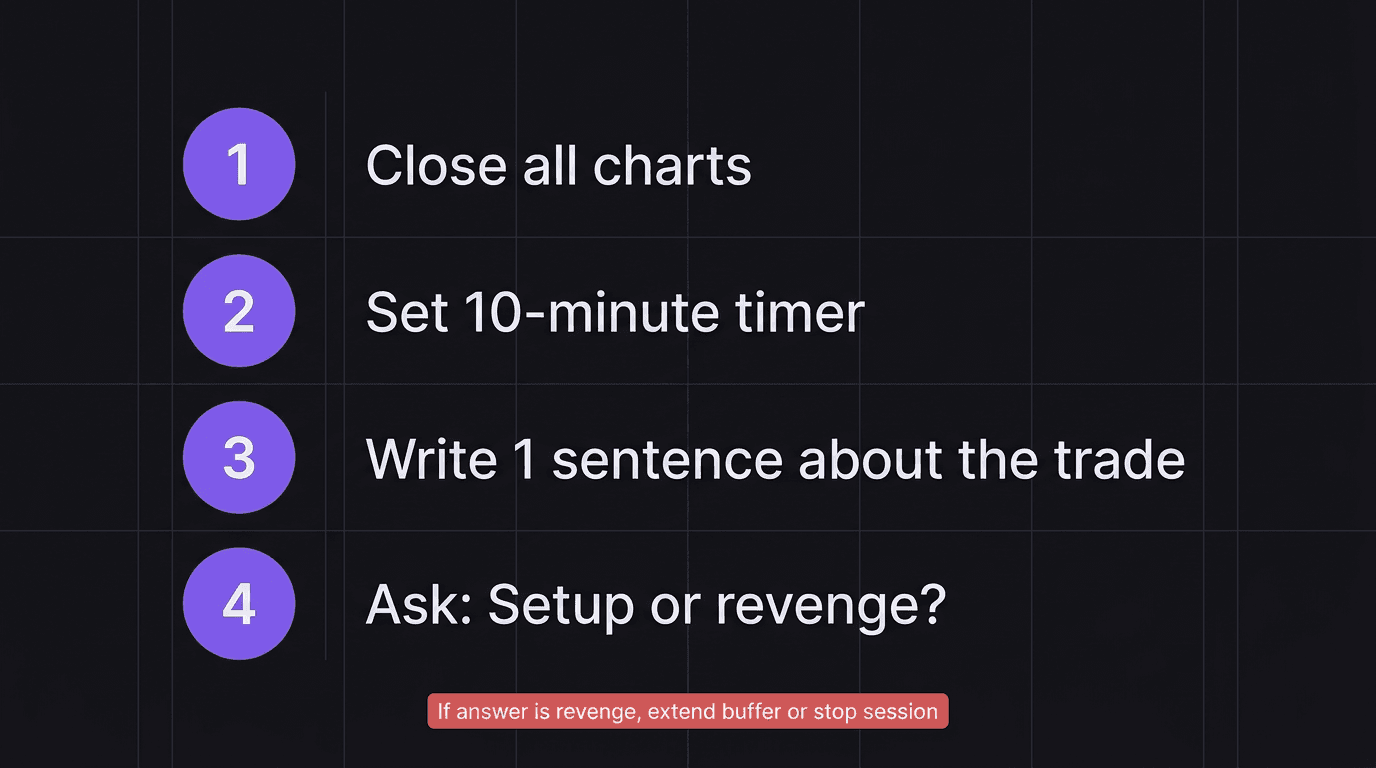
Step 1: Close the charts. Not minimize. Close. If the platform is in front of you, you will find a reason to click something.
Step 2: Set a timer for 10 minutes. Use your phone, a kitchen timer, anything that is not on your trading screen. The physical act of setting a timer makes the commitment real.
Step 3: Write one sentence. Grab a notebook or open your journal and write exactly what happened. "Stopped out on EUR/USD long, followed my plan, loss was within risk." Or: "Jumped into GBP/USD short without confirmation, broke my rules." One sentence. That is all you need during the buffer.
Step 4: Ask one question. Before opening the charts again, ask: "Am I looking for a setup, or am I looking to get even?" If the honest answer is "get even," extend the buffer. Walk away for 30 minutes or close the session entirely.
This is not complicated. But it works because it forces a gap between stimulus and response. Without that gap, the stimulus (loss) drives the response (impulse entry) every single time.
Walkthrough: Buffer Saves the Day on EUR/USD
A trader takes a long on EUR/USD at 1.0880 with a stop at 1.0850 and a target at 1.0940. Risk is 30 pips at 0.5 lots, which is $150. Price drops and the stop triggers at 1.0850. Loss: $150.
Old habit: the trader immediately scans for another long, sees a minor bounce, and enters at 1.0860 with a wider stop at 1.0820. Risk jumps to 40 pips at the same 0.5 lots, which is $200. Price drops again, and the second stop hits. Total damage: $350 in two trades, with the second one taken purely from frustration.
With the buffer: after the first stop, the trader closes the platform, sets a 10-minute timer, and writes "EUR/USD long stopped out at plan level, loss $150, rules followed." After 10 minutes, the trader reopens the chart, sees no clean setup, and walks away. Total damage: $150. The buffer saved $200.
Why "I Feel Fine" Is the Most Dangerous Sentence
Here is the trap. After a loss, most traders convince themselves they are not emotional. "I'm good, that was a clean loss, I followed my rules." Maybe that is true. But the emotional spike does not always feel like anger or frustration. Sometimes it feels like calm determination, like a quiet urgency to prove that the loss did not rattle you.
That quiet urgency is still emotion. It is just wearing a different mask. The desire to prove you are unaffected is itself a reaction to the loss.
The 10-minute buffer does not care how you feel. It is a rule, not a judgment call. You take a loss, you take 10 minutes. Every time. No exceptions. When you remove the decision about whether you need a break, you remove the one moment where your emotional brain is most likely to lie to you.
Walkthrough: The "I'm Fine" Trap on GBP/USD
A trader shorts GBP/USD at 1.2720 with a stop at 1.2750 and a target at 1.2640. Risk is 30 pips at 1.0 lot, which is $300. The stop triggers. The trader feels completely composed and tells herself the trade was textbook, just bad timing.
She opens a new chart and spots what looks like a double top on USD/JPY. Without running through her checklist, she enters a short at 148.50 with a stop at 149.00. Risk is 50 pips at 1.0 lot, which is approximately $330 (USD/JPY pip value at roughly $6.60 per pip per standard lot). Price pushes through her stop. Two losses in a row, second one off-plan.
With the buffer, she would have paused, written her one-sentence note, and noticed after 10 minutes that the USD/JPY setup did not match her criteria. The second loss never happens.
What to Do During the 10 Minutes
Do not sit there staring at a blank screen. That just builds tension. Use the time.
Option 1: Write it down. Open your journal and log the trade. What pair, what direction, what happened, whether you followed your plan. This alone shifts your brain from reactive mode to reflective mode.
Option 2: Move your body. Stand up, walk to another room, get water. Physical movement interrupts the stress loop. It sounds basic because it is. Your body holds tension after a loss, and moving releases it.
Option 3: Review your session rules. Pull up your checklist for when to stop trading. Have you hit your daily loss limit? Are you past your maximum trade count? Sometimes the buffer reveals that the answer is to stop entirely, not to take another trade.
Option 4: Do nothing. Sit quietly. No phone, no charts, no scrolling. This is the hardest option and the most effective. Boredom is uncomfortable, but it is not expensive. The trade you take to escape boredom usually is.
Building the Buffer Into a Routine
A rule only works if it is automatic. Here is how to make the 10-minute buffer stick.
Tie it to a trigger. The trigger is any closed trade that ended in a loss. Not just big losses. Every loss. Small losses feel harmless, but they still create emotional micro-shifts that stack up. Three "small" losses without a buffer can put you in the same mental state as one large one.
Pre-commit in writing. Before your session starts, write this in your journal or on a sticky note: "After any loss, I close charts for 10 minutes." Pre-commitment works because you made the decision when you were calm. You are borrowing discipline from your best self and lending it to the version of you that just got stopped out.
Track compliance. Add a column to your journal: "Buffer taken? Yes/No." At the end of the week, look at the pattern. Trades taken without a buffer will cluster around your worst results. That data turns the buffer from a nice idea into a non-negotiable.
When 10 Minutes Is Not Enough
Ten minutes is the minimum, not the maximum. Some situations call for a longer break.
After two consecutive losses: If you have been stopped out twice in a row, the emotional load compounds. The post-loss reset may need 30 minutes or even the rest of the session. Two consecutive losses does not mean your strategy is broken. It means your mental state is compromised, and staying in the market with a compromised mental state is how single bad days become account-defining events.
After a rule break: If the trade you just lost was off-plan (wrong pair, no confirmation, oversized position), the buffer needs to be longer. A rule-break loss carries guilt on top of frustration, and guilt makes you either freeze or overcompensate. Neither helps.
After hitting your daily loss limit: If your loss for the day crosses a pre-set threshold, the buffer is not 10 minutes. It is the rest of the day. Close the platform. The session is over. Come back tomorrow with a clear head and a fresh plan.
The buffer is a tool, not a finish line. Use it as the starting point for deciding whether you should keep trading at all.
How EdgeFlo Helps You Enforce the Buffer
Knowing you should take a break and actually taking one are two different problems. EdgeFlo handles the second one.
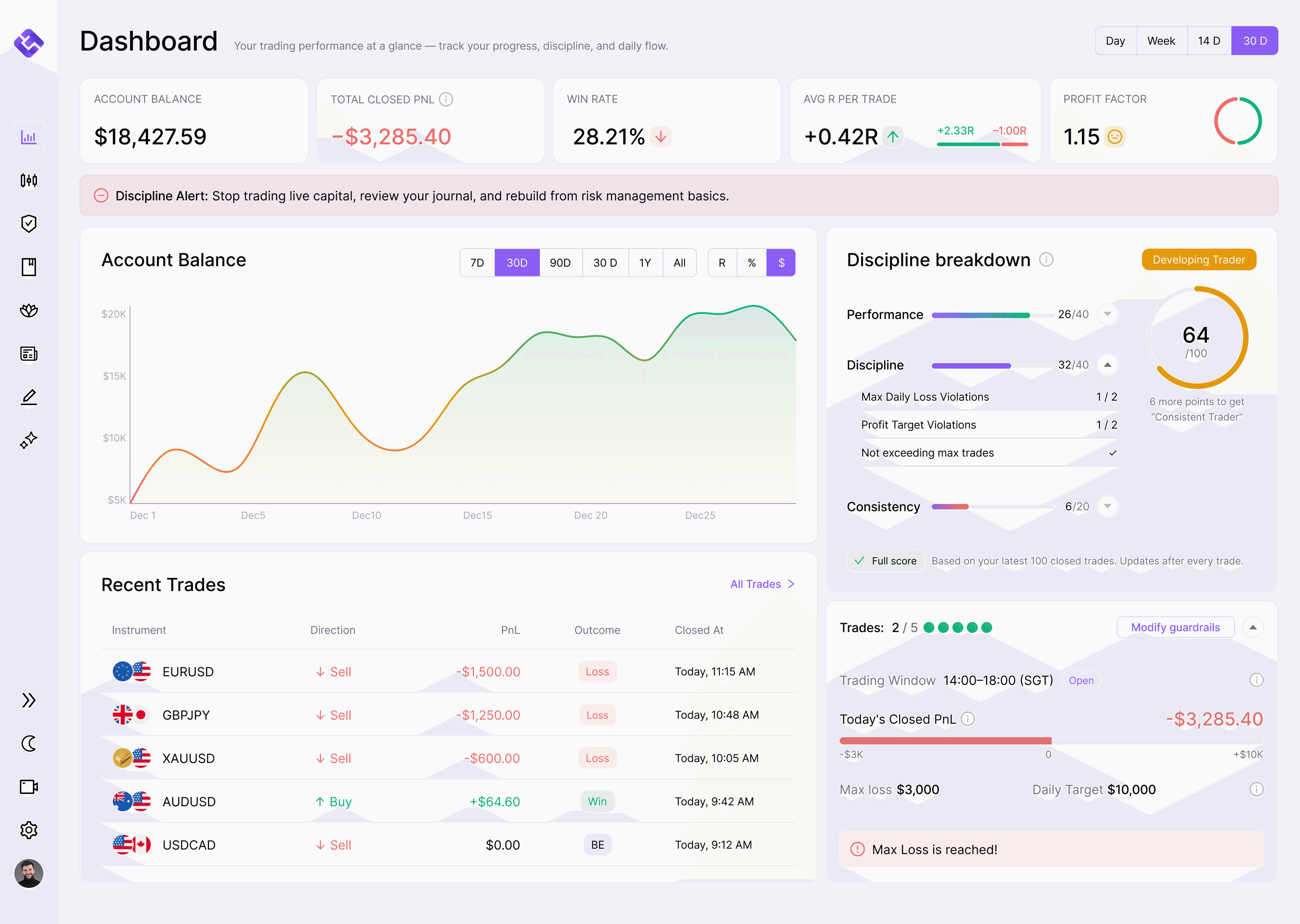
Guardrails in EdgeFlo can restrict your trading after you hit a daily loss limit or a maximum number of trades. You can override them (the choice stays yours), but the friction is deliberate. It forces you to pause and consciously decide whether the next trade is plan-based or pain-based. That pause is the buffer, built into your trading environment instead of relying on willpower alone.
Sanctuary offers guided reset routines that fit naturally into a 10-minute buffer. Instead of sitting with rising tension, you follow a short recovery session designed to bring your mental state back to baseline. It supports the cool-down process so you return to the charts calm, not just waiting for a timer to expire.
The Edge Brief
Receive Insights on trading psychology, discipline, and the behavioral patterns that create consistent traders from our Founder and the EdgeFlo team, delivered to your inbox.
Think different. Trade different.
How long should I wait after a losing trade?
What should I do during the 10-minute buffer?
Does a cool-down period actually prevent revenge trading?
Can I shorten the buffer if I feel fine after a loss?

Turn discipline on.
Every session.
EdgeFlo is the environment serious traders operate inside.
Start 7-Day Free Trial
Cancel anytime.
No long-term commitment.

Think Different, Trade Different.