

First Trade on a Funded Account: Own the Pressure
Your first trade on a funded account triggers anxiety. Learn why the pressure spikes and how to execute mechanically when it matters most.
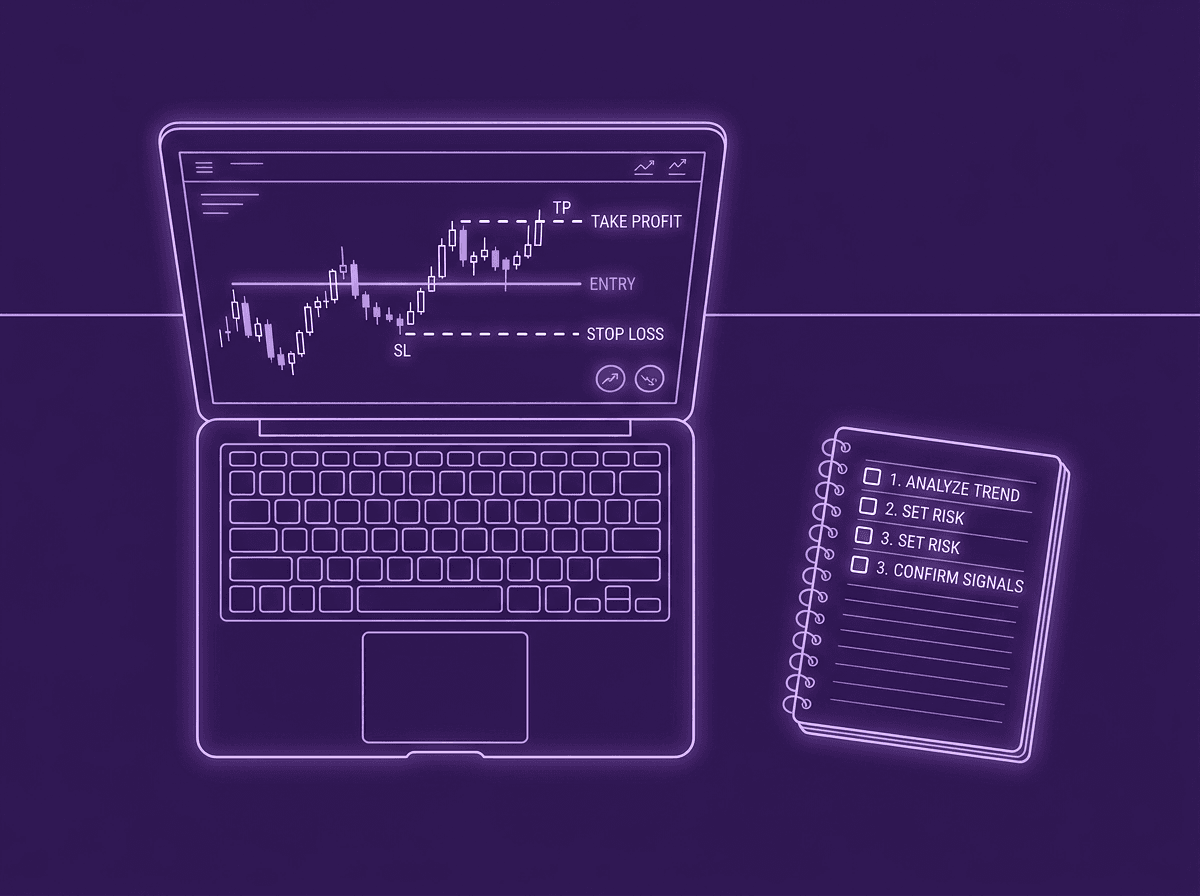
The first trade on a funded account hits different. Your hands are steady on demo. Your backtest results are solid. But the moment real money is attached to real rules, something shifts. Your chest tightens, your finger hovers over the button, and a voice in your head whispers: "What if this is the trade that ends it all?"
That voice is performance anxiety, and every trader who has ever opened a funded account has heard it. The good news is that the pressure is not a sign that something is wrong with you. It is a sign that you care about the outcome. The fix is not to stop caring. It is to build a process so clear that your emotions cannot override it.
TL;DR
The first funded trade triggers anxiety because the stakes feel elevated, even though the math has not changed from your backtest.
Performance pressure comes from attaching your identity to the outcome of a single trade.
Treating trade #1 the same as trade #47 of your backtest removes the emotional weight.
A written pre-market routine and mechanical checklist replace hesitation with execution.
One loss at 1% risk puts you at 99% of your balance. The drawdown math protects you.
Why the First Trade Feels Different
You have taken hundreds of trades on demo. Maybe you forward-tested for months. You passed a practice challenge. And yet, the first live funded trade creates a spike of anxiety that none of those experiences prepared you for.
The reason is simple: your brain has reclassified the trade. On demo, a loss costs nothing. On a funded account, a loss feels like it costs everything. The challenge fee you paid, the weeks of preparation, the identity you have built around being "funded." All of that emotional weight lands on a single click.
This is not a trading problem. It is a performance anxiety problem. Athletes, surgeons, and public speakers all experience the same spike. The task has not changed, but the perceived consequences have.
Walkthrough: The Demo-to-Funded Gap
A trader spends three months forward-testing on EUR/USD during London session. Win rate: 42%. Average R: 3.2. Every trade follows the same checklist. The results are consistent.
Day one of the funded account. Same pair, same session, same setup. A clean demand zone forms at 1.0840 with a break of structure on M15. The checklist says yes. But the trader hesitates. Watches three candles close inside the zone. By the time they enter, the stop needs to be wider to stay below the zone, turning a 3R trade into a 1.8R trade.
The setup was identical to dozens of winning trades. The only thing that changed was the label on the account.
That gap between "I know what to do" and "I cannot make myself do it" is where funded accounts die. Not from bad strategy. From hesitation caused by pressure.
The Anxiety Is Normal (Here's Why)
If you feel anxious before your first funded trade, congratulations. You are a normal human being with a functioning nervous system.
Performance anxiety follows a predictable pattern. Psychologists call it the Yerkes-Dodson law: moderate arousal improves performance, but too much arousal destroys it. The first funded trade pushes most traders past the sweet spot and into the panic zone.
Here is what happens inside your head:
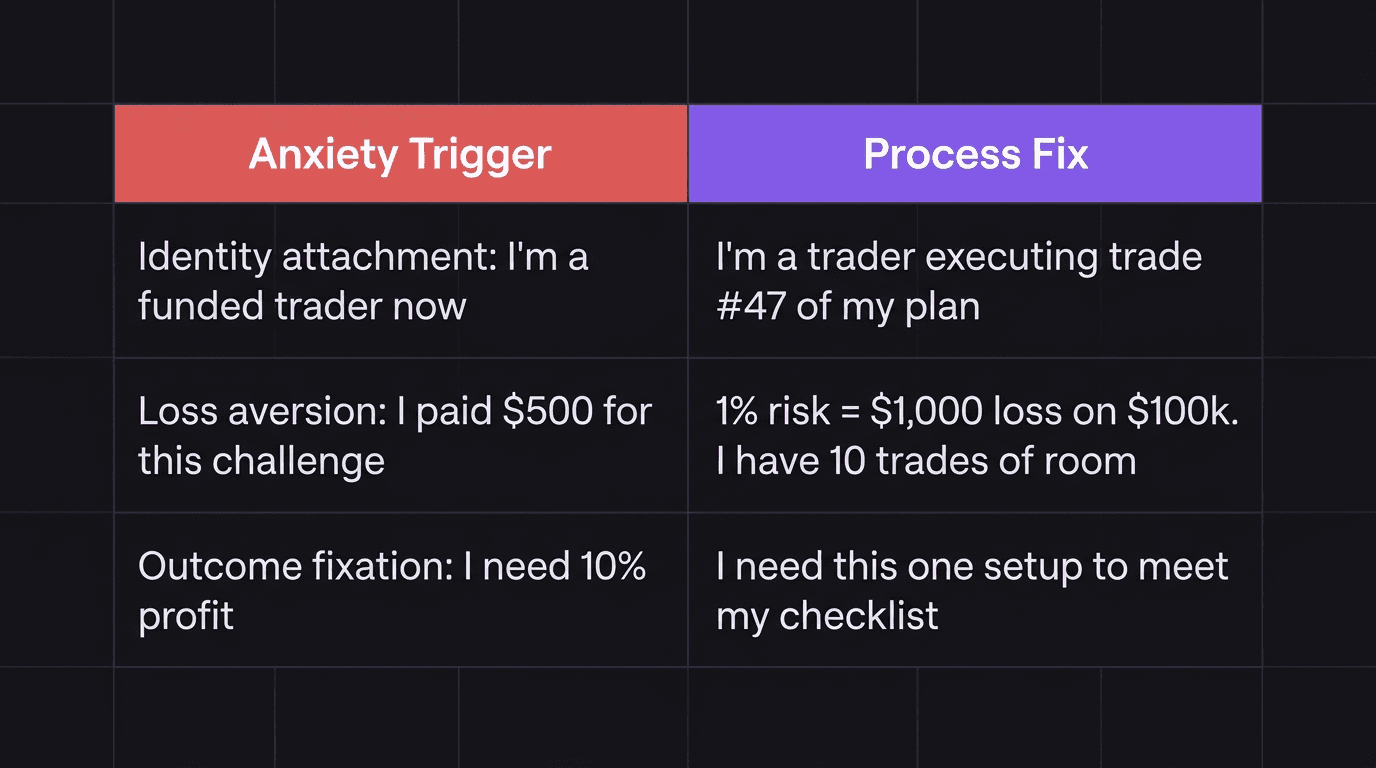
Identity attachment. You have told yourself (and maybe others) that you are a funded trader now. A loss threatens that identity.
Loss aversion. The challenge fee you paid feels like a sunk cost you must protect. Losing trade #1 feels like wasting that money.
Outcome fixation. You are thinking about the 10% profit target instead of the one trade in front of you.
Sound familiar? Every one of these triggers has the same root cause: you are thinking about results instead of process.
The fix is not to suppress the anxiety. You cannot willpower your way past a stress response. The fix is to redirect your attention from the outcome to the checklist. When your brain is busy running through entry criteria, it does not have bandwidth left to catastrophize about losing the account.
Treat It Like Trade #47 of Your Backtest
The single most effective reframe for first-trade pressure: pretend you are 47 trades into your backtest.
Why trade #47? Because nobody feels pressure on trade #47. By that point, you are deep enough into the data that each individual trade is meaningless. You know that some will win and some will lose. You are not attached to any single outcome. You are just collecting data.
That is exactly the mindset you need on a funded account. The math does not change because the account has a label on it. If your strategy wins 40% of the time at 3R, then trade #1 of the funded account has the same 40% chance as trade #47 of the backtest. The probability does not care about your feelings.
Walkthrough: What the Math Actually Says
You are trading a $100,000 funded account. Risk per trade: 1% ($1,000). Minimum R target: 3R.
Math check: 1% of $100,000 = $1,000 risk per trade. $1,000 times 3R = $3,000 profit on a win.
If you lose the first trade, your balance drops to $99,000. That is 1% below starting equity. Most prop firms allow a 5% daily drawdown and an 8% to 10% total drawdown. You are nowhere near either limit.
Even if you lose the first three trades in a row (which happens roughly 21.6% of the time at a 40% win rate), your balance is $97,000. Still 3% above most maximum drawdown limits. You have room.
Loss probability check: Three consecutive losses at 60% loss rate per trade = 0.60 times 0.60 times 0.60 = 0.216, or 21.6%.
The math says you survive. The anxiety says you do not. Trust the math.
Here is a practical technique: before your first funded trade, open your backtest journal and find trade #47. Look at it. Was it a winner or a loser? Probably you do not even remember, because it did not matter. That is the level of emotional attachment you want on trade #1 of the funded account.
Building trading confidence is not about positive self-talk. It is about accumulating enough data that you trust the probabilities more than you trust your fear.
Follow Your Plan, Not Your Nerves
The most dangerous thing about first-trade pressure is not the anxiety itself. It is the way anxiety changes your behavior.
Anxious traders do three things:
Skip setups. The checklist says yes, but they wait for "more confirmation." By the time they enter, the risk-to-reward is destroyed.
Shrink position size. They risk 0.25% instead of 1% because it "feels safer." Now a winning trade barely moves the account, and they need twice as many wins to hit the profit target.
Move the stop. Anxiety makes them widen the stop loss "just in case," increasing risk and lowering R.
Every one of these behaviors is a plan deviation. And plan deviation on a funded account is how you fail the challenge slowly instead of quickly.
The antidote is mechanical execution. Write your plan before the session. Define your setup, your entry trigger, your stop placement, and your take profit level. When the setup appears, execute. No debate, no second-guessing, no "let me just wait one more candle."
A mechanical trading plan does not eliminate anxiety. It makes anxiety irrelevant. You do not need to feel confident to follow a checklist. You just need to follow the checklist.
Here is what the first 15 minutes of your funded trading day should look like:
Sit down 30 minutes before your session opens.
Run your pre-market routine. Mark structure, identify key levels, note the daily bias.
Review your trading plan. Read the entry rules out loud if it helps.
Write down: "I will take one A+ setup today. If no setup appears, I will not trade."
When the setup triggers, execute within 3 seconds of confirmation. Do not give anxiety time to intervene.
That sequence turns a high-pressure moment into a mechanical one. The first trade becomes an output of a system, not a judgment call under stress.
Walkthrough: What Following the Plan Looks Like (and What Deviation Costs)
Trader A follows the plan. EUR/USD shows a demand zone at 1.0850 after a liquidity sweep below the previous low. Break of structure on M5 confirms. Trader A enters long at 1.0855 with a stop at 1.0830 (25 pips) and a take profit at 1.0930 (75 pips). Risk: 1% of $100,000 = $1,000.
Math check (Trader A): EUR/USD pip value = $10 per pip per standard lot. $1,000 risk / 25 pips = $40 per pip needed. $40 per pip / $10 per pip per standard lot = 4 standard lots. 4 lots times $10 per pip = $40 per pip. $40 per pip times 25 pips = $1,000 risk. Correct. $40 per pip times 75 pips = $3,000 profit. That is 3R. Correct.
Trader B feels anxious and hesitates. Same setup, but they wait for an extra candle. Now they enter at 1.0862 with the same stop at 1.0830 (32 pips) and the same target at 1.0930 (68 pips).
Math check (Trader B): $1,000 risk / 32 pips = $31.25 per pip needed. $31.25 / $10 per pip per standard lot = 3.125 standard lots. Rounded to 3.1 lots. 3.1 lots times $10 per pip = $31 per pip. $31 times 32 pips = $992 risk. Close enough to 1%. $31 times 68 pips = $2,108 profit. That is 2.12R instead of 3R.
Same setup. Same market. But Trader B's hesitation cost 0.88R on a winning trade. Over 10 wins in a challenge, that gap compounds to $8,920 in lost profit.
Compound check: Trader A: 10 wins times $3,000 = $30,000. Trader B: 10 wins times $2,108 = $21,080. Difference: $30,000 minus $21,080 = $8,920.
Hesitation is expensive. And it comes directly from emotions during trading that you did not manage before the session started.
One more thing worth adding to your pre-session routine: set your daily limits in writing before the market opens. Maximum trades today (1 or 2), maximum risk per trade (1%), and the condition that makes you stop (2 consecutive losses, or daily loss of 2%). Having those numbers on paper means you do not negotiate with yourself mid-session.
And breathe. Literally. Five slow breaths before you open the chart. This is not woo. Slow breathing downregulates your sympathetic nervous system, reducing the cortisol spike that causes hesitation and impulsive decisions.
Once you have done all of this, the first trade is not "the first trade on my funded account." It is just the next step in a process you have already started. The emotional weight drops because the context has shifted from "performing" to "executing."
If you lose that first trade? Good. You now have data. Log it in your journal, confirm you followed the plan, and move on. A single loss at 1% risk means your funded account management framework is still intact. You have plenty of room.
How EdgeFlo Pre-Session Tools Calm You Down
EdgeFlo was built for exactly this moment: the gap between knowing your plan and actually executing it under pressure.
Sanctuary guides you through a meditation and reset routine before your session opens. It is not a mindset hack or motivational speech. It is a structured cooldown that helps you approach the chart with a clear head instead of a racing one. If you are sitting down for your first funded trade and your hands are shaking, a five-minute Sanctuary session gives your nervous system time to settle.
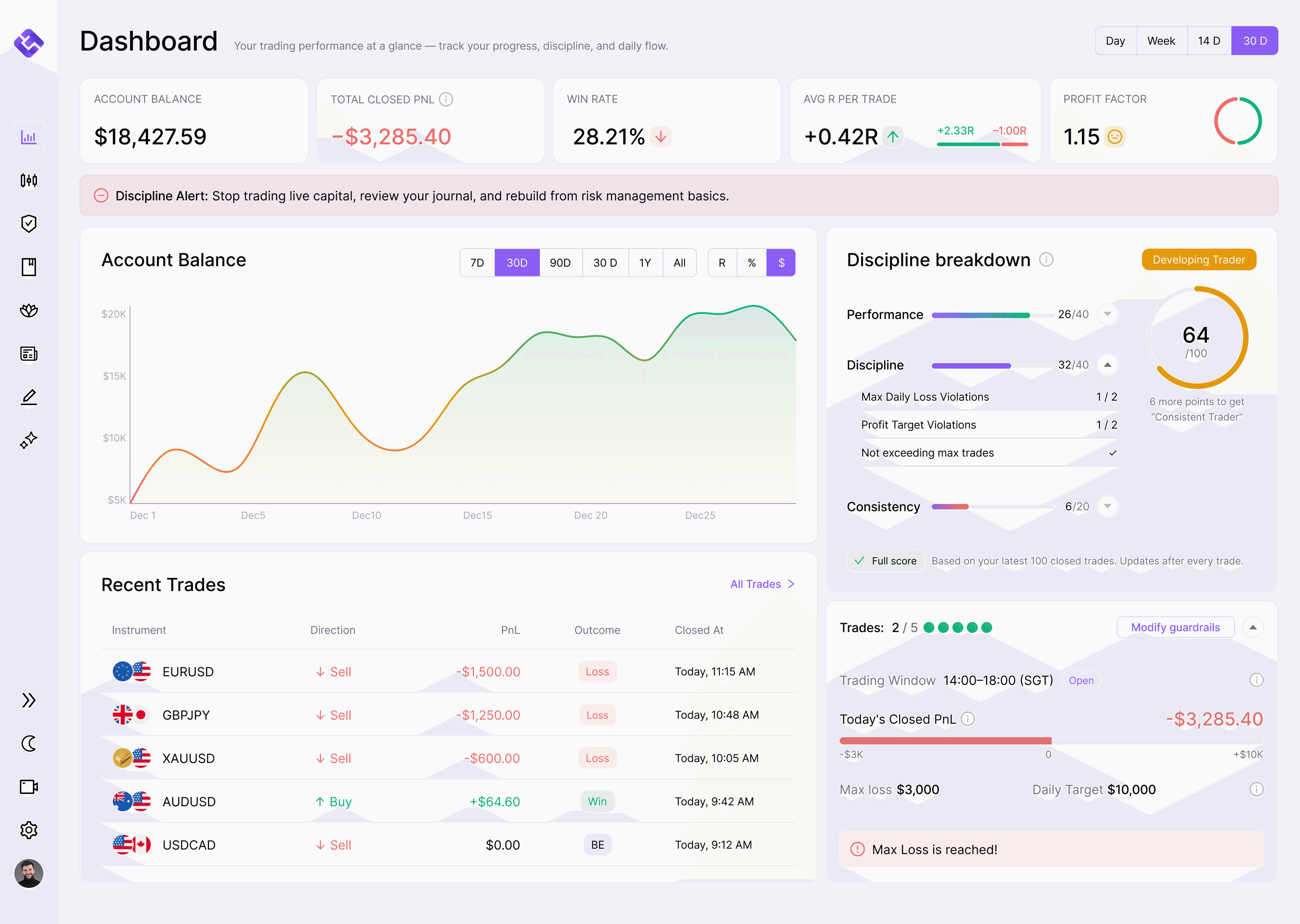
EdgeFlo also surfaces pre-market routine prompts that walk you through the preparation steps before you trade. Mark your levels, confirm your bias, set your risk parameters. By the time the prompt sequence is complete, you have already done the hardest part. The trade itself becomes the easy step, because every decision was made before the market opened.
The Edge Brief
Receive Insights on trading psychology, discipline, and the behavioral patterns that create consistent traders from our Founder and the EdgeFlo team, delivered to your inbox.
Think different. Trade different.
Why does the first trade on a funded account feel so stressful?
Should I use a smaller position size on my first funded trade?
How do I stop overthinking my first funded trade?
What if I lose my first trade on a funded account?

Turn discipline on.
Every session.
EdgeFlo is the environment serious traders operate inside.
Start 7-Day Free Trial
Cancel anytime.
No long-term commitment.

Think Different, Trade Different.