

Fight or Flight: How Survival Wiring Costs You
Your brain treats losing trades like physical threats. Learn how fight or flight instincts sabotage execution and how to build systems that override them.
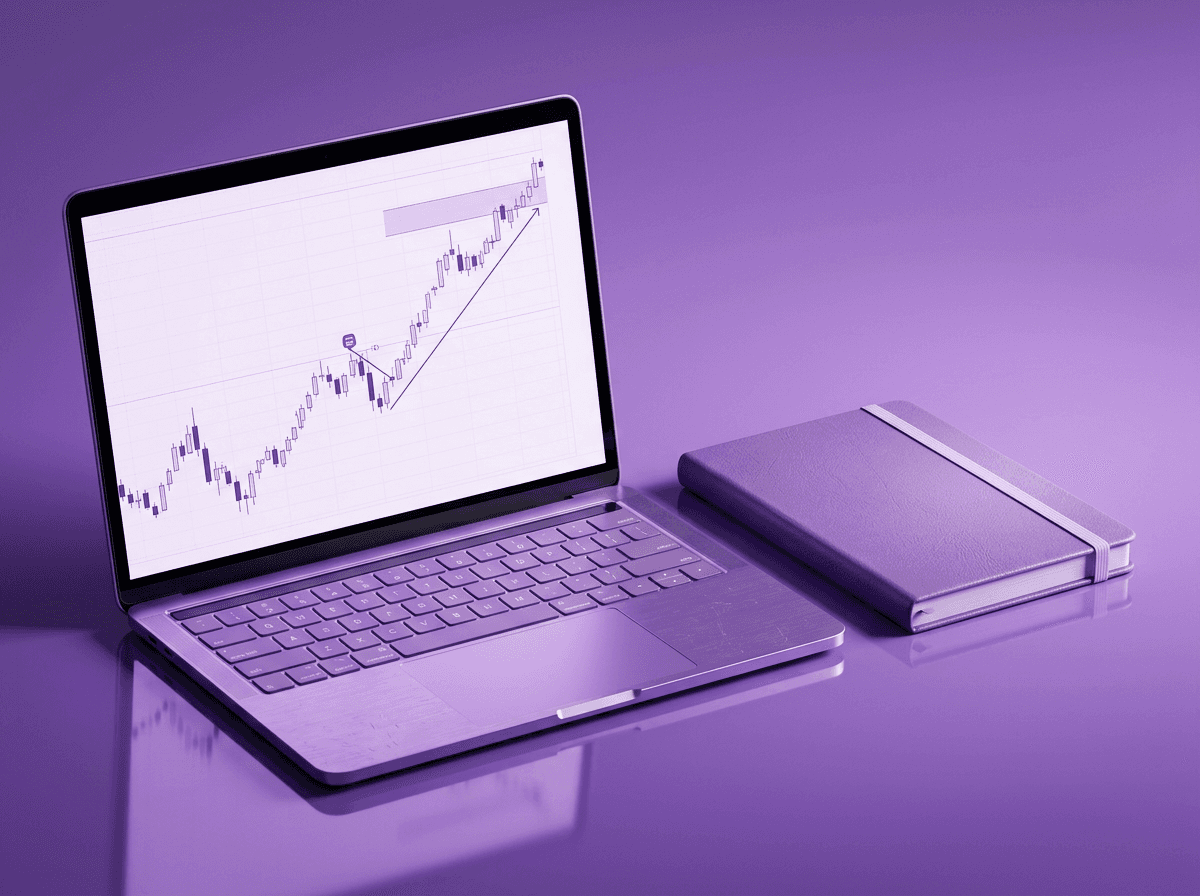
A single candle pushes 15 pips against your position. Your heart rate spikes. Your hands tense on the mouse. Every cell in your body is screaming: do something.
That is not discipline failing. That is 200,000 years of survival programming activating in front of a trading chart.
Your brain evolved to keep you alive in environments where threats were physical: predators, falling rocks, hostile terrain. It never adapted to distinguish between a lion charging and a red P&L number on your screen. So it treats both the same way. Hormones flood your system. Rational thought slows down. And you make a decision designed to escape danger, not to execute a trading plan.
TL;DR
Your fight-or-flight response triggers whenever your brain perceives a threat, including unrealized trading losses.
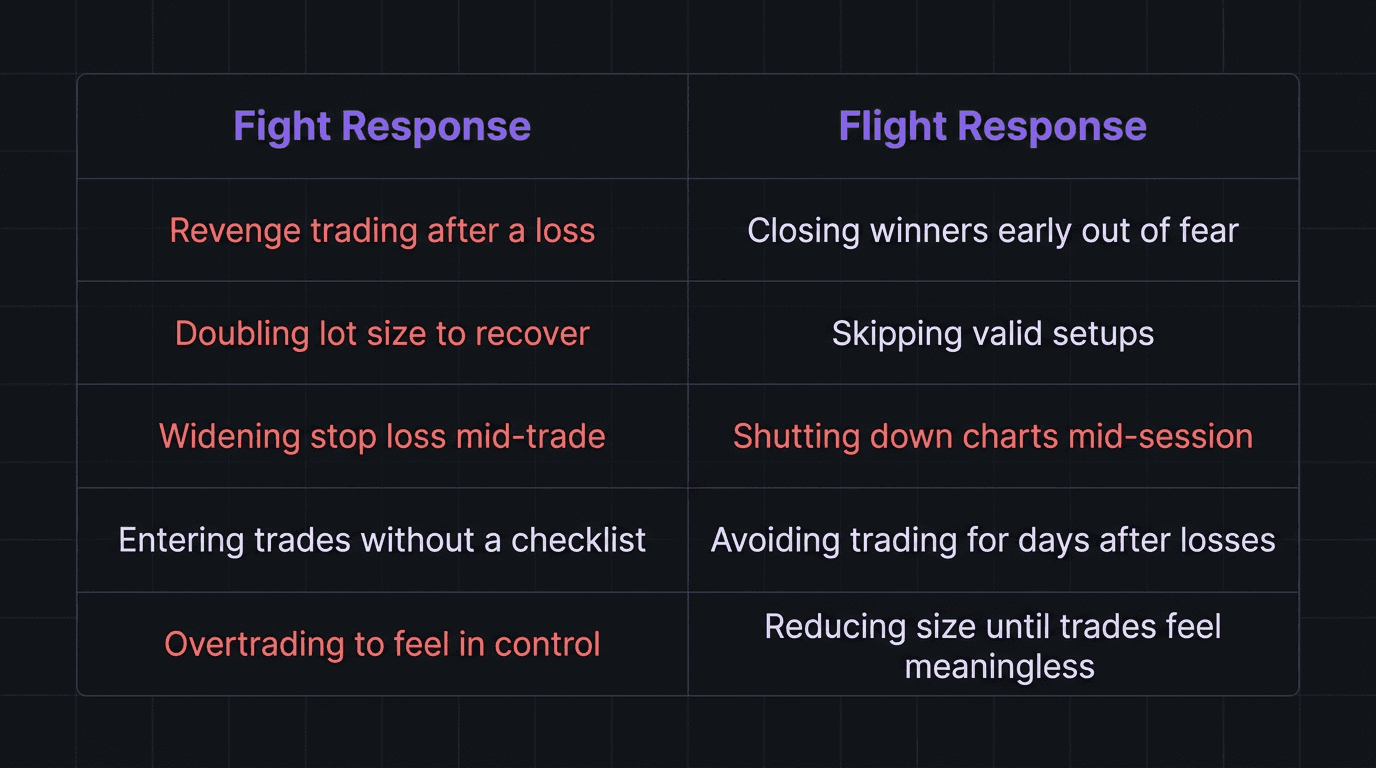
"Fight" in trading looks like revenge trading, doubling down, or widening stops. "Flight" looks like panic exits and skipped setups.
The response fires faster than rational thought, so willpower alone cannot override it.
Structural solutions (position sizing, pre-trade rules, checklists) reduce the intensity of the trigger.
Building repetition through controlled exposure gradually normalizes the stress of live trading.
Fight and Flight at the Trading Desk
In the wild, fight or flight is binary. Face the threat or run from it. In trading, both responses show up, but they wear different disguises.
Fight mode is aggressive. You take a loss and immediately enter another trade to "win it back." You double your lot size. You widen your stop loss because you refuse to accept that the market is moving against you. You start trading on impulse instead of waiting for your setup.
Flight mode is defensive. You close a winning trade at +10 pips because you are terrified it will reverse. You see a valid setup but cannot bring yourself to click buy. You shut your laptop mid-session after two losses and refuse to look at the charts for the rest of the day.
Both responses have the same root cause: your brain detected a threat and overrode your logical mind. The difference is just which side of the response you default to.
Walkthrough: Fight Mode on EUR/USD
You lose a trade on EUR/USD. Clean setup, proper risk, but the market went against you. Loss: 30 pips at 0.5 lots ($150).
Instead of walking away or reviewing the trade, your fight response kicks in. You open a new position immediately, no checklist, no confirmation. You size up to 0.8 lots because you want to recover that $150 fast.
The second trade also loses. Another 25 pips, this time at $8/pip ($200). Now you are down $350 in two trades. Your amygdala is on full alert. You take a third trade. This one loses 20 pips at 0.8 lots ($160).
Three trades. $510 gone. None of them followed your plan.
Walkthrough: Flight Mode on AUD/USD
You enter a buy on AUD/USD at 0.6540. Stop at 0.6510 (30 pips). Target at 0.6600 (60 pips). You are trading 0.3 lots, which is $3/pip. Risk: 30 pips at $3/pip = $90. Target: 60 pips at $3/pip = $180.
Price moves to 0.6555, putting you up 15 pips ($45). Then a bearish candle pulls price back to 0.6545. You are now up only 5 pips ($15). The flight response hits. You close the trade at 0.6545, banking $15 instead of the planned $180.
Price reaches 0.6598 two hours later.
Why the Response Fires Before You Think
Your brain processes threats on two tracks. The fast track runs through the amygdala and takes about half a second. The slow track runs through the prefrontal cortex and takes several seconds to fully engage.
In survival situations, the fast track saves your life. You jump out of the way of a car before you consciously register what is happening.
In trading, the fast track destroys you. You close a trade, move a stop, or enter a revenge position before your rational mind has time to ask: "Does this align with my plan?"
This is why telling yourself to "stay calm" or "be disciplined" rarely works in the moment. By the time you form that thought, the fight-or-flight response has already sent commands to your muscles. The decision is already made at the neurological level.
The only reliable counter is to make the decision before the threat arrives.
Building a Pre-Threat Decision System
If the fight-or-flight response fires faster than thought, then the solution is to do your thinking before you enter the trade. Every decision that matters should already be made by the time price starts moving.
The Pre-Trade Lock
Before every trade, run through your pre-trade checklist. Write down:
Entry price
Stop loss price
Target price
Lot size
Maximum dollar loss on this trade
Then add one line: "I will not touch this trade until it reaches my stop or my target."
That sentence is your override command. When the amygdala fires and tells you to close, move, or add, you have a written instruction that predates the emotion. Following a written rule is easier than making a new decision under stress.
Size for Your Nervous System, Not Your Account
Most trading rules focus on percentage-based risk. Risk 1% per trade, risk 0.5% per trade. These are good guidelines, but they ignore a critical variable: your emotional threshold.
If risking 1% of a $10,000 account ($100) makes your heart race on every pullback, your position size is too large for your current stress tolerance. Drop to 0.25% ($25). Trade at a size where normal pullbacks are boring. Then scale up slowly as your nervous system acclimates.
The goal is not to feel nothing. The goal is to reduce the signal intensity below the threshold where fight or flight activates.
Build Repetition Through Controlled Exposure
Your brain learns through pattern recognition. The first time you hold a trade through a 20-pip pullback and it works, your amygdala gets slightly less reactive. The tenth time, it quiets down noticeably. By the hundredth time, the pullback registers as routine instead of emergency.
This is why consistency matters more than any single trade. Every time you follow your plan through discomfort, you are teaching your nervous system that the "threat" is survivable. You are building a track record that your amygdala can reference the next time it wants to panic.
Forward testing, small lot sizes, and gradual progression from demo to micro lots to mini lots to standard lots: this is the path that respects your biology instead of fighting it.
The Compounding Damage of Unchecked Responses
A single fight-or-flight reaction costs you one trade. But the pattern, left unchecked, compounds into something far worse.
Fight mode traders blow accounts. They respond to each loss with a bigger, more aggressive trade. Three losses become six. The lot size doubles. By end of day, they have broken every rule they wrote.
Flight mode traders never reach their potential. They exit winners too early, skip setups that match their plan, and spend more time away from the charts than in front of them. Their win rate might be fine, but their average winner is tiny because they never let trades run.
Both patterns share the same origin: a nervous system that was never designed to process financial risk calmly. Knowing this is the first step toward building a system that accounts for it.
How EdgeFlo Helps You Override the Response
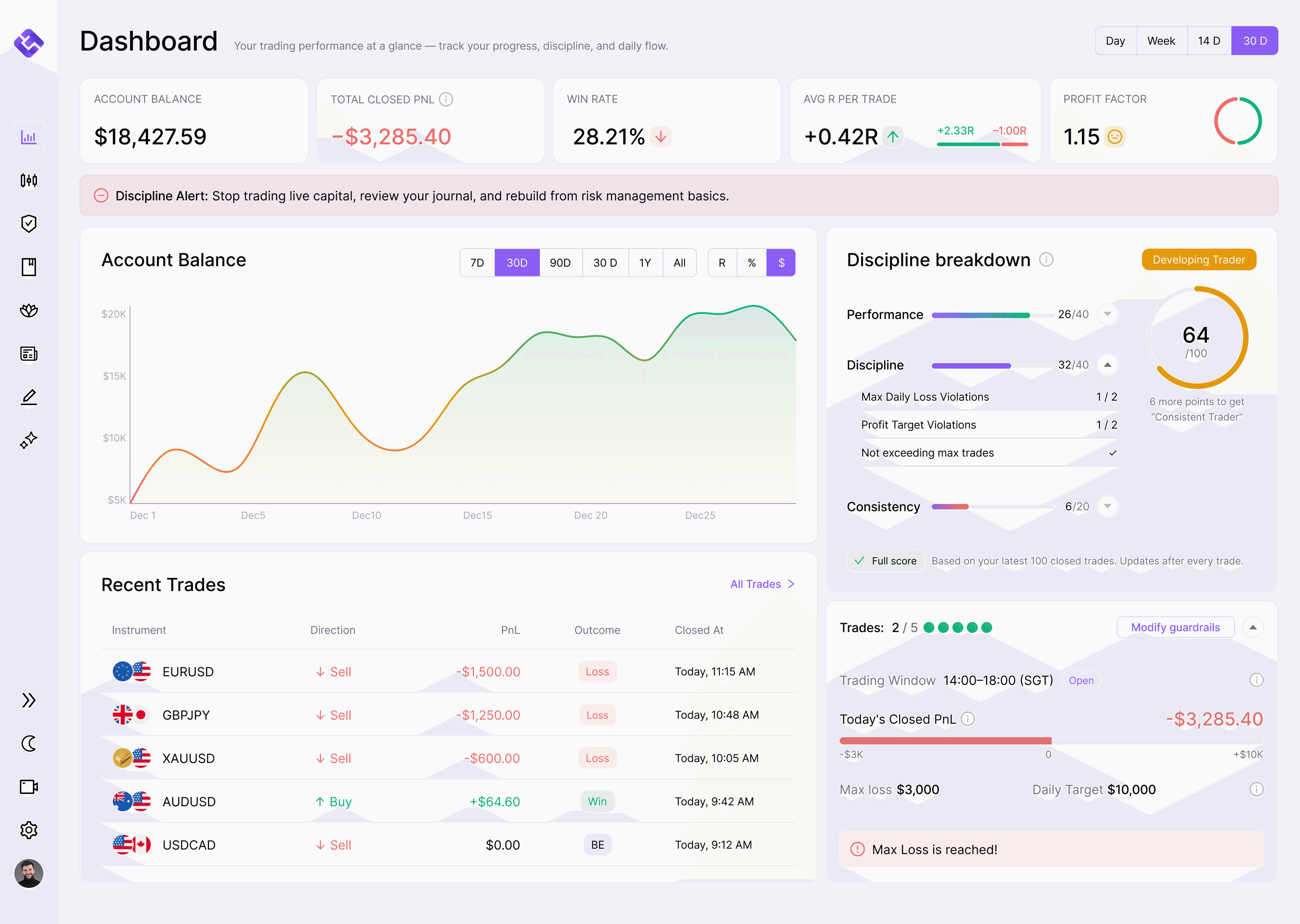
EdgeFlo puts structure between your impulse and your execution. Guardrails like daily loss limits and max trade caps restrict your ability to keep trading when fight mode is running. You can override these guardrails, but the override is a deliberate action, which gives your prefrontal cortex the seconds it needs to catch up with your amygdala.
The pre-market routine prompts you to set your plan, review your rules, and confirm your risk parameters before the session begins. This is the pre-threat decision system in practice. By the time a candle moves against you, your decisions are already locked in and visible next to your chart.
When the response fires (and it will), the difference is whether you have a system in place that makes rule-breaking a conscious choice or an automatic reflex.
The Edge Brief
Receive Insights on trading psychology, discipline, and the behavioral patterns that create consistent traders from our Founder and the EdgeFlo team, delivered to your inbox.
Think different. Trade different.
What does fight or flight look like in trading?
Why does my heart race when I trade?
Can you train yourself out of the fight or flight response?
Is fight or flight worse for new traders?

Turn discipline on.
Every session.
EdgeFlo is the environment serious traders operate inside.
Start 7-Day Free Trial
Cancel anytime.
No long-term commitment.

Think Different, Trade Different.