

Emotions During Trading: Why Logic Fails
Understand why emotions hijack your logic during open trades and how a mechanical management plan prevents panic decisions that cost money.
You spent hours analyzing the chart. Found the setup. Confirmed the bias. Placed the trade with perfect risk parameters. Then price ticked 10 pips against you and every rational thought you had disappeared.
That is not a character flaw. That is your brain doing exactly what it evolved to do. The problem is that what kept your ancestors alive in the savanna is actively destroying your trading account.
TL;DR
Emotions take over the moment real money is at risk in a live trade.
Your brain treats a losing trade like a physical threat, triggering fight-or-flight responses.
Willpower alone cannot override this; a mechanical plan can.
Consistent input (same rules, same actions, every trade) produces consistent output over time.
The goal is not to feel nothing; it is to act the same regardless of what you feel.
Why Open Trades Trigger Panic
Before you enter a trade, everything is theoretical. You can look at a chart objectively. "If price reaches this demand zone and forms a higher low, I will go long with a stop below the zone." Clean. Logical. Emotionless.
The second you click buy, the dynamic changes completely. Now that demand zone is not a concept on a chart. It is a line that determines whether you lose $500 today. Every candle that moves against you feels personal.
This is why the source transcript emphasizes having a "fixed mechanical approach" before entering. When you are inside a live trade, your hard-earned money is on the line, and emotions start to take over the logic part of your brain.
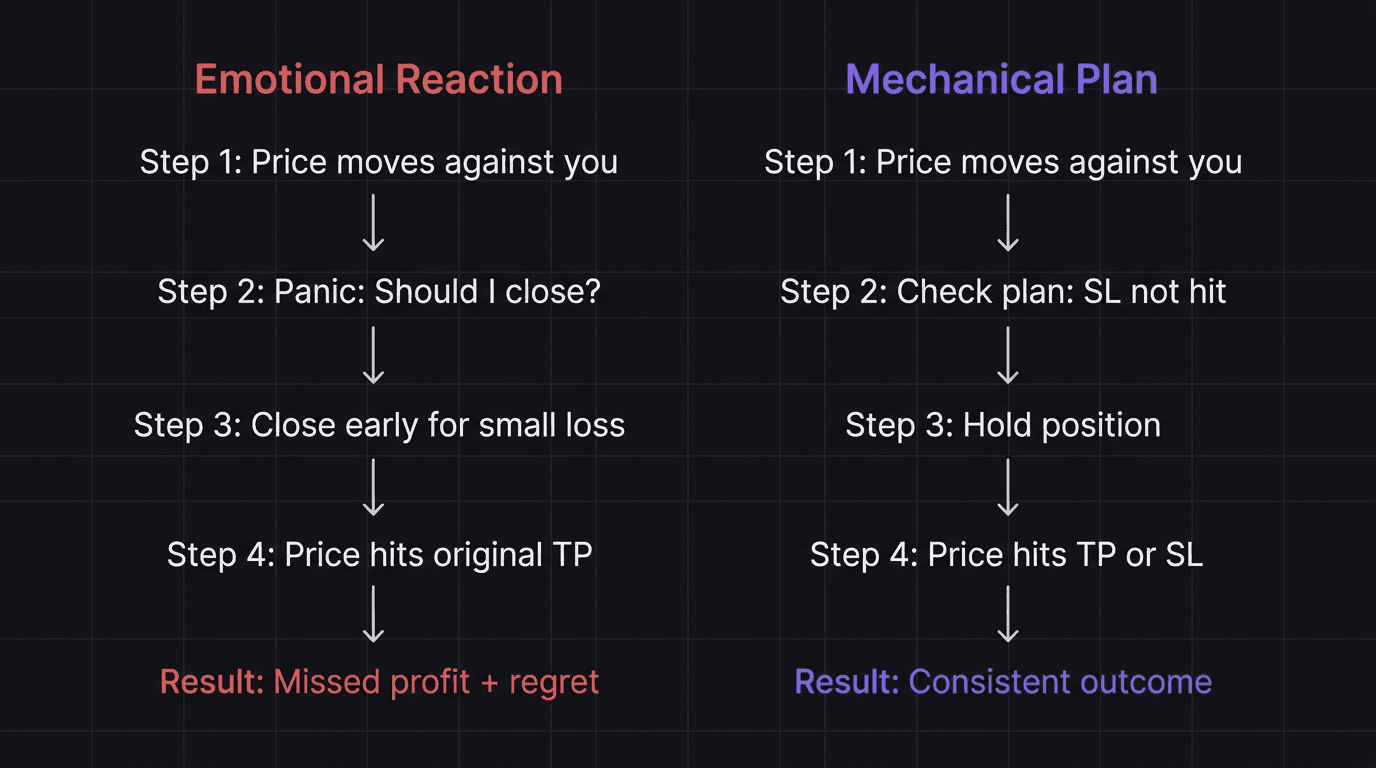
Sound familiar? You have probably been in exactly this position. Price dips, you panic, you close early. Price reverses to where you closed, and you re-enter. Then it dips again. Now you have taken two losses instead of one, and neither trade followed your rules.
The fear of losing creates a cascade of bad decisions. Each bad decision adds regret, which leads to revenge trading, which leads to bigger losses. It is a spiral, and it starts the moment your emotions overpower your plan.
The Emotion-Logic Hijack
Here is what happens in your brain during a live trade. Your prefrontal cortex (the planning, rational part) gets overridden by your amygdala (the emotional, reactive part) the moment perceived threat increases.
In practical terms: you set a stop loss at 30 pips because your analysis says the level is valid. Price moves 20 pips against you. Your amygdala screams, "You are about to lose money. Do something." Your prefrontal cortex whispers, "The plan says hold." The amygdala wins almost every time unless you have a system that makes the decision for you.
Walkthrough: USD/JPY Panic Close
You go short on USD/JPY at 149.50 on the 1-hour chart. Stop loss at 149.80 (30 pips). Take profit at 148.60 (3R). Your analysis shows a supply zone rejection and a lower high forming.
Price bounces to 149.65. You are down 15 pips. The candle is red, but the wick is long. Your brain says, "It is going to hit my stop." You close at 149.65 for a 15-pip loss.
Fifteen minutes later, price drops to 149.30. Then to 148.90. Then to 148.65, almost exactly at your take profit. You would have made 85 pips. Instead, you lost 15 pips because your emotions told you the trade was failing when it was working exactly as expected.
The pullback to 149.65 was normal price action. A 15-pip bounce in a 90-pip move is nothing. But inside the trade, with real money at risk, it felt like the beginning of a reversal.
This is the emotion-logic hijack. Your logical brain knew the stop was at 149.80 for a reason. Your emotional brain could not tolerate watching the unrealized loss grow.
A Mechanical Plan Replaces Willpower
The transcript makes a critical point: "It is very important that you actually have a fixed mechanical approach that you can use to manage your trade the same way every single time, so that you do not fall prey to your emotions."
Notice the emphasis on "the same way every single time." The solution to emotional trading is not more discipline. It is less decision-making.
A mechanical trading plan removes the decisions that emotions hijack. Instead of asking yourself, "Should I close this trade?" the plan answers for you.
Here is what a mechanical management plan looks like for the USD/JPY scenario:
Entry: short at supply zone rejection after lower high on 1H
Stop loss: 30 pips above entry (above the supply zone)
Take profit: 3R at the next demand zone
Management: set and forget. No adjustments unless a new lower high forms below entry.
If stopped out: log the trade, review in journal, no re-entry on the same setup
With this plan written down before the trade, the question "should I close?" never arises. The plan says hold. You hold. That is it.
The plan does not eliminate the anxiety you feel at 149.65. You will still feel nervous. The difference is that feeling nervous and acting on nervousness are two different things. The plan ensures you act on rules, not feelings.
A pre-trade checklist is where this starts. Before entering any trade, confirm your management rules are set. What is your stop? What is your target? What will you do if price pulls back? Answer these questions before the emotions kick in, not during.
What Consistent Input Looks Like
The transcript sums it up: "The market is inconsistent. But there is one thing you can control, and that is yourself. A consistent input leads to a consistent output."
Consistent input means doing the same thing regardless of how you feel. Same position sizing. Same stop placement. Same management rules. Same exit criteria. Whether you are up $2,000 this week or down $500, the process does not change.
This is counterintuitive. When you are losing, your instinct says change something. When you are winning, your instinct says increase size. Both instincts are the emotion-logic hijack in disguise.
Trading consistency is not about being a robot. It is about recognizing that your emotional state is the worst possible input for trading decisions. A mechanical plan acknowledges this by removing emotional decisions from the equation entirely.
Over 50 or 100 trades, consistent execution reveals your actual edge. Inconsistent execution reveals nothing except that you are reactive. And reactive trading is what most traders are already doing. It is why most traders lose.
How EdgeFlo Helps You Trade Mechanically
EdgeFlo's Sanctuary feature guides you through a reset routine before your next trade if you are feeling tilted or emotional. It does not force you to stop trading. It offers a structured pause so you can return to your plan rather than acting on impulse.
Combined with a written management plan, Sanctuary addresses the moment where most emotional damage happens: the five seconds between feeling panic and clicking the close button. A structured prompt in that gap can be the difference between following your rules and breaking them.
The Edge Brief
Receive Insights on trading psychology, discipline, and the behavioral patterns that create consistent traders from our Founder and the EdgeFlo team, delivered to your inbox.
Think different. Trade different.
Why do I make bad decisions during live trades?
How do I stop emotions from affecting my trading?
Is it normal to feel anxious during a trade?
What is a mechanical trading plan?

Turn discipline on.
Every session.
EdgeFlo is the environment serious traders operate inside.
Start 7-Day Free Trial
Cancel anytime.
No long-term commitment.

Think Different, Trade Different.