

Emotionless Trading: Let Your System Decide
Emotionless trading is not about feeling nothing. It is about building systems that make decisions before emotions arrive. Here is how.
Emotionless trading means your decisions are already made before you sit down at your charts. You write your rules in advance, define every entry condition, set your risk, and then execute what the plan says. The system decides. You just follow it. That is what "emotionless" actually looks like in practice. It does not mean you stop feeling fear, frustration, or excitement. It means those feelings never get a vote on whether you click buy or sell.
Every trader who has given back a winning week knows the pattern. A good streak builds confidence. Confidence turns into overconfidence. Overconfidence turns into a revenge trade or an oversized position. Then you spend the next three days trying to dig out of a hole that did not need to exist. A mechanical system breaks that cycle at the source.
TL;DR
Emotionless trading does not mean you feel nothing. It means your system decides, not your mood.
The emotional cycle (overconfidence, fear, revenge) repeats until you replace gut decisions with written rules.
A mechanical system is a flowchart: if you see the setup, take the trade. If you do not, stay out.
Processes like journaling and daily routines turn rule-following into a habit instead of a daily battle.
You build emotion-proof trading through preparation, not willpower.
You Cannot Delete Emotions (Stop Trying)
Here is the uncomfortable truth. You are not a robot. You have a brain that is wired for fight-or-flight, not for calmly watching a 50-pip drawdown unfold on a Tuesday afternoon. Emotions are built into your hardware. You cannot uninstall them.
The real problem is not that you feel fear after a loss. The problem is that fear gets to make the next trading decision. You see a valid setup, your plan says take it, and your gut says "not right now, I just lost money." So you sit on your hands. The trade runs 80 pips without you. Now you feel regret, which leads to chasing the next setup that is not even in your plan.
Sound familiar? This is the cycle that repeats: win, get overconfident, take bad trades, lose money, doubt your strategy, get afraid, miss good trades, get angry, revenge trade, lose more. Repeat.
Trying to "control your emotions" is fighting biology. The solution is not emotional control. It is removing emotions from the decision chain entirely by making all trading decisions before the market opens.
What Emotionless Trading Actually Means
Emotionless trading is a system problem, not a mindset problem. It means every decision that matters (entry, exit, position size, when to stop) is written down before you see a single candle.
Think of it like a flowchart. If this condition appears on the chart, you do this specific thing. If it does not appear, you do nothing. There is no third option called "I have a feeling about this one."
Put plainly, a system is a set of well-defined rules that tells you exactly what to look for on the charts so you can take high-probability setups without guesswork. If you see the setup, take the trade. If you do not see the setup, stay out of the market. That is it.
This is what a mechanical trading plan actually does. It removes the moment of hesitation where emotions typically hijack the decision. By the time you are sitting at your chart, the thinking is already done. You are just executing.
The distinction matters because most traders who say they want to "trade without emotions" are actually asking for a personality transplant. They do not need one. They need a plan that is specific enough to follow under pressure.
How a Mechanical System Replaces Gut Decisions
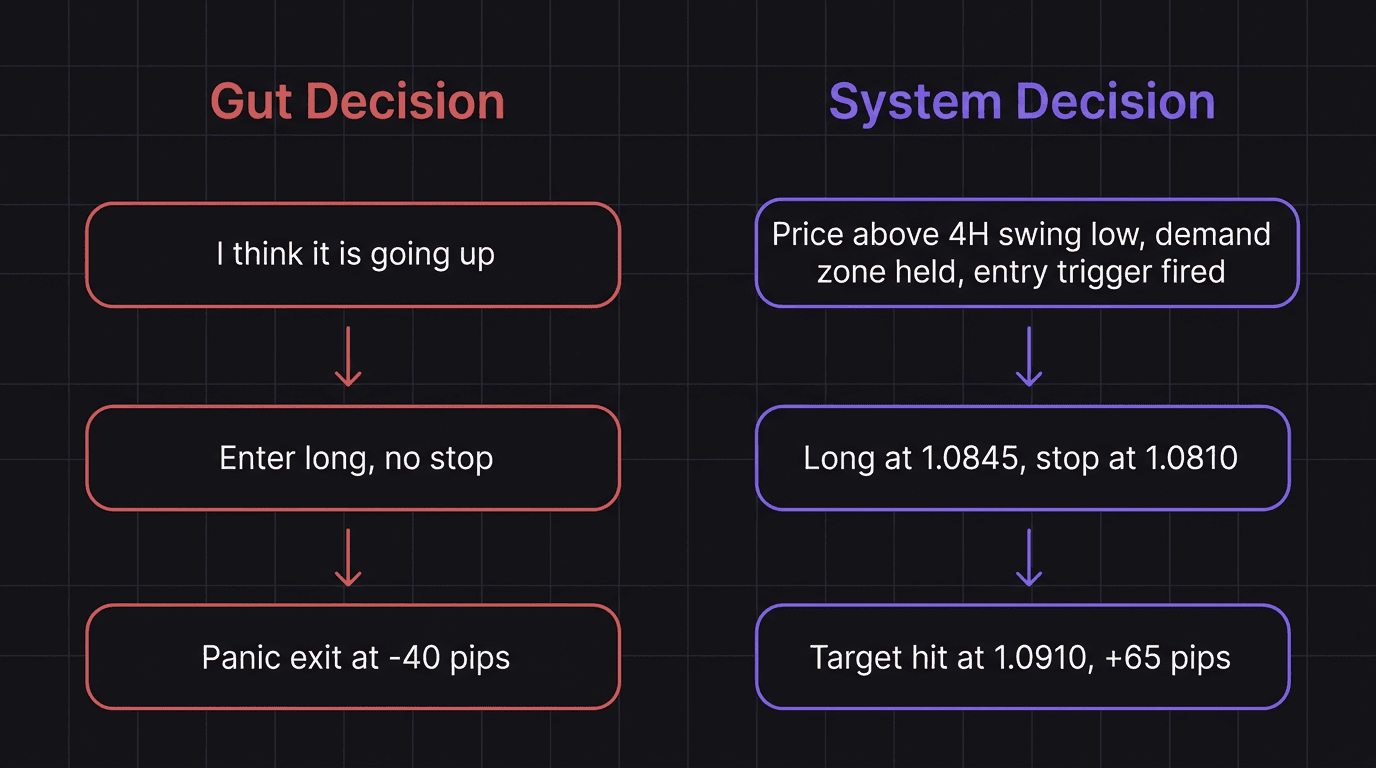
A gut decision sounds like "I think it is going up." A system decision sounds like "price is above the 4H swing low, demand zone held on the 15-minute, and my entry trigger fired. I am long at 1.0845 with a stop at 1.0810 and a target at 1.0910."
The difference is not intelligence. It is preparation.
Here is what a mechanical system covers:
Trading style. Scalper, day trader, swing trader, or position trader. Each one uses different timeframes, different session windows, and different hold times. You pick one.
Entry criteria. Exactly what needs to be true on the chart before you are allowed to take a trade. Not "it looks bullish." Specific conditions: structure, zone, trigger, timeframe alignment.
Exit criteria. Where your stop goes, where your target goes, and what happens if the trade moves to breakeven. All defined in advance.
Risk rules. How much per trade, how many trades per day, and what your daily loss cap is. These are numbers, not vibes.
When all four are written down and specific, your job during the session is just pattern matching. Does the chart match my rules? Yes or no. If yes, execute. If no, wait. That is if-then trading in its simplest form.
Walkthrough: The Emotional Cycle Without a System
The Setup
A trader, call her Sarah, has been trading GBP/USD for three months without a written plan. She uses the 1-hour chart and "knows" her strategy works because she has seen it win before. But nothing is documented. No entry checklist, no position size rule, no daily loss cap.
Week One: The Winning Streak
Sarah catches three solid trades in a row. GBP/USD moves from 1.2640 to 1.2710 on Monday, she is long and banks 70 pips. Two more winners follow. She is up about 180 pips by Thursday. She feels sharp. Confident. Maybe even invincible.
Week Two: The Slide
Friday, she sees a setup that is "close enough" to her usual pattern. Not perfect, but she is on a hot streak. She doubles her lot size because she is playing with house money. GBP/USD reverses 45 pips against her. She moves her stop once, then again. Eventually she closes manually down 90 pips (doubled lots made it twice as painful).
Monday comes. She is frustrated. She sees a valid setup but hesitates. Trading fear has taken the wheel. The setup runs 60 pips without her. Now she is angry at herself for not taking it.
Tuesday, she takes a trade that does not match any pattern she has used before. She just wants to make back what she lost. This is textbook revenge trading. She loses another 50 pips.
What a System Would Have Changed
With written rules, Friday's "close enough" trade never happens because it does not match the documented entry criteria. The lot size stays the same because risk per trade is a fixed number (say, 1% of account). Monday's valid setup gets taken because the plan says to take it, regardless of how the previous week felt. And Tuesday's revenge trade is blocked by a daily loss limit that pauses trading after a defined threshold.
Sarah did not need a better strategy. She needed trading rules she could not argue with in the moment.
Building Your Emotion-Proof Workflow
You do not need to build everything at once. Start with the system, then layer in the processes that keep you honest.
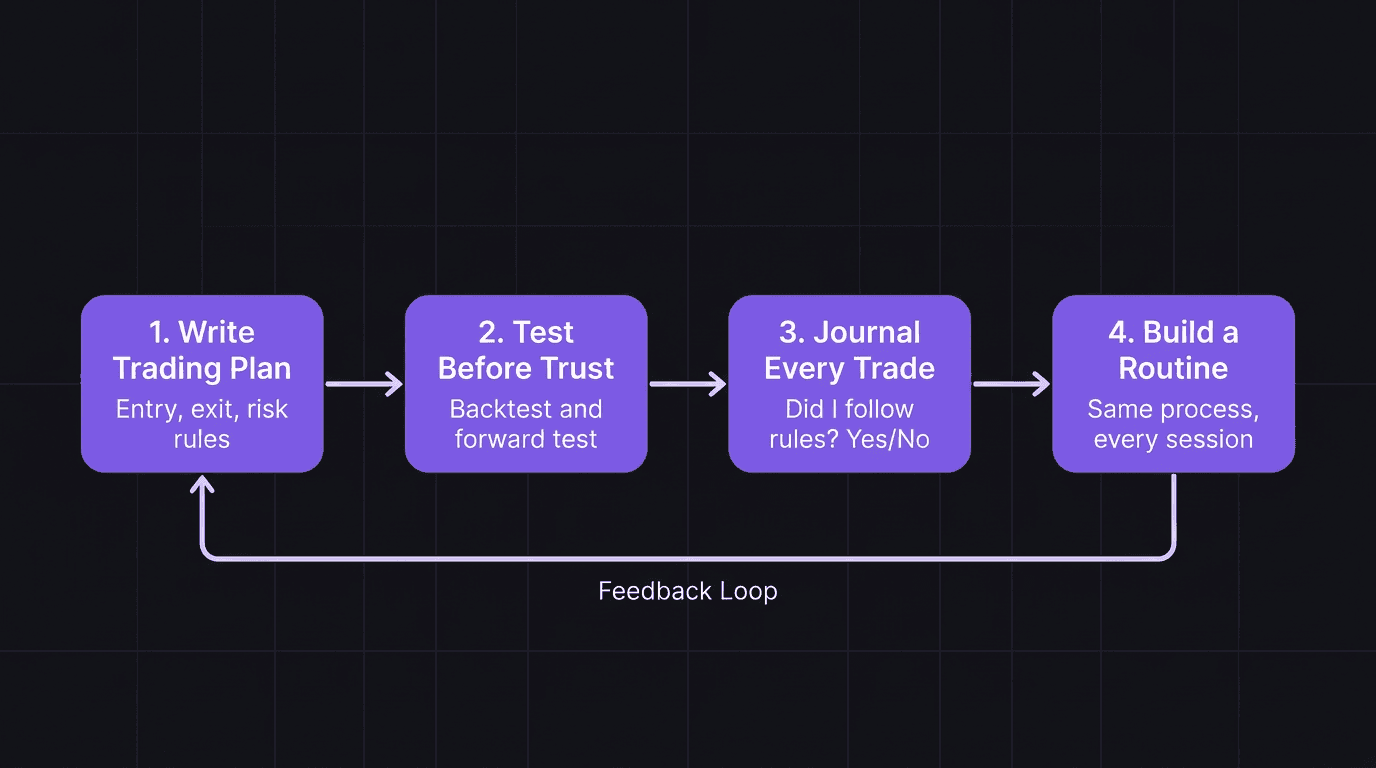
Step 1: Write Your Trading Plan
Define your style, your timeframes, your entry conditions, your exit conditions, and your risk rules. Be specific enough that someone else could trade your plan without calling you to ask what you meant.
If your plan includes the phrase "use your judgment," that is a hole where emotions will enter. Replace it with a condition.
Step 2: Test Before You Trust
Backtest the plan. Forward test it on a demo account. You need proof that the rules work before you risk real money on them. If you skip testing, the first losing streak will convince you the plan is broken, and you will abandon it. That is exactly the strategy-doubt cycle the transcript warns about.
Step 3: Journal Every Trade
After each trade, write down what you did and whether it matched your plan. Not a novel. Just: Did I follow my rules? Yes or no. If no, what did I do instead?
This creates a feedback loop. Over time, you see exactly where your execution breaks down. Maybe you always break rules during the New York session. Maybe you widen your stop on JPY pairs. The journal shows you patterns your memory hides.
Step 4: Build a Routine
Your pre-session routine is what bridges the gap between having a plan and actually following it. Review your plan. Check the economic calendar. Mark your levels. Decide which pairs you are watching and what setups you need to see. Do this before the market moves a single pip.
The routine makes rule-following automatic. You are not deciding whether to follow your plan each morning. You are just running the same process, day after day. Consistent action leads to consistent results.
The Flowchart Test
Here is a simple check for whether your system is mechanical enough. Can you draw it as a flowchart? If every decision point has a clear yes/no branch with a defined action on each side, your system is ready. If any branch says "it depends" or "use discretion," you have more work to do.
This is the test: it is a flowchart process. If this happens, do this. If it does not happen, do that. If you cannot diagram your system, you do not have a system. You have guidelines, and guidelines leave room for impulse trades.
How EdgeFlo Removes the Guesswork
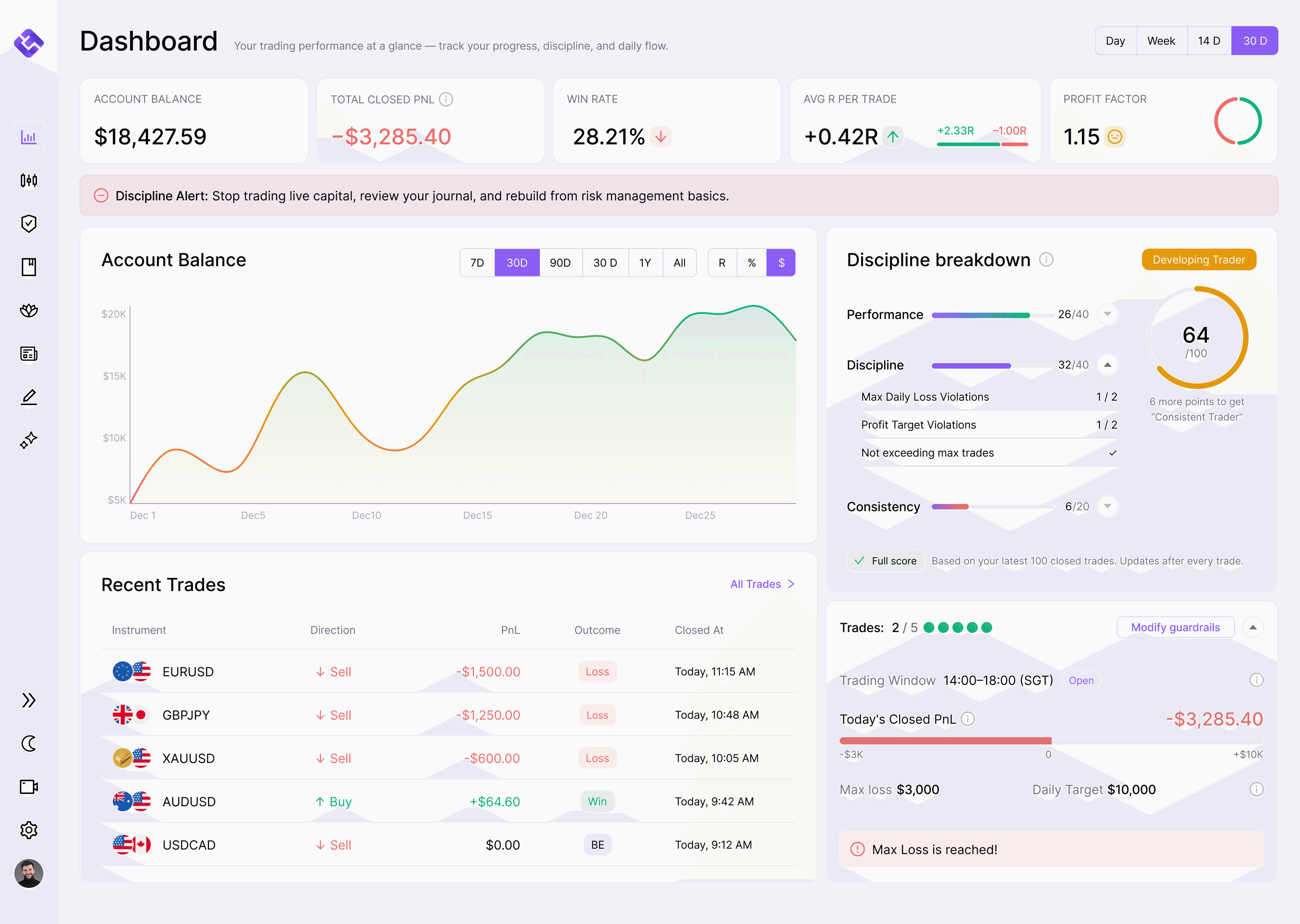
EdgeFlo is built around this exact principle: make the rules visible so emotions cannot override them quietly. Your Edge plan sits next to your chart during every session, showing your documented entry criteria, exit rules, and risk parameters. You do not need to remember your rules under pressure. They are right there.
When you hit your daily loss limit or max trade count, EdgeFlo's guardrails restrict further trading. You can override them (it is your account, your choice), but you have to make a conscious decision to break your own rules. That pause is the difference between a mechanical process and an emotional spiral.
After a rough session, Sanctuary offers guided reset routines so you can clear your head before the next session. It is not about pretending the loss did not happen. It is about making sure the loss does not make the next decision for you.
The Edge Brief
Receive Insights on trading psychology, discipline, and the behavioral patterns that create consistent traders from our Founder and the EdgeFlo team, delivered to your inbox.
Think different. Trade different.
Is emotionless trading actually possible?
What is the difference between emotionless trading and robotic trading?
How long does it take to trade without emotions?
Can emotions ever help in trading?

Turn discipline on.
Every session.
EdgeFlo is the environment serious traders operate inside.
Start 7-Day Free Trial
Cancel anytime.
No long-term commitment.

Think Different, Trade Different.