

Impulse Trading: Why Gut Entries Cost You
Impulse trading happens when you enter before your setup confirms. Learn why gut-feeling entries lose money and how a mechanical filter stops them.
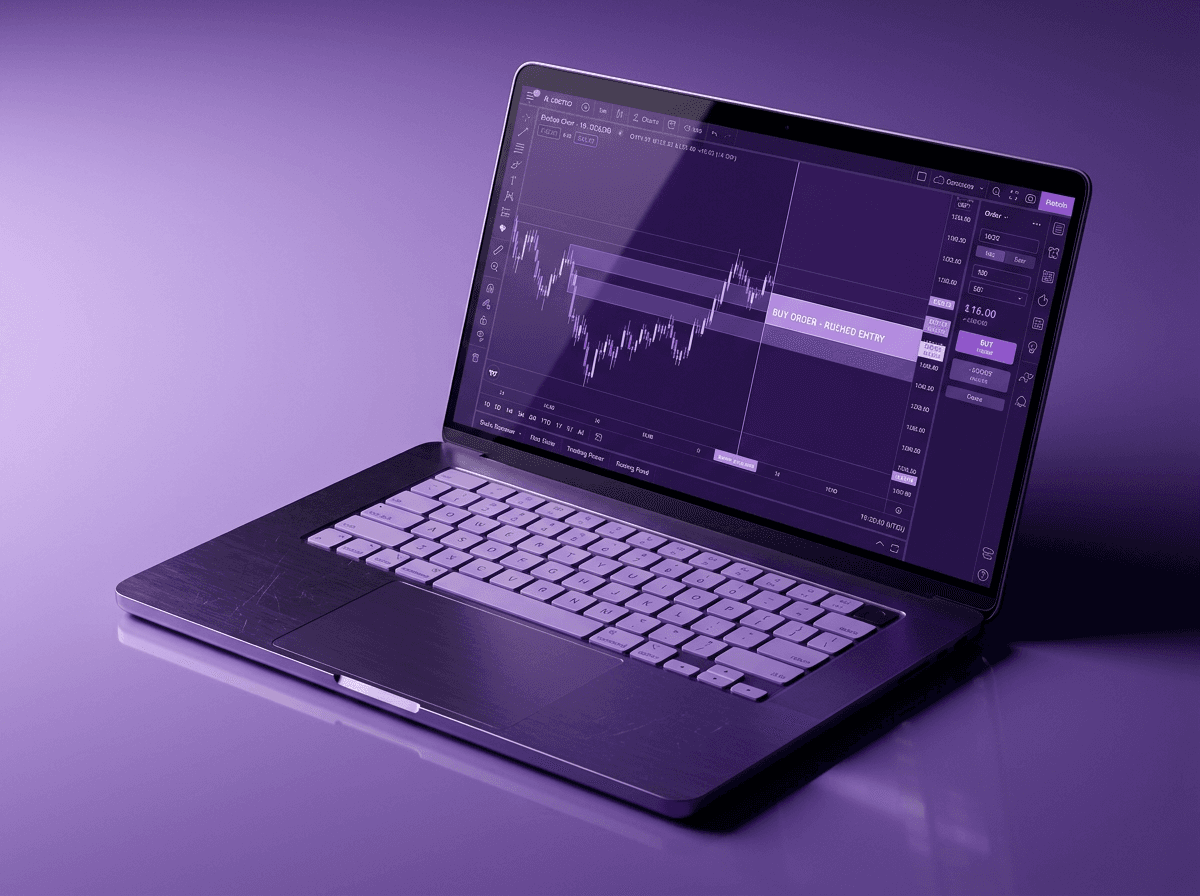
You see the setup forming. Price is moving. Your gut says "get in now before it leaves without you." So you click buy.
No confirmation. No checklist. Just a feeling.
That feeling cost one trader $10,000 on a single entry. He knew exactly where price needed to go before his model confirmed. He entered anyway. And within hours, his stop loss was hit because he skipped the one step that would have kept him out of a bad trade.
Impulse trading is the gap between knowing your plan and actually following it. It is one of the most expensive habits in trading, and almost every trader has done it.
TL;DR
Impulse entries happen when you act on a feeling instead of waiting for your setup to confirm.
One trader lost $10,000 on GBP/JPY because he entered before the liquidity sweep his plan required.
Complacency after a winning streak is a common trigger for impulse trades.
A physical pre-trade checklist forces a pause between the urge and the click.
The trade he skipped would have yielded a massive winner if he had waited for the real entry.
What Impulse Trading Looks Like
Impulse trading is not the same as being aggressive. Aggressive traders can still follow a plan. Impulse traders skip the plan entirely.
Here is what it looks like in practice. You open your chart and see price moving in a direction you expected. Instead of waiting for your specific entry model to form, you enter immediately because the move "looks right." You might even tell yourself you are being decisive.
The problem is that decisiveness without a filter is just gambling. Your gut feeling has no edge. Your tested entry model does.
The most common triggers for impulse entries include:
Price moving fast in your expected direction (urgency)
A recent win that made you feel invincible (complacency)
A recent loss that made you desperate to recover (revenge trading)
Boredom from waiting for a setup that has not appeared yet
Every one of these triggers creates the same result: you enter before your plan says to.
The $10K Lesson: Entering Before Confirmation
Walkthrough: GBP/JPY, June 3, London Pre-Session
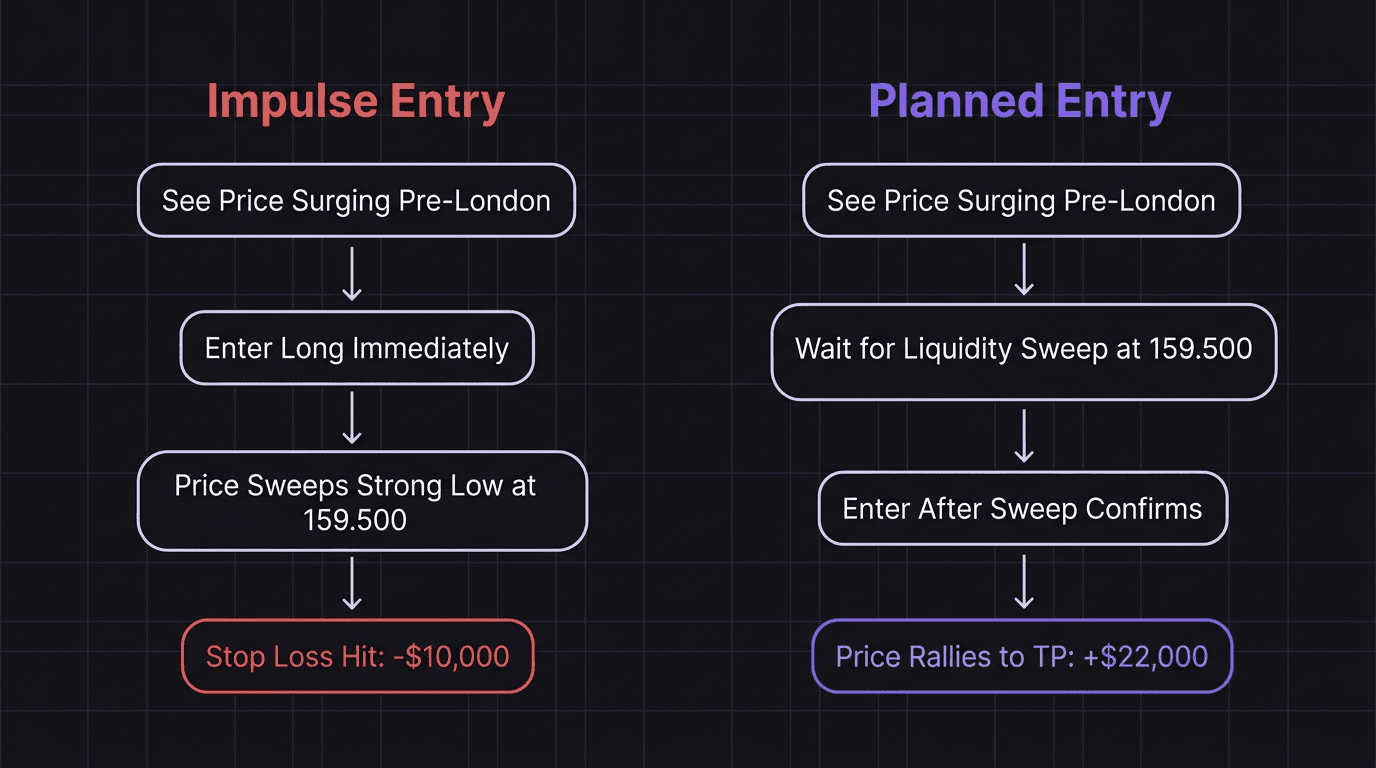
A trader had been profitable for the previous month and was feeling confident. On the first trading day of the new month, he pulled up GBP/JPY and saw price surging during the pre-London session.
His plan was clear. Wait for price to liquidate the strong low below 159.500, then enter long after the sweep confirmed. The setup required patience because the real move typically comes after London session opens and clears those lows.
But he did not wait.
He saw price pushing higher and entered long immediately, thinking the move was already underway. At that point, his position was up about $3,500. He left for the gym on a set-and-forget approach.
When he came back, his stop loss had been hit. Price dropped, swept the strong low exactly as his plan predicted, and then rallied hard. The entry he was supposed to take (after the sweep) would have produced a clean winner.
Instead, he lost $10,000.
His own words: "I kind of deserve that loss. I wasn't patient enough. I was just acting on impulse."
The painful part? His plan was right. The market did exactly what he expected. He just could not wait for confirmation.
Why Your Gut Lies Under Pressure
Your gut is not a trading system. It is a collection of emotional responses shaped by your recent experiences.
After a winning month, your gut tells you that you are good enough to skip the checklist. After a losing trade, your gut tells you that you need to get back in immediately. Both signals feel urgent and real. Both are wrong.
This is because your brain processes financial risk the same way it processes physical danger. When price moves fast, your fight-or-flight system activates. The urge to act is biological, not logical.
That is why willpower alone does not fix impulse trading. You cannot consistently override a stress response with mental effort. You need a system that creates a physical barrier between the impulse and the action.
Think of it like this. If you are on a diet and you keep chips in the kitchen, willpower has to work every single time you walk past the pantry. But if you stop buying chips, the decision is made once and the temptation disappears.
The same principle applies to your trading rules. Build the barrier before the pressure arrives.
A Mechanical Filter for Impulse Entries
The fix for impulse trading is not "be more disciplined." The fix is to make undisciplined entries harder to execute.
Here is a simple mechanical filter that works:
The 3-Box Entry Gate
Before clicking buy or sell, you must check three boxes. If any box is empty, the trade does not happen.
Setup confirmed on your entry timeframe. Not "forming." Not "close enough." Confirmed. Your specific entry model (whether that is a fractal market shift, a break of structure, or a supply/demand test) must be complete.
Liquidity conditions met. If your plan requires a sweep of a specific level before entry, that sweep must have already happened. No anticipating.
Written in your journal before entry. Open your trading journal and write the pair, the timeframe, the entry reason, and the target. If you cannot write it down clearly, you do not have a trade.
This filter works because it forces a pause. The impulse to trade is strongest in the first 10 to 15 seconds. If you can create a 60-second gap between the urge and the execution, the impulse fades and your rational process takes over.
The trader from the GBP/JPY walkthrough admitted that complacency from his previous profitable month caused him to skip his plan review on the first day of the new month. He knew what he was looking for. He just did not force himself to wait for it.
A mechanical trading plan that requires confirmation before entry would have kept him out of that $10,000 loss. Not because the plan is smarter than the trader, but because the plan does not feel urgency.
How EdgeFlo Helps You Filter Impulse Entries
EdgeFlo's Edge plan builder lets you document your exact entry criteria and keeps that plan visible during your trading session. When your setup checklist is on screen next to your chart, skipping a step becomes a conscious choice rather than an unconscious habit.
The plan stays in front of you as a reference. You can still override it (EdgeFlo never locks you out of a trade). But the act of seeing your unchecked criteria before you click the button creates that mechanical pause between impulse and action.
After each trade, EdgeFlo's post-trade self-reporting asks whether you followed the plan. Over time, this builds a data set that shows exactly how often impulse entries cost you versus how often planned entries pay.
The Edge Brief
Receive Insights on trading psychology, discipline, and the behavioral patterns that create consistent traders from our Founder and the EdgeFlo team, delivered to your inbox.
Think different. Trade different.
What causes impulse trading?
How do I stop trading on impulse?
Is impulse trading the same as FOMO trading?
Can impulse trades ever be profitable?

Turn discipline on.
Every session.
EdgeFlo is the environment serious traders operate inside.
Start 7-Day Free Trial
Cancel anytime.
No long-term commitment.

Think Different, Trade Different.