

Emotion Tagging in Trading: Spot Patterns You Can't See
Emotion tagging means recording how you feel before and after every trade. It exposes unconscious patterns that P&L alone never shows.
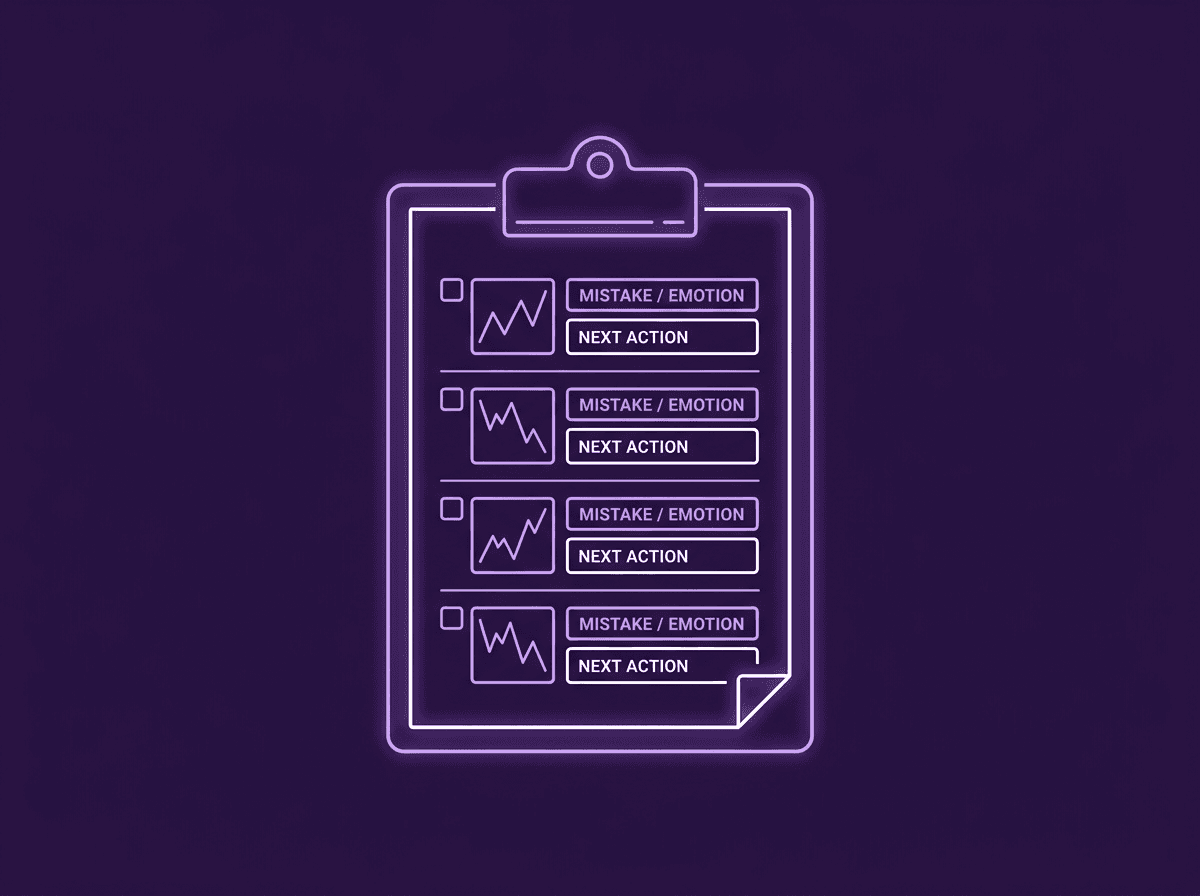
Most traders review their P&L, check their win rate, maybe glance at a chart screenshot, and call that a journal review. But none of that tells you why you took the trade. Emotion tagging does. It means recording exactly how you felt before entering and after exiting every single trade. Not a paragraph. Not a therapy session. Just a quick honest label, anxious, confident, frustrated, neutral, captured in the moment.
Over time, those labels reveal patterns your P&L hides. You might discover that every losing streak starts with a trade you tagged "impatient." Or that your best weeks all share "calm, focused" entry tags. Emotion tagging turns vague self-awareness into concrete data you can act on.
TL;DR
Emotion tagging means labeling how you feel before entry and after exit on every trade.
P&L tells you what happened, emotion tags tell you why.
After 20-30 tagged trades, unconscious patterns become visible in the data.
Connecting feelings to outcomes breaks self-destructive cycles like revenge trading.
The tag itself takes five seconds. The insight compounds over weeks and months.
Why Emotions Belong in Your Journal
Here's what most traders get wrong about journaling: they treat it like an accounting exercise. Pair, direction, entry, exit, P&L. Done. But if that's all you record, you're missing the biggest variable, you.
Your emotional state at entry shapes every decision downstream. It affects your position size, your patience with the setup, how early you move your stop, and whether you cut a winner short or let it run. Two identical setups can produce opposite results depending on whether you entered feeling calm or feeling desperate to recover yesterday's loss.
A trading journal template that only captures the technical stuff is a start. But without emotion data, you're left guessing. "Why did I move my stop?" You don't know. "Why did I size up on that one?" No clue. The technical record can't answer questions about your behavior.
Brad Goh, who built EdgeFlo after seven years of live trading, puts it bluntly: the traders who lose money, take hundreds of trades, and never improve are the ones who skip the review. They repeat the same unconscious patterns because they never recorded what was actually driving those patterns. The fix isn't more chart time. It's writing down how you felt and then looking at what that data tells you.
The Gap Nobody Fills
Plenty of traders talk about tracking emotions. Forums, Reddit threads, YouTube comments, everyone agrees it matters. But almost nobody shows the actual workflow: what to tag, when to tag it, and how to read the patterns afterward. That gap is exactly what this article covers.
What to Tag Before and After a Trade
Keep it dead simple or you won't do it. The goal isn't a detailed emotional autobiography. It's a quick label at two specific moments.
Before Entry
Right before you click buy or sell, pause and answer one question: "How do I feel about this trade?"
Pick from a short list. Something like:
Confident: Setup matches your plan, you feel clear-headed
Anxious: Hesitating, worried about the outcome
Impatient: Rushing in because you've been waiting too long
Neutral: No strong feeling either way, just executing the plan
Frustrated: Still bothered by a previous loss or missed move
Excited: Hyped up, maybe too attached to this working out
That's it. One word. Five seconds. If you're honest, that single label captures more about your decision quality than a paragraph of post-trade analysis ever could.
After Exit
The second you close the trade, win or loss, tag your emotion again before you do anything else. Before checking the next setup. Before opening Twitter. Before doing the math on your P&L for the day.
Why right after? Because that's when the feeling is rawest and most honest. Wait an hour and you'll rationalize. Wait until your post-trade review session and you'll barely remember.
Use the same short list, plus a few exit-specific ones:
Relieved: Glad it's over, regardless of outcome
Regretful: Wish you'd done something differently
Satisfied: Executed the plan, outcome doesn't matter
Angry: Mad at the market, the broker, yourself
Walkthrough: The "Frustrated" Entry Tag That Saved a Week
A trader starts Monday with two consecutive stop-outs on GBP/USD during London open. Down 1.2% by 10:30 AM. She sees a third setup forming, a clean pullback to a demand zone on the 15-minute chart. The setup is valid. But before clicking buy, she tags her emotion: "Frustrated."
She looks at that tag and asks herself: "Am I taking this because the setup is there, or because I need to make back what I lost this morning?" She can't honestly say it's purely the setup. She skips the trade.
Price runs 45 pips in her favor. Normally that would sting. But she checks her journal from the previous month and sees that 4 out of 5 trades tagged "Frustrated" at entry were losers. The one winner was a break-even scratch. Skipping that third trade wasn't leaving money on the table, it was following the data.
Spotting Unconscious Patterns
Tags become powerful when you stop looking at them one by one and start looking at them in clusters. After 20-30 tagged trades, patterns emerge that you genuinely could not see before.
What to Look For
Open your journal and sort or filter by emotion tag. Ask these questions:
Win rate by entry emotion. What's your win rate on trades tagged "Confident" versus "Impatient"? The gap between your best and worst emotional states is often large enough to change your entire edge. That's not noise. That's your behavior telling you exactly when you trade well and when you don't.
Loss streaks and emotion sequences. Look at your last three losing streaks. What entry emotion kicked off each one? If you see "Frustrated → Angry → Impatient" showing up repeatedly, you've found a self-destructive cycle. The first loss isn't the problem, the emotional cascade afterward is.
Exit emotion and trade management. Trades where you tagged "Relieved" at exit often reveal premature exits. You cut the trade because you couldn't handle the discomfort of watching it, not because your plan told you to close. Compare how far price went after those "Relieved" exits versus your "Satisfied" exits.
The Pattern Most Beginners Discover First
Here's the one that shows up in almost every beginner's data: the best trades are boring. Entries tagged "Neutral" or "Calm" consistently outperform entries tagged with any strong emotion, positive or negative. Excitement is just as dangerous as frustration. Both mean you're trading from feeling, not from plan.
This is the kind of insight a trading journal habit built on emotion data produces. Pure technical journaling, screenshots, levels, outcomes, doesn't surface it because the technical setup looked fine in every case. The difference was you.
Walkthrough: Finding the "Excited" Pattern
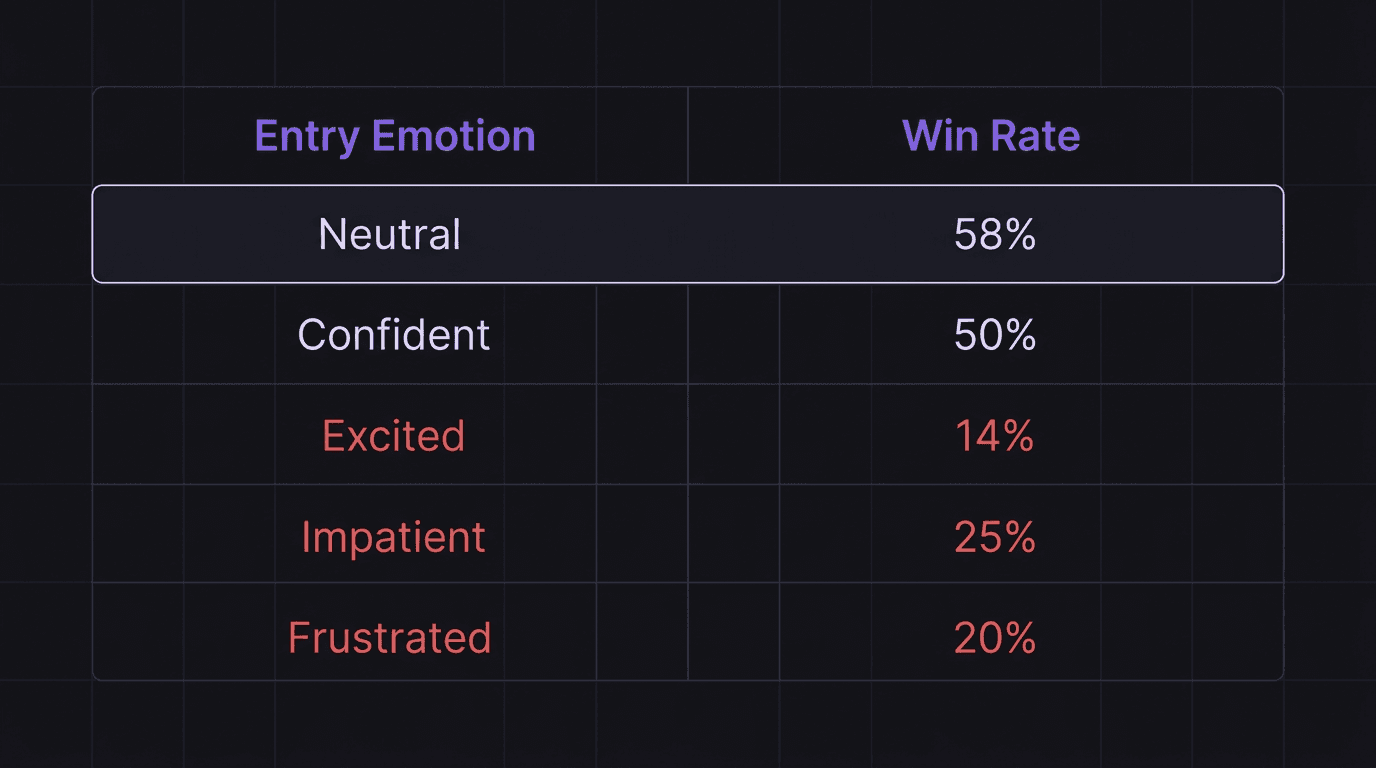
A new trader reviews 40 tagged trades after his first month. His overall win rate is 45%. Not great, not terrible. But when he filters by entry emotion, the picture changes:
- "Neutral" entries: 58% win rate (19 trades) - "Confident" entries: 50% win rate (10 trades) - "Excited" entries: 14% win rate (7 trades) - "Impatient" entries: 25% win rate (4 trades)
Seven trades tagged "Excited", and only one won. He looks at the specifics. Every "Excited" entry happened after a winning trade. He was chasing the high, oversizing, jumping into setups he'd normally skip. The emotion tag made the pattern undeniable. Without it, he'd just see a 45% win rate and blame his strategy.
From Awareness to Behavior Change
Seeing the pattern is step one. But as Brad puts it: learning isn't memorizing information, it's changing behavior. If you spot the "Frustrated" pattern and still take frustrated trades next week, you haven't learned anything. You've just collected more data.
So how do you turn emotion data into actual behavior change?
Step 1: Name Your Trigger Emotions
From your data, identify the one or two emotions most strongly linked to losing trades. For most traders, it's some version of frustration, impatience, or excitement. Write them down. These are your red-flag emotions.
Step 2: Create a Simple Rule
Attach a concrete action to each trigger emotion. Not "be more disciplined", that's useless. Something specific:
If entry emotion = Frustrated: Walk away for 15 minutes. Re-evaluate the setup after the break. If it's still valid and you now feel neutral, take it.
If entry emotion = Excited: Cut position size in half. You're likely oversizing because you "feel" certain.
If entry emotion = Impatient: Only take the trade if it matches every criterion on your checklist. No shortcuts.
Step 3: Review Weekly
Set aside 15 minutes at the end of each week to review your emotion tags alongside your trading review process. Ask two questions:
Did I follow my trigger rules this week?
What did the trades I skipped or resized actually do?
That second question matters. When you see that the "Frustrated" trade you skipped would have been a loser, the rule gets reinforced. When you see a skipped trade would have won, you check whether you're being too conservative or whether the data still supports the rule. Either way, you're making decisions from evidence, not instinct.
Why Willpower Alone Doesn't Work
Every trader who's tried "I'll just be more disciplined" knows the shelf life on that plan. A few days. Maybe a week if you're motivated. The reason emotion tagging works where willpower fails is that it creates a feedback loop. You're not relying on self-control in the moment, you're relying on data from your past behavior to inform a rule. The rule does the work. You just follow it.
This is what separates knowing something from actually doing something. Most traders know they shouldn't revenge trade. They do it anyway. Emotion tags force you to confront the pattern in your own data so you can build guardrails around it, not just promise yourself you'll do better.
How EdgeFlo Prompts Emotion Tags Automatically
Most traders who try emotion tagging give up after a week. Not because it's hard, because they forget. You close a trade, immediately start looking at the next setup, and the emotion window is gone. By the time you remember to journal, you've already rationalized the feeling.
EdgeFlo handles this by prompting you to record your emotion the moment you close a trade. Right there in the platform, before you can click into anything else. You pick a label, it gets stored in your trading journal automatically, and it's tied to that specific trade with all the technical data attached.
No separate notebook. No switching apps. No forgetting. The emotion tag lives alongside your entry price, your exit, your R-multiple, and your screenshots, so when you review, everything is in one place. This is the kind of friction reduction that turns a good idea into an actual habit. And because EdgeFlo's AI-powered trading journal tracks these tags over time, the patterns surface in your weekly reviews without manual spreadsheet work.
The Edge Brief
Receive Insights on trading psychology, discipline, and the behavioral patterns that create consistent traders from our Founder and the EdgeFlo team, delivered to your inbox.
Think different. Trade different.
What is emotion tagging in trading?
How many emotions should I tag per trade?
Can emotion tagging replace a full trading journal?
How long before emotion tagging shows useful patterns?

Turn discipline on.
Every session.
EdgeFlo is the environment serious traders operate inside.
Start 7-Day Free Trial
Cancel anytime.
No long-term commitment.

Think Different, Trade Different.