

Discretionary vs Mechanical Trading: The 90/10 Model
Pure discretionary trading leads to inconsistent losses. Learn why the 90/10 model (90% mechanical, 10% discretionary) creates consistent results.

Discretionary trading means making decisions based on how you feel in the moment. Mechanical trading means following predefined rules regardless of how you feel. One approach produces random, emotional results. The other produces consistency.
But here is the part most articles miss: the answer is not 100% mechanical. Markets evolve, and rigid systems break. The approach that actually works for most retail traders is 90% mechanical (your rules handle nearly everything) with 10% discretionary (your judgment handles the rare exceptions). This is the 90/10 model, and it gives you the consistency of rules with the adaptability of human awareness.
TL;DR
Pure discretionary trading is emotion-based and produces inconsistent results you cannot backtest or improve.
Pure mechanical trading is rigid and can break when market conditions shift.
The 90/10 model: 90% of your decisions follow fixed rules, 10% comes from informed human judgment.
Mechanical rules cover entries, exits, risk, and trade management. Discretion covers edge cases like major news events or unusual volatility.
You cannot improve what you cannot measure. Mechanical rules make your trading measurable.
What Discretionary Trading Really Means
Discretionary trading sounds professional. It suggests experience, intuition, reading the market. In reality, for most traders, it means making it up as you go.
A discretionary trader looks at a chart and thinks: "That looks bullish. I think I will buy." There is no checklist, no defined entry criteria, no preset stop loss distance. The decision depends on the trader's mood, confidence level, and what happened on the last three trades.
The problem is not that the read is always wrong. Sometimes it is right. But it is right for different reasons each time, based on different criteria, with different risk. One day you risk 1%. The next day you feel confident and risk 3%. The day after a losing streak, you do not trade at all, even when a good setup appears.
This randomness makes it impossible to track your performance meaningfully. If you change your approach every session, what exactly are you testing? You cannot calculate a reliable win rate. You cannot measure expectancy. You cannot identify what is working and what is not. It is the same problem as strategy hopping: too many variables, no consistent signal.
Why Emotions Always Win Without Rules
Ever had a day where you knew the right thing to do and did the opposite? That is what happens when there are no rules. Not guidelines, not intentions. Written rules with specific conditions.
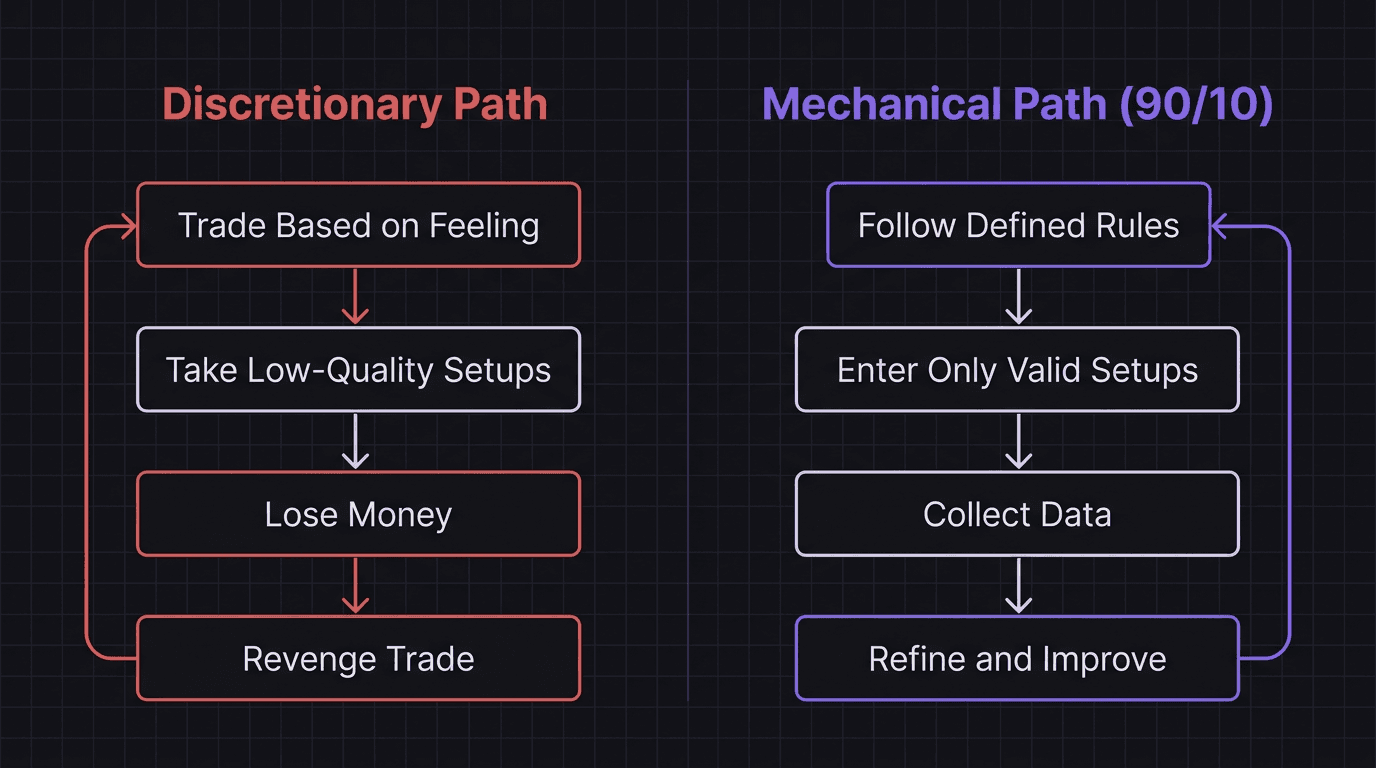
Here is the emotional trading cycle that traps discretionary traders:
Step 1: You lose a trade. Normal.
Step 2: You lose a second trade. Confidence drops. You start doubting the setup.
Step 3: A valid setup appears. You skip it because you "just know" it will lose too. The trade wins without you.
Step 4: Now you are frustrated. You missed a good setup and took two losses. You force the next trade to make up for it. This is revenge trading, and it rarely works.
Step 5: The forced trade loses. You are now down more than you should be, your confidence is destroyed, and tomorrow you will either overtrade or not trade at all.
This cycle repeats. Not because you are a bad trader, but because you have no rules to override the emotions. Emotions during trading are unavoidable. The question is whether your system is strong enough to keep you executing despite them.
Walkthrough: Same Setup, Two Approaches
GBP/USD shows a bullish break of structure on the 4-hour chart. Price pulls back to a demand zone at 1.2650 and shows a lower-timeframe shift.
Discretionary approach: The trader thinks it looks good, but they lost yesterday and feel hesitant. They wait. Price moves 80 pips in their favor without them. Frustrated, they jump into the next pullback at 1.2710, which is 60 pips above the original zone, with no clear structure. The trade reverses and hits a wide stop. Net result: a loss on a setup that was not even valid.
Mechanical approach: The trader's checklist says: bullish structure (check), price at demand zone (check), lower-timeframe shift confirmed (check). All criteria met. They enter at 1.2650 with a 25-pip stop at 1.2625 and a 3:1 target at 1.2725. Risk: 0.4 lots. Pip value: $4 per pip. Risk: $4 times 25 pips = $100. Target: $4 times 75 pips = $300.
Price hits the target. The mechanical trader followed the rules, took the setup, and captured 3R. The discretionary trader saw the same chart and lost money.
Same market, same day, opposite results. The difference was not skill. It was structure.
The 90/10 Mechanical Model
Going fully mechanical sounds like the obvious answer. But 100% mechanical has a problem: markets change. A set of rigid rules that worked perfectly in a trending market can get destroyed in a choppy range. Pure algorithms fail for this reason. The market evolves, and fixed rules cannot adapt on their own.
The 90/10 model solves this. Ninety percent of your trading decisions are governed by your mechanical trading plan. These include:
Entry criteria (market structure, point of interest, entry trigger, timeframe)
Stop loss placement (behind the zone, specific pip distance)
Take profit rules (fixed R or technical targets)
Trade management (set-and-forget, trailing stop, or partial profits)
Risk per trade (1%, 0.5%, whatever your plan states)
Daily loss cap (stop after X losses or Y% drawdown)
The remaining 10% is human judgment applied to situations the rules cannot cover. Examples:
Skipping a trade that meets all criteria but falls right before a major news release (like Non-Farm Payrolls)
Reducing position size during unusually volatile sessions
Deciding to sit out when multiple conflicting signals make the day's bias unclear
The key distinction: the 10% discretionary part is not "I feel like buying." It is "my rules say buy, but there is an exceptional reason to override." You still need a reason. The reason just is not covered by your checklist.
How Mechanical Trading Creates Consistency
Consistency does not mean winning every trade. It means taking the same type of trade, with the same risk, under the same conditions, over and over. And that is only possible with mechanical trading rules.
When you trade mechanically, three things happen:
Your data becomes meaningful. If you enter, exit, and manage every trade the same way, your win rate, average R, and expectancy numbers actually mean something. You can look at 100 trades and say "this works" or "this needs adjustment" with confidence. With discretionary trading, the same 100 trades used 37 different approaches, and the data tells you nothing.
Your losses become acceptable. When a mechanical trade hits your stop loss, it is a business expense. You followed your rules, the market did not cooperate, and you move on. When a discretionary trade loses, you do not know if the setup was bad, your timing was off, your size was wrong, or you just felt unlucky. That uncertainty breeds doubt, and doubt feeds the emotional cycle.
Your improvements become targeted. A mechanical trader can look at their journal and say: "My entries at demand zones during London session have a 63% win rate. My entries during Asian session have a 38% win rate. I should stop trading Asia." A discretionary trader has no clean data to make that kind of distinction.
This is what trading consistency actually means. Not winning consistently (that is a result). Trading consistently (that is a process). The results follow the process, but only if the process is the same every time.
The 90/10 model gives you the structure to be consistent while keeping enough flexibility to survive when the market throws something unusual at you. Write the 90% down. Keep the 10% for genuine exceptions. And never let the 10% creep past its boundary.
How EdgeFlo Supports the 90/10 Model
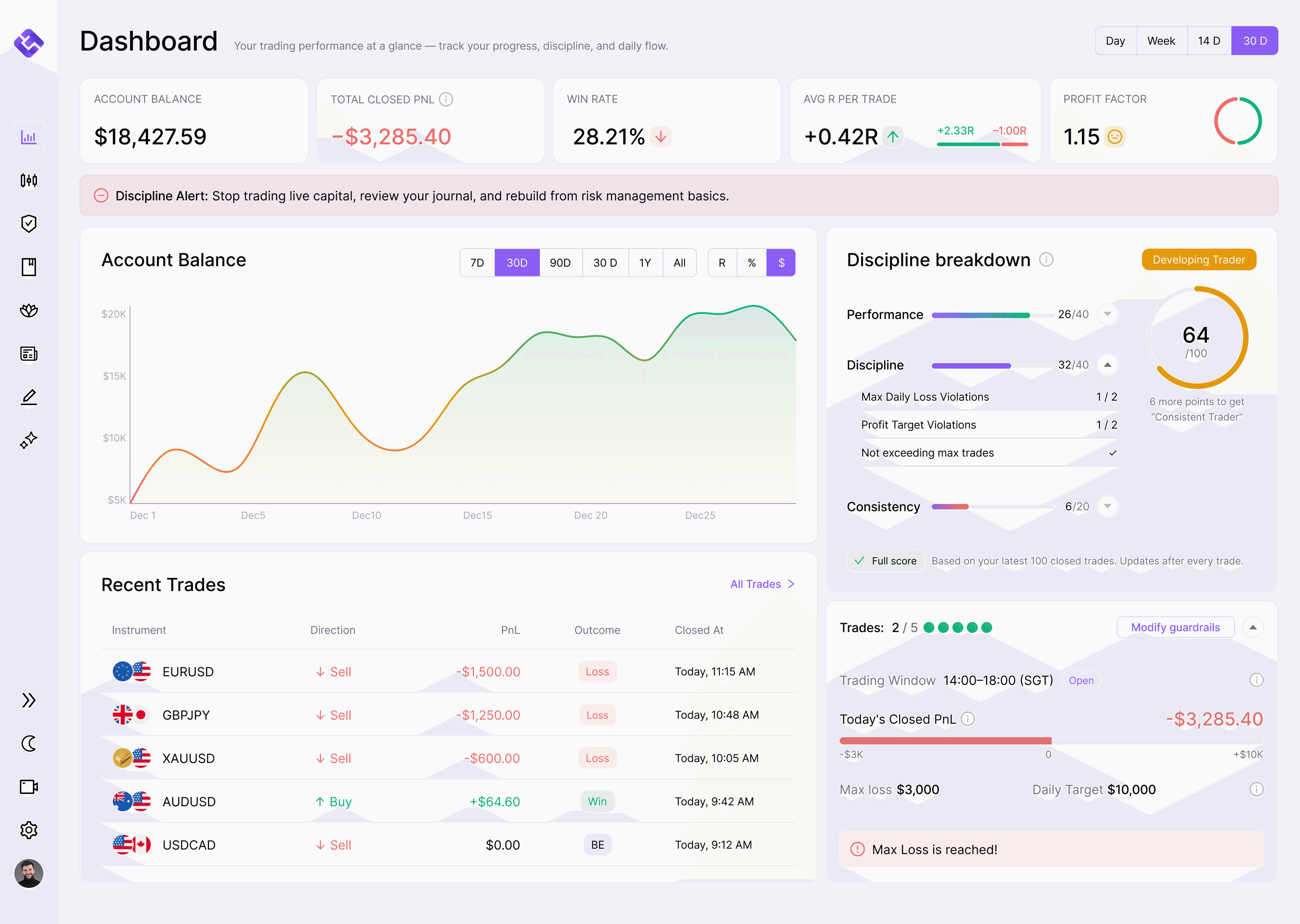
EdgeFlo's Edge plan builder is where you document the 90% mechanical portion of your strategy. Your entry criteria, exit rules, management method, and risk parameters all live in one place, visible before and during every trade.
Post-trade self-reporting asks one simple question: did you follow your plan? Over time, that data shows you the gap between your planned trades and your actual trades. If you find yourself deviating on 30% of trades, the plan needs updating, or your execution needs tightening.
The guardrails layer adds enforcement. Your daily loss cap, risk per trade limit, and max trade count are active while you trade. You can override them (because rigidity is not the goal), but overriding requires a conscious choice, not an unconscious emotional slip. That is environment design working alongside your 90/10 model.
The Edge Brief
Receive Insights on trading psychology, discipline, and the behavioral patterns that create consistent traders from our Founder and the EdgeFlo team, delivered to your inbox.
Think different. Trade different.
What is the difference between discretionary and mechanical trading?
Is discretionary trading always bad?
What is the 90/10 trading model?
Can you backtest a discretionary trading strategy?

Turn discipline on.
Every session.
EdgeFlo is the environment serious traders operate inside.
Start 7-Day Free Trial
Cancel anytime.
No long-term commitment.

Think Different, Trade Different.