

The Discipline of Waiting: Why Sitting Out Is a Trading Skill
Most trading losses come from impatience, not bad analysis. Learn why sitting out is a skill, how professionals trade less, and how waiting compounds your edge.

Blaise Pascal once wrote that all of humanity's problems stem from the inability to sit quietly in a room alone. Replace "room" with "in front of a chart" and you have the single biggest reason traders lose money.
The hard part of trading is not reading charts. It is not learning supply and demand. It is not understanding market structure. The hard part is doing nothing while the market moves without you, waiting for the one setup that checks every box, and saying no to everything else. That skill, the discipline of waiting, is what separates the 5% who profit from the 95% who do not.
TL;DR
Most trading losses come from impatience, not bad analysis. Entering too early or taking subpar setups destroys accounts faster than any bad strategy.
Professionals trade less than you think. One to three trades per session is the norm for consistently profitable traders.
Every trade you say no to protects your capital for the A-grade setup that actually pays.
Waiting is a skill you build, not a personality trait you are born with. Structure and guardrails help.
The compounding effect of skipping bad trades is more powerful than any indicator or pattern.
All of a Trader's Problems Come From Not Waiting
Think about your last five losing trades. How many of them were genuinely good setups that just did not work out? And how many were trades you took because you were bored, anxious, or feeling like you "needed" to trade today?
For most traders, at least three of those five losses came from impatience. Overtrading is the top account killer, and overtrading is just another word for not waiting. You take the B-grade setup because the A-grade has not appeared yet. You enter during the Asian session because London is three hours away and you cannot stand watching a flat chart. You front-run a confirmation because you "know" where price is going.
Every one of those decisions feels reasonable in the moment. And every one of them leaks money.
The math is straightforward. If your strategy produces two A-grade setups per day with a 55% win rate and 3:1 reward-to-risk, your expectancy is strong. But if you add three B-grade trades with a 40% win rate and 1.5:1 reward-to-risk, you dilute that expectancy down to near breakeven. The B-grade trades did not help. They just ate the profits from the A-grades.
Why Professionals Trade Less Than You Think
There is a persistent myth that profitable traders are glued to their screens all day, entering and exiting positions every few minutes. The reality is the opposite.
Most professional day traders take one to three trades per session. Some take one trade per day and turn off the screen. A few take one trade per week.
Why? Because professional traders understand that their edge only exists in specific conditions. Outside those conditions, every trade is a coin flip. And a professional does not flip coins with real money.
The session window matters too. The London Open and the London/New York Overlap produce the setups worth taking. Outside those windows, price chops, fakes out, and punishes traders who are just looking for action. A professional finishes their analysis, waits for the session, takes the trade if it appears, and walks away.
Walkthrough: The Cost of Not Waiting
A trader is long GBP/USD from 1.2680 with a target at 1.2750 and a 1% risk per trade ($200 on a $20,000 account). The trade is working. But it is 2:00 PM EST and the New York session is winding down. Bored, the trader scans for another setup and enters a short on USD/JPY at 149.80, placing the stop 25 pips above at 150.05 for another $200 risk.
The GBP/USD trade hits target the next morning for +$350 profit. But the USD/JPY "boredom trade" gets stopped out overnight for -$200. Net profit for the day: $150 instead of $350. The boredom trade ate 57% of the day's profits.
That second trade was not a bad setup necessarily. It was an unnecessary setup. The discipline of saying "I already took my trade today" would have kept the full $350 intact.
The Compounding Effect of Saying No
Each trade you skip is invisible. You cannot see the losses you avoided. But over a month, the compounded effect of avoiding five, ten, or twenty bad trades is enormous.
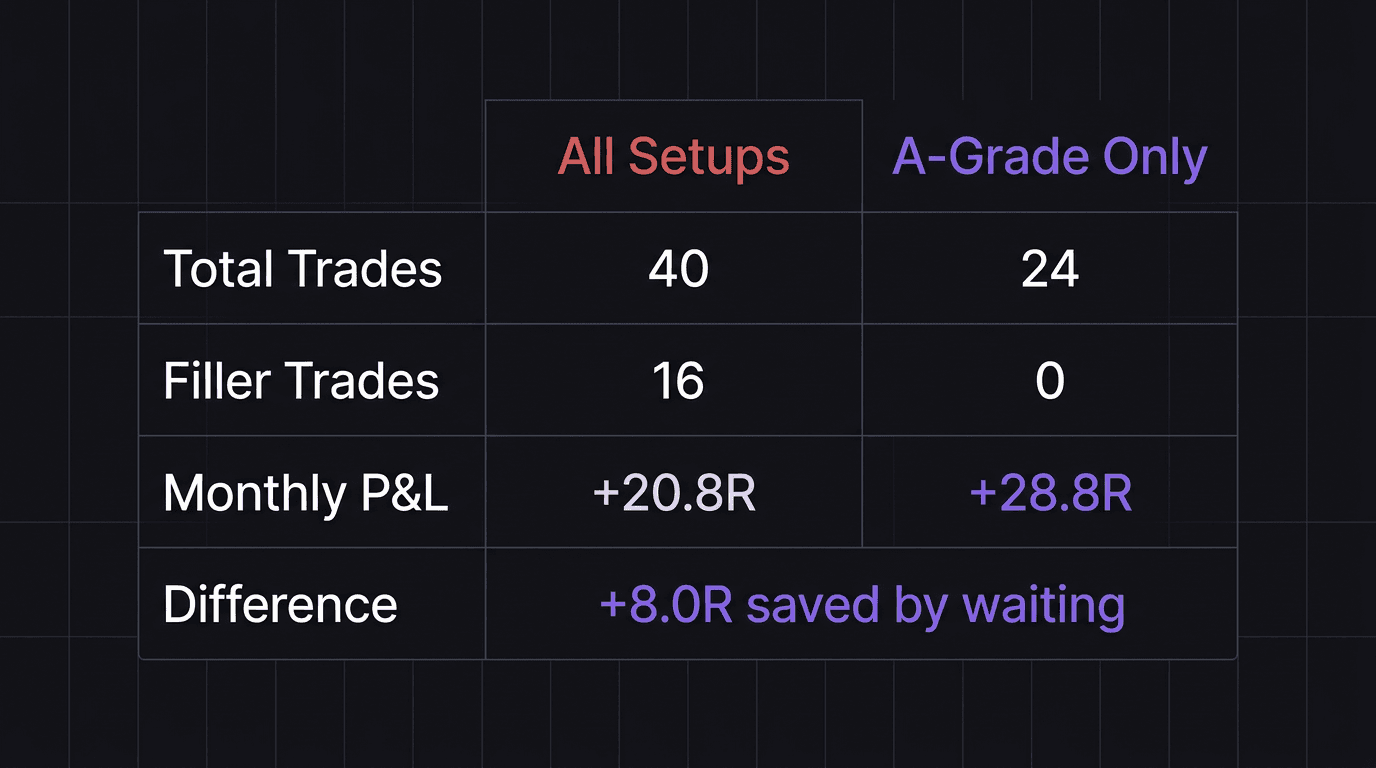
Consider a simple scenario. Over 20 trading days, a trader takes 2 trades per day (40 total). Of those, 24 are A-grade setups (60% of total) and 16 are filler trades taken from boredom or FOMO.
The A-grade trades average +1.2R. The filler trades average -0.5R. After 40 trades:
A-grade P&L: 24 trades at +1.2R average = +28.8R
Filler P&L: 16 trades at -0.5R average = -8.0R
Total: +20.8R
Now remove the filler trades entirely. Same 20 days, but the trader only takes 24 trades:
A-grade P&L: 24 trades at +1.2R average = +28.8R
Filler P&L: 0
Total: +28.8R
The trader who waits makes 8R more per month by doing less. At 1% risk per trade on a $20,000 account, that is $1,600 per month saved by simply not taking trades that should not have been taken.
How to Build the Waiting Muscle
Waiting is not a character trait. It is a skill you develop through structure. Here are four specific practices that build the muscle:
1. Set a daily trade cap. Decide before each session: "I will take a maximum of two trades today." When you hit two, close the platform. The rule is non-negotiable. If both trades lose, you are done for the day. If both win, you are done for the day.
2. Trade one session only. Pick London or New York. Do not trade both. One session gives you enough opportunity without giving you enough time to overtrade. Restricting your window forces you to be selective with your session.
3. Use a waiting log. Every time you feel the urge to enter a trade but stop yourself, write down: the time, the pair, why you wanted to enter, and why you chose not to. After two weeks, review the log. You will see that most of those "missed" trades would have been losers.
4. Review your data. Pull up your trading journal and filter by setup grade. Compare the win rate and average R of your A-grade entries against everything else. Once you see the numbers, the motivation to wait becomes automatic.
How EdgeFlo Enforces Patience Through Guardrails
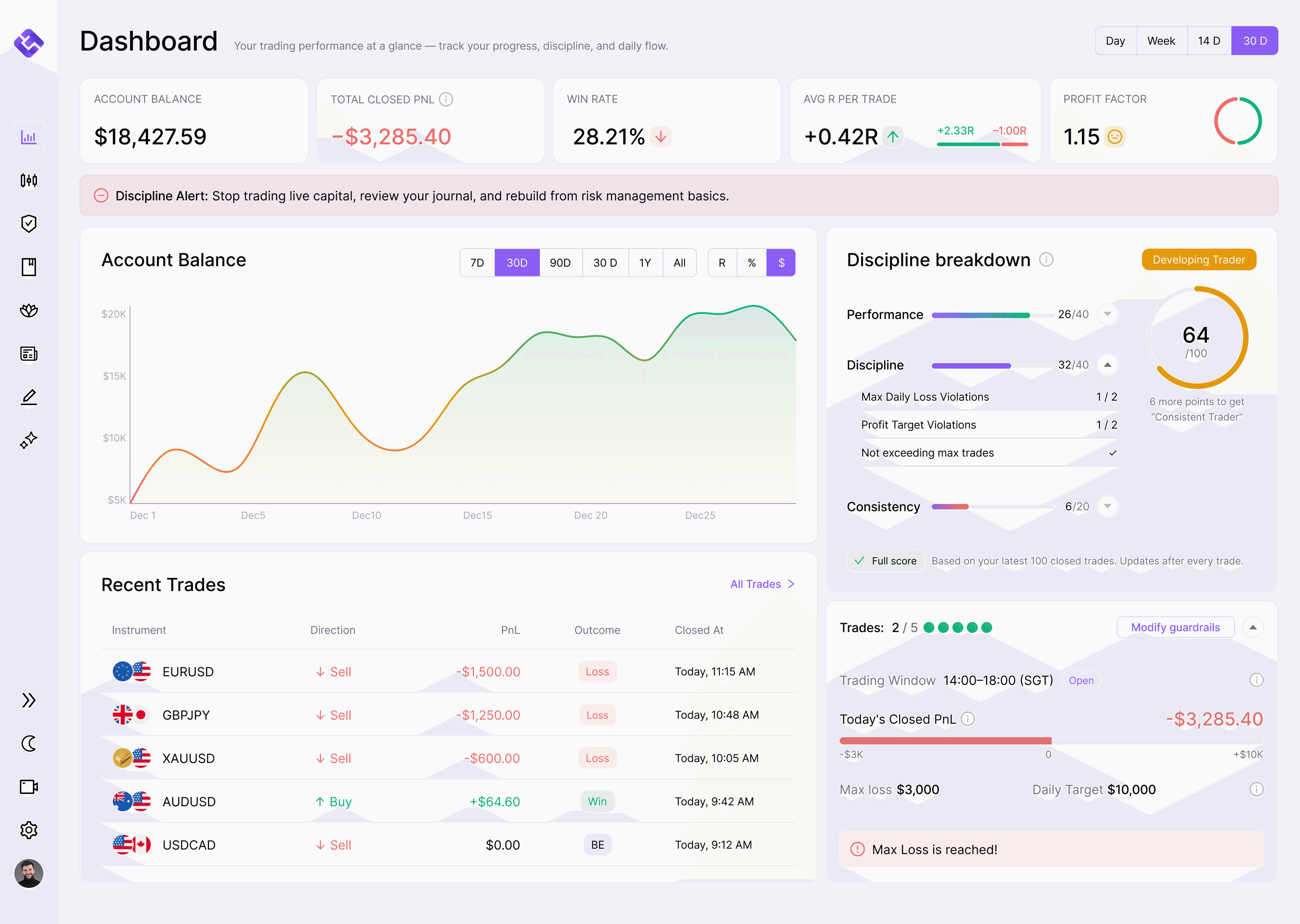
EdgeFlo gives you mechanical guardrails that enforce the waiting discipline so you do not have to rely on willpower alone. Set a maximum number of trades per day, and EdgeFlo disables the trade button after you hit your limit (you can override, but you have to consciously choose to break your own rule). Set a trading window, and the platform greys out the execution button outside your chosen session. These are not suggestions. They are friction points that force you to pause before acting on impulse, exactly the way a professional environment is designed to work.
The Edge Brief
Receive Insights on trading psychology, discipline, and the behavioral patterns that create consistent traders from our Founder and the EdgeFlo team, delivered to your inbox.
Think different. Trade different.
Why is waiting so hard in trading?
How many trades should a day trader take per day?
What is the Pascal quote applied to trading?
How do you build patience in trading?

Turn discipline on.
Every session.
EdgeFlo is the environment serious traders operate inside.
Start 7-Day Free Trial
Cancel anytime.
No long-term commitment.

Think Different, Trade Different.