

The Emotion Chain: How One Feeling Costs You Money
Every trading loss follows the same chain: emotion triggers pain, pain drives behavior, behavior creates results. Learn to break the chain before it breaks you.

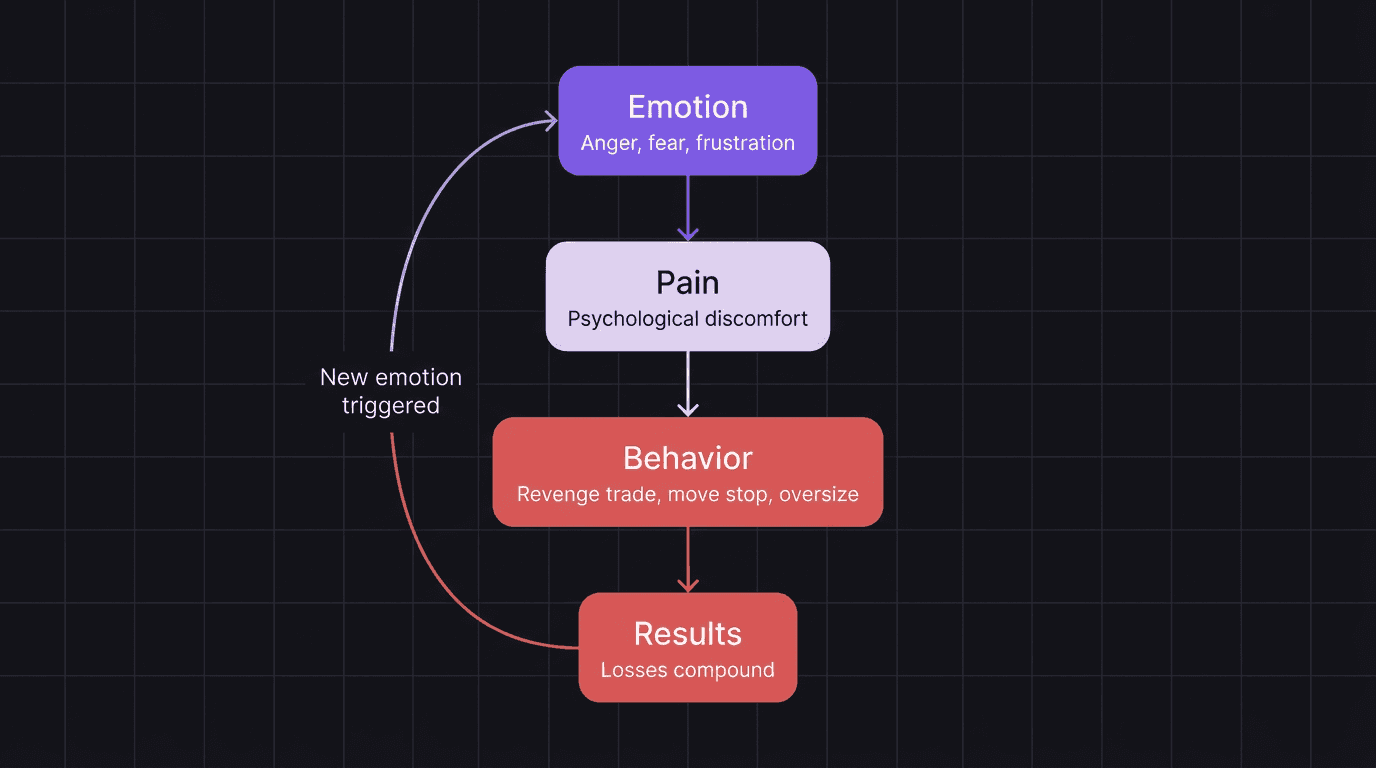
Every bad trade you have ever taken follows the same invisible sequence. A feeling shows up. That feeling creates discomfort. The discomfort pushes you into a reactive behavior. And that behavior produces a result you regret. This is the emotion chain, and it runs underneath every revenge trade, every oversized position, and every plan violation you have ever committed. Once you see it, you can break it. Before you see it, it breaks you.
TL;DR
Every trading loss follows a predictable chain: emotion triggers pain, pain drives behavior, behavior creates results.
You cannot eliminate emotions, but you can intercept the chain between pain and behavior.
The pain you are trying to avoid (boredom, humiliation, being wrong) is the root cause of your worst trades.
Tagging emotions in your journal surfaces repeating patterns you cannot see in real time.
Building rule-based responses replaces reactive behavior with planned action.
The Four Links: Emotion, Pain, Behavior, Results
The emotion chain has four links, and they fire in order every single time.
Link 1: Emotion. Something happens in the market. You get stopped out. A setup runs without you. Your winning streak snaps. The feeling arrives before any thought. Anger, fear, frustration, regret. It does not matter which one. What matters is that it showed up.
Link 2: Pain. The emotion creates psychological discomfort. Your brain reads the feeling as a threat and starts looking for the fastest way to make the discomfort stop. This is not a rational process. It happens below conscious awareness, and it happens fast.
Link 3: Behavior. To escape the pain, you act. You revenge trade. You move your stop loss. You double your lot size. You chase an entry that already left without you. The action feels urgent and justified in the moment. It is neither.
Link 4: Results. Because the behavior was reactive (not planned), it produces a losing outcome. And here is the cruel part: the loss creates a new emotion, which creates new pain, which drives another reactive behavior. The chain loops.
Sound familiar? That cycle where you lose once, then lose three more times trying to recover? That is the emotion chain running on repeat.
Why Pain Is the Real Problem (Not the Emotion)
Most traders try to fix the wrong link. They focus on the emotion itself. "Stop being afraid." "Stop being greedy." "Just be disciplined." That advice is as useful as telling someone who is drowning to stop being wet.
The emotion is not the problem. The pain response is the problem. Specifically, the speed at which pain converts into behavior.
Think about what pain you are actually avoiding when you make your worst trades:
After a losing streak: You are avoiding the pain of feeling incompetent. So you take another trade to prove you are still good. That is revenge trading.
During a winning streak: You are avoiding the pain of leaving money on the table. So you increase your size or trade extra sessions. That is greed.
When a setup runs without you: You are avoiding the pain of missing out. So you chase the entry at a terrible price. That is FOMO.
When the market reverses against your bias: You are avoiding the pain of being wrong. So you fight the trend and keep entering longs in a downtrend. That is frustration.
Every one of these behaviors traces back to a specific pain the trader is trying to escape. The emotion is just the doorbell. The pain is what kicks the door open.
How the Chain Plays Out: A Walkthrough
Walkthrough: The Revenge Spiral on EUR/USD
A trader enters a short on EUR/USD during the London session based on a bearish bias. Entry at 1.0920, stop at 1.0945, target at 1.0870. Risk is 1% of a $10,000 account ($100), using 0.4 lots.
The trade hits the stop loss. Loss: $100.
Link 1 (Emotion): Anger. The trader sees price reverse right after the stop was hit. The chart looks like it was designed to take their money personally.
Link 2 (Pain): The trader feels the sting of losing $100 and the deeper pain of "I was wrong." Their confidence is shaking. The internal voice starts: "If I do not make this back, I am a bad trader."
Link 3 (Behavior): The trader enters another short immediately. No new analysis. No plan confirmation. This time they use 0.8 lots (doubling risk to 2%) because they "need to recover faster."
Link 4 (Results): The second trade also hits the stop. Loss: $200. Total damage: $300 in two trades on a day where the plan allowed $100 of risk.
The chain ran twice. The second run was worse than the first because the behavior escalated (bigger size, no plan). And notice what happened: the trader tried to avoid the pain of a $100 loss and ended up with a $300 loss. Avoiding pain created more pain.
Walkthrough: The FOMO Chase on GBP/USD
A trader watches GBP/USD during the New York session. Their plan had a buy setup at 1.2650, but they were away from the screen when price touched the zone. Price rallied 80 pips to 1.2730 while they were gone.
Link 1 (Emotion): Regret. "I should have been watching. That was my trade."
Link 2 (Pain): The pain of missed profit. Watching 80 pips move without them feels like losing $800 on a standard lot, even though they never entered.
Link 3 (Behavior): The trader enters a buy at 1.2730, with a stop 40 pips below at 1.2690. They tell themselves "it still has room to run." Risk: 1% ($100 on a $10,000 account, 0.25 lots).
Link 4 (Results): Price pulls back to 1.2690 and stops them out. The entry was too late. The move had already happened.
This trader did not lose because of a bad strategy. They lost because regret (link 1) created pain (link 2) that drove a chase entry (link 3) that produced a preventable loss (link 4). If they had recognized the emotion chain, they would have said: "That was not my trade. I was not at the screen. Wait for the next bus."
Breaking the Chain: Where to Intervene
You cannot stop the emotion from arriving. You cannot stop the pain from forming. But you can break the connection between pain and behavior. That is where the chain is weakest.
Here are three intervention points that work:
1. Name the Pain Out Loud
When the emotion hits, ask yourself one question: "What pain am I trying to avoid right now?"
Say it out loud or write it down. "I am trying to avoid the pain of being wrong." "I am trying to avoid the pain of missing out." "I am trying to avoid the pain of boredom."
This sounds simple, and it is. But naming the pain forces your brain to engage the rational side. The emotion chain runs on autopilot. Naming the pain pulls the handbrake.
2. Tag Emotions in Your Journal
Every trade in your journal should include an emotion tag. Before you enter, write down what you are feeling. After the trade, write down what you felt during execution.
Over 20 to 30 trades, patterns emerge that you cannot see in real time. You might discover that every fear-driven hesitation happens after two consecutive losses. You might find that your oversize trades always happen on Fridays. You might realize that your worst FOMO entries all occur in the first 15 minutes of New York.
These patterns are invisible until you write them down. Once they are visible, they lose their power.
3. Build If-Then Rules for Emotional States
Instead of relying on willpower to resist the chain, build rules that activate automatically.
"If I feel the urge to trade after a loss, then I close my laptop for 10 minutes."
"If I feel frustrated after two stops in a row, then I am done for the session."
"If I see a setup that ran without me, then I mark it in my missed-trade notebook and wait for the next one."
These rules do not require discipline in the moment. They require discipline once, when you write them. After that, they are mechanical.
The 10-Minute Buffer: Your Cheapest Defense
After any loss, take 10 minutes before doing anything. Do not open a new chart. Do not scroll through timeframes looking for another entry. Just stop.
In those 10 minutes, write down three things:
The thought: What was going through your head right after the loss?
The emotion: What did you actually feel? (Anger, regret, frustration, doubt.)
The urge: What action did you want to take? (Enter again, double size, switch pairs.)
This exercise does two things. First, it breaks the speed of the chain. Pain converts to behavior in seconds. A 10-minute buffer gives your rational brain time to catch up. Second, it builds a written record that your future self can analyze.
The traders who blow accounts are the ones who go from loss to next trade in under 60 seconds. The traders who survive are the ones who pause.
How EdgeFlo Helps You Intercept the Chain
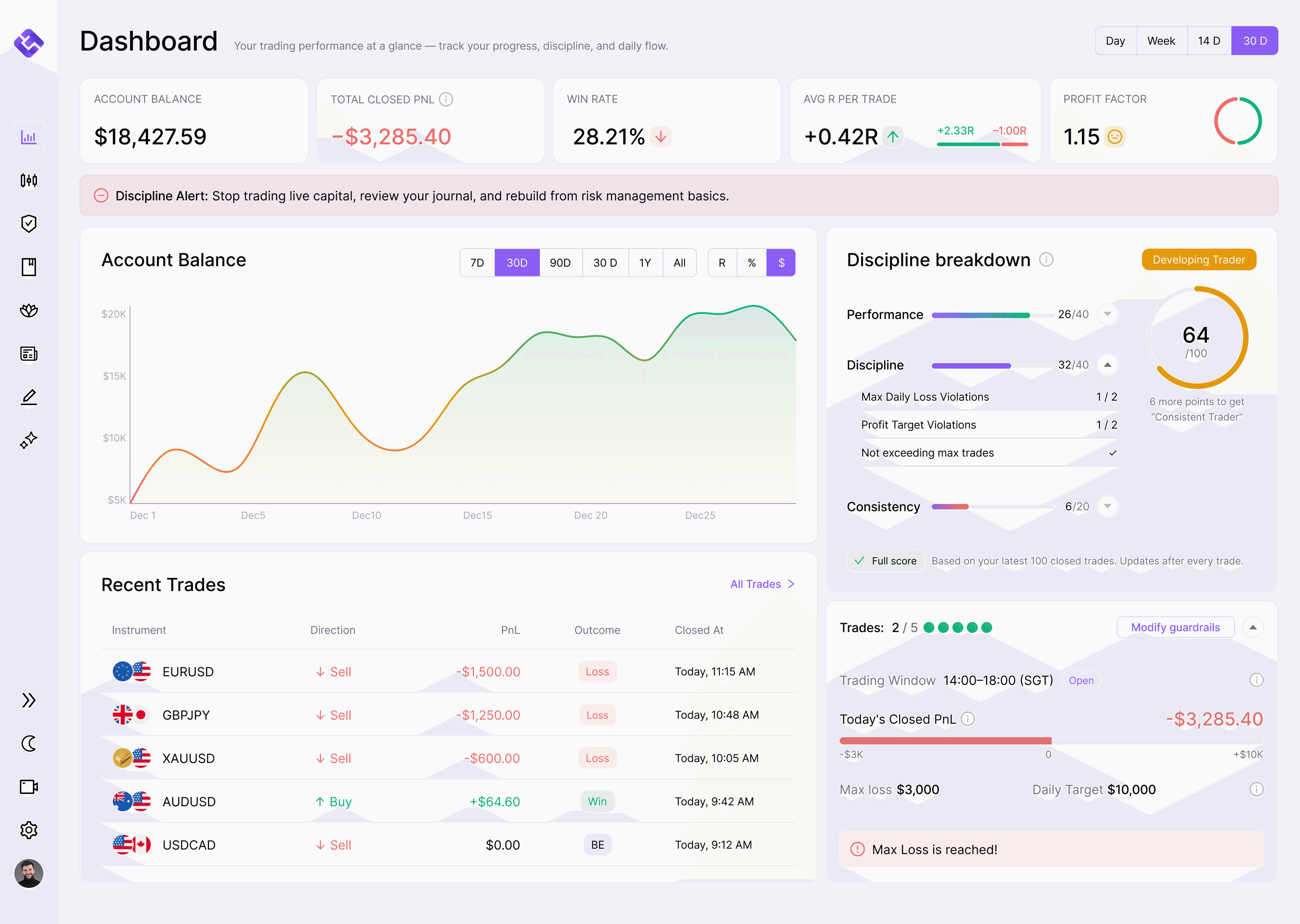
EdgeFlo's AI-powered trading journal includes emotion tagging on every trade entry. You select what you felt before, during, and after the trade. Over time, your weekly AI report surfaces the patterns between emotional states and trading outcomes, showing you exactly where the chain fires most often.
When you feel the chain starting, Sanctuary guides you through a structured reset routine before your next trade. It is not meditation for the sake of meditation. It is a specific process designed to break the link between pain and behavior, so you return to the chart calm and rational.
Your trade plan stays visible in Edge while you execute, which means the rules you wrote when you were clear-headed are right in front of you when you are not. That visibility alone stops a surprising number of reactive decisions.
The Edge Brief
Receive Insights on trading psychology, discipline, and the behavioral patterns that create consistent traders from our Founder and the EdgeFlo team, delivered to your inbox.
Think different. Trade different.
What is the emotion chain in trading?
Why do emotions cause trading losses?
Can you eliminate emotions from trading?
How do I break the emotion chain before it costs me money?

Turn discipline on.
Every session.
EdgeFlo is the environment serious traders operate inside.
Start 7-Day Free Trial
Cancel anytime.
No long-term commitment.

Think Different, Trade Different.