

The Contrarian Trader: Why You Should Buy When Everyone Panics
The best trade entries feel the worst. Learn the contrarian trading mindset: buy when the crowd panics, sell when the crowd celebrates.
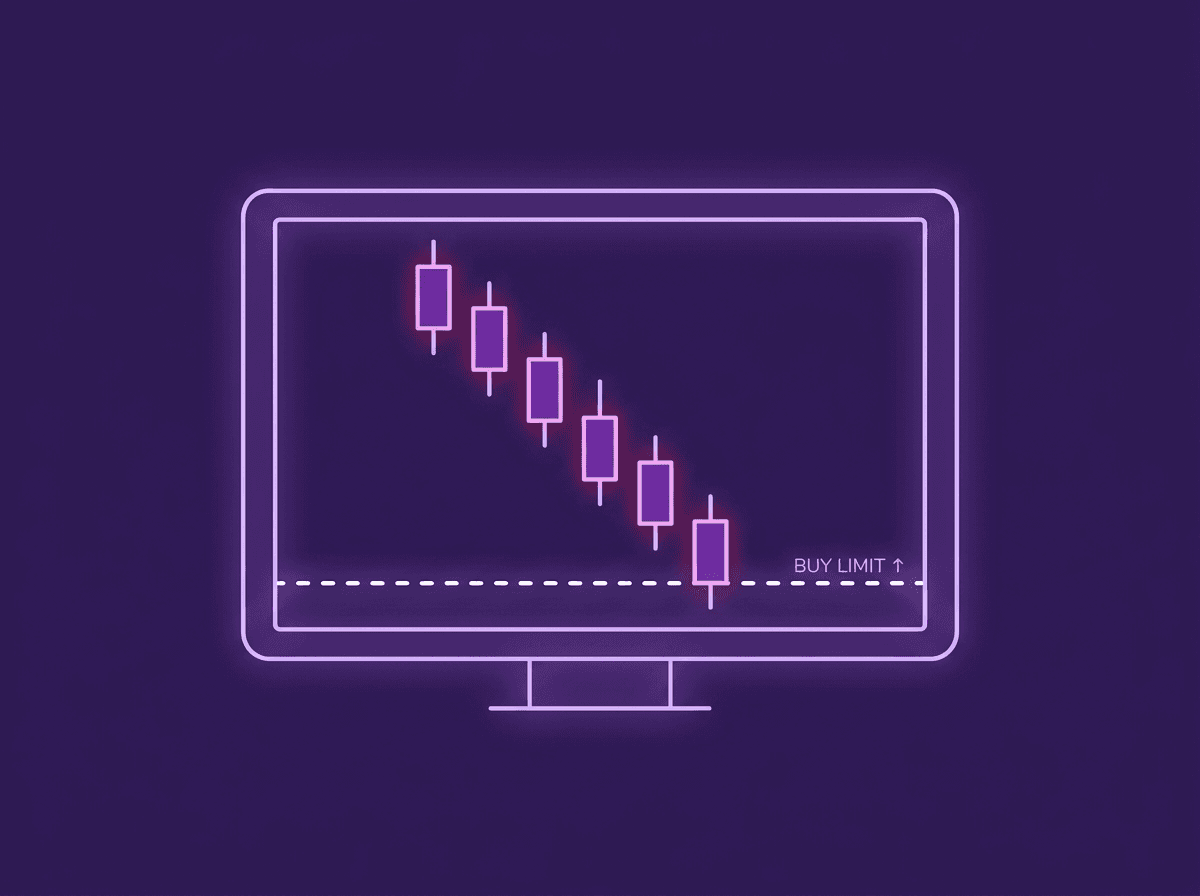
Ever noticed that your best entries feel terrible in the moment? The ones where your gut screams "don't do it" while your plan says "this is exactly the setup." That tension is not a bug. It is the signal.
The best trades are psychologically uncomfortable because they require you to do the opposite of what everyone else is doing. When the crowd panics, they sell. When the crowd celebrates, they buy. Both reactions feel safe because they match the group. But the group is not trying to make money. The group is trying to feel comfortable.
Comfortable trades lose money. Uncomfortable trades, taken with structure and a plan, are where the real edge lives.
TL;DR
The best trade entries feel the worst because they go against crowd sentiment.
Institutional money buys when retail panics. The crowd's selling provides the liquidity institutions need.
Contrarian trading requires structural backing, not blind opposition.
Buying into panic without a demand zone and invalidation level is gambling.
Log your emotional state before every trade to spot contrarian patterns in your data.
Why the Best Trades Feel the Worst
Think about the last time you had a genuinely great trade. Not a lucky scalp. A real, planned entry that paid 3R or more. Chances are, right before you clicked buy, something inside you hesitated.
That hesitation exists because your brain is wired to follow the group. When price is falling hard and your feed is full of bearish sentiment, every survival instinct tells you to join the selling. Hitting buy in that environment feels like stepping in front of a train.
But here is the reality: fear peaks at the same price levels where demand zones sit. The exact moment retail traders capitulate and dump their positions is the moment institutional money accumulates. Your discomfort is the market's opportunity.
Sound familiar? You watch price crash, decide it is "too risky" to buy, and then watch it reverse 50 pips later. You missed the entry because it felt wrong. The setup was right. Your feelings lied.
The Crowd Is Fuel, Not a Guide
The crowd does not set price direction. The crowd provides liquidity. There is a critical difference.
When everyone rushes to sell during a panic, their sell orders create a pool of liquidity sitting below obvious support levels. Institutional players need that liquidity to fill large buy orders. They cannot buy $50 million worth of EUR/USD without someone selling to them. So they wait for the panic, sweep the stops, and fill their positions with the retail crowd's fear.
This is why supply and demand zones work. The zones mark where institutional orders were previously placed. When price returns to those zones after a panic-driven selloff, the same dynamic repeats.
The crowd is not your enemy. The crowd is not your guide, either. The crowd is the fuel that moves price to the levels where your plan tells you to act.
If it is easy to buy, do not. If it is easy to sell, do not. Take the trade that is psychologically uncomfortable.
Walkthrough: Buying the Panic on GBP/USD
GBP/USD drops 120 pips in a single London session after negative economic data. Social media fills with bearish calls. Retail positioning data shows 78% of traders are short. Price sweeps below the previous week's low, tapping into a 4-hour demand zone at 1.2640.
A contrarian trader sees the demand zone, the liquidity sweep below the obvious low, and a shift in internal structure on the 15-minute chart. Entry at 1.2650 with a 20-pip stop loss below the zone. Target at 1.2730 (the 50% level of the prior range).
The trade hits target in 6 hours. Result: 80 pips gained on a 20-pip stop. That is 4R.
The entry felt awful. Every piece of sentiment data said "sell." But the structure said "buy." The trader followed the plan, not the feeling.
How to Trade Against Panic Without Gambling
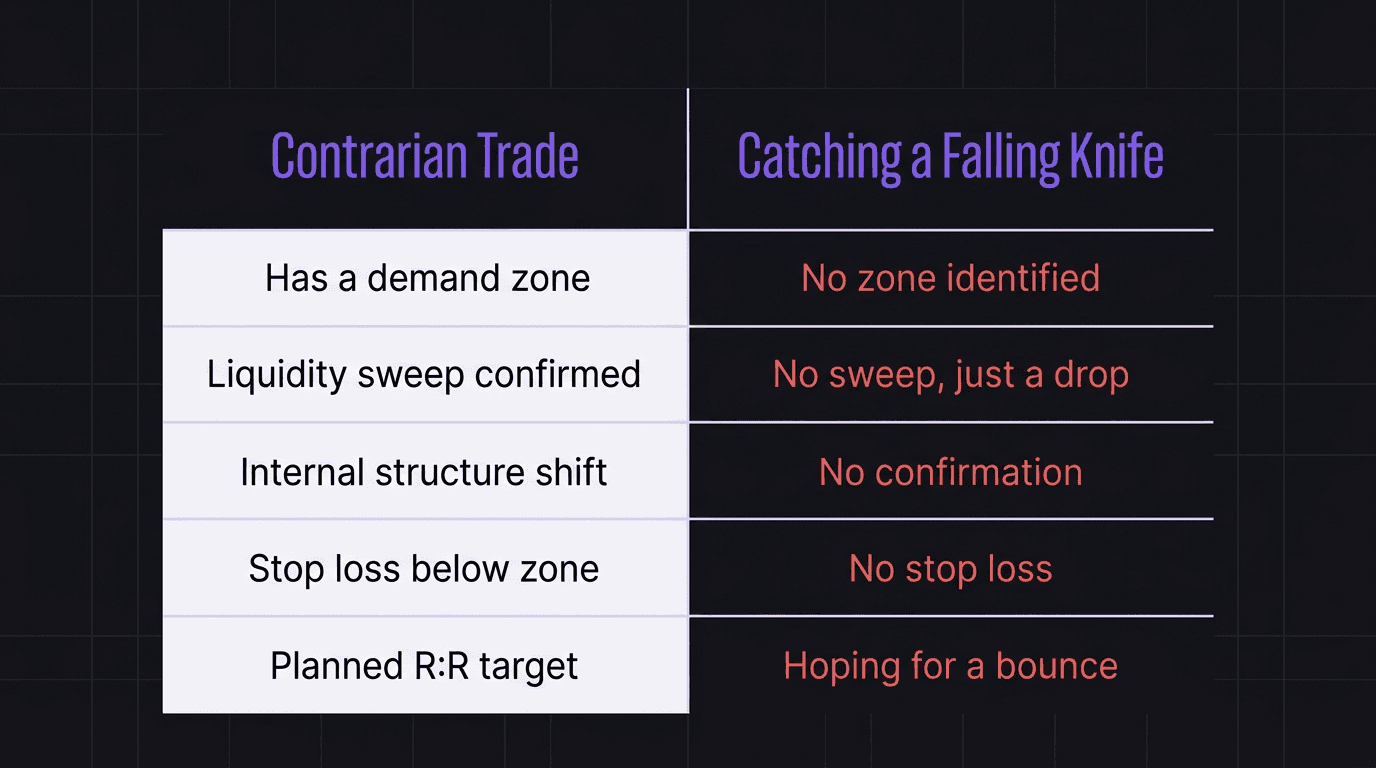
Contrarian trading is not blindly fading every move. That is how you catch falling knives and blow accounts. The difference between a contrarian trade and a gamble is structure.
Before buying into a selloff, you need three things:
1. A valid demand zone on a higher timeframe. Not a random level. A zone where price previously launched with strong momentum, preferably one that has not been tested yet.
2. A liquidity sweep. Price must push below an obvious low (previous day, previous week, or a cluster of equal lows) to sweep the stop losses sitting there. This confirms that the selling pressure was driven by stop runs, not a genuine trend change.
3. An internal structure shift. On a lower timeframe (5 or 15 minute), price must create a higher low and break a short-term high. This confirms that buying pressure is stepping in.
Without all three, you are guessing. With all three, you are trading against the crowd with structural backing.
Walkthrough: When Contrarian Thinking Fails
EUR/USD drops 90 pips during a strong bearish trend. A trader sees the sharp drop and thinks "this must be oversold." He buys at 1.0820 with no demand zone, no liquidity sweep, and no structure shift. Just a feeling that "it has to bounce."
Price continues falling another 60 pips to 1.0760. The trader holds, hoping. Eventually he closes at 1.0780 for a 40-pip loss.
The mistake was not going against the crowd. The mistake was going against the crowd without a plan. Contrarian without structure is just another form of emotional trading.
When Contrarian Thinking Becomes a Trap
Not every drop is a buying opportunity. Not every rally is a selling opportunity. Contrarian thinking becomes dangerous when it turns into a personality trait rather than a conditional response to structure.
Some traders get addicted to fading moves. They see a strong rally and immediately look for shorts, even when the trend is clearly bullish and no supply zones are in play. They mistake stubbornness for edge.
Here are the signs that contrarian thinking has become a trap:
You fade every strong move without checking structure first.
You hold losing contrarian trades because "the crowd is always wrong" (they are not always wrong).
You ignore trend direction and only look for reversals.
You feel smarter than other traders and use that feeling as your edge.
The crowd is wrong at turning points. The crowd is right during the middle of a trend. Knowing the difference is what separates a contrarian trader from a stubborn one.
Probabilistic thinking helps here. Not every contrarian setup will work. But over 100 trades, buying into panic at valid demand zones with proper structure produces a statistical edge. Individual trades do not matter. The sample does.
How EdgeFlo Logs Your Emotional State to Reveal Contrarian Patterns
The hardest part of contrarian trading is trusting the data over the feeling. Every time you take a trade that feels uncomfortable, your brain records it as a negative experience, even if the trade wins.
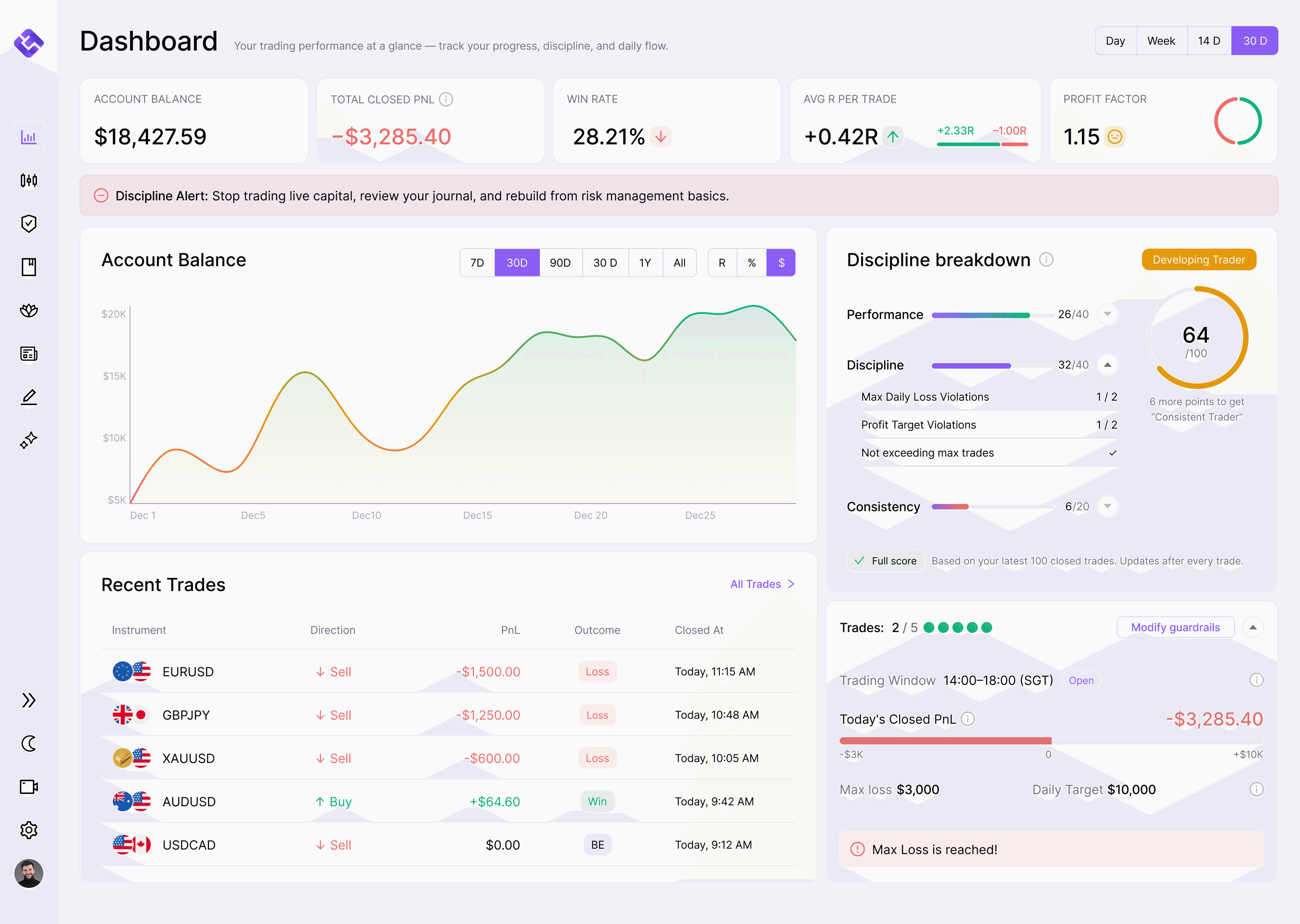
EdgeFlo's emotion tracker logs your pre-trade feelings every time you enter a position. After closing a trade, you record how you felt during it. Over time, this builds a dataset that reveals a pattern most traders never see: your emotional state at entry correlates with your results.
Many traders discover that their most profitable entries were the ones where they logged "anxious" or "uncomfortable" before the trade. The entries where they felt "confident" or "certain" often underperform because those feelings came from following the crowd, not from structural edge.
When you can see that data in your journal, contrarian trading stops being a leap of faith. It becomes a documented, repeatable pattern. You stop asking "should I really buy here?" and start recognizing "this is exactly the emotional signature of my best trades."
The Edge Brief
Receive Insights on trading psychology, discipline, and the behavioral patterns that create consistent traders from our Founder and the EdgeFlo team, delivered to your inbox.
Think different. Trade different.
What is contrarian trading?
Is buying during a market crash a good strategy?
How do you know when fear is overdone?
What is the difference between contrarian trading and catching a falling knife?

Turn discipline on.
Every session.
EdgeFlo is the environment serious traders operate inside.
Start 7-Day Free Trial
Cancel anytime.
No long-term commitment.

Think Different, Trade Different.