

Define Your Exit Before You Enter: The Pre-Trade Protocol
Define your stop-loss and take-profit before clicking buy. The pre-trade exit protocol that keeps risk defined across forex, crypto, and futures.
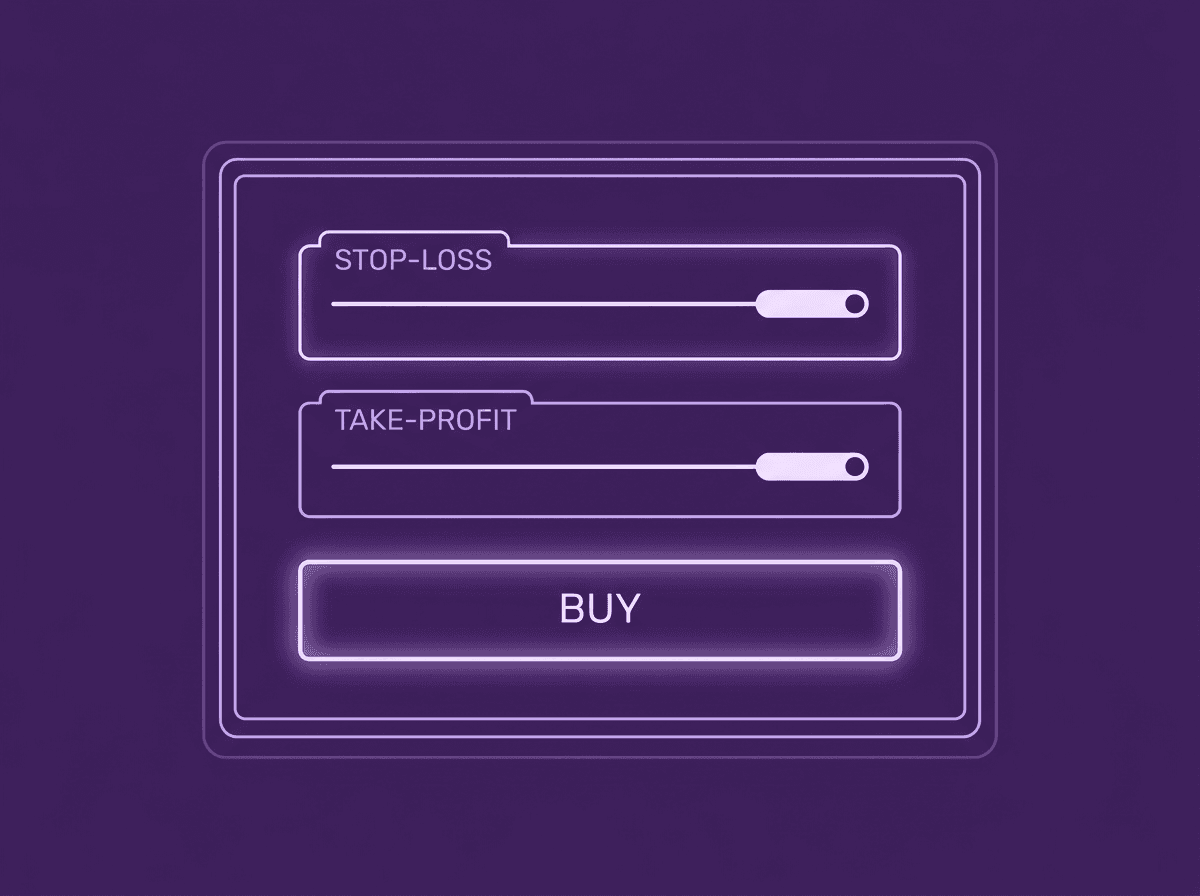
Exits matter more than entries. That single sentence would save most trading accounts if traders actually believed it. But most traders spend 90% of their preparation time finding the perfect entry and 10% figuring out what to do once they are in the trade. That ratio is backwards.
The traders who survive and compound are the ones who know exactly where they are getting out before they click buy or sell. Stop-loss defined. Take-profit defined. Position size calculated from the stop distance. Only then does the trade get placed.
If you enter a trade without knowing your exit, you are not trading. You are hoping. And hope is the most expensive strategy in every market.
TL;DR
Define your stop-loss and take-profit before placing every trade. No exceptions.
Entries without exits turn controlled risk into unlimited exposure.
The pre-trade checklist forces you to think in risk first, reward second.
This rule applies across forex, crypto, futures, and stocks, because volatility punishes unplanned exits in every market.
Hard stops in the platform beat mental stops every time.
Why Exits Matter More Than Entries
Here is a question most traders have never asked themselves: if you removed the entry entirely and just placed random trades with perfect exit discipline, would you still lose money?
The answer might surprise you. Studies on random-entry systems with structured exit rules (fixed stop-loss, fixed take-profit, trailing stops) show that exits drive a far larger share of profitability than entry timing. A mediocre entry with a disciplined exit survives. A perfect entry with no exit plan blows up.
The reason is simple. Entries can be wrong 60% to 70% of the time and you can still profit if your winners are large enough relative to your losers. That math only works when losses are defined and capped. One undefined loss, a trade with no stop-loss, can erase twenty controlled winners.
Professional traders obsess over exits because exits determine three things: how much you lose when wrong, how much you keep when right, and how long you stay in the game.
The Pre-Trade Checklist: SL and TP First
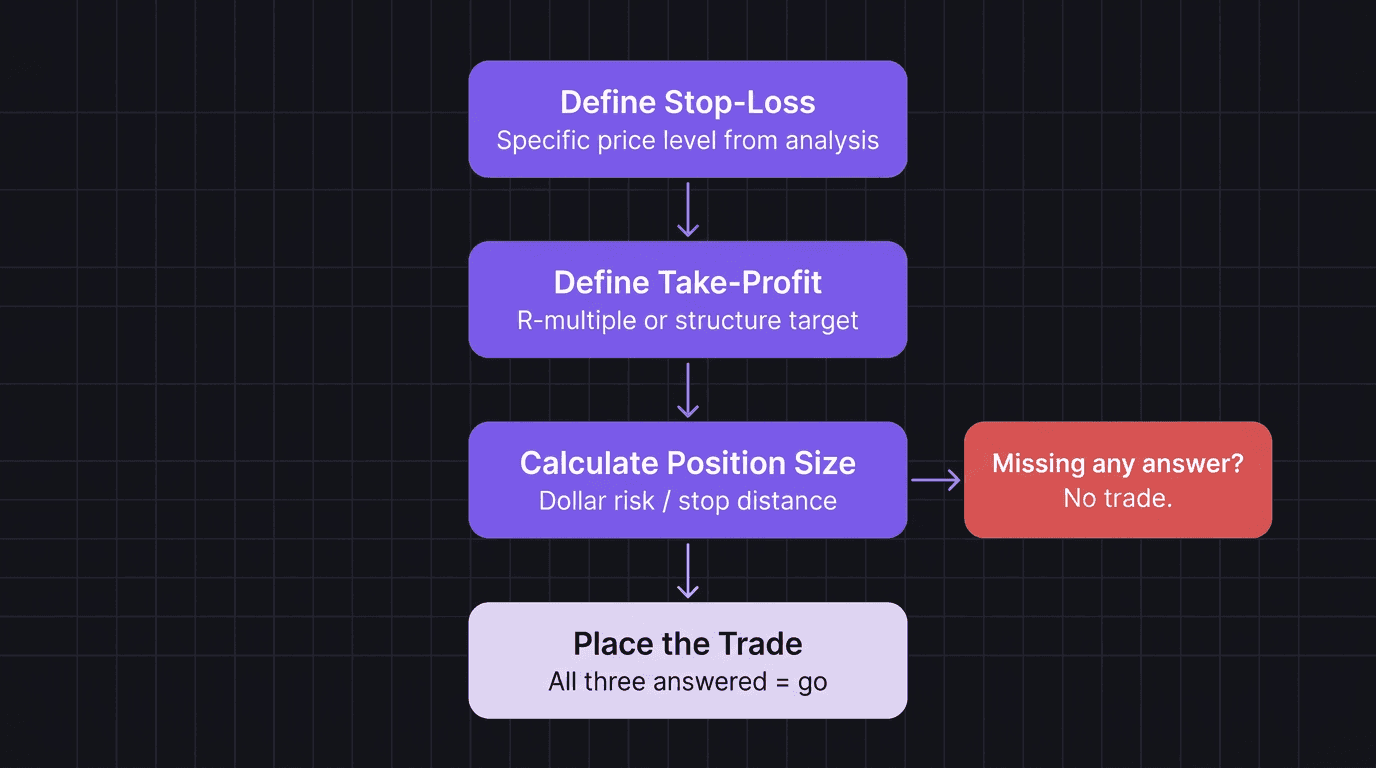
Before you place any trade, answer these three questions. Write them down. If you cannot answer all three, do not take the trade.
Where is my stop-loss? This must be a specific price level based on your analysis (below structure, beyond a zone, behind a liquidity level), not an arbitrary number of pips.
Where is my take-profit? This must be a specific price level where your analysis says the move will exhaust, or a defined R-multiple target based on your backtest data.
What is my risk per trade? Calculate position size from the stop distance. If your account is $50,000 and you risk 1%, your dollar risk is $500. If your stop is 50 pips on EUR/USD, your position size is 1 lot ($10 per pip times 50 pips = $500).
This is the pre-trade checklist at its core. Everything else (bias, session timing, confluence) matters. But without these three answers, nothing else protects you.
Walkthrough: Planned Exit vs No Exit
Trader A (Planned Exit): Sees a valid pullback entry on GBP/USD at 1.2650. Stop-loss placed at 1.2610 (40 pips below entry, below the swing low). Take-profit at 1.2770 (120 pips, 3R target). Risk: 1% of $100,000 account = $1,000. Position size: $1,000 divided by (40 pips times $10/pip) = 2.5 lots.
Price dips to 1.2625, nearly hitting stop. Trader A does nothing because the stop is placed and the plan is defined. Price recovers and hits 1.2770 two hours later.
Result: $3,000 profit. 3R win. Clean set and forget execution.
Math check: - Risk: 1% of $100,000 = $1,000. - Stop distance: 40 pips. - Position size: $1,000 / ($10 x 40) = 2.5 lots. - Profit: 2.5 lots x $10/pip x 120 pips = $3,000. - R-multiple: $3,000 / $1,000 = 3R.
Trader B (No Defined Exit): Same entry at 1.2650 on GBP/USD. No stop placed. "I will watch it and decide." Price dips to 1.2625. Trader B gets nervous. Price touches 1.2600 (50 pips against). Now the loss is bigger than planned. Trader B freezes. Refuses to cut. Price drops to 1.2540 (110 pips against). Trader B finally panic-exits.
Result: 110 pips loss at 2.5 lots = $2,750 loss. That is 2.75R, nearly three times the planned 1R risk.
Math check: - Loss: 2.5 lots x $10/pip x 110 pips = $2,750. - Intended risk: $1,000. Actual loss: $2,750. Overshoot: 175%.
Same entry. Same market. The only difference was whether the exit was defined before the trade.
What Happens Without a Defined Exit
Trading without a stop-loss creates three cascading problems that feed each other:
Problem 1: The position becomes emotional. Once you are in a trade without an exit plan, every tick against you triggers a decision point. Should I close? Should I hold? Should I add? Each decision is made under increasing emotional pressure. Your worst thinking happens when you are losing money and have no framework to fall back on.
Problem 2: Losses grow beyond budget. A 1% risk trade without a stop can easily become a 3% or 5% loss. One trade like that erases three to five winning trades. On a funded account with a 5% daily drawdown limit, a single undefined loss can end your challenge.
Problem 3: It trains bad habits. Every time you survive a trade without a stop (because price eventually came back), you reinforce the belief that stops are unnecessary. That belief holds until the one trade that does not come back. And that trade takes the account with it.
This is why closing trades too early is a separate problem from not having exits at all. At least the early closer had a plan. The trader with no exit plan has nothing.
Applying the Rule Across Markets
The exit-first rule is universal, but each market punishes unplanned exits in its own way.
Forex: The 24-hour cycle means you might enter a trade during London session and have it open during Asian session when liquidity thins. Without a stop-loss, a thin-liquidity wick at 2 AM can hit a level you never expected. Defined stops protect you while you sleep.
Crypto: Bitcoin can move 5% in an hour. Without a take-profit, you watch a $2,000 winning position become a $500 winning position while you decide whether to hold for more. Without a stop, a 10% overnight crash turns a small position into a portfolio-level event.
Futures: NQ moves in ticks worth $5 each on a standard contract. A 50-tick move against you without a stop is a $250 loss per contract. If you are holding 4 contracts, that is $1,000 gone in minutes. Futures punish bad sizing and undefined risk faster than any other market.
Stocks: A gap down at market open can blow through a mental stop instantly. If earnings miss by 20% and the stock gaps down 8%, your "I will cut if it drops 3%" plan is worthless because the market never gave you 3%. It went straight to 8%.
In every case, the fix is the same. Define the exit before you enter. Place the stop in the platform, not in your head. Define the target based on your trade exit strategy. Calculate your size from the stop distance.
How EdgeFlo Enforces Exit Discipline
Knowing you should define exits and actually doing it under pressure are two different things. That gap is where guardrails earn their value.
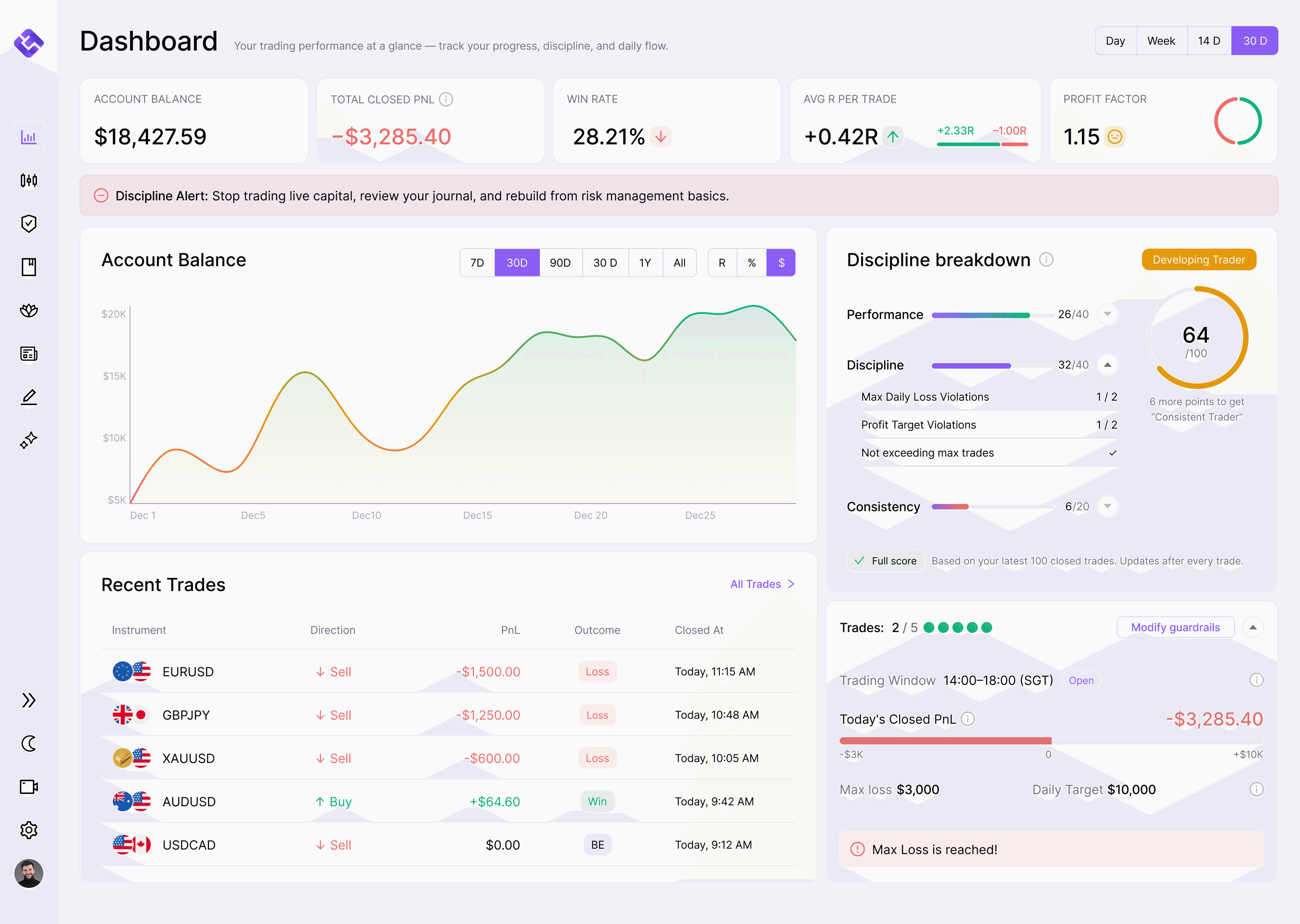
EdgeFlo's guardrails can flag trades entered without a stop-loss (with an override option if you choose to proceed). This makes the undefined-exit trade a conscious decision rather than an accidental habit. You can still override, but you have to acknowledge the risk you are taking.
Combined with the auto risk calculator, the exit-first protocol becomes mechanical. Enter your stop-loss level, and EdgeFlo calculates the lot size that matches your risk percentage. No mental math under pressure. No guessing whether 2.3 lots or 2.5 lots is the right size for a 35-pip stop on a $75,000 account.
The goal is not to prevent you from trading. It is to make sure every trade you take has a defined risk before you commit capital. That one habit, repeated across hundreds of trades, is the difference between accounts that compound and accounts that blow up.
The Edge Brief
Receive Insights on trading psychology, discipline, and the behavioral patterns that create consistent traders from our Founder and the EdgeFlo team, delivered to your inbox.
Think different. Trade different.
Why should I define my exit before entering a trade?
What happens if I enter without a stop-loss?
Should I use mental stop-losses instead of hard ones?
Does this rule apply to scalpers too?

Turn discipline on.
Every session.
EdgeFlo is the environment serious traders operate inside.
Start 7-Day Free Trial
Cancel anytime.
No long-term commitment.

Think Different, Trade Different.