

Why You Close Winning Trades Too Early
You close winners early because your brain treats unrealized profit as something to protect. Here is the mechanism behind premature exits and how to fix it.
You enter a buy on EUR/USD at 1.0850. Stop at 1.0820. Target at 1.0920. A clean 30-pip risk for a 70-pip reward.
Price moves to 1.0880. You are up 30 pips. Then a red candle pulls price back to 1.0870. Still up 20 pips. Still well within the normal structure of a winning trade. But the thought hits: "What if it comes all the way back?"
You close at 1.0870 for 20 pips. Price reaches 1.0915 two hours later.
Sound familiar?
Closing winning trades too early is one of the most common execution problems in trading, and it has nothing to do with your strategy. The issue is biological. Your brain is wired to protect what it already has, even when "what it already has" is an unrealized number on a screen. This wiring turns a winning system into a mediocre one by systematically cutting your best trades short.
TL;DR
Your brain treats unrealized profit as a possession and triggers loss aversion when it starts decreasing.
This causes you to close winners early, reducing your average winner and destroying your edge.
The damage is mathematical: cutting winners in half can turn a profitable strategy into a losing one.
Pre-defined exits, set-and-forget execution, and not watching the chart tick-by-tick are the structural fixes.
Closing early is not "locking in profit." It is volunteering to lose money over a sample of trades.
The Brain Science Behind Early Exits
Loss aversion is one of the best-documented findings in behavioral economics. Humans feel the pain of losing roughly twice as intensely as the pleasure of gaining the same amount. Losing $100 hurts about twice as much as gaining $100 feels good.
In trading, this creates an asymmetry in how you treat open positions. When a trade is underwater, you hold it, hoping it will come back (because closing would mean realizing a loss, and your brain wants to avoid that pain). When a trade is in profit, you close it quickly (because your brain treats the unrealized gain as something you now own, and any decrease in that number feels like losing).
This is the exact opposite of what a profitable strategy requires. Good trading means cutting losers quickly and letting winners run. But your biology is hardwired to do the reverse: hold losers and cut winners.
Every time you close a winner at +20 pips instead of your planned +70, you are not "playing it safe." You are systematically removing the profits that your losses need to be paid by.
The Math: How Early Exits Destroy Your Edge
This is not abstract. The numbers are brutal.
Walkthrough: 20 Trades With Full Targets vs Early Exits
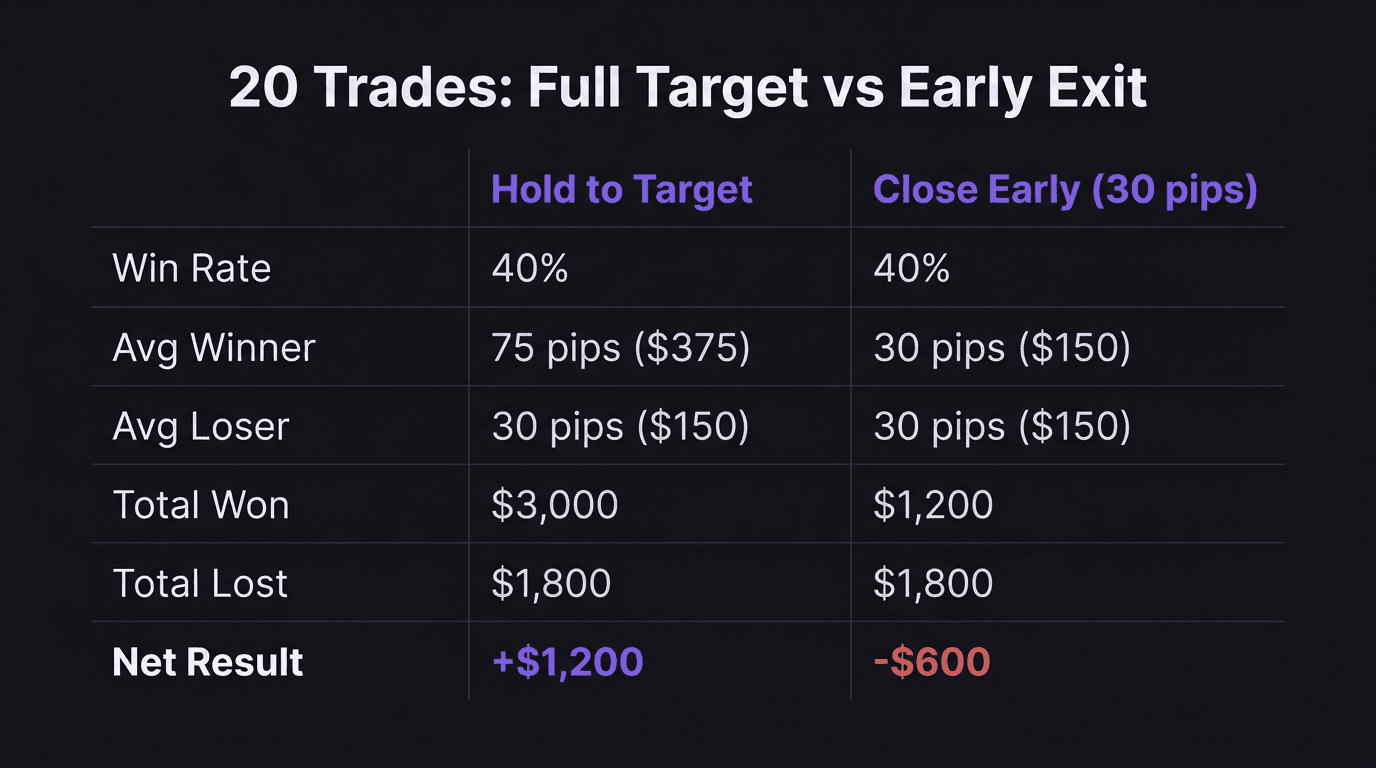
A trader has a 40% win rate, risks 30 pips per trade, and targets 75 pips (2.5:1 R:R). She trades 0.5 lots on EUR/USD ($5/pip).
Scenario A: She holds every trade to target or stop.
Wins: 8 trades at 75 pips = 600 pips. Dollar value: 600 x $5 = $3,000.
Losses: 12 trades at 30 pips = 360 pips. Dollar value: 360 x $5 = $1,800.
Net: +240 pips, +$1,200.
Scenario B: She closes winners early at an average of 30 pips.
Wins: 8 trades at 30 pips = 240 pips. Dollar value: 240 x $5 = $1,200.
Losses: 12 trades at 30 pips = 360 pips. Dollar value: 360 x $5 = $1,800.
Net: -120 pips, -$600.
Same strategy. Same entries. Same stop losses. The only difference is exit behavior. Scenario A nets +$1,200. Scenario B nets -$600. That is an $1,800 swing caused entirely by closing winners too early.
The Four Triggers That Make You Close Early
Understanding why you close early helps you build specific defenses for each trigger.
1. The Pullback Panic
Price hits +40 pips, then pulls back to +25. You feel like you are "losing" 15 pips, even though you are still comfortably in profit. The pullback triggers loss aversion, and you close to "protect what you have."
The reality: pullbacks are normal market structure. A trade moving from +40 to +25 before reaching +75 is standard behavior, not a reversal signal. But your brain does not process it as standard behavior. It processes it as a threat.
2. The Round Number Trap
You are up $200 on a trade. The plan says hold for $350. But $200 is a nice, clean number. Your brain latches onto it. "Just take the $200. That is a good day." You close, and the trade runs another $150 without you.
3. The "What If" Spiral
The trade is going well. But instead of trusting your analysis, your mind starts generating disaster scenarios. "What if news drops?" "What if there is a liquidity sweep?" "What if it reverses right now?" Each hypothetical increases anxiety until closing the trade feels like the only way to make the anxiety stop.
This is your amygdala creating perceived threats that do not exist yet. You are trading from fear, not from your plan.
4. The Revenge From Last Time
You held a winner to target once, and it reversed. You went from +50 to -30. That memory is seared into your amygdala. Now, every time a trade is in profit, your brain replays that experience and tells you to take the money before it happens again.
One bad memory can override hundreds of successful holds. That is how powerful the emotional brain is.
The Structural Fixes
You cannot think your way past loss aversion while a trade is running. The solution is to remove yourself from the decision-making loop after entry.
Set and Forget
Enter the trade. Set your stop and target. Close the chart. Walk away. Do not check the trade until you get an alert that it hit one of your levels.
This is set-and-forget trading, and it is the single most effective defense against premature exits. If you are not watching the chart, you cannot close early. The pullback that would have triggered panic happens without your knowledge, and the trade hits target while you are making lunch.
Never Move Your Target Closer
Adjusting your stop to break even after price moves in your favor is a legitimate management technique. Moving your target closer because you are scared is not management. It is surrendering edge.
Make a rule: the target does not move toward entry. Ever. If you set a 70-pip target, the trade either hits 70 or it hits stop. Removing the option to shorten the target removes the temptation.
Use Your Rules as the Authority
Your trading rules should include a specific exit protocol. Write it before you trade, not while a position is open. Something like:
Exit at stop loss: no manual override.
Exit at target: no manual override.
No partial closes unless the plan includes them with specific levels.
If not at stop or target, do not touch the trade.
When the urge to close hits, the question changes from "Should I close?" to "Does my exit protocol say to close?" If the answer is no, you leave it alone.
Walkthrough: The Discipline Hold on USD/JPY
You enter a buy on USD/JPY at 150.20. Stop at 149.80 (40 pips). Target at 151.00 (80 pips). Lot size: 0.3 lots.
Pip value for USD/JPY at current rate: approximately $6.60/pip per standard lot. At 0.3 lots: $1.98/pip (call it $2.00/pip for round numbers in the walkthrough).
Risk: 40 pips x $2.00 = $80. Potential reward: 80 pips x $2.00 = $160. R:R = 2:1.
Price moves to 150.60. You are up 40 pips ($80). A bearish candle drops price to 150.45. You are up 25 pips ($50). The old you would close here.
Instead, you follow your rule: do not touch the trade until stop or target. You close the chart and set a price alert at 151.00 and 149.80.
Three hours later, the alert fires. Price hit 150.98 (close enough that your limit order at 151.00 filled). You banked 80 pips ($160).
Had you closed at 150.45, you would have taken $50 and missed $110 of additional profit.
How EdgeFlo Helps You Hold Winners
EdgeFlo keeps your trading plan visible next to your chart during execution. When the urge to close hits, your pre-written exit rules are right there, reminding you of the decision you made before the pressure started. Post-trade self-reporting tracks whether you followed your exit plan or deviated, building a record of adherence that shows you exactly how much closing early costs over time.
Guardrails do not prevent you from closing a winner (that is your choice), but the structure of having your plan, your journal, and your risk parameters in one place reduces the chaos that leads to impulsive exits. The less you have to decide in the moment, the less room there is for loss aversion to take over.
When you stop volunteering to cut your winners, the math of your strategy starts working the way your backtest said it would.
The Edge Brief
Receive Insights on trading psychology, discipline, and the behavioral patterns that create consistent traders from our Founder and the EdgeFlo team, delivered to your inbox.
Think different. Trade different.
Why do I always close trades too early?
Does closing trades early hurt my results?
How do I stop closing winners early?
Should I take partial profits instead of closing early?

Turn discipline on.
Every session.
EdgeFlo is the environment serious traders operate inside.
Start 7-Day Free Trial
Cancel anytime.
No long-term commitment.

Think Different, Trade Different.