

Set and Forget Trading: When Less Work Wins
Set and forget trading means placing your stop loss and take profit, then walking away. Learn when this passive method outperforms active management.
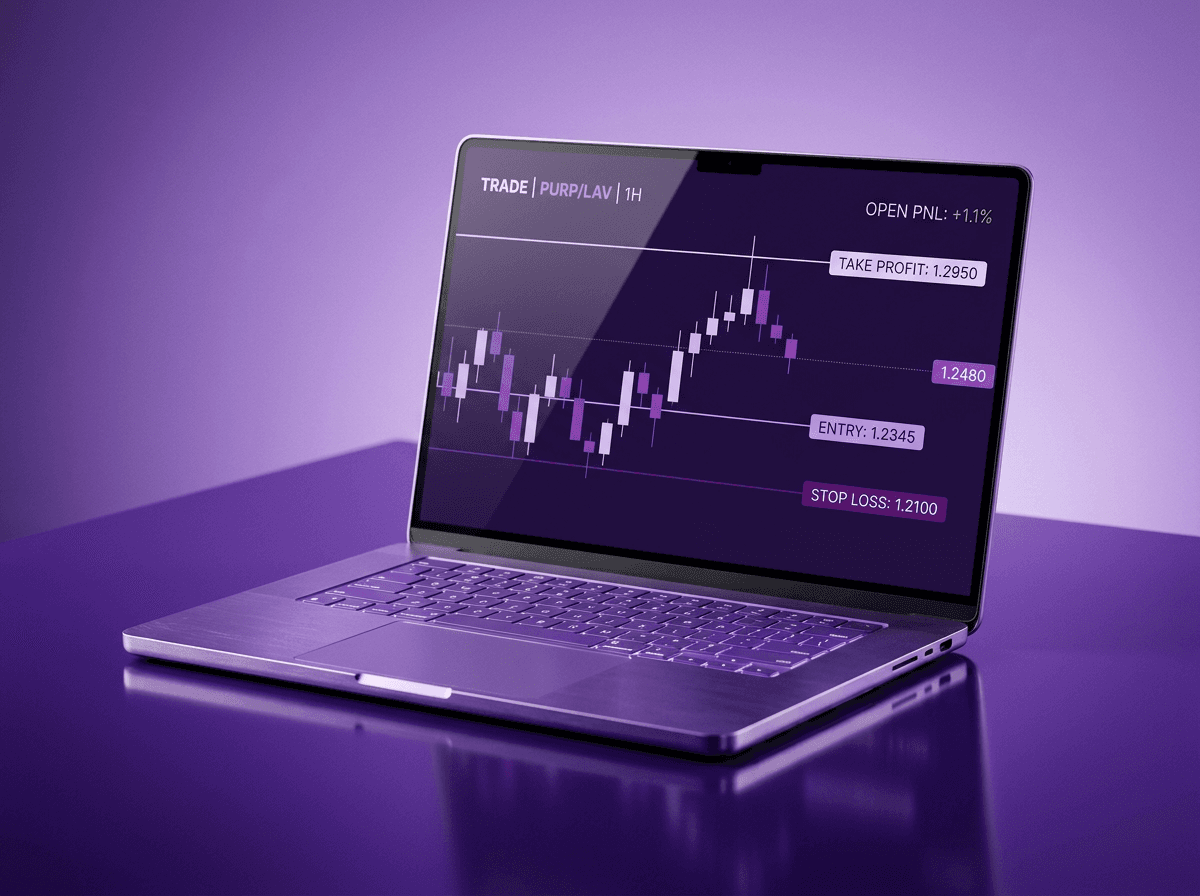
Set and forget trading means you place your stop loss and take profit at entry, then close the charts. No adjustments, no trailing, no partial closes. The trade either hits your target or your stop. You do not intervene.
This sounds too simple to work. But for many traders, especially beginners and anyone with a full-time job, it outperforms active management because it removes the most dangerous variable: you.
TL;DR
Set and forget means placing SL and TP at entry, then not touching the trade.
It removes emotional interference, which is the biggest profit killer for most traders.
Your risk per trade stays perfectly consistent (always exactly 1% or whatever you choose).
The downside is giving profits back when price reverses before hitting TP.
Best suited for swing traders on 4H or daily timeframes.
How Set and Forget Works
The mechanics are straightforward. You complete your analysis, identify your entry, calculate your position size, and place the trade with two levels defined: stop loss and take profit.
Then you walk away.
No moving your stop loss to break even. No closing half the position at 1.5R. No checking the chart every 20 minutes to see if price is "close enough" to your target.
The trade lives or dies by your original analysis. If your analysis was right and price reaches your target, you collect the full move on your full position size. If your analysis was wrong and price hits your stop, you take a clean, predetermined loss.
Every single loss is the same percentage. If you risk 1% per trade, you lose exactly 1% when stopped out. Not 0.7% because you trailed too tight. Not 1.4% because you widened your stop in a panic. Exactly 1%, every time.
This consistency is what makes set and forget powerful. Your risk stays mechanical even when your emotions do not.
When Hands-Off Beats Micromanaging
Active management sounds smarter. You are "protecting profits" and "reducing risk." But here is what actually happens for most traders who actively manage:
They move their stop to break even too early, get stopped out, and watch price hit their original take profit without them. Or they close half the position at 1R, watch the remaining half hit 3R, and realize they left significant money on the table. Or they widen their stop "just a little" because the trade "looks like it might come back."
Sound familiar?
The problem is not the management technique. The problem is that decisions made while money is on the line are almost always worse than decisions made before the trade. Fear distorts your judgment. A trade that looked like a clear 3R setup at entry suddenly looks terrifying when price pulls back 15 pips.
Set and forget removes you from that equation entirely. Your pre-trade analysis, the version of you that was calm and rational, makes every decision. The panicking version of you who is watching the P&L fluctuate does not get a vote.
Walkthrough: Micromanaging vs Set and Forget on AUD/USD
You identify a demand zone on AUD/USD daily at 0.6520. You enter long at 0.6530 with a stop loss at 0.6490 (40 pips) and a take profit at 0.6650 (120 pips, 3R). Risk is 1% of a $5,000 account, so $50. Position size: 0.125 lots.
The micromanager: Price rises to 0.6580 (+50 pips). Looking good. It pulls back to 0.6555. Panic sets in. You move your stop to 0.6530 (break even) "just to be safe." Price dips to 0.6525, stops you out at break even. Two hours later, price rallies to 0.6650 and hits your original take profit. You made $0 on a correct trade.
The set-and-forget trader: Same entry, same setup. Price rises to 0.6580, pulls back to 0.6525. You are at the gym. You do not see the pullback. Price recovers and hits your take profit at 0.6650 later that day. You made $150 (120 pips x $10/pip x 0.125 lots). Your 3R target paid in full.
The set-and-forget trader did not do anything special. They just did not interfere with a trade that was working.
The Downside: Giving Profits Back
Set and forget has a real cost, and you need to accept it before committing to this method.
Because you never move your stop loss, you are fully exposed to reversals. Price can run 80% of the way to your take profit, reverse, and stop you out at your original stop loss. You go from being up $200 in unrealized profit to losing $50.
That hurts. It feels like you "should have" done something. And that feeling is exactly why many traders abandon set and forget after a few painful reversals.
But think about the math. If your setup has a 40% win rate and you target 3R, your expectancy per trade is: (0.40 x 3R) minus (0.60 x 1R) = 1.2R minus 0.6R = 0.6R per trade. Over 100 trades, that is +60R in profit. The reversals are already priced into that number.
Trading without a stop loss is the actual dangerous alternative. Set and forget with a defined stop is disciplined, even when the reversals sting.
The question is whether you can handle watching profits evaporate without breaking your rules. If you cannot, partial profits or trailing stop loss may suit you better. But if you can stick to it, set and forget rewards you with the full target on every winner.
Set and Forget vs Active Management
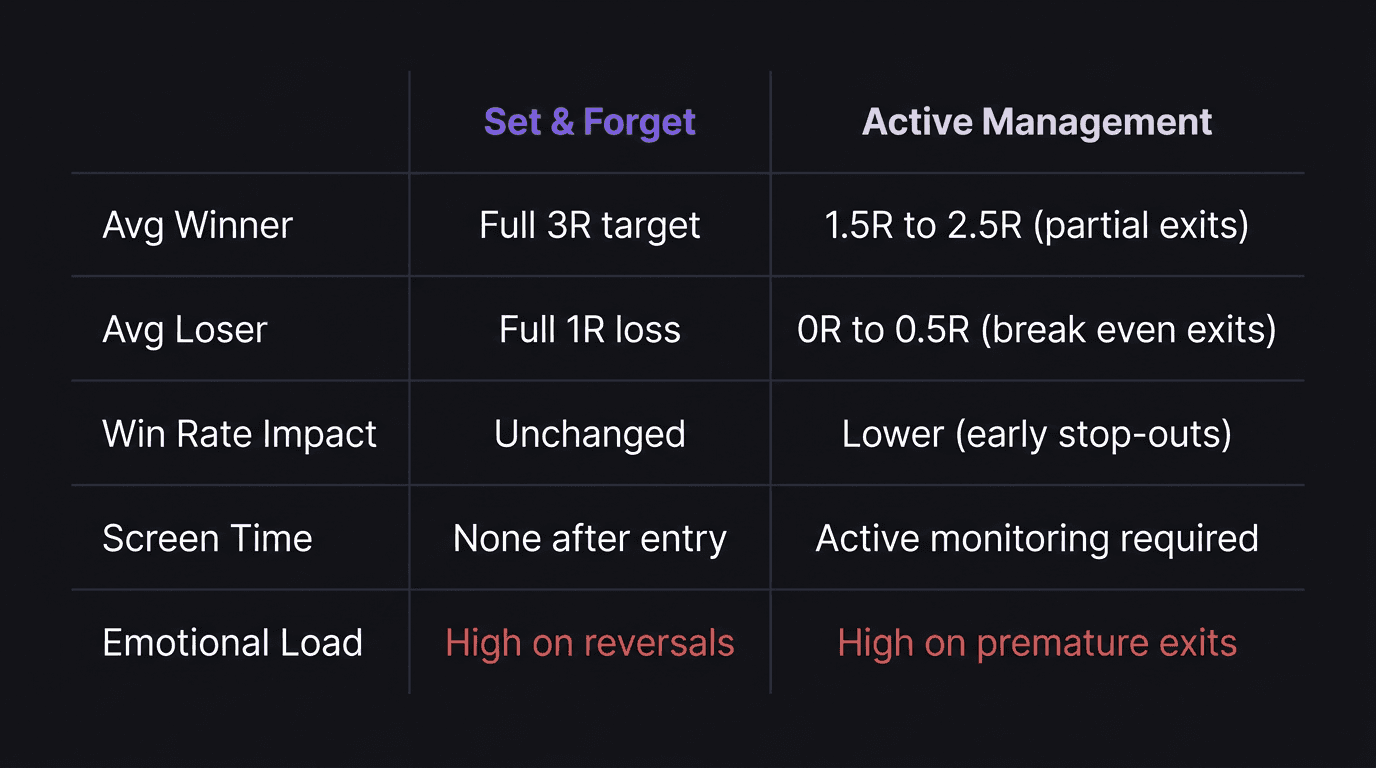
Active management means adjusting your stop loss, taking partial profits, or closing the trade manually based on what price does after entry. It comes in two main flavors: trailing stop loss (moving your stop to follow market structure) and partial profits (closing a portion of the position at intermediate targets).
Here is what each gives up compared to set and forget:
Trailing stop loss protects your downside but reduces your average win. You get stopped out at break even or small profit on trades that would have been full winners under set and forget. Your win rate may drop because liquidity sweeps trigger early exits.
Partial profits lock in gains early but reduce your position size for the big move. When the trade hits your full target, you only have 50% (or 80%) of the position riding. Your average winner shrinks.
Set and forget keeps 100% of your position in the trade from entry to exit. When you win, you win big. When you lose, you lose your full risk amount. There is no middle ground.
The right choice is not about which method is "better." It is about which method you will actually follow consistently over 100+ trades. Backtest each one on your strategy and compare average R. Then commit.
One last thing. Whatever you pick, do not switch methods in the middle of a trade. Decide before you click the buy button. Your trade management rule goes in your plan alongside your entry criteria.
How EdgeFlo Supports Set and Forget
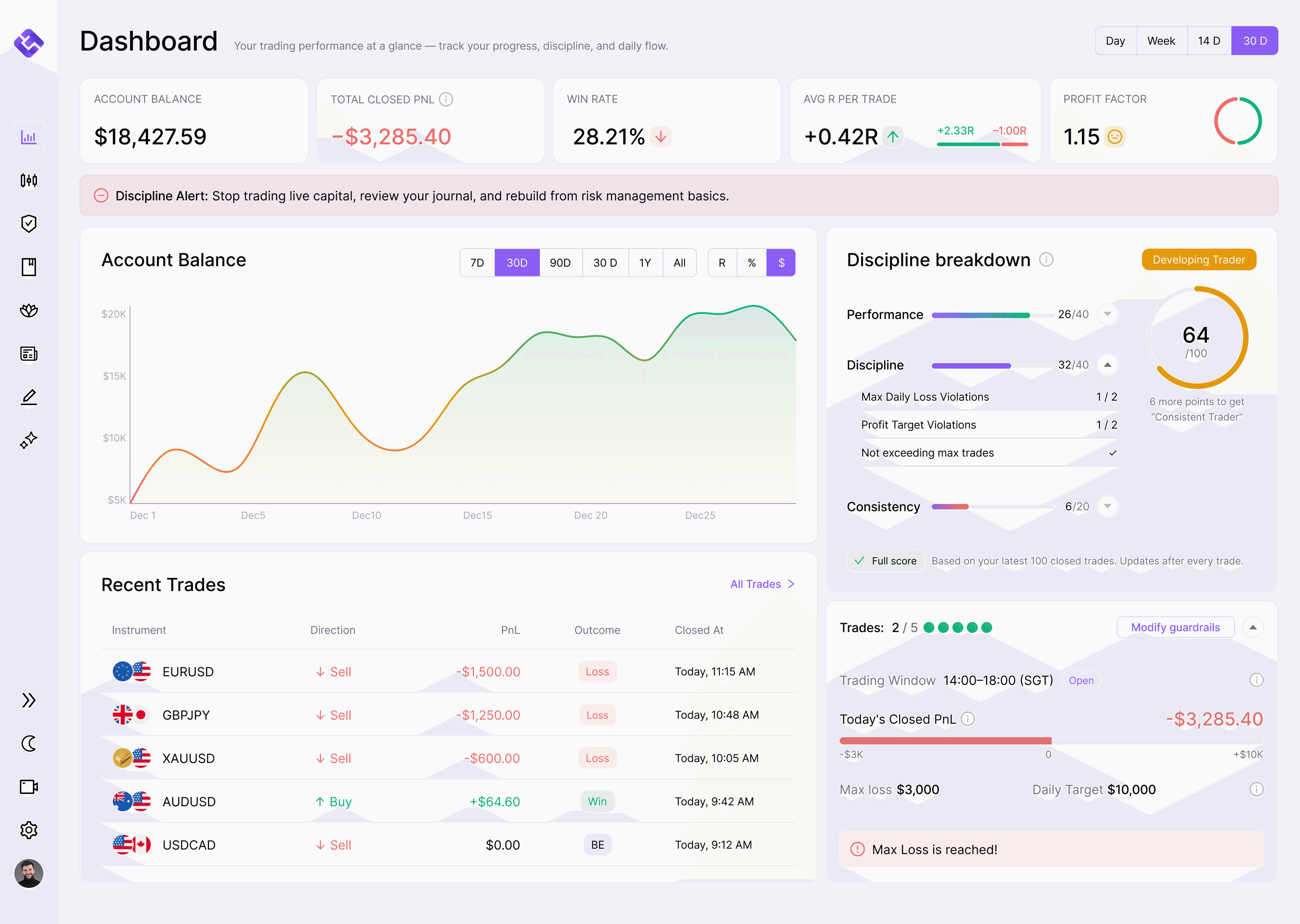
EdgeFlo's guardrails help you stick to your set-and-forget discipline. After you place a trade and walk away, guardrails can warn you or restrict further actions if you approach your daily loss limit. If a set-and-forget loss triggers your loss threshold, guardrails make it harder to jump back in and revenge-trade. You can override if you have a valid next setup, but the friction gives your rational brain a moment to catch up.
The goal is environment design. You do not need more willpower to stop micromanaging. You need a structure that makes it harder to interfere with your own plan.
EdgeFlo keeps your trading rules visible on screen, so when the urge to move your stop hits, your documented plan is right there reminding you why you chose set and forget in the first place.
The Edge Brief
Receive Insights on trading psychology, discipline, and the behavioral patterns that create consistent traders from our Founder and the EdgeFlo team, delivered to your inbox.
Think different. Trade different.
What does set and forget mean in trading?
Is set and forget good for beginners?
Does set and forget work for day trading?
What is the biggest risk of set and forget?

Turn discipline on.
Every session.
EdgeFlo is the environment serious traders operate inside.
Start 7-Day Free Trial
Cancel anytime.
No long-term commitment.

Think Different, Trade Different.